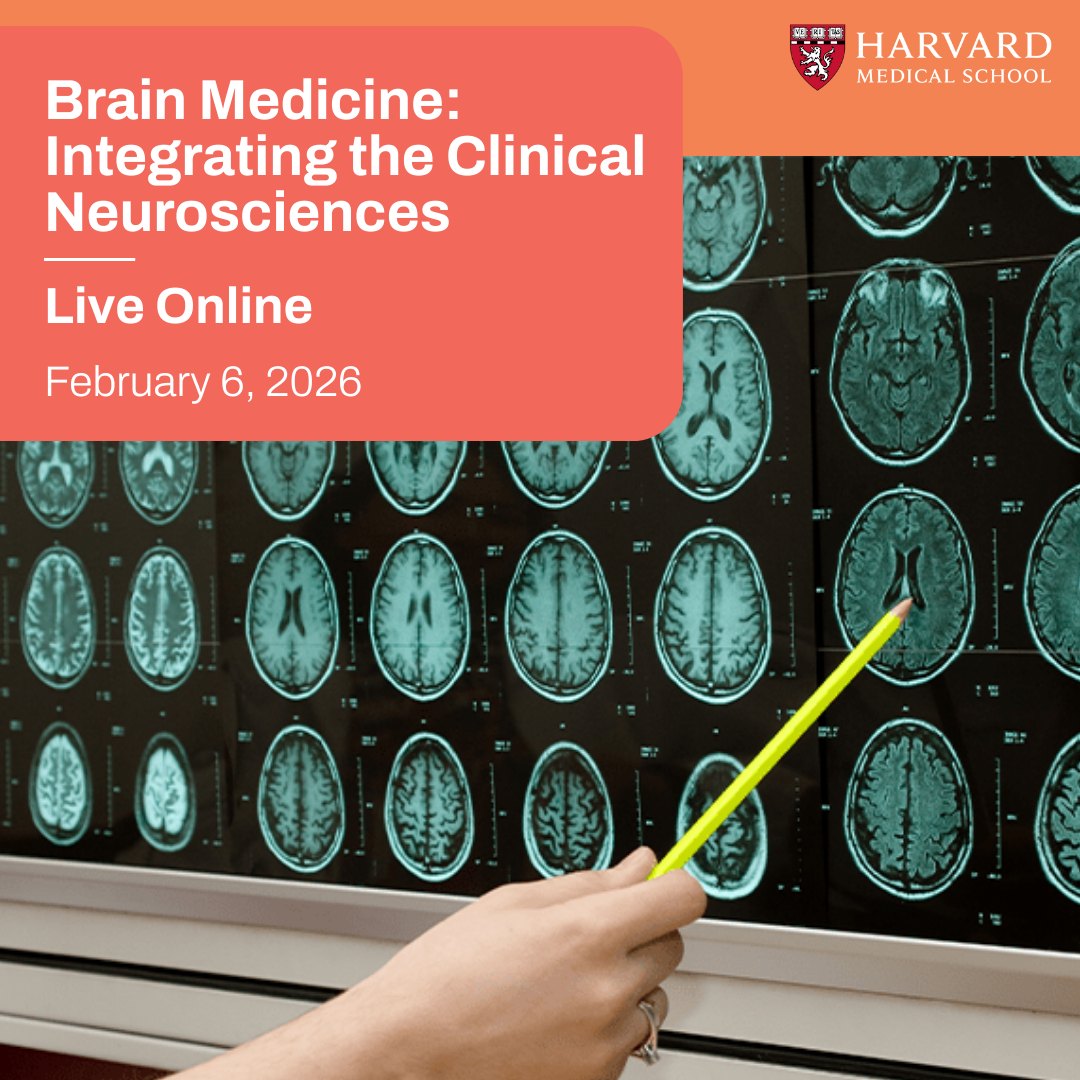
Harvard Brain Medicine: Integrating the Clinical Neurosciences 2026

The Harvard Brain Medicine: Integrating the Clinical Neurosciences 2026 course provides an advanced and multidisciplinary exploration of modern brain medicine, bridging the fields of neurology, psychiatry, psychology, neurorehabilitation, and cognitive neuroscience to improve the care of patients with complex brain disorders.
This Harvard Medical School accredited program focuses on the growing integration of clinical neurosciences and the evolving understanding of how neurological, psychiatric, cognitive, emotional, and behavioral disorders overlap within real-world patient care. Through expert-led lectures and interactive discussions, participants gain updated insight into emerging diagnostic approaches, neuropsychiatric management strategies, digital neuroscience tools, and personalized neuromodulation therapies.
The curriculum emphasizes a biopsychosocial approach to brain disorders, examining conditions that affect cognition, behavior, perception, emotional regulation, social functioning, and sensorimotor systems. Topics include digital phenotyping, neuropsychological assessment, psychotic spectrum disorders, autoimmune encephalitis with psychosis, and individualized approaches to both noninvasive and deep brain stimulation.
This course is particularly valuable for clinicians seeking a broader and more integrated framework for managing complex neuropsychiatric and neurological conditions in modern clinical practice.
Course Details
- Format: 16 Videos (.mp4) + 16 Audios (.mp3) + 16 Subtitle Files (.vtt) + 13 PDFs
- Total Size: 4.59 GB
- Course Date: February 6, 2026
- Institution: Harvard Medical School
- Access: On-demand
- Focus: Integrated Clinical Neurosciences & Brain Medicine
Course Overview
Brain medicine is an emerging interdisciplinary model that combines expertise from:
- Neurology
- Psychiatry
- Neuropsychology
- Cognitive neuroscience
- Behavioral neurology
- Consultation-liaison psychiatry
- Neurorehabilitation
- Mental health services
The goal is to improve diagnosis and treatment for patients with complex disorders involving both neurological and psychiatric manifestations.
This course explores how integrated neuroscience approaches can enhance patient-centered care through:
- Personalized neurostimulation
- Advanced neuropsychological testing
- Digital phenotyping technologies
- Psychopharmacology
- Multidisciplinary clinical models
- Modern psychosis management
Participants gain practical insight into how evolving neuroscientific concepts can be translated into clinical decision-making and comprehensive patient care.
What You Will Learn
Participants will strengthen their understanding of:
- Integrated brain medicine models and interdisciplinary neuroscience care
- Modern neuropsychiatric assessment strategies
- Digital phenotyping and social network analysis in brain disorders
- Advanced neuropsychological testing approaches
- Psychopharmacologic management of neuropsychiatric symptoms
- Personalized noninvasive neurostimulation therapies
- Deep brain stimulation applications for complex disorders
- Pathophysiology of psychotic spectrum disorders
- Autoimmune encephalitis presenting with psychiatric symptoms
- Psychotherapy approaches for psychosis
- Future directions in clinical neuroscience and brain health
The course emphasizes practical integration of neuroscience research into everyday clinical care across neurology and psychiatry settings.
Core Topics Covered
Integrated Brain Medicine
The program begins with an overview of the evolution of brain medicine as a unified clinical neuroscience framework.
Topics include:
- Historical development of integrated neuroscience care
- Multidisciplinary brain medicine models
- Inpatient medicine-psychiatry integration
- Outpatient brain medicine services
- Future directions in clinical neurosciences
These sessions explore how collaborative care models improve outcomes for patients with overlapping neurological and psychiatric disorders.
Digital Phenotyping & Social Neuroscience
Emerging neuroscience technologies are explored through sessions covering:
- Digital phenotyping
- Behavioral data collection
- Social network analysis
- Technology-driven patient monitoring
- Neurobehavioral assessment tools
Participants gain insight into how digital neuroscience may reshape diagnosis, monitoring, and personalized treatment strategies.
Neuropsychological Testing & Cognitive Assessment
The course reviews advances in:
- Neuropsychological evaluation
- Cognitive testing strategies
- Behavioral neurology assessment
- Cognitive-affective neuroscience
- Interpretation of neurocognitive dysfunction
These modules focus on modern approaches to evaluating complex cognitive and behavioral symptoms in neurological and psychiatric disorders.
Psychopharmacology & Neuropsychiatric Management
Clinical management sessions address:
- Psychopharmacological treatment of neuropsychiatric symptoms
- Medication strategies in brain disorders
- Behavioral symptom management
- Cognitive and emotional symptom treatment
- Integrated neuropsychiatric care planning
Faculty discuss practical treatment approaches that combine psychiatric and neurological expertise.
Personalized Neurostimulation
A major focus of the course is individualized neuromodulation therapy.
Topics include:
- Personalized noninvasive neurostimulation
- Transcranial stimulation concepts
- Deep brain stimulation (DBS)
- Precision neuromodulation strategies
- Neurocircuit-based treatment approaches
Participants review how personalized stimulation techniques are being applied to treatment-resistant and complex brain disorders.
Psychotic Spectrum Disorders
Advanced psychiatry and neuroscience sessions review:
- Pathophysiology of idiopathic psychotic disorders
- Neurobiological models of psychosis
- Psychotherapy for psychosis
- Integrated psychiatric-neurological management
Case-based discussions provide practical insight into evolving treatment approaches for psychotic spectrum conditions.
Autoimmune Encephalitis & Neuropsychiatric Disease
The course also explores:
- Autoimmune encephalitis presenting with psychosis
- Neuroinflammatory brain disorders
- Differential diagnosis of neuropsychiatric syndromes
- Interdisciplinary diagnostic evaluation
These discussions highlight the growing importance of recognizing medical and neurological contributors to psychiatric symptoms.
Educational Features
Harvard Faculty & Multidisciplinary Expertise
The program features leading experts in:
- Behavioral neurology
- Neuropsychiatry
- Cognitive neuroscience
- Consultation-liaison psychiatry
- Brain medicine
- Neuropsychology
- Biological psychiatry
The multidisciplinary faculty structure reflects the integrated philosophy of the course itself.
Case-Based Clinical Discussions
Interactive Q&A sessions and clinical case reviews help participants apply:
- Neuroscience principles
- Neuropsychiatric diagnostic strategies
- Personalized treatment planning
- Collaborative care approaches
to complex real-world clinical scenarios.
Emerging Neuroscience Technologies
The curriculum incorporates discussions on:
- Digital neuroscience
- AI-driven behavioral analysis
- Neuromodulation technologies
- Precision psychiatry
- Personalized brain health approaches
These topics provide insight into future directions of clinical neuroscience practice.
Flexible Multimedia Learning
The course includes:
- Video lectures
- Audio recordings
- Subtitle files (.vtt)
- Downloadable PDFs
- Interactive expert discussions
The on-demand format supports flexible learning and repeated review.
Target Audience
This course is ideal for:
- Neurologists
- Psychiatrists
- Neuropsychiatrists
- Psychologists
- Primary care physicians
- Nurse practitioners
- Physician assistants
- Neuroscience clinicians
- Mental health professionals
- Neurorehabilitation specialists
- Residents and fellows in neurology or psychiatry
It is particularly valuable for clinicians interested in:
- integrated neuroscience care,
- neuropsychiatry,
- digital neuroscience,
- neuromodulation,
- psychotic disorders,
- and brain health.
Why This Course Matters
The boundaries between neurology, psychiatry, psychology, and cognitive neuroscience are becoming increasingly interconnected. Many patients present with disorders involving overlapping cognitive, emotional, behavioral, and neurological symptoms that require integrated assessment and multidisciplinary treatment approaches.
This Harvard course provides a modern framework for understanding and managing complex brain disorders through the lens of integrated clinical neuroscience. By combining advances in neuropsychiatry, digital phenotyping, neurostimulation, psychopharmacology, and brain health, the program helps clinicians move toward more personalized and comprehensive patient care.
Its focus on translational neuroscience and interdisciplinary collaboration makes it highly relevant for the future of clinical brain medicine.