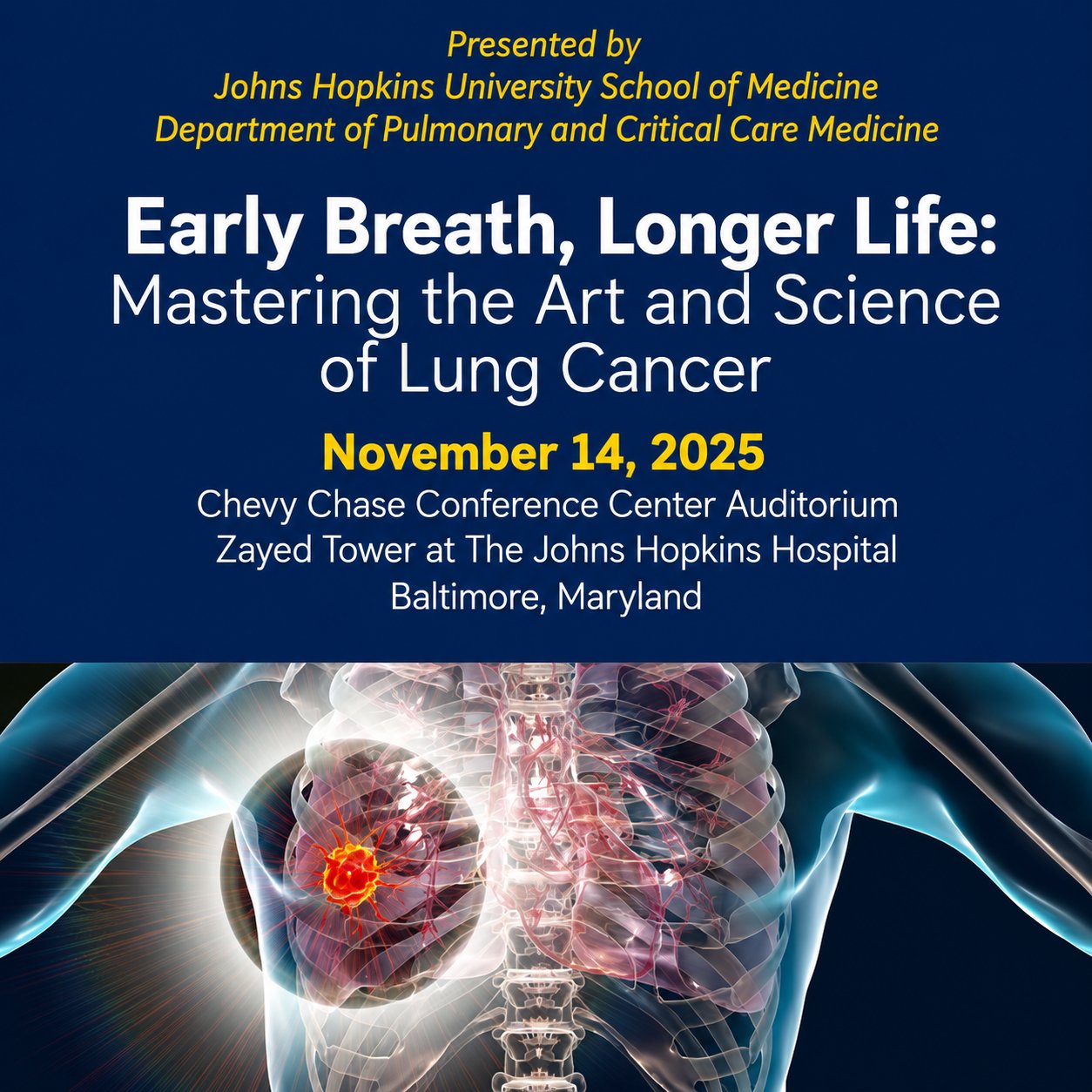
Johns Hopkins Early Breath, Longer Life: Mastering the Art and Science of Lung Cancer 2025
Comprehensive Lung Cancer Screening, Early Detection, Precision Oncology & Multidisciplinary Care Update
The Johns Hopkins Early Breath, Longer Life: Mastering the Art and Science of Lung Cancer 2025 course delivers a comprehensive, evidence-based update on the rapidly evolving field of lung cancer screening, diagnosis, and treatment. Developed by leading experts from Johns Hopkins Medicine, this one-day educational symposium focuses on improving the early detection and management of lung cancer through multidisciplinary collaboration, precision medicine, advanced imaging, and modern therapeutic approaches.
As lung cancer remains the leading cause of cancer-related mortality worldwide, timely screening, accurate nodule evaluation, and access to innovative treatments are critical for improving survival outcomes. This program equips clinicians with practical tools to identify high-risk patients, interpret screening findings, evaluate pulmonary nodules, and integrate the latest advances in chemotherapy, immunotherapy, and targeted therapies into clinical practice.
Through expert-led presentations, case-based discussions, and guideline-focused reviews, participants gain valuable insight into contemporary lung cancer care from screening through survivorship.
Course Details
Course: Johns Hopkins Early Breath, Longer Life: Mastering the Art and Science of Lung Cancer 2025
Course Date: November 14, 2025
Format: Videos + PDFs
Location: Chevy Chase Bank Conference Center, Johns Hopkins Hospital, Baltimore, Maryland
Institution: Johns Hopkins Medicine
Access: On-Demand
Program Overview
This advanced educational program addresses the complete continuum of lung cancer care, emphasizing early detection, multidisciplinary management, precision oncology, and patient-centered treatment strategies.
The curriculum reviews:
- Lung cancer screening guidelines
- Pulmonary nodule evaluation
- Risk stratification and early diagnosis
- Diagnostic imaging and biopsy techniques
- NSCLC (Non-Small Cell Lung Cancer)
- SCLC (Small Cell Lung Cancer)
- Precision oncology and molecular testing
- Immunotherapy advances
- Targeted therapies
- Chemotherapy updates
- Multidisciplinary treatment planning
- Tobacco cessation interventions
- Patient communication strategies
- Community outreach and engagement
Faculty present current evidence, emerging technologies, and practical clinical approaches that can be immediately applied in both community and academic practice settings.
Learning Objectives
Upon completion of this activity, participants will be able to:
- Identify appropriate candidates for lung cancer screening using current evidence-based criteria.
- Evaluate pulmonary nodules using modern risk assessment strategies.
- Select appropriate diagnostic procedures for patients with suspected lung cancer.
- Interpret contemporary imaging modalities used in lung cancer diagnosis and staging.
- Apply current treatment recommendations for NSCLC and SCLC.
- Incorporate precision medicine and molecular profiling into clinical decision-making.
- Utilize modern immunotherapy approaches in advanced lung cancer management.
- Improve multidisciplinary coordination of lung cancer care.
- Develop effective tobacco cessation interventions.
- Enhance communication with patients undergoing screening and treatment.
Lung Cancer Screening & Early Detection
A major focus of the symposium is improving early detection of lung cancer through evidence-based screening programs.
Topics include:
- Low-dose CT (LDCT) screening
- Patient selection criteria
- Risk assessment models
- Screening implementation strategies
- False-positive management
- Screening follow-up protocols
- Lung-RADS interpretation
- Population-based screening programs
Participants learn how to identify high-risk individuals and optimize screening practices to improve early-stage detection and survival outcomes.
Pulmonary Nodule Evaluation
The program provides detailed guidance on evaluating newly discovered pulmonary nodules.
Key topics include:
- Incidental pulmonary nodules
- High-risk versus low-risk lesions
- Nodule growth assessment
- Radiographic characteristics
- PET imaging utilization
- Biopsy decision-making
- Surveillance protocols
- Multidisciplinary nodule clinics
Faculty discuss practical approaches for distinguishing benign from malignant findings while minimizing unnecessary procedures.
Precision Medicine & Molecular Oncology
Precision oncology continues to transform lung cancer treatment.
This section explores:
- Molecular profiling
- Next-generation sequencing (NGS)
- Driver mutations
- Biomarker testing
- Personalized treatment strategies
- Targeted therapeutic selection
- Resistance mechanisms
- Emerging genomic technologies
Clinicians gain practical insight into integrating molecular testing into routine lung cancer care.
Immunotherapy Advances
Immunotherapy remains one of the most significant breakthroughs in thoracic oncology.
Topics include:
- Immune checkpoint inhibitors
- PD-1 inhibitors
- PD-L1 testing
- Combination immunotherapy
- Immunotherapy sequencing
- Adverse event management
- Biomarker-guided treatment
- Long-term outcomes
Faculty review current evidence and discuss optimal patient selection strategies.
Non-Small Cell Lung Cancer (NSCLC)
Comprehensive updates are provided on the diagnosis and treatment of NSCLC.
Coverage includes:
- Early-stage disease management
- Locally advanced disease
- Metastatic NSCLC
- Surgical considerations
- Radiation therapy integration
- Systemic treatment advances
- Targeted therapies
- Adjuvant and neoadjuvant approaches
Participants review evolving treatment algorithms and contemporary standards of care.
Small Cell Lung Cancer (SCLC)
The course also reviews important advances in SCLC management.
Topics include:
- Initial evaluation
- Disease staging
- Chemotherapy updates
- Immunotherapy integration
- Radiation therapy strategies
- Relapsed disease management
- Emerging treatment options
- Clinical trial developments
Experts discuss evolving approaches to this highly aggressive malignancy.
Tobacco Cessation & Prevention
Effective smoking cessation remains one of the most powerful interventions for reducing lung cancer mortality.
Sessions address:
- Tobacco dependence treatment
- Behavioral interventions
- Pharmacologic therapies
- Patient counseling strategies
- Relapse prevention
- Public health initiatives
- Community engagement programs
Faculty emphasize practical approaches to helping patients quit smoking successfully.
Multidisciplinary Lung Cancer Care
The symposium highlights the importance of coordinated, multidisciplinary management.
Topics include:
- Tumor boards
- Pulmonology collaboration
- Thoracic surgery
- Medical oncology
- Radiation oncology
- Pathology integration
- Nursing support
- Navigation services
Participants learn strategies to improve care coordination and patient outcomes.
Target Audience
This course is ideal for:
- Oncologists
- Pulmonologists
- Thoracic Surgeons
- Internal Medicine Physicians
- Family Medicine Physicians
- Primary Care Physicians
- Advanced Practice Providers
- Nurse Practitioners
- Physician Assistants
- Oncology Nurses
- Respiratory Specialists
- Fellows and Residents
Why This Course Stands Out
✔ Comprehensive lung cancer screening update
✔ Latest ASCO-aligned treatment advances
✔ Precision medicine and biomarker education
✔ Modern immunotherapy strategies
✔ Practical pulmonary nodule management
✔ Multidisciplinary care focus
✔ Tobacco cessation and prevention strategies
✔ Evidence-based clinical guidance from Johns Hopkins experts
Clinical & Educational Value
The Johns Hopkins Early Breath, Longer Life: Mastering the Art and Science of Lung Cancer 2025 program provides a comprehensive review of modern lung cancer care, combining advances in screening, diagnosis, precision oncology, immunotherapy, and multidisciplinary management.
By integrating current guidelines, emerging research, and practical clinical applications, this course equips healthcare professionals with the knowledge and tools needed to improve early detection, optimize treatment decisions, and enhance outcomes for patients with lung cancer.
Topics
-
American Lung Cancer Screening Initiative (ALCSI) Update and Innovations
-
ASCO Updates NSCLC and Studies
-
Can We Change the Stigma Associated with Lung Cancer-
-
Keynote Speaker- Empowering Survivors to Heal from the Inside Out
-
Lung Cancer Overview, What was New in 2025
-
Lung Cancer Screening- Why, How, and Where Updates for 2025
-
Not All Nodules Are Created Equal- How to Interpret Radiology Recommendations
-
Pulmonary Nodule Detection and Management, What Does the Future Hold-
-
Risk of Radiation with Lung Cancer Screening, How to Weigh the Risks and Benefits
-
Talking to Patients About Lung Cancer Screening- Why It Is Time Well Spent
-
The Genomics and Biology of Early Lung Cancer
-
The Journey From Radiographic Detection to Treatment- The Benefits of Multidisciplinary Care and a Diagnostic Clinic Josephine Feliciano, MD
-
The Journey From Radiographic Detection to Treatment- The Benefits of Multidisciplinary Care and a Diagnostic Clinic Kristen J …
-
Thoracic Oncology Panel Discussion for Patients and Healthcare Providers Josephine Feliciano, MD
-
Thoracic Oncology Panel Discussion for Patients and Healthcare Providers
-
Tobacco Cessation- How to Get Your Patients More Help
-
Updates from ASCO 2025 for SCLC
-
What is Precision Medicine and Why Do We Need It-