
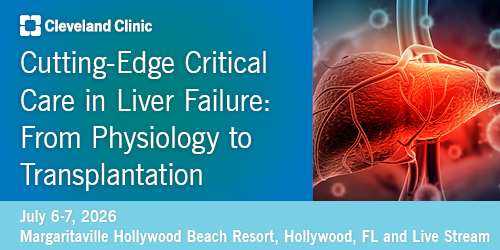
Cleveland Clinic Cutting Edge Critical Care in Liver Failure From Physiology to Transplantation 2026
$75.00
This Product is shared via google drive download link, So please share your correct Gmail id while placing the order .Please note that there are no CME points or certificate associated with this course Samples for Courses Can be found here : Free Samples Here!
EXPRESS DISCOVER PayPal
Cleveland Clinic Cutting-Edge Critical Care in Liver Failure: From Physiology to Transplantation 2026 (Videos)
Comprehensive Updates in Acute Liver Failure, Acute-on-Chronic Liver Failure (ACLF), Decompensated Cirrhosis, Hepatorenal Syndrome, Liver Transplantation, and Critical Care Hepatology
Advance your expertise in the management of critically ill patients with liver disease through Cleveland Clinic Cutting-Edge Critical Care in Liver Failure: From Physiology to Transplantation 2026, an advanced continuing medical education (CME) program that delivers a comprehensive review of modern critical care hepatology. Developed by internationally recognized experts from Cleveland Clinic and leading transplant centers, this intensive course bridges foundational liver physiology with practical bedside management, advanced ICU strategies, and liver transplantation.
Held July 6–7, 2026, in Hollywood, Florida, this multidisciplinary symposium brings together intensivists, hepatologists, transplant surgeons, anesthesiologists, nephrologists, pharmacists, nurses, and advanced practice providers to explore evidence-based management of acute liver injury (ALI), acute liver failure (ALF), acute-on-chronic liver failure (ACLF), decompensated cirrhosis, alcohol-associated hepatitis, hepatorenal syndrome, and liver transplantation.
Through expert lectures, case-based discussions, and multidisciplinary perspectives, participants gain practical strategies for recognizing life-threatening complications, optimizing organ support, preventing neurologic injury, managing shock and renal failure, coordinating transplant evaluation, and improving survival in patients with advanced liver disease.
Product Details
- Course: Cutting-Edge Critical Care in Liver Failure: From Physiology to Transplantation 2026
- Provider: Cleveland Clinic
- Conference Dates: July 6–7, 2026
- Location: Hollywood, Florida, USA
- Format: Videos
- Language: English
- Educational Level: Advanced
Course Overview
Liver failure represents one of the most challenging conditions encountered in intensive care medicine. Patients frequently develop multisystem organ dysfunction involving the brain, kidneys, cardiovascular system, lungs, coagulation pathways, and immune system, requiring coordinated multidisciplinary management and timely referral for liver transplantation.
Cutting-Edge Critical Care in Liver Failure 2026 provides a comprehensive review of modern critical care approaches for patients with severe liver disease. The curriculum integrates liver physiology with practical ICU management, emphasizing rapid recognition of clinical syndromes, evidence-based treatment protocols, organ support strategies, extracorporeal therapies, transplant decision-making, and peri-transplant critical care.
Faculty present current evidence, multidisciplinary treatment pathways, and practical bedside recommendations designed to improve outcomes in critically ill patients with liver failure.
What You’ll Learn
After completing this course, participants will be able to:
- Recognize and manage acute liver injury (ALI), acute liver failure (ALF), and acute-on-chronic liver failure (ACLF).
- Apply evidence-based ICU strategies for complications of decompensated cirrhosis.
- Differentiate hepatorenal syndrome from other causes of acute kidney injury.
- Implement neuromonitoring and cerebral edema prevention in acute liver failure.
- Optimize vasopressor therapy and hemodynamic management in cirrhotic shock.
- Identify appropriate candidates for urgent liver transplantation.
- Coordinate multidisciplinary critical care and transplant management.
- Improve perioperative outcomes before and after liver transplantation.
Comprehensive Topics Covered
Acute Liver Failure (ALF)
Develop practical strategies for early recognition and aggressive management of acute liver failure.
Topics include:
- Acute liver injury (ALI)
- Acute liver failure (ALF)
- Golden-hour management
- Neurologic monitoring
- Cerebral edema
- Intracranial hypertension
- Organ support
- Bridge to transplantation
Faculty emphasize time-sensitive interventions that improve neurological outcomes and survival.
Acute-on-Chronic Liver Failure (ACLF)
Review current concepts in diagnosis, staging, and multidisciplinary management.
Topics include:
- ACLF diagnosis
- Organ failure assessment
- Precipitating events
- Prognostic scoring
- ICU management
- Early transplant referral
- Survival optimization
Participants learn systematic approaches for evaluating disease severity and initiating appropriate interventions.
Decompensated Cirrhosis
Strengthen your approach to managing critically ill patients with advanced cirrhosis.
Topics include:
- Portal hypertension
- Variceal hemorrhage
- Spontaneous bacterial peritonitis (SBP)
- Hepatic encephalopathy
- Ascites
- Cirrhotic complications
- Evidence-based ICU care
Hepatorenal Syndrome (HRS)
Gain practical guidance for diagnosing and treating renal dysfunction in cirrhosis.
Topics include:
- Hepatorenal syndrome
- Acute kidney injury (AKI)
- Differential diagnosis
- Vasoconstrictor therapy
- Albumin therapy
- Hemodynamic optimization
- Mean arterial pressure (MAP) targets
Faculty review current recommendations for improving renal recovery and transplant candidacy.
Shock & Hemodynamic Management
Understand the unique cardiovascular physiology of advanced liver disease.
Topics include:
- Cirrhotic shock
- Vasopressors
- Hemodynamic monitoring
- Cardiac dysfunction
- Fluid management
- Critical care physiology
Extracorporeal Organ Support
Review advanced support strategies for critically ill liver patients.
Topics include:
- Extracorporeal therapies
- Renal replacement therapy
- Organ support
- Bridge to recovery
- Bridge to transplantation
Liver Transplantation
Explore every stage of transplant evaluation and perioperative critical care.
Topics include:
- Transplant candidacy
- Waitlist prioritization
- ACLF risk stratification
- Cardiac evaluation
- Combined organ transplantation
- Frailty assessment
- Sarcopenia
- Ethical decision-making
Faculty discuss practical strategies for preserving transplant eligibility during critical illness.
Peri-Transplant Critical Care
Optimize outcomes before, during, and after liver transplantation.
Topics include:
- Perioperative management
- Cardiac optimization
- Portopulmonary hypertension
- Hepatopulmonary syndrome
- Anesthesia considerations
- Post-transplant ICU care
Coagulation & Procedural Safety
Review evidence-based management of bleeding risk in advanced liver disease.
Topics include:
- Coagulopathy
- Blood product utilization
- Procedural planning
- Thromboelastography
- Bleeding management
- Procedural safety
Multidisciplinary Liver ICU
Learn practical strategies for building standardized care pathways.
Topics include:
- Liver ICU protocols
- Multidisciplinary collaboration
- Quality improvement
- Patient safety
- Critical care workflow
- Standardized clinical pathways
Learning Objectives
Upon completion of this educational activity, participants will be able to:
- Integrate liver physiology into bedside critical care management.
- Recognize and rapidly treat ALI, ALF, ACLF, and alcohol-associated hepatitis.
- Implement evidence-based ICU management for complications of decompensated cirrhosis.
- Differentiate hepatorenal syndrome from other causes of acute kidney injury.
- Optimize neuromonitoring and management of cerebral edema in acute liver failure.
- Coordinate timely transplant evaluation and multidisciplinary consultation.
- Prioritize liver transplant candidates using clinical severity, frailty, and ethical frameworks.
- Apply peri-transplant critical care strategies that improve patient outcomes.
Educational Highlights
- Critical Care Hepatology
- Acute Liver Failure (ALF)
- Acute-on-Chronic Liver Failure (ACLF)
- Acute Liver Injury (ALI)
- Decompensated Cirrhosis
- Alcohol-Associated Hepatitis
- Hepatorenal Syndrome (HRS)
- Acute Kidney Injury (AKI)
- Portal Hypertension
- Variceal Bleeding
- Hepatic Encephalopathy
- Spontaneous Bacterial Peritonitis (SBP)
- Liver Transplantation
- Transplant Critical Care
- Extracorporeal Organ Support
- Neuromonitoring
- Cerebral Edema
- Cirrhotic Shock
- ICU Protocols
- Continuing Medical Education (CME)
Why This Course Stands Out
Cleveland Clinic Cutting-Edge Critical Care in Liver Failure: From Physiology to Transplantation 2026 delivers one of the most comprehensive educational programs dedicated exclusively to liver failure in the intensive care setting. By integrating physiology, evidence-based critical care, transplant medicine, nephrology, anesthesia, and multidisciplinary collaboration, the course provides clinicians with practical tools to manage some of the most critically ill patients encountered in modern medicine. Its strong focus on bedside application, transplant decision-making, and advanced organ support makes it an exceptional resource for specialists caring for patients with severe liver disease.
Target Audience
This educational activity is ideal for:
- Intensivists
- Hepatologists
- Transplant Surgeons
- Critical Care Physicians
- Gastroenterologists
- Nephrologists
- Anesthesiologists
- Hospitalists
- Advanced Practice Providers
- Critical Care Fellows
- Gastroenterology Fellows
- Transplant Fellows
- ICU Nurses
- Clinical Pharmacists
- Healthcare professionals involved in liver failure and transplant care
Why Choose This Course?
Whether you specialize in critical care, hepatology, gastroenterology, transplant medicine, or intensive care, Cleveland Clinic Cutting-Edge Critical Care in Liver Failure: From Physiology to Transplantation 2026 provides an exceptional evidence-based review of advanced liver failure management. Featuring internationally recognized faculty, multidisciplinary expertise, practical ICU protocols, transplant-focused education, and the latest advances in critical care hepatology, this program equips clinicians with the knowledge needed to improve outcomes for patients with acute and chronic liver failure.
+ Topics:
Monday, July 6, 2026 |
|
Day 1 – Foundations & Advanced Liver Critical Care |
|
|
7:00 am
|
Registration, Breakfast, and Visit Exhibits |
|
7:45 am
|
Welcome and Setting the Stage: The Future of Liver Critical Care Aanchal Kapoor, MD, MEd |
BLOCK 1 – Core ICU Principles for Liver Patients Panel Discussion led by: Christina Lindenmeyer, MD, Jody C. Olson, MD, Ram Subramanian, MD, and Aanchal Kapoor, MD, MEd |
|
|
8:00 am
|
The Liver’s Command Center: Physiology That Drives Critical Care Leopoldo Arosemena, MD |
|
8:20 am
|
ALI, ALF, ACLF: Cracking the Code of Acute Liver Syndromes Kalyan Bhamidimarri, MD |
|
8:40 am
|
Alcohol-Associated Hepatitis: Rapid Recognition & ICU Strategies Jody C. Olson, MD |
|
9:00 am
|
Cirrhosis in Crisis: A Practical Playbook for ICU Complications Neal Chaisson, MD |
|
9:30 am
|
Panel Discussion Block 1 Panel & Faculty |
|
10:00 am
|
Refreshment Break and Visit Exhibits |
BLOCK 2 – Advanced Critical Care Challenges in Liver Failure Moderators: Tarik Hanane, MD and Neal Chaisson, MD |
|
|
10:30 am
|
Acute Liver Failure: When Minutes Matter—Mastering the Golden Hour Aanchal Kapoor, MD, MEd |
|
10:50 am
|
Acute-on-Chronic Liver Failure Decision Points: Bridge to Transplant, Road to Recovery, or Path to Comfort Jody C. Olson, MD |
|
11:15 am
|
Life Support for the Liver: Evidence and Strategies in Extracorporeal Therapy Ram Subramanian, MD |
|
11:35 am
|
Shock in Cirrhosis: MAP Targets, Pressor Choices & Hemodynamic Nuances Siddharth Dugar, MD |
|
12:00 pm
|
Question & Answer Aanchal Kapoor, MD, MEd, Jody C. Olson, MD, Ram Subramanian, MD, and Siddharth Dugar, MD |
|
12:15 pm
|
Lunch, Visit Exhibits |
|
1:15 pm
|
Expert Roundtables: Ask, Debate and Discover (non-CME, In-Person only) Table 1: Decoding Liver Failure: ALF vs ACLF Faculty: Kalyan Bhamidimarri, MD and Christina Lindenmeyer, MD Table 2: Brain Matters: Neuromonitoring in Liver Disease Faculty: Tarik Hanane, MD and Aanchal Kapoor, MD, MEd Table 3: Kidneys in Crisis: Renal Failure & Cirrhosis Faculty: Jody C. Olson, MD and Leopoldo Arosemena, MD Table 4: Shock Talk: Hemodynamics in Cirrhosis Faculty: Eduardo Mireles-Cabodevila, MD and Neal Chaisson, MD Table 5: ICU Curveballs: Managing Cirrhosis Complications Faculty: Ram Subramanian, MD and Siddharth Dugar, MD Table 6: Operationalizing Interprofessional Collaboration (Respiratory Therapists, Social Workers, Transplant Coordinators, Physical Therapists, Occupational Therapists, etc.): Core Principles and Practice Faculty: Bridget Dolan, MSPAS, PA-C and Leah Psellas, MSPAS, PA-C |
BLOCK 3 – Bridging ICU Care to Transplant Decisions Moderators: Koji Hashimoto, MD and Eduardo Mireles-Cabodevila, MD |
|
|
2:00 pm
|
Hepatic Crisis Management: When to Transfer, When to Call for Transplant Ram Subramanian, MD |
|
2:25 pm
|
Optimizing the Transplant Candidate: Making the Most of the Window Period Christina Lindenmeyer, MD |
|
2:50 pm
|
Building a Liver ICU: From Vision to Sustainability Aanchal Kapoor, MD, MEd |
|
3:15 pm
|
Question & Answer Ram Subramanian, MD, Christina Lindenmeyer, MD, and Aanchal Kapoor, MD, MEd |
|
3:30 pm
|
Refreshment Break and Visit Exhibits |
|
4:00 pm
|
Adjourn |
Block 4 – Hands-On Masterclasses (Optional Workshop, In-Person only, Limited Seating) |
|
|
4:00 pm
|
Variceal Bleed Resuscitation Bootcamp Matt Siuba, DO, Neal Chaisson, MD, Nick Koch, BSN, RN, and Ashley Haas, BSN, RN OR Organ-Specific ACLF Management: Shock, Respiratory Failure & Renal Support Siddharth Dugar, MD and Tarik Hanane, MD |
|
5:30 pm
|
Adjourn |
Related products
Anesthesiology & pain medicine

Critical Care - Emergency medicine
Anesthesiology & pain medicine
Internal Medicine
Internal Medicine
Cardiology
Internal Medicine
Critical Care - Emergency medicine
2022 UPDATES IN THERAPEUTICS: CRITICAL CARE PHARMACY PREPARATORY REVIEW AND RECERTIFICATION COURSE
- Anesthesiology & pain medicine
- Books
- Anesthesiology books
- Basic science
- Cardiology books
- Dermatology books
- DENTAL BOOKS
- Endocrine and Nutrition books
- Gastroenterology and Hepatology books
- Hematology / Oncology books
- INTERNAL MEDICINE BOOKS
- Nephrology / urology books
- Neurology / neurosurgery books
- Obstetrics and gynecology books
- ophthalmology / Optometry books
- ORTHOPEDIATRICS BOOKS
- Pathology books
- pediatric books
- plastic surgery books
- Psychiatric books
- PULMONARY BOOKS
- Qbank & Questions
- Radiology books
- Cardiology
- Critical Care – Emergency medicine
- DENTAL
- Dermatology
- Endocrine and Nutrition
- ENT / Otolaryngology
- Family medicine
- General Surgery
- GIT COURSES
- Hematology / Oncology
- Internal Medicine
- Medical Accounts
- Nephrology / Urology
- Neurology / neurosurgery courses
- Obstetrics & Gynecology
- Ophthalmology & Optometry
- Orthopaedic
- Pathology
- Pediatrics
- physiotherapy
- Plastic Surgery
- psychology
- Qbank & Questions
- Radiology
- Respiratory / Pulmonary
- Rheumatology
- Surgery