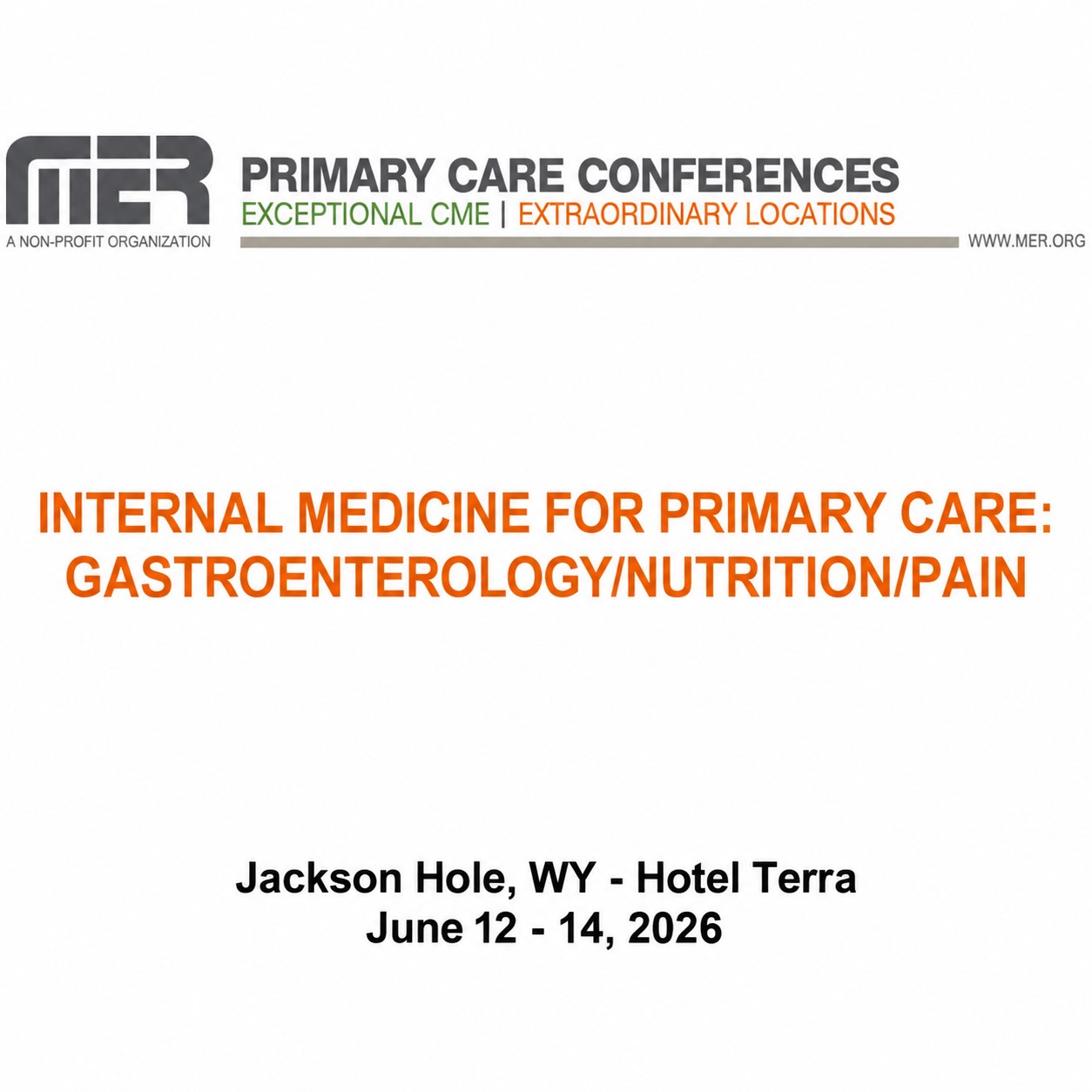
MER Primary Care Conferences Internal Medicine for Primary Care: Gastroenterology/Nutrition/Pain 2026
Comprehensive Primary Care Update – Gastroenterology, Nutrition & Pain Management
Stay current with important developments in gastroenterology, nutrition, and pain management through the MER Primary Care Conferences – Internal Medicine for Primary Care: Gastroenterology/Nutrition/Pain 2026.
This multidisciplinary educational program provides practical updates for clinicians managing common gastrointestinal, nutritional, and chronic pain conditions in primary care.
Course Details
- Course: Internal Medicine for Primary Care: Gastroenterology/Nutrition/Pain
- Year: 2026
- Dates: June 12–14, 2026
- Venue: Hotel Terra, Jackson Hole, Wyoming
- Provider: Medical Education Resources (MER)
- Specialties: Internal Medicine, Primary Care, Gastroenterology, Nutrition & Pain Management
Course Overview
The program is designed for office-based primary care providers and other healthcare professionals seeking clinically relevant updates in gastroenterology, nutrition, and pain management.
The curriculum addresses lower gastrointestinal bleeding, colorectal cancer screening, celiac disease, hepatitis B and C, chronic pain, low back pain, fibromyalgia, opioid management, healthy nutrition, and individualized dietary planning.
Gastroenterology
Lower GI Bleeding
Review current treatment recommendations for the management of lower gastrointestinal bleeding, including appropriate clinical management strategies.
Colorectal Cancer Screening
Discuss current guidelines for:
- Colonoscopic colorectal cancer screening
- Surveillance
- Appropriate follow-up strategies
Celiac Disease
Review appropriate testing approaches for the diagnostic workup of celiac disease.
Hepatitis B & C
Review current treatment recommendations for:
- Hepatitis B (HBV)
- Hepatitis C (HCV)
Pain Management
Chronic Pain
Explore strategies to overcome common challenges associated with treating chronic pain in primary care.
Low Back Pain
Review how:
- Non-surgical activity modification
- Physical therapy
can benefit patients with low back pain.
Fibromyalgia
Compare the benefits and side-effect profiles of available pharmacologic treatment options for fibromyalgia.
Opioid Pain Management
Develop appropriate opioid pain management strategies for patients with chronic pain.
Nutrition
Healthy Lifestyle & Nutrition
Explore how popular diets and current nutritional science can contribute to healthier lifestyles.
Nutrition Across the Lifespan
Identify expectations for optimal nutrition throughout the patient’s expected lifespan.
Dietary & Behavioral Modification
Review strategies for modifying:
- Diet
- Eating behaviors
- Lifestyle behaviors
in patients with a range of health conditions.
Personalized Nutrition
Explore options for developing patient-specific nutrition plans based on individual clinical needs and circumstances.
Learning Objectives
Upon completion of this program, participants should be better able to:
- List current treatment recommendations for the management of lower GI bleeding.
- Discuss guidelines for colonoscopic colorectal cancer screening and surveillance.
- Recommend appropriate testing for the workup of celiac disease.
- List current treatment recommendations for HBV and HCV.
- Identify strategies to overcome the challenges of treating chronic pain.
- Describe how non-surgical activity modification and physical therapy can benefit patients with low back pain.
- Compare the benefits and side-effect profiles of pharmacologic treatment options for fibromyalgia.
- Design opioid pain management strategies.
- Discuss how popular diets and nutritional science can contribute to healthier lifestyles.
- Identify expectations for optimal nutrition across the patient’s expected lifespan.
- List strategies to modify diet and behaviors in patients with a range of health issues.
- Describe options for personalizing a patient-specific nutrition plan.
Who Should Attend?
This program is targeted toward office-based primary care providers and other healthcare professionals seeking updates in primary care medicine.
Best For
- Internists
- Primary Care Physicians
- Gastroenterologists
- Nutritionists
- Pain Management Specialists
Major Clinical Areas
- Gastroenterology
- Nutrition
- Pain Management
- Lower GI Bleeding
- Colorectal Cancer Screening
- Celiac Disease
- Hepatitis B
- Hepatitis C
- Chronic Pain
- Low Back Pain
- Fibromyalgia
- Opioid Pain Management
- Nutrition Across the Lifespan
- Lifestyle Modification
- Personalized Nutrition
Why This Course Is Valuable
The MER Internal Medicine for Primary Care 2026 program combines three highly relevant areas of everyday primary care practice: gastroenterology, nutrition, and pain management.
The curriculum emphasizes practical clinical decision-making, current treatment recommendations, individualized nutrition strategies, and evidence-based approaches to chronic pain.
4. Topics
Friday, June 12, 2026
-
Gastroenterology – Management of Lower GI Bleeding- From Occult to Massive: The correct use and interpretation of tests for occult blood in the stool will be discussed in relation to lower GI bleeding; focus on the utility of different diagnostic and management approached to the spectrum of patients presenting with hematochezia.
-
Gastroenterology – Colorectal Cancer Screening and Surveillance: Reviews the most recent recommendations for CRC screening in the general population at average risk for CRC.
-
Gastroenterology – Celiac Disease and Chronic Diarrhea: Millions of Americans are now on a gluten free diet. Only some of them actually have Celiac disease. We will review the workup of diarrhea and malabsorption with a focus on celiac disease; We will discuss how to diagnose celiac disease when a patient is already on a gluten free diet and an appropriate differential diagnosis.
-
Pain – Chronic Pain Types and Osteoarthritis: Chronic pain is much more complex than just acute pain that lasts a long time; The physiology and categorization of chronic pain will be explored; Osteoarthritis has characteristics of more than one category of chronic pain; Characteristics that affect treatment planning.
-
Pain – Back Pain: Back pain is a common cause of long term disability; Non-pharmacologic and pharmacologic interventions will be discussed for a variety of causes of back pain including failed back surgery syndrome.
Saturday, June 13, 2026
-
Pain – Fibromyalgia and Cannabinoids for Chronic Pain: Fibromyalgia is a classic example of the nociplastic chronic pain category; A variety of treatment modalities will be discussed; In addition, the evidence regarding the use of cannabinoids for chronic pain will be presented.
-
Pain – Safe Opioid Prescribing: The role of opioids in the management of chronic pain will be addressed in the contexts of the updated CDC guidelines and the increasing prevalence of opioid use disorder.
-
Gastroenterology – Hepatitis B and C Management: HBV screening: whom to screen, whom to vaccinate; management of patients with decompensated hepatitis B related liver disease; treatment in special populations.
-
Nutrition – Myths vs. Science in Nutritional Trends: Approach for the Medical Professional: Discussion of how to scientifically navigate the nutritional maze of popular diets and nutritional trends; The potential nutrition benefits and pitfalls of various dietary preferences and related patient concerns; Ways nutrition affects healthy lifestyles.
-
Nutrition – Nutrition Through the Ages: Prevention and Potential Pitfalls: A working guide for a nutritional and behavioral rubric to understand what is expected (and what may undermine) optimal health from infancy through the elderly; Barriers patients face in implementing and sticking with nutritional strategies.
Sunday, June 14, 2026
-
Nutrition – Medical Nutrition Therapy: A Practical Approach to Diet and Disease: Science-based Nutrition and Behavioral Guide to Treating “The Big” Medical Problems that are taking over your practice; Essential (and proven) strategies to help guide patients’ diet and behaviors in the treatment of diabetes, cardiovascular disease, and GI health; Travel through the google-mess of what patients hear and why they turn to these as resources; The science-based strategies and resources that can be implemented to help patients take rational control of their health.
-
Nutrition – Cutting Edge Nutrition Innovation: A Personalized Approach: How to critically evaluate nutrition tools that patients can use to promote optimal health; Review the “latest and greatest” nutrition applications and technologies that can be used to greatly improve patients’ nutrition and health pursuits; Creation of personalized health plans based on unique, patient-specific plans, tests, and analyses.