
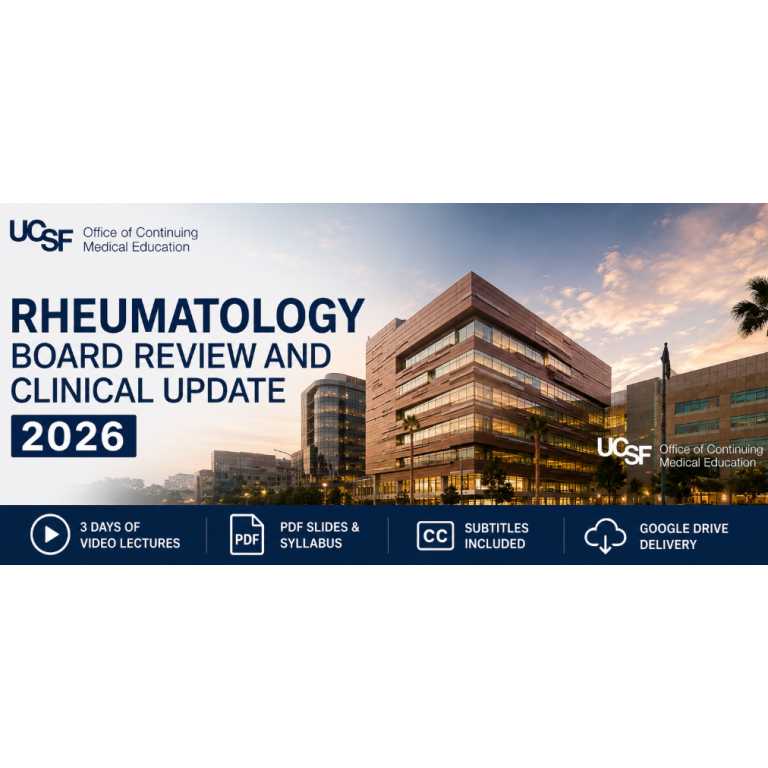
UCSF Rheumatology Board Review and Clinical Update 2026
$120.00
This Product is shared via google drive download link, So please share your correct Gmail id while placing the order .Please note that there are no CME points or certificate associated with this course Samples for Courses Can be found here : Free Samples Here!
UCSF 34th Annual Rheumatology Board Review & Clinical Update 2026
Videos + PDF Slides + Syllabus + Subtitles + Pre-Recorded Sessions
Prepare for the rheumatology boards and stay current with major advances in clinical rheumatology with the UCSF 34th Annual Rheumatology Board Review & Clinical Update 2026.
Presented by the University of California, San Francisco (UCSF), this comprehensive rheumatology review program covers major autoimmune, inflammatory, musculoskeletal, metabolic bone, and systemic rheumatic diseases encountered in both board examinations and clinical practice.
The 2026 program combines the recorded three-day main conference, additional pre-recorded lectures, available PDF presentation slides, syllabus materials, and subtitles to provide an extensive offline rheumatology learning resource.
The course is particularly valuable for rheumatologists, rheumatology fellows, internal medicine physicians, residents, and physicians preparing for rheumatology board certification or recertification.
Course Details
- Course: 34th Annual Rheumatology Board Review and Clinical Update
- Provider: University of California, San Francisco – UCSF
- Year: 2026
- Dates: August 20–22, 2026
- Original Venue: Mission Bay Conference Center at UCSF, San Francisco
- Specialty: Rheumatology
- Format: Digital / Offline Educational Content
- Main Program: 3-Day Course Recordings
- Additional Content: Pre-Recorded Rheumatology Sessions
- Files: Videos + PDF Slides + Syllabus + Subtitles
- Delivery: Google Drive
- Language: English
What Is Included?
✓ Complete 3-Day Course Video Recordings
Recorded educational sessions from the main UCSF Rheumatology Board Review and Clinical Update 2026 program held August 20–22, 2026.
Topics span the major areas of contemporary rheumatology, including lupus, rheumatoid arthritis, vasculitis, myositis, spondyloarthritis, osteoarthritis, osteoporosis, Sjögren’s disease, pediatric rheumatology, sarcoidosis, autoimmune lung disease, imaging, and medication safety.
✓ Additional Pre-Recorded Lectures
The package includes additional educational sessions extending the curriculum beyond the main three-day conference.
These sessions cover:
- IgG4-Related Disease
- Antiphospholipid Syndrome
- Spondyloarthritis II
- Mechanisms of bDMARDs & tsDMARDs
- Crystalline Disease
- Vasculitis II
- Infectious Disease and Rheumatology
- Sports Medicine I and II
- Systemic Sclerosis
✓ PDF Slides & Presentation Materials
Available faculty presentation slides and supporting PDF educational materials are included for convenient study and review.
✓ Course Syllabus
Course syllabus materials provide an additional reference for board preparation and clinical review.
✓ Subtitles
Subtitles are included with available video content, allowing easier review of lectures and important clinical concepts.
✓ Offline Study
The digital course materials can be reviewed at your own pace without attending the original live conference.
This makes the package suitable for:
- Board preparation
- Fellowship study
- Clinical review
- Topic-specific revision
- Repeated lecture review
- Independent rheumatology study
✓ Google Drive Delivery
Course files are delivered digitally through Google Drive.
Important Content Note
The UCSF program specifically states that:
“Quick Clinical Cases: A Photographic Review” – Lester D. Miller, MD
was not recorded and does not have published slides.
Therefore, this session is not advertised as part of the included recordings or PDF materials.
About the UCSF Rheumatology Board Review
The UCSF Rheumatology Board Review and Clinical Update has been offered by UCSF for more than three decades.
The program is designed to address major clinical topics in rheumatology for physicians preparing for the American Board of Internal Medicine (ABIM) Rheumatology Subspecialty Examination, as well as practicing clinicians seeking an extensive update in rheumatic disease diagnosis and management.
The curriculum emphasizes:
- Evidence-based standards of rheumatologic care
- Diagnostic accuracy
- Complex and unusual rheumatic disease presentations
- Current treatment strategies
- Medication efficacy and safety
- Newly available therapies
- Clinical decision-making
- Board-relevant rheumatology concepts
Learning Objectives
After studying the program, learners should be better able to:
- Apply current evidence-based approaches to major rheumatic diseases.
- Improve diagnostic accuracy using recent evidence and expert clinical guidance.
- Review treatment strategies for systemic autoimmune and inflammatory diseases.
- Refine and optimize rheumatic disease treatment based on efficacy and safety considerations.
- Understand current approaches to newly available rheumatology therapies.
- Improve assessment and management of pain associated with rheumatic disease.
- Strengthen knowledge relevant to rheumatology board examinations.
- Review complex and unusual rheumatologic clinical presentations.
- Apply updated clinical knowledge to daily rheumatology practice.
UCSF Rheumatology Board Review 2026 Course Content
Day 1 – August 20, 2026
1. Systemic Lupus Erythematosus
Faculty: Maria C. Dall’Era, MD
A comprehensive review of systemic lupus erythematosus (SLE) covering this major systemic autoimmune disorder and its relevance to rheumatology board preparation and clinical practice.
2. Autoimmune Disease and the Lung
Faculty: Erin Wilfong, MD
Reviews pulmonary involvement in autoimmune rheumatic diseases and important clinical relationships between systemic autoimmunity and lung disease.
3. Quick Clinical Cases: A Photographic Review
Faculty: Lester D. Miller, MD
Important: UCSF specifically states that this lecture was not recorded and does not have published slides.
It should therefore not be considered part of the included recorded course material.
4. Osteoarthritis
Faculty: Krishna Chaganti, MD
Reviews the diagnosis and clinical management of osteoarthritis, one of the most frequently encountered musculoskeletal disorders.
5. Sjögren’s Disease
Faculty: Caroline H. Shiboski, DDS
A focused review of Sjögren’s disease, including its place within systemic autoimmune and rheumatic disease.
6. Interpretation of Imaging Studies
Faculty: Thomas M. Link, MD
Reviews important principles of musculoskeletal and rheumatologic imaging interpretation and the integration of imaging into clinical diagnosis.
7. Medication Safety
Faculty: Gabby Schmajuk, MD
A clinically relevant session reviewing medication safety in rheumatology, including considerations surrounding modern rheumatic disease therapies.
Day 2 – August 21, 2026
8. Vasculitis I
Faculty: Peter Merkel, MD, MPH
A major board-review session addressing systemic vasculitis and vasculitic disorders.
9. Myositis and Myositis Mimics
Faculty: Julie Paik, MD
Reviews:
- Inflammatory myopathies
- Clinical myositis
- Diagnostic evaluation
- Disorders that can mimic inflammatory myopathy
This distinction is particularly important in both board examinations and clinical rheumatology.
10. Autoinflammatory Disease
Faculty: David Beck, MD
Reviews modern concepts in autoinflammatory disorders, including their diagnosis and clinical recognition.
11. Rheumatoid Arthritis Therapy: 2026
Faculty: Jonathan Graf, MD
A focused 2026 update on rheumatoid arthritis treatment, incorporating contemporary therapeutic strategies and evolving approaches to RA management.
12. Pediatric Rheumatology
Faculty: Erica Lawson, MD
Reviews important diseases, presentations, and clinical concepts encountered in pediatric rheumatology.
13. RA Epidemiology, EAMs, and Complications
Faculty: Ted Mikuls, MD
Reviews:
- Rheumatoid arthritis epidemiology
- Extra-articular manifestations
- Systemic complications
- Important clinical considerations in RA
Day 3 – August 22, 2026
14. Rheumatic Manifestations of Systemic Disease
Faculty: Jonathan Graf, MD
Reviews rheumatologic manifestations that may develop in association with systemic medical diseases.
15. Prevention & Treatment of Osteoporosis
Faculty: Mary Beth Humphrey, MD
A clinically focused review covering:
- Osteoporosis evaluation
- Fracture prevention
- Risk assessment
- Contemporary treatment approaches
16. Spondyloarthritis I
Faculty: Lianne S. Gensler, MD
A major review of spondyloarthritis, with related material expanded further in the additional pre-recorded Spondyloarthritis II session.
17. Sarcoidosis
Faculty: Brett W. Dietz, MD
Reviews sarcoidosis from the perspective of rheumatology, systemic inflammation, diagnosis, and clinical management.
Additional Pre-Recorded Rheumatology Sessions
The additional pre-recorded curriculum significantly expands the educational scope of the main conference.
IgG4-Related Disease
Faculty: John Stone, MD
Review of IgG4-related disease, an important immune-mediated fibroinflammatory disorder relevant to modern rheumatology.
Antiphospholipid Syndrome
Faculty: Sarah Goglin, MD
Review of antiphospholipid syndrome (APS), including its clinical significance within systemic autoimmune disease.
Spondyloarthritis II
Faculty: Lianne Gensler, MD
Continues the spondyloarthritis curriculum with additional discussion beyond the primary live session.
Mechanisms of bDMARDs & tsDMARDs
Faculty: Judith Ashouri-Sinha, MD
Reviews mechanisms underlying:
- Biological DMARDs – bDMARDs
- Targeted synthetic DMARDs – tsDMARDs
This session provides an important pharmacologic foundation for understanding contemporary immune-modifying rheumatology therapies.
Crystalline Disease
Faculty: Tuhina Neogi, MD
A dedicated review of crystal-associated rheumatic diseases, an important board and clinical topic.
Vasculitis II
Faculty: Peter Merkel, MD, MPH
Expands on the main vasculitis session with additional coverage of systemic vasculitic disease.
Infectious Disease and Rheumatology
Faculty: Brett Dietz, MD
Explores important intersections between infectious diseases and rheumatology, including clinical considerations relevant to patients receiving immunomodulatory treatment.
Sports Medicine I & II
Faculty: Carlin Senter, MD
Two sessions reviewing important sports medicine and musculoskeletal concepts relevant to rheumatologic and general clinical practice.
Systemic Sclerosis
Faculty: Francesco Boin, MD
A dedicated review of systemic sclerosis / scleroderma, including this complex systemic autoimmune connective tissue disease.
Major Rheumatology Topics Covered
The UCSF Rheumatology Board Review 2026 provides extensive coverage of:
- Systemic Lupus Erythematosus
- Rheumatoid Arthritis
- Rheumatoid Arthritis Treatment
- RA Epidemiology
- RA Extra-Articular Manifestations
- Rheumatoid Arthritis Complications
- Vasculitis
- Myositis
- Myositis Mimics
- Sjögren’s Disease
- Osteoarthritis
- Osteoporosis
- Spondyloarthritis
- Systemic Sclerosis
- Antiphospholipid Syndrome
- IgG4-Related Disease
- Autoinflammatory Diseases
- Crystalline Arthritis
- Pediatric Rheumatology
- Sarcoidosis
- Autoimmune Lung Disease
- Rheumatic Manifestations of Systemic Disease
- Musculoskeletal Imaging
- Rheumatology Imaging Interpretation
- Medication Safety
- bDMARDs
- tsDMARDs
- Infectious Disease in Rheumatology
- Sports Medicine
- Autoimmune Disease
- Connective Tissue Disease
Rheumatoid Arthritis Review
Rheumatoid arthritis receives significant attention throughout the curriculum.
Relevant areas include:
- RA epidemiology
- Extra-articular manifestations
- Complications
- Current therapy
- Medication safety
- Biological therapies
- Targeted synthetic therapies
This makes the program particularly useful for learners seeking a concentrated update on modern RA management.
Systemic Autoimmune Diseases
The curriculum addresses multiple systemic autoimmune disorders, including:
- Systemic lupus erythematosus
- Sjögren’s disease
- Systemic sclerosis
- Antiphospholipid syndrome
- Myositis
- Vasculitis
- IgG4-related disease
Participants can therefore review both common and less frequently encountered systemic rheumatic conditions within one program.
Inflammatory Arthritis
Important inflammatory arthritis topics include:
- Rheumatoid arthritis
- Spondyloarthritis
- Crystalline disease
- Autoinflammatory disorders
The course helps reinforce differential diagnosis and current management approaches across different inflammatory disease patterns.
Rheumatology Imaging
The Interpretation of Imaging Studies session provides an important review of imaging in musculoskeletal and rheumatic disease evaluation.
Imaging is especially important when evaluating:
- Inflammatory arthritis
- Degenerative joint disease
- Bone abnormalities
- Structural musculoskeletal pathology
- Complex diagnostic presentations
Rheumatology Pharmacology & Medication Safety
The curriculum also addresses the increasingly complex therapeutic landscape of rheumatology.
Relevant topics include:
- Rheumatoid arthritis therapy
- Medication safety
- bDMARD mechanisms
- tsDMARD mechanisms
- Treatment monitoring
- Risk assessment
- Immunomodulatory treatment
These areas are particularly important because rheumatology therapy continues to evolve rapidly.
Who Is This Course For?
The UCSF Rheumatology Board Review and Clinical Update 2026 is particularly valuable for:
- Rheumatologists
- Rheumatology Fellows
- Physicians preparing for the ABIM Rheumatology Subspecialty Examination
- Physicians preparing for rheumatology recertification
- Internal Medicine Physicians
- Internal Medicine Residents
- Academic Physicians
- Hospital-Based Physicians
- Primary Care Physicians with an interest in rheumatic disease
- Physician Assistants working in rheumatology
- Clinicians treating patients with autoimmune diseases
- Healthcare professionals seeking an extensive rheumatology update
Why This Course Is Valuable for Board Preparation
Successful rheumatology board preparation requires familiarity with a broad spectrum of diseases rather than focusing exclusively on inflammatory arthritis.
The UCSF curriculum provides coverage across:
Autoimmunity + Inflammatory Arthritis + Connective Tissue Disease + Vasculitis + Bone Disease + Musculoskeletal Medicine + Pharmacology + Imaging + Pediatric Rheumatology
This broad curriculum can help physicians:
- Review high-yield board topics
- Identify knowledge gaps
- Refresh core rheumatology concepts
- Review uncommon rheumatic disorders
- Stay current with therapeutic advances
- Improve diagnostic reasoning
- Reinforce medication knowledge
- Review important systemic manifestations
- Prepare for clinical rheumatology practice
Why This Course Is Useful for Practicing Rheumatologists
The program is not limited to examination preparation.
Practicing clinicians can use the lectures to review:
- Current treatment approaches
- Evolving rheumatoid arthritis therapy
- Medication safety
- Complex autoimmune diseases
- Diagnostic imaging
- Systemic complications
- Modern DMARD mechanisms
- Osteoporosis management
- Vasculitis
- Myositis
- Spondyloarthritis
- Autoinflammatory disorders
This combination of board review and clinical updates makes the course useful for both trainees and established clinicians.
Product / Delivery Information
- Product: UCSF 34th Annual Rheumatology Board Review & Clinical Update 2026
- Year: 2026
- Format: Digital / Offline Educational Content
- Main Program: 3-Day Recorded Course
- Additional Material: Pre-Recorded Lectures
- Included Content: Videos + PDF Slides + Syllabus + Subtitles
- Delivery: Google Drive
- Access Type: Offline Study Materials
- Language: English
- Specialty: Rheumatology / Internal Medicine
Important
The Quick Clinical Cases: A Photographic Review session is not included because UCSF specifically stated that it would not be recorded and would not have published slides.
Only available course materials should be considered included.
CME / Certificate Notice
This digital educational package is intended for independent study.
Purchase of the offline files does not provide UCSF CME/CE credit, ABIM MOC credit, or an official UCSF certificate.
Credits associated with the original UCSF live educational activity are subject to UCSF’s official attendance and credit-claiming requirements.
4. Short Description
UCSF 34th Annual Rheumatology Board Review & Clinical Update 2026 is a comprehensive board review and clinical update featuring the recorded three-day UCSF program, additional pre-recorded lectures, available PDF slides, syllabus materials, and subtitles.
The curriculum covers rheumatoid arthritis, SLE, vasculitis, myositis, spondyloarthritis, systemic sclerosis, Sjögren’s disease, osteoporosis, osteoarthritis, pediatric rheumatology, IgG4-related disease, APS, DMARDs, imaging, medication safety, and more.
Ideal for rheumatologists, rheumatology fellows, internists, residents, and physicians preparing for rheumatology board certification or recertification.
Related products

Internal Medicine
Internal Medicine

Anesthesiology & pain medicine
Anesthesiology & pain medicine
Critical Care - Emergency medicine
2022 UPDATES IN THERAPEUTICS: CRITICAL CARE PHARMACY PREPARATORY REVIEW AND RECERTIFICATION COURSE
Medical Accounts
Internal Medicine
Internal Medicine