
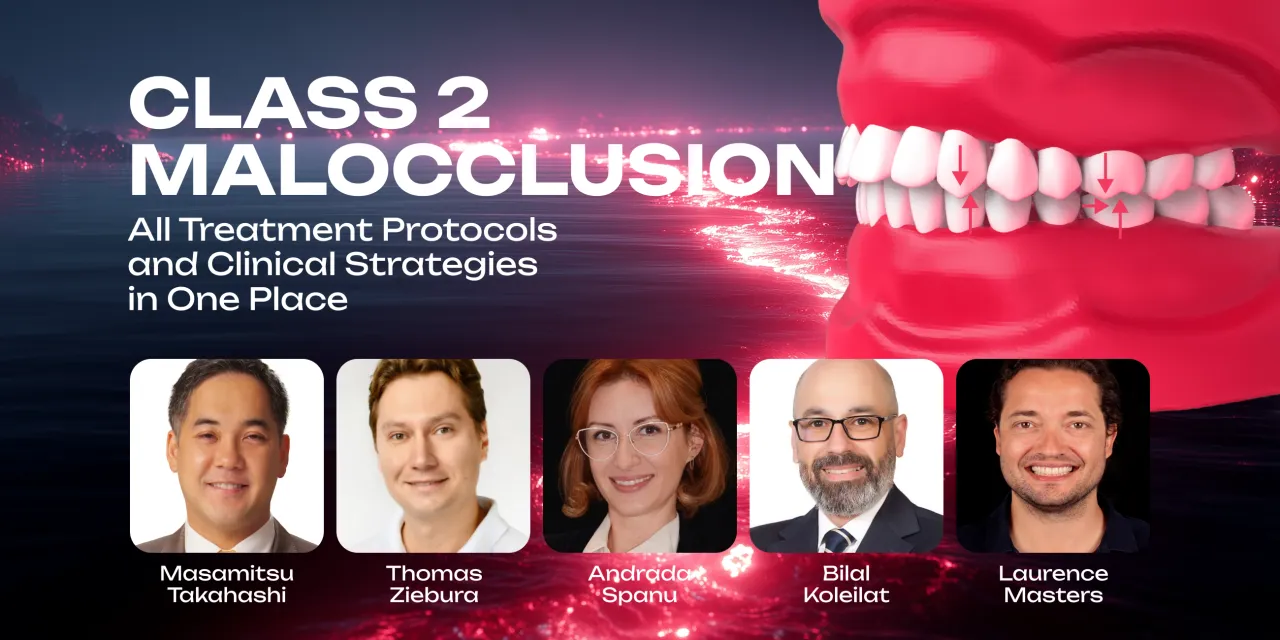
OHI-S Class 2 Malocclusion. All Treatment Protocols and Clinical Strategies in One Place 7 lessons 6h 49min
$65.00
This Product is shared via google drive download link, So please share your correct Gmail id while placing the order .Please note that there are no CME points or certificate associated with this course Samples for Courses Can be found here : Free Samples Here!
OHI-S Class 2 Malocclusion
All Treatment Protocols & Clinical Strategies in One Place
7 Lessons | 6 Hours 49 Minutes | 6 CE Credits
Build a structured, biomechanics-driven approach to Class II malocclusion with OHI-S Class 2 Malocclusion: All Treatment Protocols and Clinical Strategies in One Place.
This comprehensive orthodontic program brings together multiple treatment philosophies and clinical strategies for both growing and non-growing patients, helping clinicians move beyond a single-appliance approach to Class II correction.
The program is presented by:
- Masamitsu Takahashi
- Thomas Ziebura
- Andrada Spanu
- Laurence Masters
- Bilal Koleilat
Across seven lessons, the curriculum covers:
- Class II diagnosis
- Skeletal vs. dentoalveolar discrepancies
- Vertical dimension control
- Occlusal plane management
- Gummy smile
- Deep bite
- Open bite
- Camouflage treatment
- Growth modification
- Functional appliances
- Herbst mechanics
- Intermaxillary elastics
- Extraction vs. non-extraction decisions
- Molar distalization
- Temporary Anchorage Devices – TADs
- En-masse retraction
- CBCT-guided planning
- Alveolar bone limitations
- Root resorption assessment
- Facial-profile changes
- Treatment of adolescents and adults
- Retention and relapse
The central clinical framework is:
Diagnose the Class II Pattern → Define Skeletal, Dental & Vertical Components → Evaluate Growth → Assess Biological Limits → Select Mechanics → Control Anchorage → Finish & Retain
Course Details
- Course: Class 2 Malocclusion. All Treatment Protocols and Clinical Strategies in One Place
- Provider: OHI-S
- Lessons: 7
- Official Duration: 6 Hours 49 Minutes
- Language: English
- Official OHI-S CE: 6 CE Credits
- Primary Specialty: Orthodontics
- Main Focus: Class II Malocclusion
- Level: Advanced Clinical Orthodontics
- Patient Groups: Growing and Non-Growing Patients
Faculty
- Masamitsu Takahashi
- Thomas Ziebura
- Andrada Spanu
- Laurence Masters
- Bilal Koleilat
Understanding Class II Malocclusion
Class II malocclusion should not be treated as a single diagnosis.
Different patients may present with varying combinations of:
- Maxillary protrusion
- Mandibular retrusion
- Dental protrusion
- Dentoalveolar compensation
- Deep bite
- Open bite
- Vertical excess
- Vertical deficiency
- Occlusal-plane abnormalities
- Increased overjet
- Gummy smile
- Asymmetry
Therefore, treatment selection should follow diagnosis rather than appliance preference.
A Three-Dimensional Approach
Class II treatment can be divided into three major dimensions.
Sagittal
- Maxillary position
- Mandibular position
- Overjet
- Molar relationship
- Incisor position
- Distalization
- Retraction
Vertical
- Deep bite
- Open bite
- Gummy smile
- Incisor intrusion
- Molar intrusion
- Occlusal-plane inclination
Transverse
- Arch width
- Skeletal width
- Dental compensations
- Asymmetry
Successful treatment may require simultaneous control of more than one dimension.
LESSON 1
Gummy Smile Management in Class 2 Malocclusion
Faculty: Masamitsu Takahashi
Duration: 41 Minutes
This lesson focuses on the relationship between Class II malocclusion, vertical control, incisor position, and excessive gingival display.
Topics include:
- Diagnosis of vertical problems
- Assessment of the need for vertical control
- Advantages and disadvantages of different vertical-control methods
- Anterior vertical control
- Gummy-smile prevention
- Gummy-smile correction
- High-pull J-hook headgear
- 2×4 intrusion arch mechanics
- TAD vertical positioning
- Occlusal-plane effects
- Extraction mechanics in Class II cases
Diagnosing the Gummy Smile
A gummy smile is not one single orthodontic problem.
Possible contributing factors may include:
- Excessive incisor display
- Vertical dentoalveolar excess
- Short or hypermobile upper lip
- Gingival factors
- Skeletal vertical excess
- Incisor extrusion
The treatment plan should therefore begin with diagnosis of the underlying cause.
Vertical Control of Anterior Teeth
The lesson discusses strategies to control the anterior vertical dimension.
Potential biomechanical objectives include:
- Intrusion
- Prevention of further extrusion
- Modification of the occlusal plane
- Improvement of gingival display
TAD Position & Occlusal Plane
The vertical position of a TAD changes the direction of the applied force.
This can influence:
- Incisor inclination
- Intrusion
- Retraction
- Occlusal-plane rotation
Therefore, skeletal anchorage position should be planned according to the desired force vector.
LESSON 2
Class 2 and Vertical Dimension Control in Orthodontic Treatment
Faculty: Masamitsu Takahashi
Duration: 1 Hour 1 Minute
Lesson 2 expands the vertical-control concepts into a more detailed biomechanical framework.
Topics include:
- Diagnosis of vertical discrepancies
- TAD vertical positioning
- Lever-arm length
- Incisor inclination
- Overbite control
- Molar vertical control
- Absolute intrusion
- Occlusal-plane rotation
- Retention
- Relapse
Lever Arms & Force Direction
The relationship between:
TAD Position + Lever Arm Length
affects the force system acting on the anterior teeth.
Changes in geometry can influence:
- Retraction
- Intrusion
- Torque
- Incisor inclination
- Overbite
Absolute Intrusion vs. Occlusal-Plane Rotation
One important distinction is between:
Absolute Intrusion
True apical movement of a tooth or group of teeth.
Apparent Vertical Change Through Occlusal-Plane Rotation
A change in vertical relationship caused partly by rotation of the dental system.
These mechanisms should not be considered identical.
Retention & Relapse
Vertical correction requires attention to stability.
Factors influencing relapse may include:
- Original skeletal pattern
- Growth
- Muscular forces
- Habit
- Type of tooth movement
- Retention strategy
LESSON 3
Camouflage Treatment of Class 2 Malocclusion: Clinical Protocols
Faculty: Thomas Ziebura
Duration: 50 Minutes
This lesson focuses on non-surgical Class II camouflage strategies.
Topics include:
- Upper anterior retraction
- Facial-profile changes
- Functional appliances in growing patients
- Intermaxillary elastics
- Herbst appliance
- Herbst-type appliances
- Hybrid Herbst derivatives
- Class II Division 2
Orthodontic Camouflage
Camouflage treatment aims to compensate dentally for an underlying discrepancy when appropriate.
Potential strategies can include:
- Incisor retraction
- Distalization
- Intermaxillary elastics
- Extraction
- Anchorage reinforcement
The choice depends on:
- Skeletal pattern
- Growth
- Facial profile
- Incisor position
- Periodontal limits
Facial Profile Changes
Retraction of anterior teeth can affect:
- Lip position
- Facial convexity
- Soft-tissue balance
Therefore, extraction and retraction decisions should be made with the facial outcome in mind.
Functional Appliances
The course reviews functional-appliance approaches in growing patients.
Their use should be coordinated with:
- Growth stage
- Skeletal diagnosis
- Dental compensation
- Patient cooperation
Herbst Appliance
The curriculum covers:
- Herbst biomechanics
- Clinical use
- Herbst-type appliances
- Hybrid designs
The Herbst concept can be used in selected growing-patient protocols for Class II correction.
Class II Elastics
Intermaxillary Class II elastics can provide useful sagittal correction but also generate vertical and dental side effects.
Clinicians should therefore consider:
- Force direction
- Anchorage loss
- Incisor effects
- Vertical effects
Class II Division 2
The program includes specific protocols for Class II Division 2, where retroclined incisors and deep bite can change both the sequence and mechanics of correction.
LESSON 4
The Role of TADs in Class 2 Orthodontic Treatment
Faculty: Thomas Ziebura
Duration: 54 Minutes
This lesson focuses on skeletal anchorage.
Topics include:
- Molar distalization
- Customized distalization mechanics
- Posterior anchorage reinforcement
- Stabilization
- En-masse anterior retraction
- Sagittal correction through molar intrusion
Temporary Anchorage Devices
TADs can provide additional anchorage when conventional dental anchorage is insufficient.
Applications in Class II treatment can include:
- Distalization
- Retraction
- Intrusion
- Anchorage preservation
- Vertical control
Molar Distalization
TAD-supported distalization may be considered in selected non-extraction Class II cases.
The biomechanical plan should consider:
- Available posterior space
- Root position
- Alveolar bone
- Third molars
- Anchorage
- Desired tooth movement
Posterior Anchorage
Anchorage reinforcement helps prevent unwanted reciprocal movement during anterior retraction.
TADs allow the clinician to reduce dependence on:
- Other teeth
- Headgear
- Patient cooperation
in selected cases.
En-Masse Retraction
The course discusses retraction of the anterior segment as a unit.
Force-system design must consider:
- Center of resistance
- Torque
- Vertical force
- Anchorage
- Facial objectives
Molar Intrusion for Sagittal Correction
Vertical changes can influence sagittal relationships.
Selected Class II patients may benefit from mechanics that alter:
- Posterior vertical dimension
- Occlusal plane
- Mandibular autorotation
LESSON 5
Role of CBCT in Class 2 Malocclusion Diagnosis and Treatment Planning
Faculty: Andrada Spanu
Duration: 52 Minutes
Lesson 5 brings three-dimensional imaging into Class II treatment planning.
Topics include:
- Tooth angulation relative to alveolar bone
- CBCT vs. cephalometric assessment
- Alveolar bone limitations
- Extraction vs. distalization
- Root resorption
- Finishing
- Temporomandibular disorders
CBCT & Alveolar Bone Limits
Orthodontic movement occurs within the available alveolar housing.
CBCT may help evaluate selected cases where three-dimensional information is clinically justified.
Important considerations include:
- Root position
- Cortical boundaries
- Bone thickness
- Existing defects
Extraction vs. Distalization
One of the strongest clinical applications of the lesson is using three-dimensional anatomical information to support the decision between:
Extraction
and:
Distalization
for camouflage treatment.
Root Resorption
CBCT may provide additional information in selected patients when root-resorption assessment is clinically indicated.
Risk evaluation should be incorporated into treatment planning and monitoring.
CBCT in the Finishing Phase
Three-dimensional imaging can reveal relationships that may not be obvious on two-dimensional records.
However, CBCT should be used when clinically justified rather than as routine imaging for every orthodontic patient.
TMD Assessment
The curriculum also addresses CBCT evaluation in the context of temporomandibular disorders.
Imaging findings should be interpreted alongside clinical history and examination.
LESSON 6
Vertical Dimension and Occlusal Plane Control in Class 2 Malocclusion Treatment
Faculty: Laurence Masters
Duration: 57 Minutes
This lesson integrates vertical and sagittal treatment planning.
Topics include:
- Occlusal-plane angulation
- Vertical excess
- Vertical deficiency
- Mandibular position
- Facial aesthetics
- Long-term stability
- Fixed appliances
- Aligners
- TADs
- Skeletal anchorage
- Hybrid mechanics
Occlusal Plane in Class II
The occlusal plane can influence how the mandible relates to the maxilla.
The course explores how vertical control may influence:
- Mandibular positioning
- Facial balance
- Smile aesthetics
- Long-term stability
Vertical Excess vs. Deficiency
Treatment mechanics should differ depending on whether a patient demonstrates:
- Vertical excess
- Vertical deficiency
- High-angle pattern
- Low-angle pattern
One universal Class II protocol cannot be applied equally to every vertical facial type.
Conventional vs. Skeletal Anchorage
The lesson compares:
- Conventional mechanics
- TAD-assisted mechanics
- Hybrid approaches
The appropriate method depends on the specific movement required.
Fixed Appliances + Aligners + TADs
Complex Class II treatment can involve combinations of:
- Braces
- Clear aligners
- Intermaxillary elastics
- TADs
The appliance should serve the biomechanical objective rather than dictate it.
Soft-Tissue Harmony
Occlusal and dental changes can influence:
- Lip position
- Smile
- Facial appearance
The course therefore links biomechanical planning to the intended soft-tissue result.
LESSON 7
Simplified Mechanics for the Treatment of Class 2 Malocclusion in Growing and Non-Growing Patients
Faculty: Bilal Koleilat
Duration: 1 Hour 32 Minutes
The final lesson brings the curriculum together into a simplified treatment framework.
Topics include:
- Class II etiology
- Occlusal-plane considerations
- Mandibular deficiency
- Growing vs. non-growing diagnosis
- Intermaxillary elastics
- Bite ramps
- Deep bite
- Open bite
- Vertical control
- Transverse control
- Functional appliances
- Pubertal growth
- Fixed appliances
- Extraction treatment
- Non-extraction treatment
- TADs
- Reduced wire sequences
- Non-compliance mechanics
Growing vs. Non-Growing Patients
One of the most important decisions in Class II treatment is determining whether clinically meaningful growth potential remains.
The treatment opportunities differ substantially.
Growing Patients
Treatment may incorporate:
- Growth modification
- Functional appliances
- Bite ramps
- Intermaxillary elastics
Non-Growing Patients
Treatment may rely more heavily on:
- Dental camouflage
- Extraction
- Distalization
- Skeletal anchorage
- Fixed appliances
- Orthognathic referral when indicated
Pubertal Growth Phase
The course discusses functional-appliance treatment during the pubertal growth spurt.
Timing is important because growth-modification strategies depend partly on remaining craniofacial growth.
Deep Bite + Severe Overjet
The course presents clinical applications involving growing patients with:
- Deep bite
- Severe overjet
requiring coordinated sagittal and vertical treatment.
Deep Bite + Gummy Smile
Another case type combines:
Class II + Deep Bite + Gummy Smile
demonstrating why vertical diagnosis must be included in Class II planning.
Class II Subdivision
Asymmetric Class II relationships require asymmetric diagnosis and mechanics.
A subdivision case should not automatically receive the same bilateral mechanics used for a symmetric Class II.
Premolar Extraction in Non-Growing Patients
Extraction treatment remains one option for selected adult camouflage cases.
The decision should consider:
- Facial profile
- Incisor inclination
- Crowding
- Bone limits
- Anchorage needs
Non-Extraction Class II with TADs
The course also demonstrates non-extraction treatment of selected non-growing Class II patients using skeletal anchorage.
This illustrates an important theme of the entire program:
Different Patients Require Different Mechanics
EXTRACTION vs. NON-EXTRACTION
The course repeatedly returns to this clinical decision.
Extraction May Be Considered When
The case requires significant space for:
- Crowding relief
- Retraction
- Incisor position correction
- Camouflage
Non-Extraction Strategies May Include
- Distalization
- Arch development
- TAD-supported mechanics
- Growth modification in selected younger patients
The correct decision depends on the complete diagnosis.
Class II Treatment Toolbox
The program brings together multiple modalities.
Fixed Appliances
For comprehensive tooth control.
Intermaxillary Elastics
For selected sagittal corrections.
Functional Appliances
For selected growing patients.
Herbst-Type Appliances
For fixed functional correction.
TADs
For anchorage, distalization, retraction, and vertical control.
Aligners
For selected cases and hybrid vertical/sagittal mechanics.
Extraction Mechanics
For selected camouflage strategies.
No single modality is appropriate for every Class II patient.
Vertical Dimension
One of the strongest themes of the program is that Class II should not be evaluated only in the sagittal plane.
Vertical factors can influence:
- Overbite
- Gummy smile
- Facial height
- Occlusal plane
- Mandibular position
- Stability
Occlusal Plane Control
The course repeatedly discusses occlusal-plane management using:
- TADs
- Lever arms
- Intrusion
- Fixed appliances
- Aligners
- Hybrid mechanics
This makes occlusal plane control one of the most distinctive SEO topics for this product.
Long-Term Stability
Finishing treatment is not the same as achieving long-term stability.
Retention strategy should reflect:
- Initial malocclusion
- Vertical pattern
- Growth
- Treatment mechanics
- Tooth movement
- Biological response
Major Topics Covered
- Class II Malocclusion
- Class 2 Malocclusion
- Skeletal Class II
- Dental Class II
- Class II Division 2
- Orthodontic Biomechanics
- Class II Camouflage
- Growth Modification
- Functional Appliances
- Herbst Appliance
- Class II Elastics
- Temporary Anchorage Devices
- TADs
- Molar Distalization
- En-Masse Retraction
- Extraction Orthodontics
- Non-Extraction Orthodontics
- Vertical Dimension
- Occlusal Plane Control
- Gummy Smile
- Deep Bite
- Open Bite
- Incisor Intrusion
- Molar Intrusion
- CBCT Orthodontics
- Root Resorption
- Facial Profile
- Orthodontics in Growing Patients
- Adult Orthodontics
Who Should Take This Course?
The strongest target audience is:
- Orthodontists
- Orthodontic Residents
- Dentists with advanced orthodontic training
The program is also relevant to:
- Pediatric Dentists involved in interceptive orthodontics
- General Dentists providing orthodontic care within their training and legal scope
Restorative dentists may benefit from understanding Class II treatment planning when collaborating in multidisciplinary cases, but they should be considered a secondary audience.
The course itself is fundamentally an:
Advanced Orthodontics Program
Why This Course Is Useful
The program does not teach one universal Class II protocol.
Instead, it creates a decision framework around:
Diagnosis
- Skeletal
- Dental
- Vertical
- Facial
Patient Growth
- Growing
- Non-growing
Treatment Strategy
- Growth modification
- Camouflage
- Extraction
- Non-extraction
Anchorage
- Dental
- Functional
- Skeletal / TAD
Vertical Control
- Gummy smile
- Deep bite
- Open bite
- Occlusal plane
Imaging
- Cephalometry
- Selective CBCT
The overall pathway is:
Diagnose → Determine Growth → Define Vertical Pattern → Assess Bone Limits → Select Class II Strategy → Design Anchorage → Apply Biomechanics → Finish → Retain
CBCT Safety & Clinical Use
CBCT is included as an important diagnostic topic, but it should not be interpreted as a requirement for every orthodontic patient.
Three-dimensional imaging should be justified according to:
- Clinical need
- Diagnostic benefit
- Radiation exposure
- Existing imaging
- Patient-specific circumstances
Original OHI-S CE Information
The official OHI-S course is listed for:
6 CE Credits
with:
7 Lessons
and an official total duration of:
6 Hours 49 Minutes
Official CE eligibility applies to participation through the OHI-S educational platform and completion of its applicable requirements.
An independently distributed MedicalAmboss recording package should not automatically be advertised as providing official OHI-S CE credit or certificate unless the required OHI-S participation pathway is included.
Product Summary
- Product: Class 2 Malocclusion. All Treatment Protocols and Clinical Strategies in One Place
- Provider: OHI-S
- Faculty: Masamitsu Takahashi, Thomas Ziebura, Andrada Spanu, Laurence Masters, Bilal Koleilat
- Lessons: 7
- Official Duration: 6h 49min
- Language: English
- Official OHI-S CE: 6 Credits
- Primary Specialty: Orthodontics
- Main Focus: Comprehensive Class II Malocclusion Treatment
4. Short Description
OHI-S Class 2 Malocclusion: All Treatment Protocols and Clinical Strategies in One Place is a comprehensive 7-lesson, 6h 49min advanced orthodontic program.
Presented by Masamitsu Takahashi, Thomas Ziebura, Andrada Spanu, Laurence Masters, and Bilal Koleilat, the course covers skeletal and dental Class II diagnosis, gummy smile, vertical dimension and occlusal-plane control, adult camouflage, growth modification, Herbst appliances, intermaxillary elastics, extraction vs. non-extraction decisions, TAD-supported distalization and retraction, CBCT-based bone-limit assessment, root resorption, and treatment of growing and non-growing patients.
Topics
Lesson 1. Gummy Smile Management in Class 2 Malocclusion
-
Diagnosis and assessment of the need for vertical control
-
Methods of vertical dimension control: advantages and disadvantages
-
Vertical control of anterior teeth. Improvement or prevention of gummy smile
-
Treatment approaches for gummy smile correction
-
Clinical application of high-pull J-hook headgear
-
Application of 2×4 intrusion arch mechanics
-
Influence of TAD vertical position on the occlusal plane
-
Extraction treatment mechanics in Class 2 cases
Lesson 2. Class 2 and Vertical Dimension Control in Orthodontic Treatment
-
Diagnosis and assessment of the need for vertical control
-
Influence of TAD vertical positioning on the occlusal plane
-
Effect of lever arm length on incisor inclination
-
Relationship between TAD vertical position, lever arm length, incisor inclination, and overbite
-
Methods for controlling the vertical dimension of occlusion: advantages and disadvantages
-
Vertical control of the molar region
-
Difference between intrusion by rotation of occlusal plane applying biomechanics and absolute intrusion
-
Effect of the vertical position of TADs on the inclination of the occlusal plane
-
Retention and relapse following vertical dimension control
Lesson 3. Camouflage Treatment of Class 2 Malocclusion: Clinical Protocols
-
Retraction of upper anterior teeth in Class 2 cases and associated facial profile changes
-
Functional appliance therapy strategies in growing patients
-
Protocols for Class 2 correction using intermaxillary elastics
-
Clinical application and biomechanics of Herbst and Herbst-type appliances
-
Elastic-supported and hybrid Herbst appliance derivatives
-
Treatment protocols for Class 2 Division 2 malocclusions
Lesson 4. The Role of TADs in Class 2 Orthodontic Treatment
-
Protocols for Class 2 correction through molar distalization techniques
-
Design and customization of distalization mechanics protocols
-
Posterior anchorage reinforcement strategies and stabilization techniques
-
En-masse retraction protocols for anterior teeth control
-
Sagittal correction protocols through molar intrusion mechanics
Lesson 5. Role of CBCT in Class 2 Malocclusion Diagnosis and Treatment Planning
-
Tooth angulation in relation to the alveolar bone using CBCT
-
Correlation between CBCT and cephalometric (teleradiographic) analysis
-
Assessment of bone limitations based on CBCT findings
-
Extraction vs distalization for camouflage treatment: CBCT-based decision-making process
-
Root resorption: assessment and implications on CBCT imaging
-
Finishing phase guided by CBCT evaluation
-
Temporomandibular disorders (TMD) assessment using CBCT
Lesson 6. Vertical Dimension and Occlusal Plane Control in Class 2 Malocclusion Treatment
-
Role of vertical dimension and occlusal plane angulation in Class 2 diagnosis and treatment planning
-
Cephalometric and clinical indicators of vertical excess and deficiency in Class 2 cases
-
Influence of occlusal plane control on mandibular positioning, facial aesthetics, and long-term stability
-
Comparison of conventional, skeletal anchorage–assisted, and hybrid vertical control approaches
-
Biomechanical strategies for vertical dimension control using fixed appliances, aligners, and TADs
-
Effects of vertical control on soft tissue harmony and smile aesthetics
-
Case-based applications of occlusal plane modification in Class 2 correction
-
Integration of vertical control principles in comprehensive treatment planning for adolescent and adult patients
Lesson 7. Simplified Mechanics for the Treatment of Class 2 Malocclusion in Growing and Non-Growing Patients
-
Etiology of Class 2 malocclusion with emphasis on occlusal plane and mandibular deficiency
-
Treatment principles in growing vs non-growing patients: diagnostic differentiation and decision-making
-
Early use of intermaxillary elastics and bite ramps in Class 2 deep bite and open bite cases
-
Vertical and transverse control strategies in Class 2 correction
-
Functional appliance therapy during the pubertal growth spurt for skeletal modification
-
Fixed appliance strategies in non-growing patients: extraction and non-extraction protocols
-
Use of TADs in severe non-growing Class 2 cases
-
Simplified biomechanics: reduced wire sequences and non-compliance treatment approaches
-
Clinical case applications:
-
Deep bite and severe overjet in growing patients
-
Deep bite with gummy smile in growing patients
-
Class 2 subdivision cases in growing patients
-
Class 2 treatment with premolar extractions in non-growing patients
-
Class 2 non-extraction treatment with TADs in non-growing patients
-
Class 2 treatment with extractions and gummy smile correction in non-growing patients
-
Related products

Critical Care - Emergency medicine

Neurology / neurosurgery courses
International League Against Epilepsy 14th International Newborn Brain Conference 2023
Critical Care - Emergency medicine

Family medicine

ENT / Otolaryngology

Anesthesiology & pain medicine