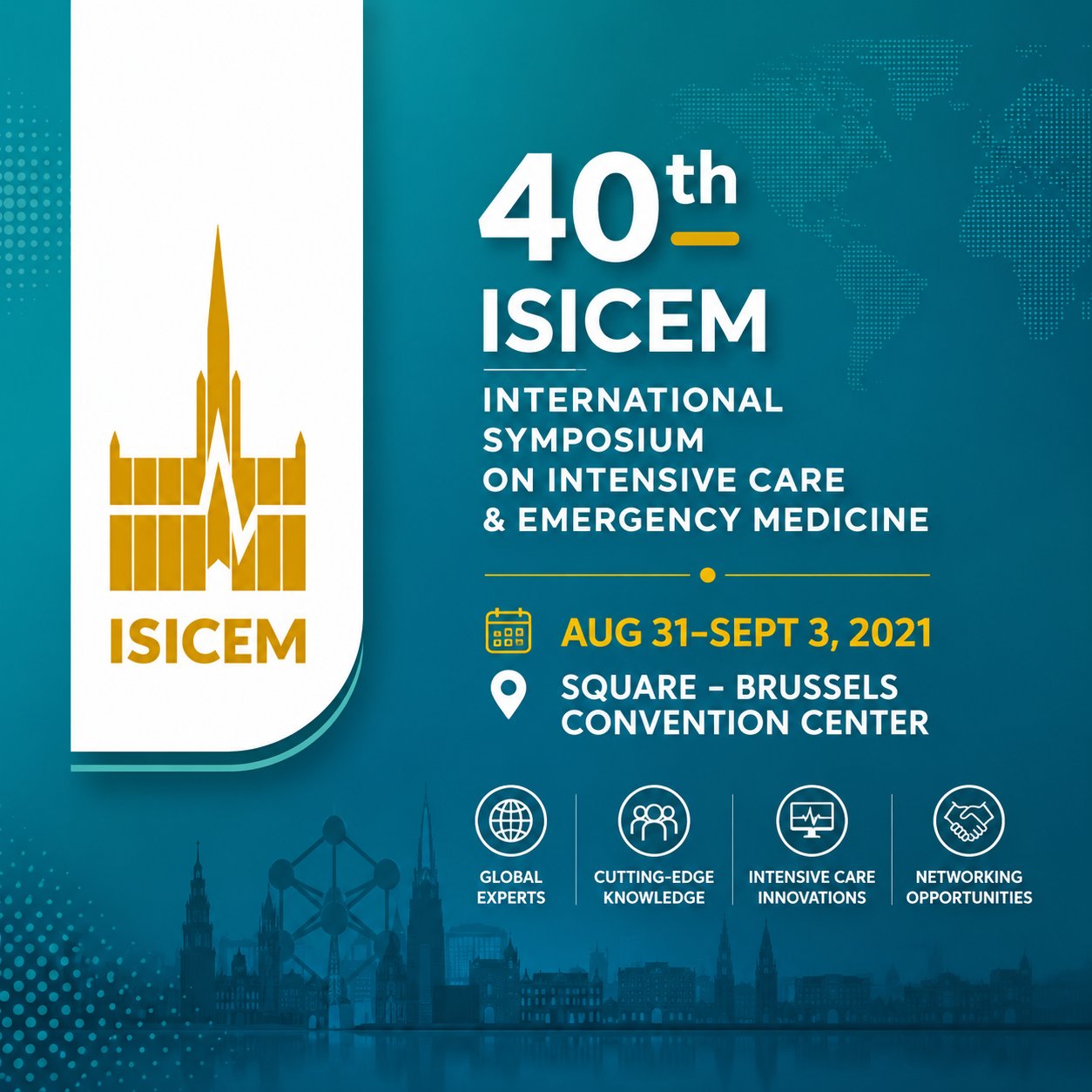

40th ISICEM International Symposium on Intensive Care & Emergency Medicine 2021
Comprehensive Critical Care, Emergency Medicine & Intensive Care Education
The 40th ISICEM International Symposium on Intensive Care & Emergency Medicine 2021 is one of the world’s leading educational events in critical care medicine, bringing together internationally recognized experts to discuss the latest advances in intensive care, emergency medicine, sepsis management, respiratory failure, hemodynamic monitoring, and life-support technologies.
Organized by the International Symposium on Intensive Care and Emergency Medicine (ISICEM), this comprehensive program delivers cutting-edge education through expert lectures, clinical updates, evidence-based discussions, and multidisciplinary perspectives designed to improve outcomes for critically ill patients.
The symposium covers a broad range of contemporary critical care topics, including mechanical ventilation, extracorporeal support, shock management, infectious diseases, organ dysfunction, trauma care, critical care ultrasound, and emerging technologies in intensive care medicine.
Course Features
• 130 Video Lectures
• Total Size: 61.26 GB
• International Critical Care Faculty
• Intensive Care Medicine Updates
• Emergency Medicine Education
• Evidence-Based Clinical Practice Reviews
• Advanced Organ Support Strategies
• Mechanical Ventilation Education
• Sepsis & Shock Management Updates
• Multidisciplinary Critical Care Discussions
Target Audience
This course is ideal for:
• Intensivists
• Critical Care Physicians
• Emergency Medicine Physicians
• Anesthesiologists
• Pulmonologists
• Internal Medicine Physicians
• Critical Care Fellows
• Emergency Medicine Residents
• ICU Nurses
• Respiratory Therapists
• Advanced Practice Providers
• Healthcare Professionals Managing Critically Ill Patients
It is particularly valuable for clinicians seeking:
• Critical Care CME
• Intensive Care Medicine Updates
• Sepsis Management Education
• Mechanical Ventilation Training
• Hemodynamic Monitoring Strategies
• Emergency Medicine Reviews
• Organ Support Technologies
• ICU Best Practices
Program Overview
The 40th ISICEM 2021 symposium provides a comprehensive review of contemporary intensive care and emergency medicine practice. The program focuses on the latest scientific evidence, clinical guidelines, and emerging technologies that influence the management of critically ill patients.
Participants gain practical knowledge in the diagnosis and treatment of life-threatening conditions, including septic shock, acute respiratory failure, cardiovascular emergencies, neurologic critical illness, trauma, and multiple organ dysfunction syndrome.
The curriculum emphasizes multidisciplinary collaboration, evidence-based medicine, patient safety, and innovative approaches to critical care delivery across a variety of healthcare settings.
Learning Objectives
Upon completion of this activity, participants will be able to:
• Apply evidence-based strategies in critical care medicine
• Optimize management of septic shock and severe infections
• Implement advanced mechanical ventilation techniques
• Utilize hemodynamic monitoring to guide therapy
• Improve diagnosis and management of respiratory failure
• Apply current recommendations for organ support therapies
• Recognize emerging technologies in intensive care medicine
• Enhance patient safety and quality improvement initiatives
• Improve multidisciplinary critical care decision-making
• Integrate recent research findings into daily clinical practice
Core Topics Covered
Sepsis & Septic Shock
• Early Recognition
• Hemodynamic Resuscitation
• Antimicrobial Therapy
• Organ Dysfunction Management
• Evidence-Based Sepsis Care
Mechanical Ventilation
• Ventilator Management
• ARDS Strategies
• Lung Protective Ventilation
• Weaning Protocols
• Advanced Respiratory Support
Acute Respiratory Failure
• COVID-19 Critical Care
• Noninvasive Ventilation
• High-Flow Oxygen Therapy
• ECMO Support
• Pulmonary Critical Care
Hemodynamic Monitoring
• Shock Assessment
• Cardiac Output Monitoring
• Fluid Responsiveness
• Vasopressor Management
• Bedside Ultrasound
Cardiovascular Critical Care
• Cardiogenic Shock
• Cardiac Arrest Management
• Mechanical Circulatory Support
• Advanced Resuscitation
• Critical Cardiology
Neurological Critical Care
• Brain Injury Management
• Stroke in Critical Care
• Neuro-Monitoring
• Sedation Strategies
• ICU Delirium
Infectious Diseases in Critical Care
• Severe Infections
• Antimicrobial Stewardship
• Multidrug-Resistant Organisms
• ICU Infection Prevention
Renal & Multiorgan Support
• Acute Kidney Injury
• Renal Replacement Therapy
• Organ Support Technologies
• Multiorgan Failure Management
Trauma & Emergency Medicine
• Trauma Resuscitation
• Emergency Airway Management
• Massive Hemorrhage Protocols
• Critical Emergencies
Educational Features
✔ 130 Expert Video Presentations
✔ Internationally Recognized Faculty
✔ Evidence-Based Clinical Updates
✔ Multidisciplinary Critical Care Perspectives
✔ Advanced Organ Support Education
✔ Emergency Medicine Reviews
✔ Practical ICU Management Strategies
✔ State-of-the-Art Clinical Research
Why This Course Stands Out
✔ One of the World’s Leading Critical Care Conferences
✔ Comprehensive Intensive Care Curriculum
✔ International Expert Faculty
✔ Covers the Full Spectrum of ICU Medicine
✔ Strong Focus on Evidence-Based Practice
✔ Includes Emerging Technologies & Research
✔ Valuable for Both Specialists and Trainees
✔ Practical Clinical Applications for Daily ICU Practice
Clinical & Educational Value
The 40th ISICEM International Symposium on Intensive Care & Emergency Medicine 2021 provides a comprehensive and up-to-date review of modern critical care medicine.
By integrating advances in sepsis management, respiratory support, hemodynamic monitoring, emergency medicine, organ support technologies, and multidisciplinary critical care, this program equips healthcare professionals with the knowledge and skills necessary to improve outcomes in critically ill patients.
This extensive educational resource serves as an invaluable reference for clinicians working in intensive care units, emergency departments, and acute care settings worldwide.
Topics :
Day 1
1-COVID-19 the basics
- 2-COVID-19 management
3-Before the ICU
4-Personalized medicine
5-When to intubate That is the question
6-How much oxygen
7-Analgesia and sedation
8-Neuromonitoring
9-The role of albumin administration
10-How much fluid
11-Cardiogenic shock
12-The microcirculation
13-Sepsis important concepts
14-Renal replacement therapy.mp4
15-End of life
16-Starting a critical care research program
17-Intra-abdominal hypertension (CD)
18-1COVID-19 requires a specific strategy
19-Therapies for COVID-19
20-Coma and disorders of consciousness
21-Mechanical ventilation
22-Current mamangement of septic shock
23-COVID-19 respiratory management
24-Hematological issues
25-The multiple organ dysfunction syndrome a history
Day 2
- 1-COVID-19 pathophysiology of respiratory failure
2-COVID-19 a unique form of ARDS
3-COVID-19 pharmacological therapies
4-COVID-19 what happens to the survivors
5-A fresh look at corticosteroids
6-Ventilatory support
7-Prone positioning revisited
8-ARDS management
9-ntracranial hypertension
10-Hemodynamic monitoring
11-Vasopressor therapy when and why
12-Circulatory shock
13-Severe liver disease
14-Metabolic fine-tuning
15-Revisiting Acidemia
16-Emergencies
17-Massive bleeding
18-0Severe infections
19-Preventing renal failure
20-Blood purification
21-The golden hour a failed concept
22-How I apply TTM after cardiac arrest
23-s there a place for artificial colloid solutions in the perioperative setting
24-Liberal use of parenteral nutrition in the critically ill
25-Control of hypercapnia by ECCO2R in severe ARDS
26-Promoting gender equity in intensive care
27-Promoting gender equity in intensive care_2
28-Oral Poster Presentations
29-TTM in cardiac arrest from non-shockable rhythms
30-An interactive and practical approach to cerebral oximetry
31-Management of subarachnoid hemorrhage
32-Temperature management in head trauma
33-Sepsis biomarkers
34-COVID-19 requires a specific strategy
35-Severe ARDS
36-Arrhythmia management
37-The pregnant patient
38-How to improve presenting skills
39-Evaluation of platelets function in the ICU
40-Assessment of thrombocytopenia
41-Circulatory effects of mechanical ventilation
42-Optimal use of CPAP.
43-How I feed my patient
44-Critical bleeding the near future
45-Pulmonary hypertension
46-Refeeding syndrome
Day 3
- 1-COVID-19 infectious complications
2-COVID-19 metabolic support
3-COVID-19 other organ involvement
4-COVID-19 coagulopathy
5-ARDS as a syndrome
6-VILI
7-ECMO
8-ECCO2R
9-VAP
10-Delirium
11-Nutritional support
12-The future of sepsis therapies
13-Working together
14-Antibiotic therapy
15-Antibiotic therapy_2
16-Life after Intensive Care
17-Quality of care
18-Renal dysfunction
19-Postanoxic brain damage
20-0Big data and AI
21-1Interacting with relatives
22-Should we use indirect calorimetry to guide nutrition
23-How to minimize delirium
24-What we did wrong during COVID-19
25-imPURE project – Medical supplies how could Europe be more self-efficient
26-Severe pancreatitis
27-Dosing of anti-infective drugs during extracorporeal therapies
28-Diabetic ketoacidosis
29-Passive leg raising and fluid challenges
30-How to approach patients with ARDS of unknown origin
31-What is new in CPR
32-CAR T-cell related complications
33-Mechanical ventilation in COPD
34-Patient-ventilator dyssynchrony
Day 4
- 1-COVID-19 what we´ve learned
2-COVID-19 a view from inside the ICU
3-COVID-19 what´s relevant to other forms of Sepsis
4-Subarachnoid hemorrhage
5-Traumatic brain injury
6-The importance of the gut
7-The surgical patient
8-Polytrauma
9-Post ICU syndrome
10-Clinical trials room for improvement
11-CPR
12-After cardiac arrest
13-New guidelines