
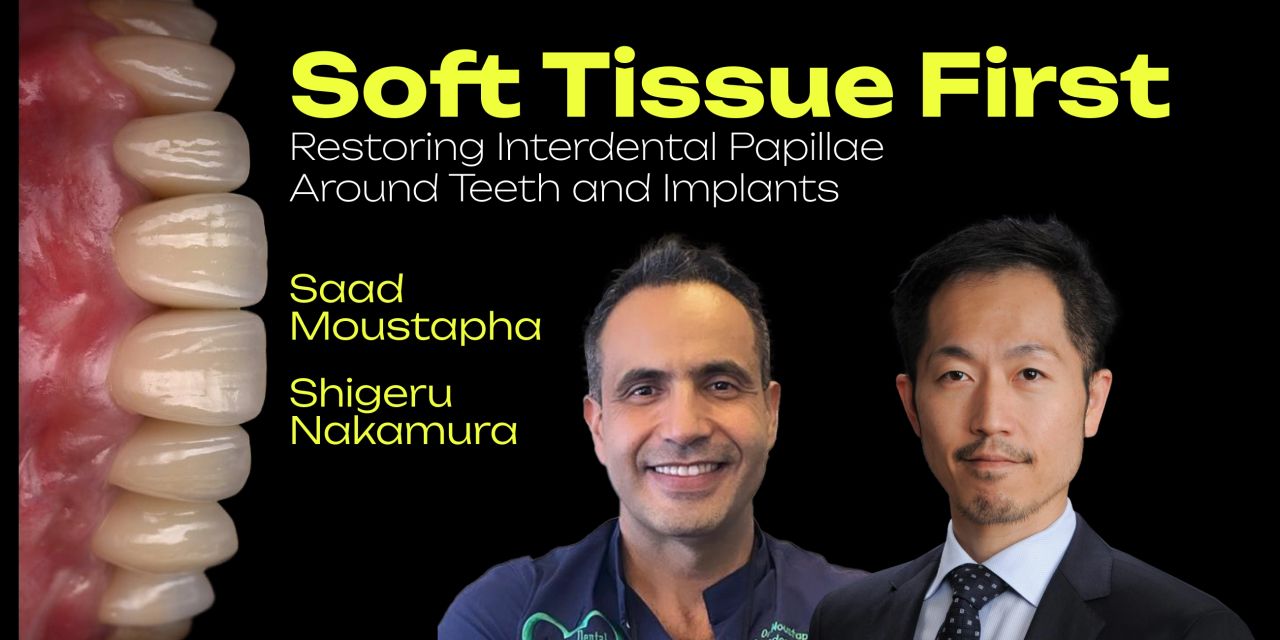
OHI-S Soft Tissue First. Restoring Interdental Papillae Around Teeth and Implants 4 lessons 2h 11min
$20.00
This Product is shared via google drive download link, So please share your correct Gmail id while placing the order .Please note that there are no CME points or certificate associated with this course Samples for Courses Can be found here : Free Samples Here!
EXPRESS DISCOVER PayPal
OHI-S Soft Tissue First. Restoring Interdental Papillae Around Teeth and Implants 4 lessons 2h 11min
Periodontology • Implantology • Soft Tissue Management • GBR • Mucogingival Surgery
4 Lessons | 2 Hours 11 Minutes | English
Develop a structured approach to soft tissue preservation, interdental papilla management, mucogingival surgery, and peri-implant tissue reconstruction with OHI-S Soft Tissue First. Restoring Interdental Papillae Around Teeth and Implants 4 lessons 2h 11min.
Led by Saad Moustapha and Shigeru Nakamura, this focused periodontal and implant dentistry course combines advanced soft-tissue surgery with contemporary hard-tissue and biomaterial protocols to improve aesthetic outcomes around both natural teeth and dental implants.
The program addresses the relationship between soft tissue phenotype, gingival recession, interdental papillae, emergence profile, provisional restorations, connective tissue grafting, Coronally Advanced Flap (CAF), guided bone regeneration (GBR), and open membrane techniques using D-PTFE membranes.
OHI-S officially lists the course as 4 lessons totaling 2 hours 11 minutes, in English, with 1.5 CE Credits.
The overall treatment philosophy can be summarized as:
Preserve Tissue → Diagnose Deficiency → Reconstruct Hard Tissue → Optimize Soft Tissue → Shape Emergence Profile → Maintain Aesthetic Stability
Course Details
- Course: Soft Tissue First. Restoring Interdental Papillae Around Teeth and Implants
- Provider: OHI-S
- Lecturers: Saad Moustapha and Shigeru Nakamura
- Number of Lessons: 4
- Total Duration: 2 Hours 11 Minutes
- Language: English
- Official OHI-S CE Listing: 1.5 CE Credits
- Primary Specialty: Periodontology
- Related Specialties: Implantology, Oral Surgery, Restorative Dentistry
- Primary Focus: Soft Tissue Preservation and Reconstruction Around Teeth and Implants
- Major Surgical Areas: CAF, CTG, Soft Tissue Phenotype Modification, GBR, Ridge Preservation
- Biomaterials: D-PTFE, NeoGen®, Cytoplast®
- Implant Focus: Immediate Implant Placement, Delayed Implant Placement, Emergence Profile, Peri-Implant Tissue Preservation
- Primary Audience: Periodontists, Implantologists, Oral and Maxillofacial Surgeons, Restorative Dentists
The official course page confirms both lecturers, all four lessons, duration, language, and CE information.
Who Was the Original Program Designed For?
The course is designed for dental clinicians across different levels of experience who want simplified and predictable protocols for managing soft tissues around teeth and implants.
It is particularly relevant for:
- Periodontists
- Implantologists
- Oral and Maxillofacial Surgeons
- Restorative Dentists
- General Dentists involved in implant therapy
- Clinicians performing mucogingival surgery
- Dentists treating gingival recession
- Clinicians performing immediate implant placement
- Dentists involved in aesthetic-zone implant treatment
- Clinicians performing connective tissue grafting
- Practitioners using GBR and membrane techniques
The strongest clinical audience remains:
Periodontology + Implantology + Mucogingival Surgery + Restorative Dentistry
Learning Objectives
Upon completion of this course, participants should be better able to:
- Enhance soft tissue phenotype and manage muco-gingival deformities around teeth and implants.
- Master surgical flap design and suturing techniques for optimal healing and aesthetic outcomes.
- Perform Coronally Advanced Flap (CAF) and Connective Tissue Graft (CTG) procedures for root coverage and soft tissue augmentation.
- Apply open membrane techniques using D-PTFE, NeoGen®, and Cytoplast® membranes for immediate and delayed implant placement, ridge preservation, and guided bone regeneration (GBR).
Soft Tissue First
The central philosophy of the program is that soft tissue appearance strongly influences the final aesthetic outcome of restorative and implant treatment.
Successful treatment therefore requires clinicians to consider soft tissue from the beginning rather than treating it only after implant placement or restoration.
Important considerations include:
- Soft tissue phenotype
- Gingival architecture
- Interdental papillae
- Keratinized tissue
- Tissue thickness
- Implant position
- Emergence profile
- Provisional restoration design
- Hard-tissue support
- Surgical wound management
The clinical pathway can be summarized as:
Evaluate → Preserve → Augment → Shape → Restore
Interdental Papillae
Interdental papillae play an important role in both periodontal health and aesthetic outcomes.
Loss or alteration of papillary tissue can become particularly challenging in:
- Periodontal defects
- Gingival recession
- Implant therapy
- Aesthetic-zone restorations
- Tissue remodeling following extraction
The course integrates papilla management into broader strategies involving flap design, connective tissue grafting, emergence profile, provisional restoration, and tissue preservation.
Peri-Implant Soft Tissue Management
Peri-implant aesthetics depend on more than implant osseointegration.
The program emphasizes the relationship between:
- Hard-tissue architecture
- Soft-tissue phenotype
- Implant positioning
- Abutment selection
- Emergence profile
- Provisional restorations
This encourages clinicians to view implant therapy as a coordinated hard-tissue + soft-tissue + restorative process.
Aesthetic-Zone Implantation
The first two lessons place particular emphasis on implant therapy in aesthetically sensitive areas.
Treatment planning may require consideration of:
- Extraction timing
- Immediate versus delayed implantation
- Ridge preservation
- Guided bone regeneration
- Membrane selection
- Implant positioning
- Soft-tissue preservation
- Restoration contours
The objective is to coordinate surgical and restorative decisions from the beginning of treatment.
Open Membrane Technique
Lesson 1 focuses on a contemporary open membrane technique using D-PTFE membranes.
The official program covers application of dense PTFE membranes and their use in aesthetic implant treatment, immediate placement, delayed placement, ridge preservation, and GBR.
This approach is integrated into implant-site management rather than being presented as an isolated regenerative procedure.
D-PTFE Membranes
Dense polytetrafluoroethylene — D-PTFE — is a central biomaterial in the first lesson.
The program examines its application in:
- Open membrane protocols
- Extraction sites
- Ridge preservation
- Guided bone regeneration
- Implant-site development
The course specifically includes both NeoGen® and Cytoplast® membrane systems.
NeoGen® Membranes
The first lesson reviews the use of:
- Reinforced NeoGen® membranes
- Non-reinforced NeoGen® membranes
within implant and regenerative workflows.
Membrane selection is considered according to the clinical defect and treatment strategy.
Cytoplast® D-PTFE
The program also addresses Cytoplast® dense PTFE membranes.
These are incorporated into the broader open-membrane strategy for hard-tissue management around extraction and implant sites.
Guided Bone Regeneration – GBR
GBR forms an important component of the first two lessons.
The course integrates guided bone regeneration with:
- Delayed implant placement
- Immediate implant placement
- Anterior aesthetic treatment
- Ridge preservation
- Hard-tissue reconstruction
The broader treatment concept is:
Bone Support → Implant Position → Soft Tissue Support → Restorative Contour
Immediate Implant Placement
The first lesson includes protocols for immediate implant placement after tooth extraction, together with ridge preservation considerations.
The aesthetic-zone context makes preservation of both hard and soft tissue particularly important.
Delayed Implant Placement
The same lesson also covers delayed implant placement with a GBR approach.
This allows comparison of regenerative planning across different implant timing strategies.
Ridge Preservation
Ridge preservation is incorporated into the immediate implant and extraction-site protocols.
The course connects ridge preservation with:
- Membrane techniques
- Implant-site architecture
- Future restoration
- Soft-tissue support
rather than viewing socket management as a purely bone-focused procedure.
Emergence Profile
Emergence profile is a recurring concept throughout the implant-related lessons.
Restorative contours can influence the appearance and stability of peri-implant soft tissues.
The course therefore connects:
Implant Position → Abutment → Provisional Restoration → Emergence Profile → Soft-Tissue Architecture
Peri-Implant Tissue Preservation
Lesson 2 is dedicated to a multifaceted approach to peri-implant tissue preservation.
The official program integrates:
- PTFE membrane-based hard-tissue management
- Provisional restoration-based soft-tissue control
- Abutment selection
- Emergence profile development
- GBR in anterior implant placement
- Clinical case analysis
Hard Tissue Management
Hard-tissue reconstruction creates the support necessary for stable peri-implant soft tissue.
The program demonstrates how PTFE membranes can form part of a broader strategy involving:
Bone Reconstruction → Implant Placement → Soft Tissue → Restoration
Provisional Restorations
The second lesson specifically addresses soft tissue control with provisional restorations.
Provisionalization can therefore become a tissue-management tool rather than serving only as a temporary replacement tooth.
Nobel Biocare N1™ System
The official Lesson 2 curriculum includes work with the Nobel Biocare N1™ system.
Its inclusion is presented within the wider clinical workflow of anterior implant placement and peri-implant tissue preservation.
Abutment Selection
The course also addresses:
- Abutment selection
- Emergence-profile management
as part of peri-implant tissue control.
This reinforces the relationship between restorative component selection and soft-tissue aesthetics.
Anterior Implant Placement
The program includes a step-by-step anterior implant case incorporating guided bone regeneration.
Anterior implant treatment is particularly demanding because both biological stability and aesthetic integration must be considered.
Muco-Gingival Deformities
Lesson 3 transitions from implant-site management to mucogingival defects around natural teeth.
The program covers:
- Gingival recession
- Etiology
- Classification
- Clinical assessment
- Root coverage
- Soft-tissue phenotype
- Connective tissue grafting
- Flap design
- Suturing
- Biomaterials
Gingival Recession
The course reviews the diagnosis of gingival recession through:
- Etiology
- Classification
- Clinical assessment
before treatment selection.
This helps ensure that surgery is based on the defect and patient characteristics rather than using one technique universally.
Soft Tissue Phenotype
The concept of soft tissue phenotype is one of the major teaching areas in Lesson 3.
Assessment includes factors such as:
- Tissue thickness
- Keratinized tissue width
- Root morphology
- Patient-specific variables
These characteristics may influence treatment selection and prognosis.
Root Coverage
The program reviews established root-coverage approaches, particularly:
- Coronally Advanced Flap – CAF
- Connective Tissue Graft – CTG
The aim is to improve both root coverage and soft-tissue volume where appropriate.
Coronally Advanced Flap – CAF
CAF is a major surgical technique throughout Lessons 3 and 4.
The course covers:
- Indications
- Flap design
- Incision planning
- Tissue handling
- Papilla management
- Suturing
- Anatomical challenges
- Clinical outcome factors
Lesson 4 is dedicated to a detailed video demonstration of the technique.
Connective Tissue Graft – CTG
The program also reviews Connective Tissue Graft (CTG) in combination with CAF.
Topics include:
- When CTG may be indicated
- Graft harvesting
- Graft handling
- Placement
- Root coverage
- Increasing tissue thickness
CTG + CAF
Combining CTG with a Coronally Advanced Flap can form part of a strategy for improving:
- Root coverage
- Tissue thickness
- Soft-tissue phenotype
- Aesthetic outcome
The course emphasizes selecting this combination according to clinical indications rather than using it automatically in every recession defect.
Flap Design
Flap design is one of the most important surgical components of the program.
Lesson 4 includes:
- Incision planning
- Papilla management
- Keratinized tissue handling
- Flap mobilization
- Anatomical considerations
Thoughtful flap design supports both wound stability and aesthetic healing.
Interdental Papilla Management
The CAF demonstration specifically addresses handling of interdental papillae.
This is especially important because careless incision or suturing around papillary tissues can affect both healing and aesthetics.
Suturing Techniques
Suturing is another major practical area.
The course reviews techniques intended to support:
- Flap stability
- Wound adaptation
- Tissue positioning
- Healing
- Aesthetic outcomes
Both Lessons 3 and 4 emphasize proper suturing principles.
Healing & Tissue Stability
Successful mucogingival surgery depends on more than executing an incision.
The course encourages consideration of:
- Tissue thickness
- Keratinized tissue
- Root anatomy
- Flap stability
- Patient factors
- Graft handling
- Suturing
throughout treatment planning.
Biomaterials & Growth Factors
Lesson 3 includes the role of biomaterials and growth factors in soft-tissue augmentation.
These options are considered within the broader objective of improving tissue phenotype and periodontal aesthetics.
Clinical Case Analysis
All major portions of the course use clinical cases.
The implant lessons include case analysis related to:
- Aesthetic implantation
- GBR
- Tissue preservation
while the mucogingival section includes cases with before-and-after clinical outcomes.
This helps translate individual surgical concepts into complete treatment workflows.
Complication & Anatomical Challenge Management
Lesson 4 specifically addresses:
- Anatomical challenges
- Procedural complications
- Strategies for more predictable CAF outcomes
The aim is to connect technique with real-world surgical problem solving.
Aesthetic Implant Dentistry
The course integrates several factors that influence aesthetic implant outcomes:
Hard Tissue
- Ridge preservation
- GBR
- Membrane techniques
Soft Tissue
- Tissue phenotype
- Papillae
- Keratinized tissue
Implant Components
- Implant position
- Abutment selection
Prosthetic Tissue Shaping
- Provisional restorations
- Emergence profile
The combined framework is:
Bone + Implant + Soft Tissue + Restoration = Aesthetic Integration
Major Topics Covered
- Periodontology
- Implantology
- Soft Tissue Management
- Interdental Papillae
- Peri-Implant Tissue
- Aesthetic Implant Dentistry
- Gingival Recession
- Mucogingival Deformities
- Soft Tissue Phenotype
- Keratinized Tissue
- Root Coverage
- Coronally Advanced Flap
- CAF
- Connective Tissue Graft
- CTG
- Flap Design
- Incision Planning
- Suturing Techniques
- Papilla Management
- Soft Tissue Augmentation
- Biomaterials
- Growth Factors
- D-PTFE Membranes
- PTFE Membranes
- NeoGen®
- Cytoplast®
- Open Membrane Technique
- Guided Bone Regeneration
- GBR
- Ridge Preservation
- Immediate Implant Placement
- Delayed Implant Placement
- Extraction Socket Management
- Anterior Implant Placement
- Emergence Profile
- Provisional Restorations
- Abutment Selection
- Nobel Biocare N1™
- Root Morphology
- Tissue Thickness
- Periodontal Plastic Surgery
- Clinical Case Analysis
Who Should Take This Course?
OHI-S Soft Tissue First. Restoring Interdental Papillae Around Teeth and Implants 4 lessons 2h 11min is particularly relevant for:
- Periodontists
- Implantologists
- Oral and Maxillofacial Surgeons
- Restorative Dentists
- General Dentists involved in implant therapy
- Clinicians treating gingival recession
- Dentists performing mucogingival surgery
- Clinicians performing CTG procedures
- Dentists using GBR
- Clinicians performing immediate implant placement
- Practitioners working in the aesthetic zone
- Dentists seeking predictable peri-implant soft-tissue protocols
The strongest clinical audience remains:
Periodontology + Implantology + Oral Surgery + Restorative Dentistry
Why This Course Is Useful
OHI-S Soft Tissue First. Restoring Interdental Papillae Around Teeth and Implants integrates periodontal plastic surgery with implant-site development and restorative tissue management.
The course brings together several major areas:
Implant Site Development
- D-PTFE membranes
- GBR
- Ridge preservation
- Immediate implantation
- Delayed implantation
Peri-Implant Aesthetics
- Soft-tissue preservation
- Provisional restorations
- Emergence profile
- Abutment selection
Mucogingival Surgery
- Gingival recession
- Soft-tissue phenotype
- Root coverage
- CAF
- CTG
Surgical Technique
- Flap design
- Papilla management
- Suturing
- Graft handling
Biomaterials
- NeoGen®
- Cytoplast®
- PTFE membranes
- Soft-tissue augmentation materials
The overall treatment pathway can be summarized as:
Assess Defect → Preserve Architecture → Reconstruct Bone When Needed → Enhance Soft Tissue → Shape the Papilla & Emergence Profile → Restore
Lecturers
Shigeru Nakamura
Shigeru Nakamura presents Lessons 1 and 2, which focus primarily on implant-site reconstruction and peri-implant tissue preservation.
OHI-S identifies him as President of Medical Corporation AIKOUKAI, Director of Dental Clinic AL’AISE GINZA, Visiting Professor at Nihon University, and a clinician involved in periodontal prosthetics, implantology, and aesthetic dentistry.
Saad Moustapha
Saad Moustapha presents Lessons 3 and 4, covering mucogingival deformities, CAF, CTG, flap design, and root coverage.
OHI-S lists qualifications including Fellow of the American Academy of Implant Dentistry, Diplomate of the American Board of Oral Implantology / Implant Dentistry, and clinical work in periodontology and implant dentistry.
Original OHI-S CE Information
The official OHI-S course listing identifies:
1.5 CE Credits
for the complete four-lesson course.
Individual lessons also display CE information where applicable; for example, the official listings show 0.5 CE Credits for the mucogingival-deformities lesson and 0.5 CE Credits for the CAF demonstration.
These credits apply to eligible participation through the official OHI-S educational activity and completion of its applicable requirements.
An independently distributed MedicalAmboss package should not automatically be represented as providing:
- OHI-S CE Credits
- ADA CERP Credit
- Official OHI-S Certificate
- Official OHI-S Membership
- OHI-S Platform Access
- Official Progress Tracking
unless these benefits are specifically included with the purchase.
Product Summary
- Product: OHI-S Soft Tissue First. Restoring Interdental Papillae Around Teeth and Implants 4 lessons 2h 11min
- Provider: OHI-S
- Lecturers: Saad Moustapha and Shigeru Nakamura
- Lessons: 4
- Duration: 2 Hours 11 Minutes
- Language: English
- Official CE Listing: 1.5 CE Credits
- Primary Specialty: Periodontology
- Related Specialties: Implantology, Oral Surgery, Restorative Dentistry
- Major Areas: Soft Tissue Phenotype, Gingival Recession, CAF, CTG, GBR, Ridge Preservation, D-PTFE Membranes, Emergence Profile
- Biomaterials / Systems: NeoGen®, Cytoplast®, PTFE Membranes, Nobel Biocare N1™
- Primary Audience: Periodontists, Implantologists, Oral and Maxillofacial Surgeons, and Restorative Dentists
- Educational Focus: Predictable Soft-Tissue and Peri-Implant Aesthetic Management
Short Description
OHI-S Soft Tissue First. Restoring Interdental Papillae Around Teeth and Implants 4 lessons 2h 11min is an advanced periodontal and implant dentistry course led by Saad Moustapha and Shigeru Nakamura.
The program covers peri-implant tissue preservation, D-PTFE open membrane techniques, NeoGen® and Cytoplast® membranes, GBR, ridge preservation, emergence profile management, gingival recession, soft-tissue phenotype, Coronally Advanced Flap (CAF), Connective Tissue Graft (CTG), flap design, suturing, and root-coverage protocols.
Topics
Lesson 1. New Concept of the Open Membrane Technique with a D-PTFE Membrane for Aesthetic Implantation — 28min
- Implantation considerations in the aesthetic zone
- Emergence profile and restoration contour
- NeoGen® reinforced and non-reinforced membrane applications
- Cytoplast® dense PTFE membrane applications
- Delayed implant placement with GBR
- Immediate implant placement with ridge preservation
- Immediate implantation after tooth extraction
- Clinical case analysis
Lecturer: Shigeru Nakamura.
Lesson 2. Multifaceted Approach to Peri-Implant Tissue Preservation — 26min
- Hard-tissue management with PTFE membranes
- Soft-tissue control using provisional restorations
- Nobel Biocare N1™ system
- Abutment selection
- Emergence profile management
- Anterior implant placement combined with GBR
- Clinical case analysis
Lecturer: Shigeru Nakamura.
Lesson 3. Diagnosis and Treatment of Muco-Gingival Deformities Around Teeth — 34min
- Gingival recession: etiology, classification, and clinical assessment
- Root-coverage principles and Coronally Advanced Flap
- Soft-tissue phenotype around teeth
- Phenotype-enhancement techniques
- Connective Tissue Graft + CAF
- Prognostic factors for root coverage
- Flap design and suturing
- Biomaterials and growth factors
- Clinical cases and treatment outcomes
Lecturer: Saad Moustapha.
Lesson 4. Coronally Advanced Flap (CAF): Video Demonstration of the Technique — 41min
- Flap design and incision planning
- Management of interdental papillae and keratinized tissue
- Suturing for wound stability and healing
- Step-by-step CAF video demonstration
- Management of anatomical challenges and complications
- Tissue thickness, keratinized tissue width, and root morphology
- Patient-related prognostic factors
- Indications for CTG with CAF
- Graft harvesting and handling
- CTG placement for root coverage and tissue thickening
- Literature review and soft-tissue objectives
Related products
DENTAL
Sinus Grafting for Implant Reconstruction (Pikos Online MasterClass Series) – Michael A. Pikos
DENTAL
- Anesthesiology & pain medicine
- Books
- Anesthesiology books
- Basic science
- Cardiology books
- Dermatology books
- DENTAL BOOKS
- Endocrine and Nutrition books
- Gastroenterology and Hepatology books
- Hematology / Oncology books
- INTERNAL MEDICINE BOOKS
- Nephrology / urology books
- Neurology / neurosurgery books
- Obstetrics and gynecology books
- ophthalmology / Optometry books
- ORTHOPEDIATRICS BOOKS
- Pathology books
- pediatric books
- plastic surgery books
- Psychiatric books
- PULMONARY BOOKS
- Qbank & Questions
- Radiology books
- Cardiology
- Critical Care – Emergency medicine
- DENTAL
- Dermatology
- Endocrine and Nutrition
- ENT / Otolaryngology
- Family medicine
- General Surgery
- GIT COURSES
- Hematology / Oncology
- Internal Medicine
- Medical Accounts
- Nephrology / Urology
- Neurology / neurosurgery courses
- Obstetrics & Gynecology
- Ophthalmology & Optometry
- Orthopaedic
- Pathology
- Pediatrics
- physiotherapy
- Plastic Surgery
- psychology
- Qbank & Questions
- Radiology
- Respiratory / Pulmonary
- Rheumatology
- Surgery