
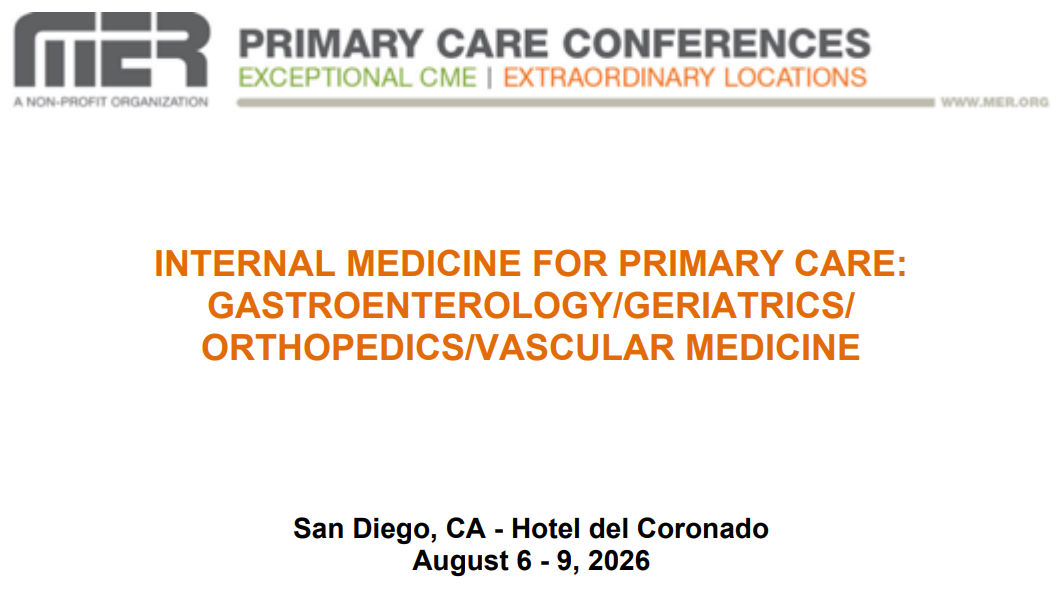
MER Primary Care Conferences Internal Medicine for Primary Care Gastro Geri Ortho Vasc Aug 06-09, 2026

$135.00
This Product is shared via google drive download link, So please share your correct Gmail id while placing the order .Please note that there are no CME points or certificate associated with this course Samples for Courses Can be found here : Free Samples Here!
EXPRESS DISCOVER PayPal
MER Primary Care Conferences Internal Medicine for Primary Care Gastro Geri Ortho Vasc Aug 06-09, 2026
Gastroenterology • Geriatrics • Orthopedics • Vascular Medicine
August 6–9, 2026 | San Diego, California
Review practical, evidence-based updates across four high-frequency areas of outpatient medicine with MER Primary Care Conferences Internal Medicine for Primary Care Gastro Geri Ortho Vasc Aug 06-09, 2026.
Organized by Medical Education Resources (MER), the original conference was held August 6–9, 2026, at the Hotel del Coronado in San Diego, California. The official MER title is Internal Medicine for Primary Care: Gastro/Geri/Ortho/Vasc.
This four-day program was designed for office-based primary care clinicians and other healthcare professionals seeking clinically relevant updates across:
- Gastroenterology
- Geriatrics
- Orthopedics
- Vascular Medicine
- Internal Medicine
- Primary Care
The curriculum addresses common and clinically important conditions encountered in adult outpatient practice, including lower gastrointestinal bleeding, colorectal cancer screening, celiac disease, chronic diarrhea, MASLD, comprehensive geriatric assessment, urinary incontinence, Alzheimer’s disease, behavioral problems in dementia, shoulder and upper-extremity disorders, knee injuries, foot and ankle pain, peripheral vascular disease, stroke, aneurysms, and venous thrombosis.
Course Details
- Course: Internal Medicine for Primary Care: Gastro/Geri/Ortho/Vasc
- Provider: Medical Education Resources – MER
- Year: 2026
- Original Conference Dates: August 6–9, 2026
- Duration: 4 Days
- Venue: Hotel del Coronado
- Location: San Diego, California
- Primary Specialty: Internal Medicine / Primary Care
- Subspecialties: Gastroenterology, Geriatrics, Orthopedics, Vascular Medicine
- Official MER Listing: 16 Credit Hours
- ANCC Pharmacotherapeutic Contact Hours: 6.50
- Primary Audience: Office-Based Primary Care Providers and Other Health Professionals
- Primary Clinical Focus: Evidence-Based Primary Care Updates
MER’s official conference listing confirms the venue, dates, 16 Credit Hours, and 6.50 ANCC pharmacotherapeutic contact hours.
Who Was the Original Program Designed For?
MER describes the target audience as:
Office-based primary care providers and other health professionals seeking updates in primary care medicine.
The program is particularly relevant for:
- Primary Care Physicians
- Internal Medicine Physicians
- Family Medicine Physicians
- Gastroenterologists
- Geriatricians
- Orthopedists
- Vascular Medicine Specialists
- Nurse Practitioners
- Physician Associates / Physician Assistants
- Clinicians caring for older adults
- Clinicians managing gastrointestinal disease
- Clinicians treating common musculoskeletal complaints
- Healthcare professionals managing vascular disease
The strongest primary audience remains:
Primary Care + Internal Medicine
with focused education in:
Gastroenterology + Geriatrics + Orthopedics + Vascular Medicine
Learning Objectives
Upon completion of this program, participants should be better able to:
- List current treatment recommendations for the management of lower GI bleeding.
- Discuss the guidelines for colonoscopic colorectal cancer screening and surveillance.
- Recommend appropriate testing for the workup of celiac disease.
- Identify risk factors for the development of MASLD.
- Utilize a comprehensive geriatric assessment to identify potential issues in the elderly patient.
- Review common lower urinary tract symptoms (LUTS) that may progress to urinary incontinence, and initiate treatment options.
- Diagnose and treat cognitive impairment, dementias, and Alzheimer’s disease.
- Discuss strategies for the management of difficult behaviors in patients with dementia without the use of psychotropic medications.
- Diagnose and treat shoulder injuries.
- Diagnose and treat wrist, hand, and finger injuries.
- Describe the anatomy and function of the knee joint.
- Recognize chronic injuries and pain syndromes to the foot and ankle.
- Describe the spectrum of maladies included in peripheral vascular disease.
- Discuss presentation and interventional treatment of stroke patients.
- List current pharmacologic options for the management of aneurysms.
- Describe the evaluation and treatment of venous thrombosis.
These learning objectives are confirmed in MER’s official agenda for this specific conference.
GASTROENTEROLOGY
The gastroenterology portion of the program focuses on common gastrointestinal and hepatologic problems encountered in primary care.
Major areas include:
- Lower gastrointestinal bleeding
- Occult gastrointestinal bleeding
- Hematochezia
- Colorectal cancer screening
- Colorectal cancer surveillance
- Celiac disease
- Chronic diarrhea
- Malabsorption
- MASLD
- Abnormal liver chemistry
The overall clinical pathway can be summarized as:
Recognize → Evaluate → Select Testing → Diagnose → Treat → Refer When Appropriate
Lower GI Bleeding
The official program begins with:
Management of Lower GI Bleeding – From Occult to Massive
The session addresses the spectrum of lower gastrointestinal bleeding, ranging from occult blood loss to clinically apparent hematochezia.
The program specifically reviews:
- Tests for occult blood in stool
- Interpretation of stool blood testing
- Hematochezia
- Diagnostic strategies
- Management approaches
- Selection of appropriate investigations
MER’s official agenda confirms that the session focuses on appropriate use and interpretation of occult blood testing and diagnostic and management approaches for patients presenting with lower GI bleeding.
Occult GI Bleeding
Occult gastrointestinal bleeding can present differently from overt hematochezia.
Primary care clinicians must determine when additional gastrointestinal evaluation is warranted based on:
- Clinical presentation
- Patient risk
- Laboratory findings
- Stool testing
- Associated symptoms
The course places these considerations within the broader management of lower GI bleeding.
Hematochezia
The official curriculum specifically includes patients presenting with hematochezia.
Evaluation requires integration of:
History → Severity → Hemodynamic Status → Differential Diagnosis → Diagnostic Testing → Management
Colorectal Cancer Screening & Surveillance
A dedicated session addresses:
Colorectal Cancer Screening and Surveillance
The program reviews contemporary recommendations for CRC screening in average-risk patients.
Primary care clinicians play an important role in:
- Identifying appropriate candidates for screening
- Discussing screening options
- Facilitating colonoscopic screening
- Ensuring appropriate surveillance
- Following patients after abnormal findings
Colonoscopy & CRC Surveillance
One of the stated learning objectives is to:
Discuss the guidelines for colonoscopic colorectal cancer screening and surveillance.
This emphasizes not only initial screening but also appropriate longitudinal follow-up.
The clinical pathway is:
Assess Risk → Screen → Interpret Findings → Determine Surveillance Interval
Celiac Disease & Chronic Diarrhea
The program includes:
Celiac Disease and Chronic Diarrhea
The official agenda reviews:
- Chronic diarrhea
- Malabsorption
- Celiac disease
- Appropriate testing
- Patients already following a gluten-free diet
- Differential diagnosis
MER specifically notes the clinical challenge of determining whether patients on gluten-free diets actually have celiac disease and selecting appropriate diagnostic strategies.
Celiac Disease Evaluation
A structured approach may involve:
- Clinical history
- Gastrointestinal symptoms
- Nutritional consequences
- Appropriate serologic testing
- Dietary history
- Differential diagnosis
- Further gastrointestinal evaluation when indicated
The learning objective emphasizes recommending appropriate testing for the workup of celiac disease.
Chronic Diarrhea & Malabsorption
The celiac disease session also addresses the broader workup of:
- Chronic diarrhea
- Malabsorption
This is useful because celiac disease represents only one possible cause of persistent gastrointestinal symptoms.
The goal is to move from:
Chronic Diarrhea → Pattern Recognition → Differential Diagnosis → Targeted Testing
Metabolic Dysfunction-Associated Steatotic Liver Disease – MASLD
A dedicated session covers:
Metabolic Dysfunction-Associated Steatotic Liver Disease (MASLD)
The official MER agenda describes a primary care approach to evaluating and managing mildly abnormal hepatocellular liver chemistry in asymptomatic patients and reviewing MASLD, its implications, and management.
MASLD Risk Factors
A specific learning objective is to:
Identify risk factors for the development of MASLD.
This connects liver disease with broader metabolic health and highlights the importance of considering MASLD in appropriate primary care patients.
Abnormal Liver Chemistry
MASLD may be discovered during evaluation of mildly abnormal liver chemistry in an otherwise asymptomatic patient.
The course therefore connects:
Abnormal Liver Tests → Clinical Assessment → Metabolic Risk → MASLD Evaluation → Management
GERIATRICS
The geriatrics portion focuses on practical issues encountered when caring for older adults.
Major areas include:
- Comprehensive geriatric assessment
- Physiologic changes of aging
- Medication use
- Polypharmacy considerations
- Lower urinary tract symptoms
- Urinary incontinence
- Cognitive impairment
- Dementia
- Alzheimer’s disease
- Behavioral symptoms of dementia
Approach to the Geriatric Patient
A major session is:
Approach to the Geriatric Patient
The official program reviews:
- Demographics of aging
- Physiologic changes in older adults
- Medication use in elderly patients
- Age-related pharmacokinetic changes
- Age-related pharmacodynamic changes
- Medication adherence
- Potentially risky medications
Comprehensive Geriatric Assessment
A stated learning objective is to:
Utilize a comprehensive geriatric assessment to identify potential issues in the elderly patient.
A comprehensive approach to older adults may involve multiple domains rather than focusing on a single diagnosis.
The overall framework is:
Medical Status → Medications → Function → Cognition → Mobility → Social Factors → Care Plan
Medication Use in Older Adults
Medication management becomes increasingly important with aging.
The official agenda specifically addresses:
- Changes in pharmacokinetics
- Changes in pharmacodynamics
- Medication adherence
- Risky medications
These issues may affect treatment safety and therapeutic decision-making in older patients.
Urological Disorders in the Older Adult
The program includes:
Urological Disorders in the Older Adult
Confirmed areas include:
- Lower urinary tract symptoms – LUTS
- Urinary incontinence
- Stress incontinence
- Overflow incontinence
- Overactive bladder – OAB
- Urge incontinence
- Differential diagnosis
- Initial management
Lower Urinary Tract Symptoms – LUTS
The course reviews common lower urinary tract symptoms in older adults and their potential progression toward urinary incontinence.
The clinical approach requires determining:
- Type of symptoms
- Likely mechanism
- Reversible contributors
- Appropriate treatment
- Need for further evaluation
Urinary Incontinence
Confirmed forms discussed include:
- Stress Incontinence
- Overflow Incontinence
- Overactive Bladder
- Urge Incontinence
The objective is to move from a nonspecific complaint of urinary leakage toward a more specific clinical diagnosis and treatment plan.
Alzheimer’s & Other Dementias
The official Friday curriculum includes:
Alzheimer’s & Other Dementias
The session reviews:
- Normal age-related cognitive changes
- Disorders of memory
- Cognitive impairment
- Dementing illnesses
- Mental status examinations
- Limitations of memory assessment
- Different dementia types
- Importance of accurate diagnosis
- Current treatment options
- Potentially reversible dementias
- Responsibilities of healthcare providers
Cognitive Impairment
A major primary care challenge is distinguishing:
Normal Aging ↔ Mild Cognitive Changes ↔ Dementia
The program supports clinicians in recognizing cognitive impairment and determining when further diagnostic evaluation is appropriate.
Alzheimer’s Disease
A specific learning objective is to:
Diagnose and treat cognitive impairment, dementias, and Alzheimer’s disease.
The program reviews Alzheimer’s disease within the wider differential diagnosis of cognitive decline rather than treating all memory concerns as the same disorder.
Potentially Reversible Dementia
The official curriculum specifically includes potentially reversible dementias.
This reinforces the need to avoid assuming that every cognitive decline represents irreversible neurodegenerative disease.
Managing Behavior Problems in Dementia
Another dedicated session is:
Managing Behavior Problems in Dementia Patients
The program focuses on:
- Common behavioral disturbances
- Behavioral techniques
- Nonpharmacologic management
- Alzheimer’s disease
- Other dementias
- Avoiding unnecessary psychotropic treatment
- Adverse effects of psychotropic medications
Nonpharmacologic Dementia Management
One of the learning objectives specifically emphasizes management of difficult behavior:
without the use of psychotropic medications.
The curriculum therefore highlights behavioral interventions and patient-specific approaches before automatically relying on pharmacologic restraint of symptoms.
Psychotropic Medication Risks
The session also reviews potential adverse effects of medications commonly used for behavioral symptoms in dementia.
This is particularly important in older adults because medication-related complications may be amplified by:
- Age
- Frailty
- Comorbid disease
- Polypharmacy
- Altered drug metabolism
ORTHOPEDICS & MUSCULOSKELETAL MEDICINE
Musculoskeletal complaints are among the most frequent reasons patients seek primary care.
The orthopedic curriculum focuses on practical evaluation and treatment of:
- Shoulder
- Wrist
- Hand
- Fingers
- Knee
- Ankle
- Foot
The Shoulder
The official session:
The Shoulder: Anatomy, Common Injuries, and Exam Techniques
covers:
- Rotator cuff syndrome
- Impingement
- Frozen shoulder
- Subacromial bursitis
- Bicipital tendonitis
- A-C joint disease
Shoulder Examination
A practical primary care approach may include:
- History
- Mechanism
- Pain location
- Range of motion
- Strength
- Focused examination
- Imaging when appropriate
The learning objective is straightforward:
Diagnose and treat shoulder injuries.
Rotator Cuff & Impingement
The official curriculum includes both:
- Rotator cuff syndrome
- Shoulder impingement
These conditions must be differentiated from other causes of shoulder pain through focused history and examination.
Frozen Shoulder
Frozen shoulder / adhesive capsulitis is another confirmed topic within the shoulder session.
Recognition requires attention to both pain and restriction in shoulder motion.
Wrist, Hand & Fingers
A dedicated session reviews:
Wrist, Hand, and Fingers
Confirmed conditions include:
- Carpal tunnel syndrome
- CMC arthritis of the thumb
- Ganglion cyst
- Trigger finger
- de Quervain disease
Carpal Tunnel Syndrome
Carpal tunnel syndrome is one of the most common upper-extremity conditions seen in outpatient practice.
The program includes it within a broader review of hand and wrist disorders requiring accurate clinical differentiation.
CMC Arthritis
CMC arthritis of the thumb is included among common degenerative hand disorders addressed in the curriculum.
Trigger Finger & de Quervain Disease
The program also reviews:
- Trigger finger
- de Quervain disease
These conditions illustrate the importance of localizing symptoms accurately when evaluating hand and wrist pain.
The Knee
The Saturday program begins with:
The Knee: Anatomy, Common Injuries, and Exam Techniques
Confirmed content includes:
- ACL
- Meniscus
- MRI
- Common sports injuries
- Osteoarthritis
- Hyaluronan
- Prepatellar bursitis
- Pes anserine bursitis
- Baker’s cyst
- Joint injection
- X-ray interpretation
- Pediatric considerations
Knee Anatomy & Function
A specific learning objective is to:
Describe the anatomy and function of the knee joint.
Understanding anatomy provides a framework for differentiating:
- Ligament injury
- Meniscal disease
- Osteoarthritis
- Bursitis
- Cystic lesions
- Sports injuries
ACL & Meniscal Injury
The official curriculum specifically includes:
- ACL injury
- Meniscal pathology
These disorders often require integration of mechanism, physical examination, and imaging.
Knee Osteoarthritis
Osteoarthritis is included alongside common knee injuries.
The program therefore addresses both acute musculoskeletal presentations and chronic degenerative complaints.
Knee Injection & X-Ray Interpretation
The agenda includes:
- Joint injection
- X-ray interpretation
giving the session a practical office-based orientation rather than limiting it to anatomy and diagnosis.
Ankle & Foot
The program includes:
Ankle and Foot
The session focuses on common acute and chronic injuries and pain syndromes as they present in primary care.
MER emphasizes developing a working differential diagnosis based on:
- Historical mechanism of injury
- Examination findings
Chronic Foot & Ankle Pain
A stated learning objective is to:
Recognize chronic injuries and pain syndromes to the foot and ankle.
The clinical approach can be summarized as:
Location → Mechanism → Examination → Differential Diagnosis → Treatment or Referral
VASCULAR MEDICINE
The vascular component focuses on clinically important arterial and venous disease.
Major areas include:
- Peripheral vascular disease
- Atherosclerosis
- Lipid-lowering therapy
- Antiplatelet therapy
- Stroke
- Embolic disease
- Aortic aneurysms
- Peripheral aneurysms
- Venous thrombosis
Peripheral Vascular Disease & Medical Therapy
The official session:
Peripheral Vascular Disease and Medical Therapy
reviews:
- Spectrum of peripheral vascular disease
- Atherosclerosis
- Underlying arterial pathology
- Lipid-lowering agents
- Antiplatelet therapy
Peripheral Arterial Disease
Peripheral vascular disease encompasses multiple disorders affecting arterial circulation.
The course emphasizes understanding the underlying role of atherosclerosis and contemporary medical therapy.
The treatment framework includes:
Recognize Disease → Assess Vascular Risk → Modify Risk Factors → Medical Therapy → Consider Intervention
Lipid-Lowering & Antiplatelet Therapy
The official agenda highlights:
- Lipid-lowering agents
- Antiplatelet therapy
as important elements of medical management for vascular disease.
Stroke: Initial Presentation to Medical & Surgical Treatment
Another official session is:
Stroke: Initial Presentation to Medical and Surgical Treatment
The program provides an overview of embolic stroke involving:
- Diagnosis
- Medical therapy
- Surgical therapy
- Interventional treatment
Stroke Recognition
Stroke requires rapid identification and appropriate escalation.
The learning objective emphasizes:
Discuss presentation and interventional treatment of stroke patients.
The overall pathway can be summarized as:
Recognize → Diagnose → Assess Vascular Cause → Acute Therapy → Intervention When Appropriate
Medical, Surgical & Interventional Stroke Care
The session connects multiple treatment pathways rather than presenting stroke as a purely medical condition.
This supports understanding of how primary care and outpatient clinicians fit into the broader continuum of:
- Prevention
- Early recognition
- Emergency referral
- Long-term vascular management
Aortic & Peripheral Aneurysms
The Sunday program includes:
Aortic and Peripheral Aneurysms
MER describes this as a guide for primary care outlining:
- Diagnosis
- Management
- Therapeutic options
Aneurysm Management
The learning objectives specifically include:
List current pharmacologic options for the management of aneurysms.
This allows clinicians to review both recognition and longitudinal management of patients with aneurysmal disease.
Management of Venous Thrombosis
The final session is:
Management of Venous Thrombosis
The program focuses on:
- Different venous thrombotic diagnoses
- Evaluation
- Management
- Multiple treatment options
Venous Thromboembolism Evaluation
A structured approach to venous thrombosis requires:
- Recognition of clinical risk
- Assessment of symptoms
- Appropriate diagnostic evaluation
- Treatment selection
- Follow-up
- Recognition of complications
The learning objective is to:
Describe the evaluation and treatment of venous thrombosis.
Four-Specialty Primary Care Integration
The strength of the conference comes from integrating four clinically important domains into one primary care program:
Gastroenterology
Lower GI Bleeding + CRC Screening + Celiac Disease + MASLD
Geriatrics
Comprehensive Assessment + LUTS/Incontinence + Dementia + Behavioral Management
Orthopedics
Shoulder + Wrist/Hand/Fingers + Knee + Foot/Ankle
Vascular Medicine
Peripheral Vascular Disease + Stroke + Aneurysms + Venous Thrombosis
This multidisciplinary structure is particularly useful for clinicians who manage broad adult outpatient populations.
Major Topics Covered
- Primary Care Medicine
- Internal Medicine
- Gastroenterology
- Geriatrics
- Orthopedics
- Vascular Medicine
- Lower GI Bleeding
- Occult GI Bleeding
- Hematochezia
- Colorectal Cancer Screening
- Colonoscopy
- CRC Surveillance
- Celiac Disease
- Chronic Diarrhea
- Malabsorption
- MASLD
- Abnormal Liver Chemistry
- Comprehensive Geriatric Assessment
- Aging
- Geriatric Pharmacology
- Polypharmacy
- Lower Urinary Tract Symptoms
- LUTS
- Urinary Incontinence
- Stress Incontinence
- Overflow Incontinence
- Overactive Bladder
- Urge Incontinence
- Cognitive Impairment
- Dementia
- Alzheimer’s Disease
- Behavioral Problems in Dementia
- Nonpharmacologic Dementia Management
- Shoulder Injuries
- Rotator Cuff Syndrome
- Shoulder Impingement
- Frozen Shoulder
- Subacromial Bursitis
- Bicipital Tendonitis
- Wrist Disorders
- Carpal Tunnel Syndrome
- CMC Arthritis
- Ganglion Cyst
- Trigger Finger
- de Quervain Disease
- Knee Anatomy
- ACL Injuries
- Meniscal Injuries
- Knee Osteoarthritis
- Knee Bursitis
- Baker’s Cyst
- Joint Injection
- X-Ray Interpretation
- Foot Pain
- Ankle Pain
- Peripheral Vascular Disease
- Peripheral Arterial Disease
- Atherosclerosis
- Lipid-Lowering Therapy
- Antiplatelet Therapy
- Stroke
- Embolic Stroke
- Aortic Aneurysm
- Peripheral Aneurysm
- Venous Thrombosis
- Evidence-Based Primary Care
Who Should Take This Course?
The course is particularly relevant for:
- Primary Care Physicians
- Internal Medicine Physicians
- Family Medicine Physicians
- Gastroenterologists
- Geriatricians
- Orthopedists
- Vascular Medicine Specialists
- Nurse Practitioners
- Physician Associates / Physician Assistants
- Clinicians caring for elderly patients
- Clinicians managing gastrointestinal conditions
- Clinicians evaluating musculoskeletal complaints
- Clinicians managing vascular risk and vascular disease
- Healthcare professionals involved in adult outpatient medicine
The strongest clinical audience remains:
Primary Care + Internal Medicine
with concentrated updates in:
Gastroenterology + Geriatrics + Orthopedics + Vascular Medicine
Why This Course Is Useful
MER Primary Care Conferences Internal Medicine for Primary Care Gastro Geri Ortho Vasc Aug 06-09, 2026 provides an efficient multidisciplinary review of diseases and clinical problems frequently encountered in adult primary care.
Learners can update their approach to:
Gastrointestinal Disease
- Lower GI bleeding
- CRC screening
- Celiac disease
- Chronic diarrhea
- MASLD
Geriatric Medicine
- Comprehensive geriatric assessment
- Medication safety
- LUTS
- Urinary incontinence
- Cognitive impairment
- Alzheimer’s disease
- Behavioral symptoms of dementia
Musculoskeletal Complaints
- Shoulder injuries
- Wrist and hand disorders
- Knee injuries
- Knee osteoarthritis
- Foot and ankle pain
Vascular Disease
- Peripheral vascular disease
- Stroke
- Aneurysms
- Venous thrombosis
The overall primary care pathway can be summarized as:
Recognize → Assess Risk → Evaluate → Diagnose → Treat → Monitor → Refer When Appropriate
Original MER Credit & Accreditation Information
The official MER conference is listed as:
16 Credit Hours
with:
6.50 ANCC Pharmacotherapeutic Contact Hours.
Medical Education Resources is jointly accredited by the:
- Accreditation Council for Continuing Medical Education – ACCME
- Accreditation Council for Pharmacy Education – ACPE
- American Nurses Credentialing Center – ANCC
to provide continuing education for the healthcare team. MER’s accreditation framework also includes eligible credit pathways for physicians, nurses, physician associates, pharmacists, and other healthcare professionals.
These credits apply to eligible participation in the original MER educational activity and completion of the provider’s applicable requirements.
An independently distributed MedicalAmboss package should not automatically be represented as providing:
- MER CME Credit
- AMA PRA Category 1 Credits™
- ABIM MOC Points
- ANCC Contact Hours
- ANCC Pharmacotherapeutic Contact Hours
- AAPA Credit
- ACPE Credit
- Official MER Certificate
- Official MER Account Access
unless official MER participation and credit-claiming eligibility are specifically included with the purchase.
Product Summary
- Product: MER Primary Care Conferences Internal Medicine for Primary Care Gastro Geri Ortho Vasc Aug 06-09, 2026
- Official Course: Internal Medicine for Primary Care: Gastro/Geri/Ortho/Vasc
- Provider: Medical Education Resources – MER
- Year: 2026
- Conference Dates: August 6–9, 2026
- Duration: 4 Days
- Venue: Hotel del Coronado
- Location: San Diego, California
- Original MER Listing: 16 Credit Hours
- ANCC Pharmacotherapeutic Contact Hours: 6.50
- Primary Specialty: Internal Medicine / Primary Care
- Subspecialties: Gastroenterology, Geriatrics, Orthopedics, Vascular Medicine
- Primary Audience: Office-Based Primary Care Providers and Other Healthcare Professionals
- Major Areas: GI Bleeding, CRC Screening, Celiac Disease, MASLD, Geriatric Assessment, Dementia, Orthopedic Injuries, Peripheral Vascular Disease, Stroke, Aneurysms, and Venous Thrombosis
Short Description
MER Primary Care Conferences Internal Medicine for Primary Care Gastro Geri Ortho Vasc Aug 06-09, 2026 provides practical, evidence-based updates across Gastroenterology, Geriatrics, Orthopedics, and Vascular Medicine.
Held August 6–9, 2026, at the Hotel del Coronado in San Diego, California, the program covers lower GI bleeding, colorectal cancer screening, celiac disease, MASLD, comprehensive geriatric assessment, urinary incontinence, Alzheimer’s disease, dementia behavior management, shoulder and upper-extremity injuries, knee disorders, chronic foot and ankle pain, peripheral vascular disease, stroke, aneurysms, and venous thrombosis.
Topics
Thursday, August 6, 2026
- Management of Lower GI Bleeding – From Occult to Massive (Gastroenterology): The correct use and interpretation of tests for occult blood in the stool in relation to lower GI bleeding; diagnostic and management approaches across the spectrum of patients presenting with hematochezia.
- Colorectal Cancer Screening and Surveillance (Gastroenterology): Current recommendations for colorectal cancer screening in the general population at average risk for CRC.
- Celiac Disease and Chronic Diarrhea (Gastroenterology): Workup of diarrhea and malabsorption with a focus on celiac disease; diagnosis in patients already following a gluten-free diet; appropriate differential diagnosis.
- Approach to the Geriatric Patient (Geriatrics): Demographics and physiology of aging; medication use in elderly patients; age-related pharmacokinetic and pharmacodynamic changes; medication adherence; review of potentially risky medications.
- Urological Disorders in the Older Adult (Geriatrics): Common lower urinary tract symptoms that may progress to incontinence; differential diagnosis and management of stress incontinence, overflow incontinence, overactive bladder, and urge incontinence.
Friday, August 7, 2026
- Alzheimer’s & Other Dementias (Geriatrics): Normal age-related cognitive changes; disorders of memory and cognition; mental status examinations and their limitations; dementia types; accurate diagnosis; treatment options; potentially reversible dementias; responsibilities of healthcare providers caring for patients with dementia.
- Managing Behavior Problems in Dementia Patients (Geriatrics): Common behavioral disorders in dementia; behavioral techniques for Alzheimer’s and other dementias; nonpsychotropic approaches; examples of behavioral disturbances and management strategies; potential adverse effects of psychotropic medications.
- Metabolic Dysfunction-Associated Steatotic Liver Disease (MASLD) (Gastroenterology): Primary care evaluation and management of mildly abnormal hepatocellular liver chemistry in asymptomatic patients; MASLD implications and management.
- The Shoulder: Anatomy, Common Injuries, and Exam Techniques (Orthopedics): Rotator cuff syndrome; impingement; frozen shoulder; subacromial bursitis; bicipital tendonitis; A-C joint disease.
- Wrist, Hand, and Fingers (Orthopedics): Carpal tunnel syndrome; CMC arthritis of the thumb; ganglion cyst; trigger finger; de Quervain disease.
Saturday, August 8, 2026
- The Knee: Anatomy, Common Injuries, and Exam Techniques (Orthopedics): ACL and meniscal injuries; MRI; common sports injuries; osteoarthritis and hyaluronan; prepatellar and pes anserine bursitis; Baker’s cyst; joint injection; X-ray interpretation; pediatric considerations.
- Ankle and Foot (Orthopedics): Common acute and chronic injuries and pain syndromes of the foot and ankle; development of a working differential diagnosis based on mechanism of injury and examination findings.
- Peripheral Vascular Disease and Medical Therapy (Vascular Medicine): Spectrum of peripheral vascular disease; pathophysiology of atherosclerosis; medical treatment with emphasis on lipid-lowering agents and antiplatelet therapy.
- Stroke: Initial Presentation to Medical and Surgical Treatment (Vascular Medicine): Embolic stroke diagnosis and contemporary medical, surgical, and interventional treatment approaches.
Sunday, August 9, 2026
- Aortic and Peripheral Aneurysms (Vascular Medicine): Primary care approach to diagnosis, management, and therapeutic options for aortic and peripheral aneurysms.
- Management of Venous Thrombosis (Vascular Medicine): Evaluation of different venous thrombotic diagnoses and review of the multiple available treatment options.
Thursday, August 6, 2026
-
Management of Lower GI Bleeding- From Occult to Massive (Gastroenterology): The correct use and interpretation of tests for occult blood in the stool will be discussed in relation to lower GI bleeding; focus on the utility of different diagnostic and management approached to the spectrum of patients presenting with hematochezia.
-
Colorectal Cancer Screening and Surveillance (Gastroenterology): Reviews the most recent recommendations for CRC screening in the general population at average risk for CRC.
-
Celiac Disease and Chronic Diarrhea (Gastroenterology): Millions of Americans are now on a gluten free diet. Only some of them actually have Celiac disease. We will review the workup of diarrhea and malabsorption with a focus on celiac disease; We will discuss how to diagnose celiac disease when a patient is already on a gluten free diet and an appropriate differential diagnosis.
-
Approach to the Geriatric Patient (Geriatrics): The demographics of aging and the physiologic changes in the elderly patient; Medication use in the elderly including changes in age-related pharmacokinetics and pharmacodymamics and medication adherence; Review of risky medications often used in elderly patients.
-
Urological Disorders in the Older Adult (Geriatrics): Review common lower urinary tract symptoms (LUTS) in older adults that may progress to incontinence; Practical approaches to differential diagnoses and management of Stress Incontinence, Overflow Incontinence, and Overactive Bladder (OAB), leading to Urge Incontinence.
Friday, August 7, 2026
-
Alzheimer’s & Other Dementias (Geriatrics): Review of normal age-related changes in cognitive function as well as disorders of memory and cognition as part of dementing illness; Mental status exams, including their limitations in evaluating memory; Various types of dementia and the importance of an accurate diagnosis; Current treatment options for various kinds of dementia; Potentially reversible dementias; The responsibilities of healthcare providers in managing patients with dementia.
-
Managing Behavior Problems in Dementia Patients (Geriatrics): Review of common behavior disorders often seen in patients with dementia; Behavioral techniques which have shown to be effective in managing some of the behavior disorders in patients with Alzheimer’s and other dementias, focusing on the management of these patients without the use of psychotropic medications; Examples of behavior disturbances along with the behavior management technique which was effective in managing the patient with the behavior problem; Review of the potential adverse effects of the psychotropic medications usually used to manage behavior.
-
Metabolic Dysfunction-Associated Steatotic Liver Disease (MASLD) (Gastroenterology): A primary care approach to evaluating and managing mildly abnormal hepatocellular liver chemistry in the asymptomatic patient; review of MASLD, its implications and management.
-
The Shoulder: Anatomy, Common Injuries, and Exam Techniques (Orthopedics): Rotator cuff syndrome; impingement, frozen shoulder; subacromail bursitis; bicipital tendonitis; A-C joint disease.
-
Wrist, Hand, and Fingers (Orthopedics): Carpal tunnel, CMC arthritis thumb, ganglion cyst, trigger finger, de Quervains disease.
Saturday, August 8, 2026
-
The Knee: Anatomy, Common Injuries, and Exam Techniques (Orthopedics): ACL, meniscus, MRI; common sports injuries; osteoarthritis and hyaluronan; bursitis: prepatellar, pesanserine; baker’s cyst; joint injection/X-ray interpretation; pediatrics.
-
Ankle and Foot (Orthopedics): This presentation will address a series of common acute and chronic injuries and pain syndromes to the foot and ankle as they would present in the primary care setting. The focus will be on developing a working differential diagnosis based on the historical mechanism of injury and exam findings.
-
Peripheral Vascular Disease and Medical Therapy (Vascular Medicine): Defining the spectrum of maladies under the umbrella of Peripheral Vascular Disease including the pathophysiology of atherosclerosis and treatments highlighting lipid lowering agents and antiplatelet therapy.
-
Stroke: Initial Presentation to Medical and Surgical Treatment (Vascular Medicine): An overview of embolic stroke including diagnosis and medical, surgical, and interventional therapy.
Sunday, August 9, 2026
-
Aortic and Peripheral Aneurysms (Vascular Medicine): A guide for primary care outlining diagnosis, management, and therapeutic options.
-
Management of Venous Thrombosis (Vascular Medicine): A discussion focusing on the variety of venous thrombotic diagnoses and the multiple available treatment options.
Related products

Critical Care - Emergency medicine

Critical Care - Emergency medicine

USMLE / kaplan and Board Review
Uworld USMLE COMLEX Level 1 Qbank, Updated Jan 2023, System- and Subject-wise (PDF)

Critical Care - Emergency medicine
ASN Critical Care Nephrology – 2022 Update (On-Demand and Livestream)

Critical Care - Emergency medicine
Critical Care - Emergency medicine
Critical Care - Emergency medicine
- Anesthesiology & pain medicine
- Books
- Anesthesiology books
- Basic science
- Cardiology books
- Dermatology books
- DENTAL BOOKS
- Endocrine and Nutrition books
- Gastroenterology and Hepatology books
- Hematology / Oncology books
- INTERNAL MEDICINE BOOKS
- Nephrology / urology books
- Neurology / neurosurgery books
- Obstetrics and gynecology books
- ophthalmology / Optometry books
- ORTHOPEDIATRICS BOOKS
- Pathology books
- pediatric books
- plastic surgery books
- Psychiatric books
- PULMONARY BOOKS
- Qbank & Questions
- Radiology books
- Cardiology
- Critical Care – Emergency medicine
- DENTAL
- Dermatology
- Endocrine and Nutrition
- ENT / Otolaryngology
- Family medicine
- General Surgery
- GIT COURSES
- Hematology / Oncology
- Internal Medicine
- Medical Accounts
- Nephrology / Urology
- Neurology / neurosurgery courses
- Obstetrics & Gynecology
- Ophthalmology & Optometry
- Orthopaedic
- Pathology
- Pediatrics
- physiotherapy
- Plastic Surgery
- psychology
- Qbank & Questions
- Radiology
- Respiratory / Pulmonary
- Rheumatology
- Surgery