
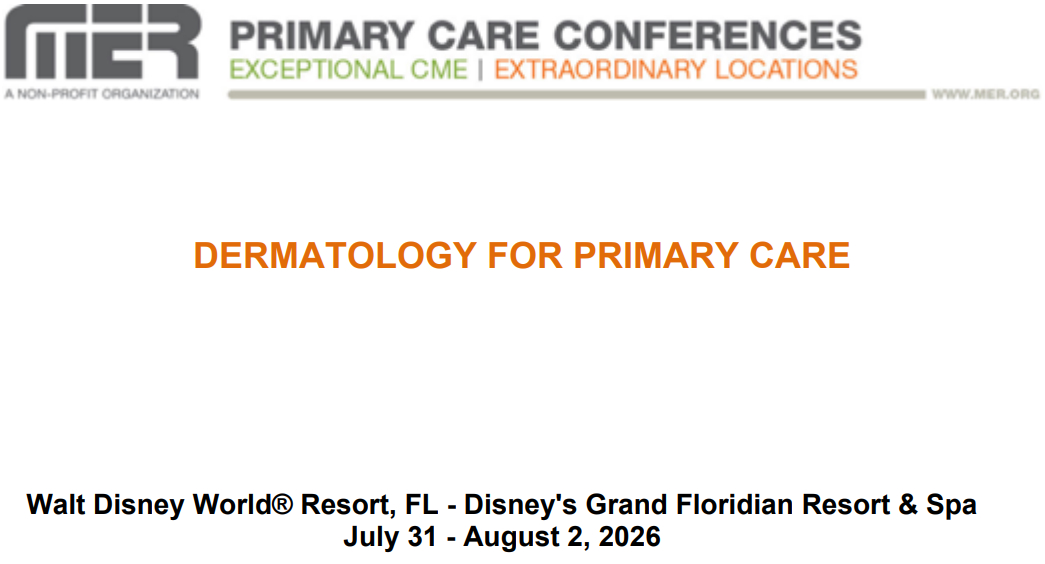
MER Primary Care Conferences Dermatology for Primary Care Jul 31 – Aug 02, 2026

$100.00
This Product is shared via google drive download link, So please share your correct Gmail id while placing the order .Please note that there are no CME points or certificate associated with this course Samples for Courses Can be found here : Free Samples Here!
EXPRESS DISCOVER PayPal
MER Primary Care Conferences Dermatology for Primary Care Jul 31 – Aug 02, 2026
Dermatology • Skin Infections • Skin Cancer • Office Procedures • Primary Care
July 31 – August 2, 2026 | Walt Disney World® Resort, Florida
Build practical confidence in recognizing, diagnosing, and managing common dermatologic conditions with MER Primary Care Conferences Dermatology for Primary Care Jul 31 – Aug 02, 2026.
Organized by Medical Education Resources (MER), the original Dermatology for Primary Care conference was held July 31 through August 2, 2026, at Disney’s Grand Floridian Resort & Spa at Walt Disney World® Resort, Florida. The official MER program provided a focused three-day review of dermatologic conditions commonly encountered by office-based primary care clinicians.
The curriculum combines recognition of common skin diseases with practical management strategies, including benign and malignant skin tumors, acne and acneiform eruptions, papulosquamous diseases, dermatitis, bacterial skin infections, fungal skin and nail infections, viral skin disease, and dermatologic office procedures.
The broader educational objectives also emphasize parasitic skin infections, cutaneous manifestations of systemic disease, skin cancer recognition, melanoma and pigmented lesions, and basic skin surgery applicable to primary care practice.
Course Details
- Course: Dermatology for Primary Care
- Provider: Medical Education Resources – MER
- Year: 2026
- Original Conference Dates: July 31 – August 2, 2026
- Duration: 3 Days
- Venue: Disney’s Grand Floridian Resort & Spa
- Location: Walt Disney World® Resort, Florida
- Primary Specialty: Dermatology
- Related Specialty: Primary Care
- Original MER Listing: 12 Credit Hours
- ANCC Pharmacotherapeutic Contact Hours: 5.00
- Primary Audience: Office-Based Primary Care Providers and Other Health Professionals
- Educational Focus: Practical Diagnosis and Management of Common Dermatologic Conditions
- Clinical Setting: Primary Care / Outpatient Medicine
MER’s current conference listing confirms the dates, venue, 12-credit format, and 5.00 ANCC pharmacotherapeutic contact hours.
Who Was the Original Program Designed For?
MER describes the primary target audience for its Primary Care Conferences as:
Office-based primary care providers and other health professionals seeking updates in primary care medicine.
This program is particularly relevant for:
- Primary Care Physicians
- Family Medicine Physicians
- Internal Medicine Physicians
- Dermatologists
- Emergency Medicine Physicians
- Nurse Practitioners
- Physician Associates / Physician Assistants
- Clinicians managing common dermatologic problems
- Healthcare professionals working in outpatient medicine
The strongest clinical audience remains:
Primary Care + Family Medicine + Internal Medicine + Dermatology
Learning Objectives
Upon completion of this program, participants should be better able to:
- Differentiate between the presentations and causes of atopic, contact (irritant and allergic), and nummular dermatitis.
- Discriminate the diagnostic principles and treatment options for papulosquamous diseases with red, raised bumps.
- Discriminate between various viral skin infections and treatment strategies.
- Compare the different treatment options for fungal skin infections and nail infections.
- Perform a differential diagnosis of common bacterial skin infections and recommend appropriate treatment.
- Identify cutaneous findings that serve as surrogates of internal diseases.
- Identify clinical presentations of various parasitic skin infections including scabies, lice, ticks, and bedbugs.
- Describe the step-wise approach for the diagnosis and treatment of acne and acneiform eruptions.
- Employ proper diagnostic principles to monitor and manage patients at risk for skin cancer.
- Detect pre-cancerous and cancerous skin lesions.
- Perform comprehensive and effective treatment of melanomas and other pigmented lesions.
- Review basic skin surgeries typically conducted in the primary care office.
DERMATOLOGY FOR PRIMARY CARE
Dermatologic problems are among the most frequent complaints encountered in outpatient medicine.
Primary care clinicians regularly evaluate patients with:
- Rashes
- Dermatitis
- Acne
- Skin infections
- Pigmented lesions
- Benign skin growths
- Suspicious lesions
- Nail abnormalities
- Skin manifestations of systemic disease
The goal of this MER program is to improve practical dermatologic recognition and help clinicians determine:
Recognize → Differentiate → Diagnose → Treat → Biopsy or Refer When Appropriate
Benign Skin Tumors
The official conference opened with Benign Skin Tumors.
MER’s agenda covers:
- Proper diagnosis of common benign tumors
- Treatment of common benign tumors
- Biopsies
- Histopathologic examination
- Nevi
- Seborrheic keratoses
- Keloids
- Hemangiomas
- Miscellaneous tumors
- Determining when referral is appropriate
This topic is particularly useful in primary care because benign lesions must often be distinguished from suspicious or malignant processes.
Benign vs. Malignant Skin Lesions
A fundamental dermatologic skill is distinguishing lesions that appear clinically benign from those requiring:
- Further examination
- Biopsy
- Histopathologic evaluation
- Dermatology consultation
- Definitive treatment
The program reinforces practical lesion recognition within the outpatient setting.
Premalignant & Malignant Skin Tumors
The second official session focuses on Premalignant and Malignant Skin Tumors.
Confirmed content includes:
- Recognition of precursors of malignancy
- Excisional biopsy
- Punch biopsy
- Actinic keratosis
- Bowen’s disease
- Squamous cell carcinoma
- Basal cell carcinoma
- Melanoma
- Other selected tumors
- Risk-reduction education
Skin Cancer Detection
Early recognition of potentially malignant lesions is a central responsibility in dermatologic primary care.
The learning objectives emphasize the ability to:
- Identify patients at risk for skin cancer
- Monitor high-risk patients
- Detect precancerous lesions
- Detect cancerous lesions
- Evaluate pigmented lesions
- Recognize possible melanoma
The clinical pathway is:
Identify Risk → Examine → Recognize Suspicious Features → Biopsy or Refer → Manage Appropriately
Actinic Keratosis
The official agenda specifically includes actinic keratosis among premalignant skin lesions.
Recognition is important because these lesions occur within the broader continuum of sun-related skin damage and require appropriate evaluation and management.
Bowen’s Disease
Bowen’s disease is also specifically included in the malignancy-focused session.
The program places it within the broader review of precancerous and malignant lesions relevant to office-based clinicians.
Basal Cell Carcinoma
The curriculum includes recognition of basal cell carcinoma, one of the malignant skin tumors primary care clinicians may encounter during routine examinations.
Squamous Cell Carcinoma
Squamous cell carcinoma is another confirmed malignancy covered in the official agenda.
Recognition and appropriate biopsy or referral decisions are emphasized within the broader skin-cancer curriculum.
Melanoma & Pigmented Lesions
The learning objectives specifically emphasize effective management of:
- Melanomas
- Pigmented lesions
The broader educational goal is to help clinicians distinguish benign pigmented findings from lesions that warrant more urgent evaluation.
Skin Surgery for Primary Care
A major practical component of the conference is:
Skin Surgery for Primary Care
The official agenda includes:
- Common office dermatology procedures
- Shave biopsy
- Punch biopsy
- Excisional biopsy
- Local anesthesia
- Cryosurgery
- Appropriate procedural setting
- Best-practice procedural techniques
Shave Biopsy
Shave biopsy is one of the specific techniques reviewed.
The course places it within a broader framework of selecting an appropriate biopsy technique according to the lesion being evaluated.
Punch Biopsy
Punch biopsy is also included among the office-based techniques covered.
Understanding appropriate biopsy selection can help clinicians obtain suitable diagnostic tissue while recognizing when a procedure should instead be performed by dermatology.
Excisional Biopsy
The program includes excisional biopsy in both its procedural and skin-tumor content.
This reinforces the connection between:
Lesion Assessment → Procedure Selection → Histopathology → Management
Local Anesthesia in Dermatologic Procedures
MER’s official agenda specifically includes instruction and best practices for local anesthesia as part of Skin Surgery for Primary Care.
This supports safer performance of appropriate office-based dermatologic procedures.
Cryosurgery
The procedural curriculum also reviews:
- Cryosurgery
- Appropriate indications
- Appropriate clinical setting
Cryotherapy represents a common procedure relevant to both primary care and dermatology practices.
Acne & Acneiform Eruptions
The official agenda includes a dedicated session:
Acne and Acneiform Eruptions
Confirmed areas include:
- Noninflammatory open comedones
- Closed comedones
- Inflammatory lesions
- Acne grading
- Treatment selection
- Bacterial folliculitis
- Drug-induced acne
- Hidradenitis suppurativa
- Miliaria
- Perioral dermatitis
- Pseudofolliculitis barbae
- Rosacea
- Seborrheic dermatitis
- Topical therapy
- Systemic therapy
Acne Diagnosis
An important goal is to distinguish different patterns of acne and acneiform eruptions.
Assessment may consider:
- Lesion morphology
- Inflammatory versus noninflammatory disease
- Distribution
- Severity
- Medication exposure
- Associated dermatologic findings
Acne Grading & Treatment
The official MER agenda specifically connects acne grading with treatment selection.
The clinical pathway can be summarized as:
Identify Lesion Type → Grade Severity → Select Therapy → Monitor Response
Hidradenitis Suppurativa
Hidradenitis suppurativa is included among the acneiform and inflammatory conditions addressed within this session.
Its recognition is important because its clinical course and management differ from conventional acne.
Rosacea
The official curriculum also includes rosacea, allowing clinicians to distinguish it from acne and other inflammatory facial eruptions.
Perioral Dermatitis
Perioral dermatitis is another confirmed acneiform condition included in the course agenda.
Papulosquamous Diseases
The first day also includes:
Papulosquamous Diseases
MER describes the session as focusing on diagnostic principles for skin lesions characterized by red or purple papules and scaly eruptions.
Confirmed conditions include:
- Psoriasis
- Lichen planus
- Pityriasis rosea
- Lupus erythematosus
The objective is practical differentiation of one scaly rash from another.
Psoriasis
Psoriasis represents one of the major papulosquamous disorders covered.
Clinicians must distinguish its characteristic presentation from other scaly inflammatory conditions.
Lichen Planus
The curriculum includes lichen planus, allowing comparison with other papulosquamous eruptions.
Pityriasis Rosea
Pityriasis rosea is also included in the confirmed official agenda.
Lupus Erythematosus
Cutaneous manifestations of lupus erythematosus are included within the papulosquamous differential.
This also illustrates the important relationship between dermatologic findings and systemic disease.
Dermatitis
The second day begins with a dedicated session on:
Dermatitis
Confirmed areas include:
- Contact dermatitis
- Atopic dermatitis
- Irritant dermatitis
- Nummular dermatitis
- Seborrheic dermatitis
- Exfoliative dermatitis
- Blistering
- Oozing
- Crusting
- Flaking
- Diagnostic principles
- Management strategies
Atopic Dermatitis
The learning objectives specifically emphasize differentiation of atopic dermatitis from other eczematous disorders.
Evaluation may include:
- Distribution
- Morphology
- Chronicity
- Associated atopy
- Symptoms
- Trigger patterns
Contact Dermatitis
The course addresses both:
- Irritant contact dermatitis
- Allergic contact dermatitis
An important clinical distinction is determining whether a skin reaction is caused by direct irritation or an allergic response.
Nummular Dermatitis
Nummular dermatitis is specifically included among the dermatitis patterns participants should be able to distinguish.
Seborrheic & Exfoliative Dermatitis
The official session also includes:
- Seborrheic dermatitis
- Exfoliative dermatitis
providing a broader review of inflammatory skin presentations seen in outpatient medicine.
Dermatology Cases
The official agenda includes multiple Dermatology Cases sessions involving challenging case presentations.
Case-based learning helps clinicians integrate:
Presentation → Morphology → Differential Diagnosis → Testing → Treatment → Referral
rather than reviewing dermatologic diseases only in isolation.
Bacterial Infections of the Skin
A dedicated session covers:
Bacterial Infections of the Skin
Confirmed conditions and concepts include:
- Impetigo
- Ecthyma
- Folliculitis
- Furunculosis
- Necrotizing fasciitis
- Lyme disease
- Syphilis
- Diagnosis
- Management
- Antibiotic-treatment guidelines
- Management of special populations
Impetigo
Impetigo is included as one of the common bacterial infections primary care clinicians should recognize and manage appropriately.
Folliculitis & Furunculosis
The program includes both:
- Folliculitis
- Furunculosis
within the broader bacterial differential.
Necrotizing Fasciitis
The inclusion of necrotizing fasciitis highlights the need to recognize potentially severe skin and soft-tissue infections requiring urgent escalation.
Lyme Disease & Syphilis
Both Lyme disease and syphilis appear in the bacterial skin-infection session, emphasizing that dermatologic findings can provide important clues to systemic infectious disease.
Fungal Infections of the Skin
The official program includes:
Fungal Infections of the Skin
Topics include:
- Dermatophytes
- Tinea versicolor
- Candidiasis
- Selected deep fungal infections
- Fungal diagnosis
- Management
- Antifungal treatment options
Nail Disorders & Fungal Nail Infection
The same session incorporates several nail-related problems, including:
- Onycholysis
- Drug-induced nail changes
- Paronychia
- Koilonychia
- Nail discoloration
- Nail tumors
alongside fungal infection diagnosis and treatment.
Antifungal Therapy
A specific learning objective is to compare treatment options for:
- Fungal skin infections
- Nail infections
The official agenda likewise includes an overview and comparison of antifungal treatment options.
Viral Infections of the Skin
The final day includes a dedicated session:
Viral Infections of the Skin
Confirmed content includes:
- Herpes simplex
- Varicella-zoster
- Viral exanthems
- Molluscum contagiosum
- Warts
- Post-herpetic neuralgia
- Symptom management
- Dermatology referral
Herpes Simplex
The program reviews recognition and differentiation of herpes simplex as part of the viral skin-infection curriculum.
Varicella-Zoster
Varicella-zoster is another confirmed viral disease discussed in the course.
The curriculum also addresses persistent post-herpetic neuralgia.
Molluscum & Warts
The viral dermatology section includes:
- Molluscum
- Warts
along with principles of diagnosis, symptom management, and appropriate referral.
Parasitic Skin Infections
The supplied learning objectives include recognition of several parasitic skin conditions:
- Scabies
- Lice
- Ticks
- Bedbugs
These conditions are also part of MER’s established Dermatology for Primary Care curriculum. MER’s dermatology program brochure lists Parasitic Infections of the Skin among the course’s dermatology topics.
Scabies
Recognition of scabies requires attention to characteristic symptoms, lesion distribution, exposure history, and household transmission.
Lice
The broader parasitic curriculum includes lice, another common outpatient dermatology presentation.
Ticks & Bedbugs
Tick- and bedbug-related skin findings are also included within the learning objectives for parasitic disease recognition.
These topics reinforce the importance of:
Exposure History + Morphology + Distribution + Associated Symptoms
in dermatologic diagnosis.
Skin Manifestations of Systemic Disease
One of the supplied learning objectives is to identify cutaneous findings that serve as surrogates of internal diseases.
This concept is an established component of MER’s Dermatology for Primary Care curriculum and is also listed in MER’s broader dermatology program topics.
Skin findings may sometimes provide the first indication of disease involving other organ systems.
Dermatology & Internal Medicine
The relationship between the skin and systemic disease illustrates why dermatologic knowledge is important for internists and family physicians.
The clinical framework is:
Skin Finding → Recognize Pattern → Consider Systemic Association → Evaluate Patient → Refer or Treat
Primary Care Dermatology
One of the major strengths of the program is its emphasis on practical office dermatology.
The curriculum combines:
Recognition
- Rashes
- Tumors
- Pigmented lesions
- Infections
- Acne
Diagnosis
- Morphology
- Differential diagnosis
- Clinical patterns
- Biopsy
Treatment
- Topical therapies
- Systemic therapies
- Antimicrobials
- Antifungals
Procedures
- Shave biopsy
- Punch biopsy
- Excision
- Cryosurgery
- Local anesthesia
Referral
- Suspicious lesions
- Complex disease
- Severe infection
- Potential malignancy
Major Topics Covered
- Dermatology
- Primary Care Dermatology
- Benign Skin Tumors
- Premalignant Skin Lesions
- Malignant Skin Tumors
- Skin Cancer
- Melanoma
- Pigmented Lesions
- Actinic Keratosis
- Bowen’s Disease
- Basal Cell Carcinoma
- Squamous Cell Carcinoma
- Acne
- Acneiform Eruptions
- Hidradenitis Suppurativa
- Rosacea
- Perioral Dermatitis
- Papulosquamous Diseases
- Psoriasis
- Lichen Planus
- Pityriasis Rosea
- Lupus Erythematosus
- Dermatitis
- Atopic Dermatitis
- Allergic Contact Dermatitis
- Irritant Contact Dermatitis
- Nummular Dermatitis
- Seborrheic Dermatitis
- Bacterial Skin Infections
- Impetigo
- Ecthyma
- Folliculitis
- Furunculosis
- Necrotizing Fasciitis
- Lyme Disease
- Syphilis
- Fungal Skin Infections
- Dermatophytes
- Tinea Versicolor
- Candidiasis
- Nail Disorders
- Viral Skin Infections
- Herpes Simplex
- Varicella-Zoster
- Viral Exanthems
- Molluscum
- Warts
- Parasitic Skin Infections
- Scabies
- Lice
- Ticks
- Bedbugs
- Skin Manifestations of Systemic Disease
- Dermatology Cases
- Skin Surgery
- Shave Biopsy
- Punch Biopsy
- Excisional Biopsy
- Local Anesthesia
- Cryosurgery
Who Should Take This Course?
MER Primary Care Conferences Dermatology for Primary Care Jul 31 – Aug 02, 2026 is particularly relevant for:
- Primary Care Physicians
- Family Medicine Physicians
- Internal Medicine Physicians
- Dermatologists
- Emergency Medicine Physicians
- Nurse Practitioners
- Physician Associates / Physician Assistants
- Clinicians performing office dermatologic procedures
- Healthcare professionals managing common skin disease
- Clinicians seeking a practical dermatology refresher
The strongest clinical audience remains:
Primary Care + Family Medicine + Internal Medicine + Dermatology
Why This Course Is Useful
MER Dermatology for Primary Care 2026 provides a focused review of dermatologic conditions that clinicians frequently encounter in everyday outpatient practice.
The curriculum connects several major areas:
Inflammatory Skin Disease
- Dermatitis
- Psoriasis
- Lichen planus
- Pityriasis rosea
- Acne
- Rosacea
Infectious Dermatology
- Bacterial infections
- Viral infections
- Fungal infections
- Parasitic infections
Skin Cancer
- Precancerous lesions
- Basal cell carcinoma
- Squamous cell carcinoma
- Melanoma
- Pigmented lesions
Office Dermatology
- Shave biopsy
- Punch biopsy
- Excision
- Local anesthesia
- Cryosurgery
Systemic Disease
- Cutaneous manifestations of internal illness
- Infectious disease manifestations
- Lupus-associated skin disease
Case-Based Learning
- Challenging dermatology cases
- Differential diagnosis
- Treatment selection
- Referral decisions
The overall clinical pathway can be summarized as:
Recognize → Differentiate → Diagnose → Treat → Perform Office Procedure or Refer When Appropriate
Original MER Credit & Accreditation Information
MER’s current listing for this specific conference shows:
12 Credit Hours
and:
5.00 ANCC Pharmacotherapeutic Contact Hours.
Medical Education Resources is jointly accredited by:
- Accreditation Council for Continuing Medical Education – ACCME
- Accreditation Council for Pharmacy Education – ACPE
- American Nurses Credentialing Center – ANCC
to provide continuing education for the healthcare team. MER’s accreditation information also covers eligible physician, nursing, physician associate, and pharmacist credit pathways for its live activities.
These credits and accreditations apply to eligible participation in the original MER educational activity and completion of the provider’s applicable requirements.
An independently distributed MedicalAmboss package should not automatically be represented as providing:
- MER CME Credit
- AMA PRA Category 1 Credits™
- ANCC Contact Hours
- ACPE Credit
- AAPA Credit
- ABIM MOC Points
- Official MER Certificate
- Official MER Account Access
unless official MER participation and credit-claiming eligibility are specifically included with the purchase.
Product Summary
- Product: MER Primary Care Conferences Dermatology for Primary Care Jul 31 – Aug 02, 2026
- Official Course: Dermatology for Primary Care
- Provider: Medical Education Resources – MER
- Year: 2026
- Conference Dates: July 31 – August 2, 2026
- Duration: 3 Days
- Venue: Disney’s Grand Floridian Resort & Spa
- Location: Walt Disney World® Resort, Florida
- Original MER Listing: 12 Credit Hours
- ANCC Pharmacotherapeutic Contact Hours: 5.00
- Primary Specialty: Dermatology
- Related Specialty: Primary Care
- Primary Audience: Office-Based Primary Care Providers and Other Health Professionals
- Major Areas: Skin Tumors, Skin Cancer, Acne, Papulosquamous Disease, Dermatitis, Bacterial/Fungal/Viral Skin Infections, and Office Skin Surgery
Short Description
MER Primary Care Conferences Dermatology for Primary Care Jul 31 – Aug 02, 2026 is a focused three-day dermatology program for primary care clinicians held at Disney’s Grand Floridian Resort & Spa, Walt Disney World® Resort, Florida.
The course covers benign and malignant skin tumors, melanoma and skin cancer detection, acne and acneiform eruptions, papulosquamous diseases, dermatitis, bacterial, fungal and viral skin infections, challenging dermatology cases, and office-based skin procedures including shave biopsy, punch biopsy, excision, local anesthesia, and cryosurgery.
Topics
Friday, July 31, 2026
- Benign Skin Tumors: Proper diagnosis and treatment of common benign tumors; biopsies and histopathologic examination; nevi, seborrheic keratosis, keloids, hemangiomas and miscellaneous tumors; when to refer.
- Premalignant and Malignant Skin Tumors: Recognition of precursors of malignancies; excisional and punch biopsies; actinic keratosis, Bowen’s disease, squamous cell carcinoma, basal cell carcinoma, melanoma and other selected tumors; risk-reduction education.
- Skin Surgery for Primary Care: Techniques and procedures for common office dermatology procedures; shave, punch, and excisional biopsy techniques; local anesthesia; cryosurgery.
- Acne and Acneiform Eruptions: Open and closed comedones; inflammatory lesions; acne grading; bacterial folliculitis; drug-induced acne; hidradenitis suppurativa; miliaria; perioral dermatitis; pseudofolliculitis barbae; rosacea; seborrheic dermatitis; topical and systemic therapy.
- Papulosquamous Diseases: Diagnostic principles for red or purple papular and scaly lesions; psoriasis; lichen planus; pityriasis rosea; lupus erythematosus; differentiation of common scaly rashes.
Saturday, August 1, 2026
- Dermatitis: Contact, atopic, irritant, nummular, seborrheic and exfoliative dermatitis; blistering, oozing, crusting and flaking; diagnostic principles and management.
- Dermatology Cases: Challenging case presentations in dermatology.
- Dermatology Cases: Additional challenging case presentations in dermatology.
- Bacterial Infections of the Skin: Impetigo, ecthyma, folliculitis, furunculosis, necrotizing fasciitis, Lyme disease and syphilis; diagnosis, management, antibiotic-treatment guidelines and special populations.
- Fungal Infections of the Skin: Dermatophytes, tinea versicolor, candidiasis, selected deep fungal infections, nail disorders, fungal diagnosis and management, and comparison of antifungal treatments.
Sunday, August 2, 2026
- Viral Infections of the Skin: Herpes simplex, varicella-zoster, viral exanthems, molluscum and warts; post-herpetic neuralgia; symptom management and dermatology referral.
- Dermatology Cases: Challenging case presentations in dermatology.
Friday, July 31, 2026
-
Dermatitis: Overview of the causes and forms of skin irritants; Contact, atopic, irritant, nummular, seborrheic and exfoliative; Treatment of blistering, oozing, crusting and flaking; Diagnostic principles and management strategies.
-
Papulosquamous Diseases: Diagnostic principles of skin lesions consisting of red or purple papules; Psoriasis, lichen planus, pityriasis rosea, lupus erythematosus; Discussion of how to tell one scaly rash from another.
-
Viral Infections of the Skin: Proper diagnosis and differences in viral skin presentation; Herpes simplex, varicella-zoster, viral exanthems; Molluscum and warts; Treating lasting post-herpetic neuralgia; Symptom management and referral to dermatology.
-
Bacterial Infections of the Skin: Impetigo, ecthyma, folliculitis, furunculosis, necrotizing fasciitis, Lyme disease, syphilis; diagnosis and management; Guidelines for antibiotic treatment; Management of special populations.
-
Skin Manifestations of Systemic Disease: Skin will often reflect signs of systemic diseases, be useful for diagnosis, or suffer from a complication of disease or its treatment; Diagnosis of rheumatologic, endocrine, gastrointestinal, and psychologic conditions based on cutaneous findings.
Saturday, August 1, 2026
-
Parasitic Infections of the Skin: Clinical presentations of various parasitic skin infections including scabies, lice, ticks, and bedbugs; Principles of treatment.
-
Acne and Acneiform Eruptions: Identification of noninflammatory open or closed comedones and inflammatory lesions; Determination of treatment therapies based on acne grading scale; Bacterial folliculitis, drug-induced acne, hidradenitis suppurativa, miliaria, perioral dermatitis, pseudofolliculitis barbae, rosacea, seborrheic dermatitis; Topical and systemic therapy.
-
Fungal Infections of the Skin: Dermatophytes, tinea versicolor, candidiasis; Selected deep fungal infections; Onycholysis; Drug induced nail changes; paronychia, koilonychia, nail discolorations, tumors of the nail; Fungal infections diagnosis and management; Overview and comparison of antifungal treatment options.
-
Diagnosis and Management of Patients at High Risk for Skin Cancer: Actinic Keratosis recognition and need for treatment; Field therapies for actinic keratosis; Basal cell carcinoma: Different types and their appearance; Squamous cell carcinoma: Different types and their appearance.
-
Premalignant, Basal, and Squamous Cell Skin Cancers: Recognition of precursors of malignancies; Excisional and punch biopsies; Actinic keratosis, Bowen’s disease, squamous cell carcinoma, basal cell carcinoma, melanoma and other selected tumors; Risk reduction education.
Sunday, August 2, 2026
-
Diagnosis and Management of Pigmented Lesions and Melanoma: Development and appearance of benign nevi; “Dysplastic Nevus Syndrome” controversies; Malignant Melanoma developing de novo; Diagnosis of Lentigo Maligna type of superficial malignant melanoma.
-
Skin Surgery for Primary Care: Techniques and procedures to perform common dermatology procedures in the office setting; Biopsy techniques for shave, punch, and excision; Instruction and best practices for local anesthesia; Overview and proper setting for cryosurgery.
Related products
Dermatology
Dermatology

- Anesthesiology & pain medicine
- Books
- Anesthesiology books
- Basic science
- Cardiology books
- Dermatology books
- DENTAL BOOKS
- Endocrine and Nutrition books
- Gastroenterology and Hepatology books
- Hematology / Oncology books
- INTERNAL MEDICINE BOOKS
- Nephrology / urology books
- Neurology / neurosurgery books
- Obstetrics and gynecology books
- ophthalmology / Optometry books
- ORTHOPEDIATRICS BOOKS
- Pathology books
- pediatric books
- plastic surgery books
- Psychiatric books
- PULMONARY BOOKS
- Qbank & Questions
- Radiology books
- Cardiology
- Critical Care – Emergency medicine
- DENTAL
- Dermatology
- Endocrine and Nutrition
- ENT / Otolaryngology
- Family medicine
- General Surgery
- GIT COURSES
- Hematology / Oncology
- Internal Medicine
- Medical Accounts
- Nephrology / Urology
- Neurology / neurosurgery courses
- Obstetrics & Gynecology
- Ophthalmology & Optometry
- Orthopaedic
- Pathology
- Pediatrics
- physiotherapy
- Plastic Surgery
- psychology
- Qbank & Questions
- Radiology
- Respiratory / Pulmonary
- Rheumatology
- Surgery