
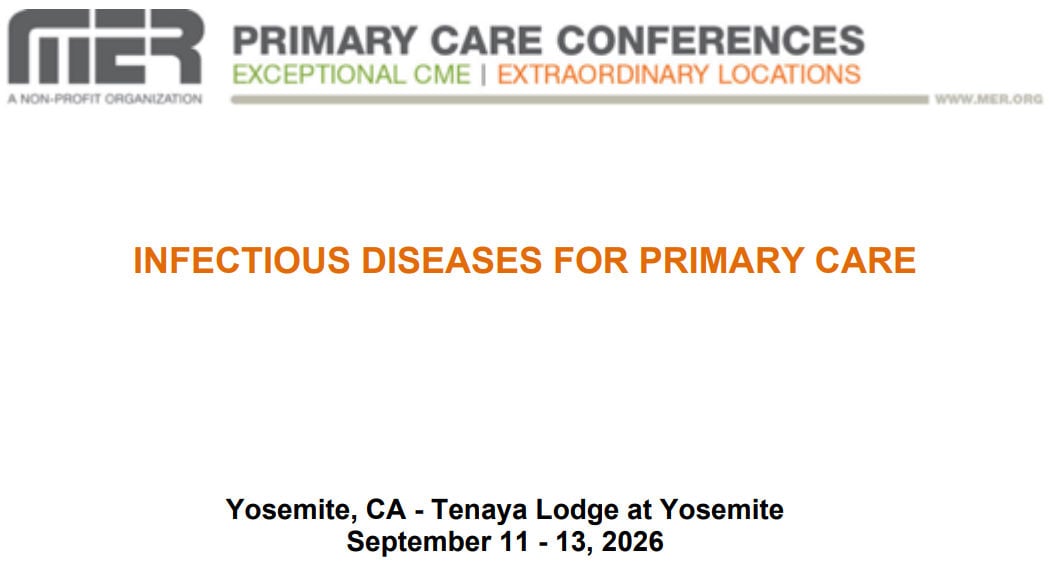
MER Primary Care Conferences Infectious Diseases for Primary Care Sep 11-13, 2026
$100.00
This Product is shared via google drive download link, So please share your correct Gmail id while placing the order .Please note that there are no CME points or certificate associated with this course Samples for Courses Can be found here : Free Samples Here!
MER Primary Care Conferences Infectious Diseases for Primary Care Sep 11-13, 2026
Infectious Diseases for Primary Care • Clinical Infection Management • Immunizations • Antimicrobial Stewardship • Emerging Infections • Primary Care Education
MER Primary Care Conferences Infectious Diseases for Primary Care Sep 11-13, 2026 provides a clinically focused review of infectious disease diagnosis, prevention, and management for primary care practice. Organized by Medical Education Resources (MER), the original three-day conference was scheduled for September 11–13, 2026, at Tenaya Lodge at Yosemite, California. MER
The program addresses both common infections encountered in ambulatory medicine and more complex presentations requiring careful diagnostic evaluation. Its scope extends from bone and joint infections, immunizations, and respiratory illness to healthcare-associated infections, antimicrobial resistance, and infections in patients with specific risk factors.
Through case-based discussions and evidence-based guideline reviews, the course is designed to strengthen clinical reasoning, support appropriate treatment selection, and improve recognition of potentially serious infectious disease presentations.
Course Details
| Detail | Information |
|---|---|
| Product Title | MER Primary Care Conferences Infectious Diseases for Primary Care Sep 11-13, 2026 |
| Official Conference Name | Infectious Diseases for Primary Care |
| Original Organizer | Medical Education Resources — MER |
| Conference Dates | September 11–13, 2026 |
| Original Program Duration | Three days |
| Conference Venue | Tenaya Lodge at Yosemite |
| Location | Yosemite, California, United States |
| Clinical Focus | Infectious diseases in primary care and ambulatory practice |
| Educational Approach | Clinical updates, case-based discussions, and evidence-based guideline reviews |
| MedicalAmboss Delivery | Google Drive download link |
| CME Points or Certificate with This Product | Not included |
The conference identity, dates, and venue are confirmed in MER’s official listing. Delivery and product-specific certification information are taken from the existing MedicalAmboss draft. MER
Target Audience
This program is targeted to office-based primary care providers and other health professionals seeking updates in primary care medicine.
It is particularly relevant to Primary Care Physicians, Infectious Disease Specialists, and General Practitioners who want a structured review of infectious disease presentations, diagnostic approaches, preventive strategies, and treatment considerations.
Program Overview
The curriculum combines an organ-system approach to infection with broader themes in prevention, antimicrobial prescribing, and patient-specific risk assessment.
Participants review musculoskeletal, respiratory, gastrointestinal, genitourinary, skin and soft tissue, and central nervous system infections. Complementary topics address immunizations, emerging pathogens, outpatient infectious disease emergencies, healthcare-associated infections, and antimicrobial stewardship.
The program also considers how clinical evaluation changes in special patient populations, including people with diabetes, patients with HIV/AIDS, and pregnant patients. The stated learning objectives additionally address evaluation strategies for infections in immunocompromised hosts.
Learning Objectives
Upon completion of this program, participants should be better able to:
- Recognize risk factors, diagnostic indicators and clinical features for osteomyelitis and joint infections.
- Recommend appropriate immunizations based on patient specific risk factors.
- Discuss the approach to a febrile patients with potentially life-threatening diseases in both hospital and clinic-associated settings.
- Diagnose and manage genitourinary infections.
- Discuss emerging infectious diseases including resurgence of vaccine-preventable diseases, zoonoses, and diseases related to animal exposures.
- Evaluate the severity of diarrhea and evaluate the need for treatment.
- List common causative pathogens for various respiratory tract infections.
- Review epidemiology and microbiology of skin and soft tissue infections (SSTI).
- Identify patients at risk for healthcare-associated infections.
- Describe the epidemiology, diagnosis and treatment of common CNS infectious disease syndromes.
- List goals of an antimicrobial stewardship program and strategies for antimicrobial treatment.
- Describe evaluation strategies for infections in immunocompromised hosts.
Program Topics
The following topic coverage is drawn from the Topics section of MedicalAmboss draft #48559. It is presented in the listing’s original order, without unverified speaker assignments or session times.
1. Bone and Joint Infections
Review the major syndromes and causative pathogens associated with bone and joint infections, including osteomyelitis, septic arthritis, bursitis, and prosthetic joint infections.
The topic integrates clinical presentation with practical diagnostic, therapeutic, and preventive considerations, emphasizing the recognition and management of important musculoskeletal infections.
2. Immunizations
Explore key vaccine-preventable diseases and their clinical presentations, alongside the immunization recommendations reviewed in the program.
Coverage includes vaccination schedules, vaccine safety, and efficacy information, with an emphasis on relating preventive care to individual patient risk factors.
3. Ambulatory Care Infectious Disease Emergencies
Examine potentially urgent infectious disease presentations through case-based, interactive discussion.
The focus is on diagnostic reasoning and management strategies for outpatient cases that may represent serious infection, helping clinicians distinguish routine presentations from situations requiring a more urgent response.
4. Emerging Infectious Diseases
Review emerging and re-emerging infectious threats, including novel influenza viruses, the resurgence of vaccine-preventable diseases, zoonoses, and infections associated with animal exposure.
Additional coverage includes vector-associated illnesses involving mosquitoes, such as West Nile virus and dengue, together with bioterrorism-related infectious threats and foodborne or waterborne illness.
5. Gastrointestinal Infections & Clostridioides difficile
Review important enteric pathogens and the clinical approaches used to recognize, diagnose, and manage gastrointestinal infections.
Particular attention is given to Clostridioides difficile colitis, including relevant developments discussed in the infectious disease and infection-control literature. The associated learning objective addresses assessment of diarrhea severity and the need for treatment.
6. Respiratory Tract Infections
Examine clinically important aspects of diagnosing and managing pneumonia and bronchitis.
The topic emphasizes causative pathogens and the implications of multidrug resistance, connecting respiratory infection assessment with broader antimicrobial treatment considerations.
7. Skin & Soft Tissue Infections
Review important skin and soft tissue infections, with an emphasis on timely recognition.
Coverage incorporates evaluation and management strategies, supported by the program’s objective of reviewing the epidemiology and microbiology of skin and soft tissue infections (SSTI).
8. Genitourinary Infections
Develop a practical approach to patients presenting with genitourinary complaints.
The topic reviews the spectrum of urinary tract infections, relevant guideline-based management discussed in the program, and selected clinically important sexually transmitted disease syndromes.
9. Healthcare-Associated Infections
Review important pathogens encountered in healthcare settings and their associated clinical, epidemiological, and infection-control considerations.
The topic also addresses recognition of patients at risk for healthcare-associated infection.
Training limitation: The listed discussion of blood-borne pathogens does not satisfy standard hospital CME requirements for blood-borne pathogen training.
10. Central Nervous System Infections
Review common central nervous system infectious disease presentations and syndromes.
Coverage includes foundational epidemiology, diagnostic approaches, and treatment strategies, supporting the recognition and assessment of infectious conditions involving the CNS.
11. Antimicrobial Stewardship and Multidrug Resistance
Explore the definition and core concepts of an antimicrobial stewardship program (ASP).
The topic includes the four goals of antimicrobial stewardship and reviews newer additions to the antimicrobial treatment options discussed in the program. It connects responsible prescribing with the clinical challenges posed by multidrug-resistant pathogens.
12. Infectious Diseases in the Special Host
Apply case-based clinical reasoning to infectious disease syndromes in three specifically identified patient groups: patients with diabetes, patients with HIV/AIDS, and pregnant patients.
The discussion emphasizes how the patient’s underlying condition or physiological context influences the evaluation and management of infection.
Major Topics Covered
Prevention and recognition: Immunizations, vaccine-preventable disease, emerging infections, zoonoses, animal and vector exposures, and potentially serious ambulatory infectious disease presentations.
System-based infection management: Bone and joint infections, gastrointestinal infections and C. difficile, respiratory tract infections, skin and soft tissue infections, genitourinary infections, and CNS infections.
Treatment and patient-specific considerations: Antimicrobial stewardship, multidrug resistance, healthcare-associated infection, evaluation of immunocompromised hosts, and infection management in patients with diabetes, HIV/AIDS, or pregnancy.
Why This Course Is Relevant
For clinicians seeking an infectious diseases review for primary care, this program brings together common outpatient presentations and more complex infectious disease problems within a single curriculum.
Its educational value lies in connecting several practical questions: Which clinical features suggest infection? Which patient-specific risks matter? How should diagnostic evaluation be approached? When is antimicrobial treatment appropriate? How do prevention and stewardship fit into the overall management plan?
The combination of system-based topics, case discussions, and special-host considerations makes the program relevant to clinicians reviewing infectious disease knowledge for everyday primary care practice.
Original Conference Accreditation
MER’s official listing identifies the original live conference as a 12-credit-hour activity, including 6.25 ANCC pharmacotherapeutic contact hours. These designations describe the original MER conference, not the MedicalAmboss product. MER
The MedicalAmboss product does not include CME points or a certificate. Purchasing the educational materials should not be presented as registration for the original live activity.
Product and Delivery Information
The MedicalAmboss product is delivered through a Google Drive download link. Please provide the correct Gmail address during checkout so the materials can be shared with the intended account.
The existing listing does not specify a verified file count, recording duration, or complete file-format inventory. The conference topic outline describes the educational curriculum and should not be treated as a file-by-file inventory of the delivered package.
Related Learning on MedicalAmboss
Continue your clinical review through the Internal Medicine collection, or explore the Family Medicine collection for additional primary care learning resources. Medical Amboss
Short Description
<div style="border:2px solid #1677b8;border-left:6px solid #1677b8;border-radius:10px;padding:16px;background:#f7fbfe;color:#17324d;line-height:1.65;">
  <p style="margin:0 0 12px;">
    <strong>MER Primary Care Conferences Infectious Diseases for Primary Care Sep 11-13, 2026</strong>
    reviews infectious disease diagnosis, prevention, and management for primary care clinicians.
    Topics include bone and joint infections, immunizations, respiratory and gastrointestinal
    infections, skin and soft tissue infections, genitourinary and CNS infections,
    emerging pathogens, antimicrobial stewardship, and infections in special patient populations.
  </p>
  <p style="margin:0 0 12px;">
    <strong>Best for:</strong> Primary Care Physicians, Infectious Disease Specialists,
    and General Practitioners.
  </p>
  <p style="margin:0;">
    <strong>MedicalAmboss delivery:</strong> Google Drive download link.
    Please provide your correct Gmail address at checkout.
    <strong>No CME points or certificate are included.</strong>
  </p>
</div>
Topics
-
Bone and Joint Infections: Presentation on the most important syndromes and pathogens involved in bone and joint infections – e.g., osteomyelitis, septic arthritis, bursitis, prosthetic joint infections and others – including related diagnostic, therapeutic and prevention pearls.
-
Immunizations: Presentation on key vaccine preventable diseases and their presentations with an emphasis on the latest recommendations including newest schedules, safety and efficacy information.
-
Ambulatory Care Infectious Disease Emergencies: Case-based interactive discussion around exemplary cases that addresses key diagnostic and management strategies for potentially emergent outpatient infectious disease challenges.
-
Emerging Infectious Diseases: Novel influenza viruses, resurgence of vaccine-preventable diseases, zoonoses and disease related to animal exposures (including vectors such as mosquitoes that bear west Nile virus and dengue), bioterrorism and food/waterborne illness.
-
Gastrointestinal Infections & Clostridiodes Difficile: Presentation on important enteric pathogens and their recognition, diagnosis and management; special emphasis on clostridiodes difficile colitis and related updates from the ID and infection control literature.
-
Respiratory Tract Infections: Discussion highlighting critical points regarding the diagnosis and management of pneumonia and bronchitis – with a focus on the impact of multidrug resistant pathogens.
-
Skin & Soft Tissue Infections: Presentation on important skin and soft-tissue infections and their prompt recognition, emphasizing evaluation and management strategies.
-
Genitourinary Infections: Presentation on a relevant and clinically practical approach to the patient with genitourinary complaints focusing on the latest guidelines for the range of urinary tract infections and highlights of selected and important sexually-transmitted disease syndromes.
-
Healthcare-Associated Infections: Presentation on important pathogens in the healthcare setting and related clinical, epidemiologic and infection control information (please note that the discussion on blood-borne pathogens will NOT suffice for standard hospital CME requirements for BBP training).
-
Central Nervous System Infections: Presentation on common CNS infectious disease presentation and syndromes including basic epidemiology, diagnosis and treatment strategies.
-
Antimicrobial Stewardship and Multidrug Resistance: Definition of an antimicrobial stewardship program (ASP); Concepts of the antimicrobial stewardship program; Four goals of antimicrobial stewardship; Most recent additions to the antimicrobial armamentarium.
-
Infectious Diseases in the Special Host: Case-based interactive discussion involving important infectious disease syndromes in three special hosts: the diabetic patient, the HIV/AIDS patient and the pregnant woman.
Related products

Critical Care - Emergency medicine

Internal Medicine
Critical Care - Emergency medicine

Critical Care - Emergency medicine
Critical Care - Emergency medicine
Medical Accounts
Critical Care - Emergency medicine
International Symposium on Intensive Care & Emergency Medicine ( ISICEM ) 2020
Critical Care - Emergency medicine
The Brigham Board Review in Infectious Diseases Brigham and Women’s Hospital Board Review