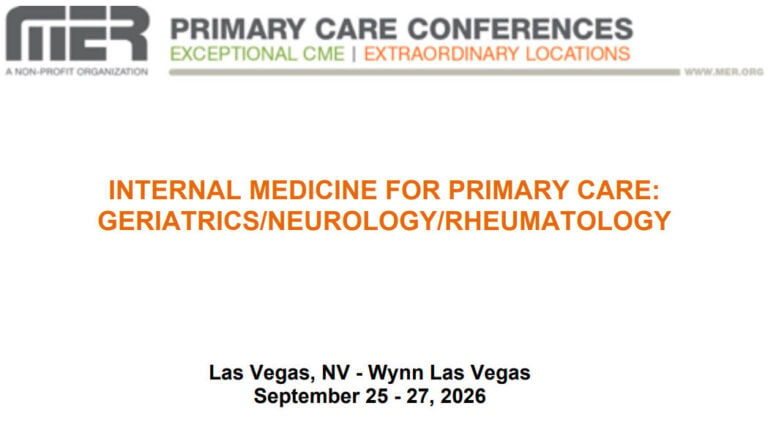
MER Primary Care Conferences Internal Medicine for Primary Care Geri Neuro Rheum Sep 25-27, 2026
$100.00
Review geriatrics, neurology and rheumatology topics from the September 25–27, 2026 primary care conference.
Delivery Information: This Product is shared via google drive download link. Please use your correct Gmail address at checkout.
Please note: there are no CME points or certificate associated with this course.
Samples for Courses Can be found here: Free Samples Here!
MER Geriatrics Neurology Rheumatology 2026 is a digital study resource associated with the MER Internal Medicine for Primary Care conference. Review geriatrics, neurology and rheumatology topics from the September 25–27, 2026 primary care conference. This purchase is not conference registration and does not include a MER account, CME credit or a certificate.
Organized by Medical Education Resources (MER) and held at the Wynn Las Vegas, the conference emphasizes practical diagnostic strategies, case-based decision-making, and treatment approaches that can be applied directly in outpatient and primary care settings.
Course Details
Course: MER Primary Care Conferences Internal Medicine for Primary Care Geri Neuro Rheum Sep 25-27, 2026
Program: Internal Medicine for Primary Care: Geriatrics/Neurology/Rheumatology
Dates: September 25–27, 2026
Organizer: Medical Education Resources (MER)
Location: Wynn Las Vegas
Focus: Internal Medicine, Primary Care, Geriatrics, Neurology, Rheumatology, Heart Failure, Hypertension, Cerebrovascular Disease, Arthritis, Gout, Fibromyalgia, and Alzheimer’s Disease
Target Audience
This educational program is targeted to office-based primary care providers and other healthcare professionals seeking current updates in primary care medicine.
It is especially relevant for:
- Internists
- Family Medicine Physicians
- Primary Care Physicians
- Neurologists
- Rheumatologists
- Geriatricians
- Cardiologists
- Other healthcare professionals involved in the care of adults and older patients
Program Overview
Internal Medicine for Primary Care: Geriatrics/Neurology/Rheumatology provides a practical review of important clinical conditions that commonly overlap across primary care, neurology, rheumatology, cardiology, and geriatric medicine.
Through concise lectures, case studies, and interactive discussions, participants will examine evidence-based approaches to:
- Clinical assessment of weakness
- Alzheimer’s disease
- Migraine headaches
- Cerebrovascular disease
- Inflammatory and non-inflammatory joint pain
- Arthritis pharmacotherapy
- Gout and pseudogout
- Fibromyalgia
- Heart failure
- Hypertension
- Cardiovascular management in older adults
The course emphasizes clinical differentiation, appropriate workup, treatment selection, and practical application of current evidence.
Neurologic Symptom Assessment
Neurologic complaints are common in primary care and may range from benign symptoms to manifestations of serious neurologic disease.
The conference reviews a structured approach to assessing patients with weakness and other neurologic symptoms.
Participants will focus on the role of:
- Clinical history
- Physical examination
- Symptom characterization
- Neurologic localization
- Differential diagnosis
- Appropriate management pathways
A key objective is helping clinicians distinguish true weakness from non-specific symptoms that may require a different diagnostic approach.
Alzheimer’s Disease
Cognitive decline and dementia represent major challenges in the care of older adults.
The program reviews evidence-based management options for Alzheimer’s disease, helping clinicians understand current therapeutic approaches and practical considerations in longitudinal patient care.
Discussion focuses on integrating available treatments with broader clinical management of patients experiencing progressive cognitive impairment.
Migraine Headaches
Migraine is a common neurologic disorder frequently managed in primary care.
The conference reviews:
- Differential diagnosis of headache disorders
- Recognition of migraine presentations
- Treatment options
- Clinical decision-making
- Long-term management strategies
Participants will strengthen their ability to distinguish migraine from alternative causes of headache and select appropriate evidence-based treatment approaches.
Cerebrovascular Disorders
Stroke and other cerebrovascular conditions are important causes of morbidity and mortality.
The program addresses both prevention and treatment strategies for cerebrovascular disease.
Topics emphasize:
- Risk assessment
- Primary prevention
- Secondary prevention
- Recognition of cerebrovascular disease
- Evidence-based treatment strategies
- Long-term management
The objective is to help clinicians incorporate cerebrovascular prevention and management into routine primary care.
Rheumatology and Joint Pain
Musculoskeletal and joint complaints are among the most common reasons for outpatient medical visits.
The rheumatology component focuses on distinguishing inflammatory and non-inflammatory joint pain and developing appropriate differential diagnoses.
Participants will review clinical approaches to:
- Arthritis
- Inflammatory joint disease
- Non-inflammatory joint pain
- Crystal arthropathies
- Chronic musculoskeletal pain
This framework supports more accurate diagnosis and appropriate selection of treatment or specialist referral.
Arthritis Pharmacotherapy
The conference reviews major medication classes used in the management of arthritis.
Treatment options include:
- Non-selective NSAIDs
- COX-2 inhibitors
- Disease-modifying antirheumatic drugs (DMARDs)
- Narcotics
- Tramadol
Participants will compare the potential benefits and risks of these therapies and consider how patient-specific factors influence treatment decisions.
Gout and Pseudogout
Crystal arthropathies can present with acute and severe joint inflammation.
The course addresses practical approaches to the diagnosis and treatment of:
- Gout
- Pseudogout
Participants will review how to differentiate these conditions from other causes of acute arthritis and select appropriate treatment strategies.
Fibromyalgia
Fibromyalgia frequently requires individualized, multidisciplinary management.
The program reviews pharmacologic treatment options and compares their:
- Potential clinical benefits
- Side effect profiles
- Appropriate roles in patient management
The goal is to help clinicians select therapies based on patient symptoms, comorbidities, and treatment tolerance.
Heart Failure in Older Adults
Heart failure is a major cause of morbidity, hospitalization, and mortality, particularly among older adults.
The course reviews evidence-based assessment and management of both:
- Heart failure with reduced ejection fraction (HFrEF)
- Heart failure with preserved ejection fraction (HFpEF)
Participants will examine treatment planning in collaboration with cardiology and consider how guideline-based therapy can be incorporated into primary care practice.
Case-Based Heart Failure Management
Case-based learning is used to reinforce clinical decision-making in heart failure.
Participants will apply evidence-based concepts to realistic patient scenarios involving:
- Diagnosis
- Medication selection
- Disease monitoring
- Comorbidities
- Coordination with cardiology
- Long-term management
This practical approach is intended to help clinicians translate current heart failure treatment recommendations into everyday practice.
Hypertension in Younger and Older Adults
Hypertension management requires individualized assessment based on age, cardiovascular risk, comorbidities, and potential treatment-related adverse effects.
The conference reviews:
- Evaluation of hypertension
- Differences between younger and older adults
- Cardiovascular risk
- Treatment goals
- Pharmacologic intervention
- Non-pharmacologic management
- Appropriate individualized treatment strategies
Special attention is given to balancing blood pressure control with safety considerations in older adults.
Case-Based Hypertension Management
Interactive discussion and case-based learning reinforce practical hypertension treatment strategies.
Participants will explore common clinical scenarios and consider how to:
- Select appropriate treatment targets
- Choose interventions
- Adjust medication regimens
- Manage comorbidities
- Apply evidence-based recommendations
Original conference agenda
The topics below match the MER agenda dated June 10, 2026. They describe the original program, not a verified inventory of delivered files; file count, formats and completeness have not been independently checked.
-
Friday, September 25, 2026
-
Neurology: Evaluating Weakness (Using history and physical examination to distinguish weakness from non-specific symptoms; characteristics of neurological diseases that produce weakness; presentations of representative diseases of the nervous system)
-
Neurology: Alzheimer’s & Other Dementias (Definition; statistics; neurological changes of normal aging; pathology; etiological theories; vascular dementias; investigations; social issues; symptomatic treatment; research therapies)
-
Neurology: Headaches & Migraines (Basic headache mechanisms; headache history: characteristics, precipitating factors, medical conditions; migraine: common tension, classic, treatment, complicated, cluster, sinus; trigeminal neuralgia; Giant Cell Arteritis; brain tumor; subarachnoid hemorrhage; emergency room treatment)
-
Rheumatology: Evaluating the Patient with Joint Pain (Differentiating between inflammatory and non-inflammatory joint pain; the utility of joint aspiration and lab work-up with interpretation of synovial fluid analysis; differential diagnosis of joint pain and inflammatory arthritis)
-
Rheumatology: Update in Pharmacology for Arthritis (Review risks and benefits of traditional NSAIDs and COX-2 inhibitors; analgesics [narcotics and tramadol], acetaminophen, conventional-synthetic DMARDs, and bDMARDs)
-
-
Saturday, September 26, 2026
-
Rheumatology: Crystal Disease: Gout & Pseudogout (Properly diagnosing and treating crystal diseases such as gout and pseudogout)
-
Rheumatology: Fibromyalgia (Differential diagnosis and treatment of this difficult-to-manage pain syndrome; treatment options of anti-epileptics and SNRIs)
-
Neurology: Cerebrovascular Disorders (Epidemiology; identifying the high-risk patient; treatment effects; transient neurological deficit: carotid, vertebrobasilar; non-specific cerebral symptoms; migraines vs. TIA; treatment options)
-
Geriatrics: Heart Failure in Older Adults (Recognition of the high mortality associated with heart failure; understanding how to diagnose heart failure and the difference between reduced ejection fraction and preserved ejection fraction heart failure; evidence-based treatments available for heart failure)
-
Geriatrics: Heart Failure Discussion and Q&A (Interactive review of the principles of heart failure diagnosis and treatment in older adults, and audience questions further clarifying the topic)
-
-
Sunday, September 27, 2026
-
Geriatrics: Controversies in the Management of Hypertension in Older Adults (Best evidence for treatment goals for hypertension in diabetics and those with previous stroke; controversial evidence for the various guidelines for diagnosing and treating hypertension in older adults; best evidence-based medications for hypertension)
-
Geriatrics: Hypertension Discussion and Q&A (Interactive review of the principles of hypertension diagnosis and treatment in older adults, and audience questions further clarifying the topic)
-
MER original conference agenda documents the source program. Accreditation and live participation benefits apply to the original activity, not this file purchase.
Related products

Critical Care - Emergency medicine
ASN Critical Care Nephrology – 2022 Update (On-Demand and Livestream)

Internal Medicine
Internal Medicine
Cardiology

Critical Care - Emergency medicine

Internal Medicine
Medical Accounts