
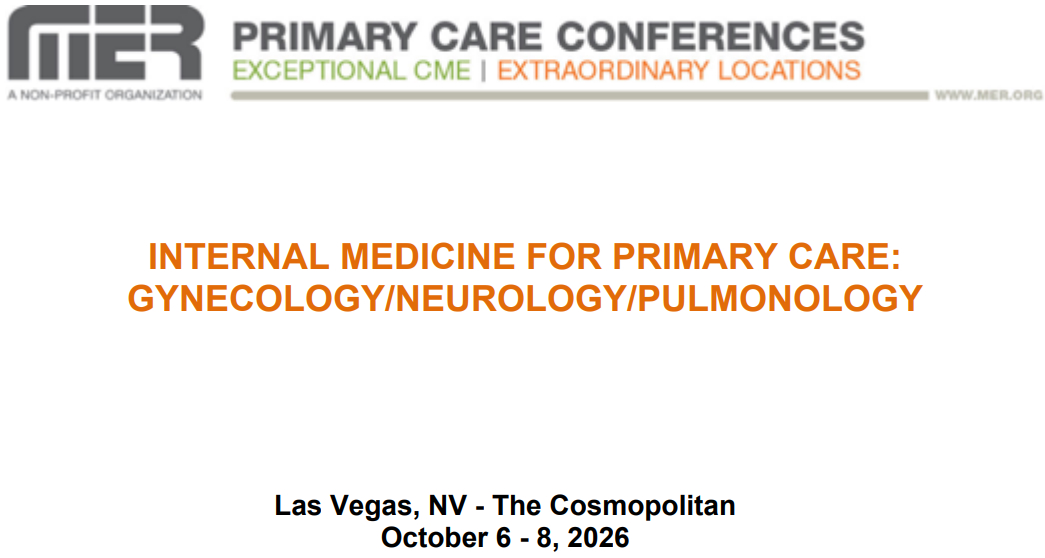
MER Primary Care Conferences Internal Medicine for Primary Care Gyn Neuro Pulm Oct 06-08, 2026
$100.00
Delivery Information: This Product is shared via google drive download link. Please use your correct Gmail address at checkout.
Please note: there are no CME points or certificate associated with this course.
Samples for Courses Can be found here: Free Samples Here!
MER Primary Care Conferences Internal Medicine for Primary Care Gyn Neuro Pulm October 6–8, 2026
Gynecology, Neurology & Pulmonology | 12 Scientific Lectures | Primary Care CME Review
The MER Primary Care Conferences Internal Medicine for Primary Care: Gynecology/Neurology/Pulmonology 2026 is a three-day medical education conference organized by Medical Education Resources (MER), a nonprofit continuing education provider.
Held October 6–8, 2026, at The Cosmopolitan in Las Vegas, Nevada, the conference provides evidence-based clinical updates in women’s health, neurological disorders, and respiratory medicine.
Designed for internists, family physicians, primary care clinicians, gynecologists, neurologists, pulmonologists, nurse practitioners, and physician assistants, the program focuses on practical diagnostic approaches, current clinical recommendations, treatment strategies, and improving patient outcomes.
The curriculum includes women’s preventive healthcare, abnormal uterine bleeding, breast cancer screening, menopause, asthma, respiratory infections, COPD, lung nodules, lung cancer, Alzheimer’s disease, Parkinson’s disease, neurological weakness, and migraine management.
Course Details
- Organizer: Medical Education Resources (MER)
- Dates: October 6–8, 2026
- Venue: The Cosmopolitan, Las Vegas, Nevada, USA
- Original Format: Live CME Conference
- Scientific Lectures: 12
- Original Maximum CME: 12 AMA PRA Category 1 Credits
- ABIM MOC: Up to 12 Points
- ANCC Pharmacotherapeutic Hours: 5.25
- Primary Specialty: Internal Medicine
- Specialties: Gynecology, Neurology, Pulmonology
- Language: English
Complete Scientific Program
Day 1 – Tuesday, October 6, 2026
Gynecology and Pulmonology
- Annual Exam for Women — 7:30–8:30 AM
Women’s preventive care, pelvic examinations, screening, vaccination, and individualized health assessment. - Abnormal Uterine Bleeding — 8:30–9:30 AM
Menstrual disorders, ovulatory and anovulatory bleeding, diagnostic assessment, and treatment. - Breast Cancer Screening and Risk Assessment — 9:40–10:40 AM
Screening guidelines, risk assessment, BRCA-related cancer risk, genetic counseling, and surveillance considerations. - Asthma — 10:40–11:40 AM
Diagnosis, severity assessment, airway inflammation, treatment selection, and difficult-to-control asthma. - Controversies in the Treatment of Common Respiratory Infections — 11:40 AM–12:40 PM
Bronchitis, pneumonia, antibiotic stewardship, antimicrobial resistance, and clinical guidelines.
Day 2 – Wednesday, October 7, 2026
Pulmonology, Gynecology and Neurology
- COPD — 7:30–8:30 AM
Diagnosis, risk reduction, inhaled therapies, pulmonary interventions, and long-term management. - Lung Cancer Screening & Pulmonary Nodules — 8:30–9:30 AM
Screening recommendations, pulmonary nodule evaluation, imaging, and diagnostic management. - Menopause Transition and Hormone Replacement Therapy — 9:40–10:40 AM
Menopausal symptoms, hormone therapy, nonhormonal alternatives, and individualized risk assessment. - Evaluating Weakness — 10:40–11:40 AM
Neurological examination, differentiation of true weakness from nonspecific symptoms, and diagnostic reasoning. - Alzheimer’s & Other Dementias — 11:40 AM–12:40 PM
Cognitive decline, dementia assessment, treatment approaches, delirium recognition, and differential diagnosis.
Day 3 – Thursday, October 8, 2026
Neurology
- Parkinson’s Disease & Other Movement Disorders — 7:30–8:30 AM
Parkinsonian symptoms, movement disorder recognition, differential diagnosis, and treatment principles. - Migraine Headaches — 8:30–9:30 AM
Migraine diagnosis, acute therapy, preventive treatment, chronic headaches, and related disorders.
Learning Objectives
Upon completion of the original educational activity, participants should be better able to:
- Apply evidence-based recommendations during annual women’s health visits.
- Evaluate and manage abnormal uterine bleeding.
- Review breast cancer screening and menopause treatment options.
- Diagnose and manage asthma, COPD, and respiratory infections.
- Evaluate lung nodules and apply appropriate lung cancer screening recommendations.
- Distinguish neurological weakness from nonspecific symptoms.
- Review evidence-based management of Alzheimer’s disease and other dementias.
- Recognize Parkinson’s disease and other movement disorders.
- Diagnose and manage migraine headaches.
Target Audience
- Internal Medicine Physicians
- Family Medicine and Primary Care Physicians
- Gynecologists and OB-GYNs
- Neurologists
- Pulmonologists
- Nurse Practitioners
- Physician Assistants
- Other Healthcare Professionals Involved in Primary Care
Continuing Medical Education
The original MER conference was designated for up to 12 AMA PRA Category 1 Credits, 12 ABIM MOC Points, 12 AAFP Prescribed Credits, and 12 ANCC Contact Hours, including 5.25 pharmacotherapeutic contact hours.
These credits apply to eligible participation in the original accredited activity.
Important: Independently distributed recordings or educational files do not automatically include official CME credits, MOC points, certificates, or MER platform access. The exact digital file inventory must be verified separately.
Official Program
Official Scientific Agenda PDF
Short Description
MER Primary Care Conferences Internal Medicine for Primary Care: Gyn/Neuro/Pulm October 6–8, 2026 provides a comprehensive three-day review of women’s health, neurological disorders, and respiratory medicine.
Topics
Tuesday, October 6, 2026
7:00 am — Check-In and Breakfast
7:30 am – 8:30 am | Gynecology: Annual Exam for Women
Best practices in offering annual pelvic examinations in asymptomatic non-pregnant women; Determination of who should be offered a clinical breast exam as a routine part of the annual women’s health exam; The principal elements of the annual women’s health visit: screening, vaccinations, evaluation of health risks and needs, counseling; Evidence-based tools to guide components of the annual women’s health visit based on age and health needs
8:30 am – 9:30 am | Gynecology: Abnormal Uterine Bleeding
Overview of normal/abnormal menstrual physiology/profile; Menstrual disturbances; Ovulatory and anovulatory uterine bleeding; Other menstrual abnormalities; Diagnosis and appropriate treatment options
9:30 am – 9:40 am — Coffee Break
9:40 am – 10:40 am | Gynecology: Breast Cancer Screening and Risk Assessment
Comparison of recent breast cancer screening recommendations from U.S. Preventive Services Task Force, ACOG/ACS/NCCN, including a discussion of risks and benefits of screening at various ages; Review of the new USPSTF guideline on BRCA-related cancer: risk assessment, genetic counseling, and genetic testing, including risk assessment tools for women with a personal or family history of breast, ovarian and related cancers
10:40 am – 11:40 am | Pulmonology: Asthma
The medical impact of asthma; fundamental role of inflammation, with possible scarring and irreversible loss of lung function; practical points of diagnosis; goal setting management based on levels of severity; risk factors for mortality and treatment in the acute setting; management options for the difficult to control asthmatic patient
11:40 am – 12:40 pm | Pulmonology: Controversies in the Treatment of Common Respiratory Infections
Acute and chronic bronchitis; pneumonia (community versus hospital-acquired); role of the Pneumonia Severity Index score in determining indication for hospitalization; cost-effective use of antibiotics; clinical significance of drug resistance; guidelines for management
12:40 pm — Session Adjourns
Wednesday, October 7, 2026
7:00 am — Arrival and Breakfast
7:30 am – 8:30 am | Pulmonology: COPD
Definition; pathophysiology; early detection and intervention; risk reduction; management update including new modalities (including lung volume reduction surgery) and the role of inhaled corticosteroids and domiciliary oxygen
8:30 am – 9:30 am | Pulmonology: Lung Cancer Screening & Pulmonary Nodules
Appropriate use of the new lung cancer screening recommendations; Fleischner Society guidelines and American College of Chest Physician Lung Cancer guidelines; approach to definitive evaluation and management strategies
9:30 am – 9:40 am — Coffee Break
9:40 am – 10:40 am | Gynecology: Menopause Transition and Hormone Replacement Therapy
Symptoms of menopause, including hot flashes, night sweats, and atrophy; Menopause syndromes, including osteoporosis, breast cancer, cardiac disease, and colon cancer; Estrogen analogs; Counseling patients in options and alternatives to hormone therapy; Designer estrogens; SERMS; HRTs; Discussion of risks and benefits, especially in breast cancer and CHD
10:40 am – 11:40 am | Neurology: Evaluating Weakness
Using the history and physical examination to distinguish weakness from non-specific symptoms; characteristics of neurological diseases that produce weakness; presentations of representative diseases of the nervous system
11:40 am – 12:40 pm | Neurology: Alzheimer’s & Other Dementias
Review changes in cognition with normal aging; Behavioral changes that may precede early dementia; Screening tools for dementia; Characteristics of different dementia syndromes; Risks and benefits for treatment of Alzheimer Disease; Risk factors and causes of delirium, and how to reduce them; How to suspect and identify delirium; Management of the symptoms of delirium; Distinguishing delirium from dementia
12:40 pm — Session Adjourns
Thursday, October 8, 2026
7:00 am — Arrival and Breakfast
7:30 am – 8:30 am | Neurology: Parkinson’s Disease & Other Movement Disorders
Epidemiology; cardinal features; secondary features; pathology; neurochemistry; differential diagnosis; treatment; complication; other movement disorders; neuroleptic-induced movement disorders; chorea
8:30 am – 9:30 am | Neurology: Migraine Headaches
Diagnosis based on headache history; Classification and pathophysiology of migraine; Acute migraine treatment; Prophylaxis for recurrent migraine attacks; Chronic migraine, tension-type headaches, and cluster headaches; Trigeminal Neuralgia
9:30 am — Conference Adjourns
Related products
Critical Care - Emergency medicine
2022 ISICEM International Symposium on Intensive Care & Emergency Medicine

Critical Care - Emergency medicine
The Brigham Board Review in Infectious Diseases Brigham and Women’s Hospital Board Review

USMLE / kaplan and Board Review
Uworld USMLE COMLEX Level 1 Qbank, Updated Jan 2023, System- and Subject-wise (PDF)
Critical Care - Emergency medicine
Internal Medicine
Critical Care - Emergency medicine
Critical Care - Emergency medicine
2022 UPDATES IN THERAPEUTICS: CRITICAL CARE PHARMACY PREPARATORY REVIEW AND RECERTIFICATION COURSE

Internal Medicine