
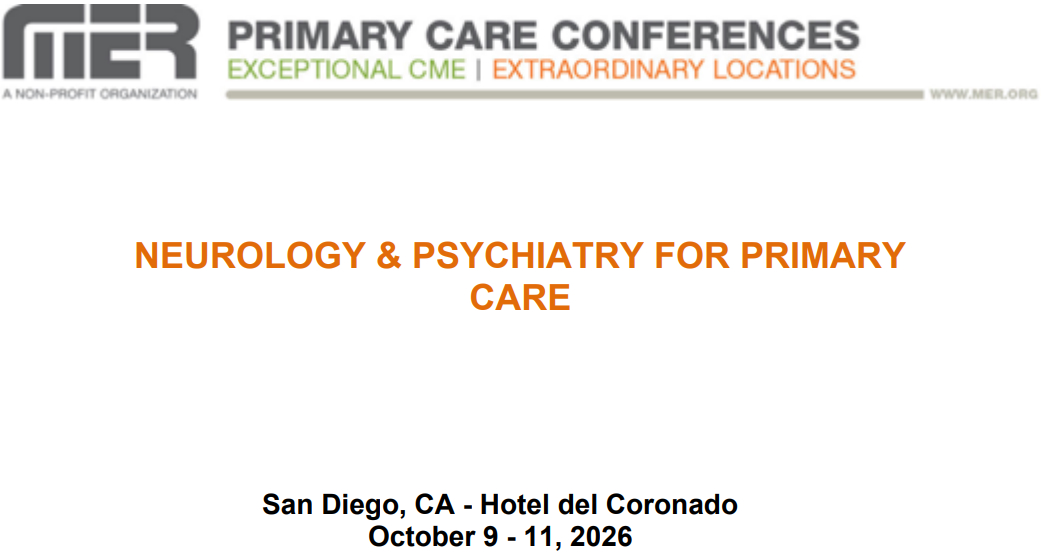
MER Primary Care Conferences Neurology & Psychiatry for Primary Care Oct 09-11, 2026
$100.00
This Product is shared via google drive download link, So please share your correct Gmail id while placing the order .Please note that there are no CME points or certificate associated with this course Samples for Courses Can be found here : Free Samples Here!
MER Primary Care Conferences Neurology & Psychiatry for Primary Care Oct 09-11, 2026
October 9–11, 2026 | Hotel del Coronado, San Diego | Neurology & Psychiatry for Primary Care
The MER Primary Care Conferences Neurology & Psychiatry for Primary Care Oct 09-11, 2026 program provides a focused review of neurological, psychiatric, and sleep-related conditions relevant to office-based primary care.
Organized by Medical Education Resources (MER), a nonprofit organization, the original three-day conference was held October 9–11, 2026, at Hotel del Coronado in San Diego, California. mer.org
The program emphasizes clinical assessment, recognition of common presentations, evidence-based management, and the selection of appropriate treatment strategies. Its neurological content covers the neurological examination, Alzheimer’s disease, Parkinson’s disease and other movement disorders, weakness, migraine headaches, cerebrovascular disorders, and dizziness.
The psychiatry curriculum addresses ADHD, bipolar disorder, anxiety disorders, and substance use disorders, with attention to medication benefits, side effect profiles, psychosocial treatments, and psychiatric comorbidities. Sleep disorders are also included, supporting a broader review of conditions encountered across primary care, neurology, and mental health practice.
Course Details
| Feature | Details |
|---|---|
| Conference Title | Neurology & Psychiatry for Primary Care |
| Conference Series | MER Primary Care Conferences |
| Organizer | Medical Education Resources (MER) |
| Organization Type | Nonprofit Organization |
| Year | 2026 |
| Original Conference Dates | October 9–11, 2026 |
| Duration | Three Days |
| Original Venue | Hotel del Coronado |
| Location | San Diego, California, USA |
| Main Specialties | Neurology and Psychiatry |
| Clinical Focus | Office-Based Primary Care |
| Additional Educational Focus | Sleep Disorders, Neurological Assessment, and Treatment Selection |
Target Audience
This program is targeted to office-based primary care providers and other health professionals seeking updates in primary care medicine.
It is particularly relevant to:
- Primary Care Physicians
- Internists
- Family Physicians
- Neurologists
- Psychiatrists
- Sleep Medicine Specialists
The course supports clinicians reviewing the assessment and management of patients with neurological symptoms, psychiatric conditions, and sleep-related concerns.
Learning Objectives
Upon completion of this program, participants should be better able to:
- Perform a neurological exam
- Discuss evidence-based management options for Alzheimer’s disease
- Evaluate weakness and recognize cardinal features of Parkinson’s disease as well as other movement disorders
- Discuss the spectrum of sleep disorders and current management strategies
- Compare the benefits and side effect profiles of pharmacologic treatment options for ADHD
- Discuss mood stabilizing psychosocial and pharmacologic treatments of bipolar disorder as well as frequent co-morbid psychiatric disorders
- Review current evidence for the treatment of anxiety disorders
- Describe strategies for identifying and treating substance use disorders
- Utilize history and physical examination to distinguish weakness from non-specific symptoms
- Describe the differential diagnosis and treatment options for migraine headaches
- Utilize prevention and treatment strategies for cerebrovascular disorders
- Recognize diseases that present with a complaint of dizziness
Core Topics and Educational Focus
The following clinical areas summarize the program’s stated learning objectives.
| Clinical Area | Educational Focus |
|---|---|
| Neurological Examination | Performing a neurological examination as part of clinical assessment. |
| Alzheimer’s Disease | Reviewing evidence-based management options. |
| Weakness Assessment | Evaluating weakness and using the history and physical examination to distinguish it from non-specific symptoms. |
| Parkinson’s Disease and Other Movement Disorders | Recognizing cardinal clinical features and relevant presentations. |
| Sleep Disorders | Reviewing the spectrum of sleep disorders and their management strategies. |
| ADHD | Comparing the benefits and side effect profiles of pharmacologic treatment options. |
| Bipolar Disorder | Reviewing mood stabilizing psychosocial and pharmacologic treatments, including consideration of frequent psychiatric comorbidities. |
| Anxiety Disorders | Examining the evidence supporting treatment approaches. |
| Substance Use Disorders | Reviewing strategies for identification and treatment. |
| Migraine Headaches | Considering the differential diagnosis and available treatment options. |
| Cerebrovascular Disorders | Reviewing prevention and treatment strategies. |
| Dizziness | Recognizing diseases that may present with dizziness. |
Neurology in Primary Care
The neurological component begins with clinical examination and symptom assessment. It addresses the evaluation of weakness, the recognition of movement disorders, and the use of history and physical examination to distinguish specific neurological findings from non-specific complaints.
The program also reviews management options for Alzheimer’s disease and approaches to migraine headaches, cerebrovascular disorders, and dizziness. Together, these topics support a structured review of neurological conditions encountered in outpatient practice.
Psychiatry and Treatment Selection
The psychiatry component focuses on conditions that commonly require assessment and ongoing management in primary care.
For ADHD, the educational emphasis is on comparing pharmacologic treatment benefits and side effect profiles. For bipolar disorder, the program considers both psychosocial and pharmacologic approaches, together with frequent co-morbid psychiatric disorders.
The curriculum also reviews evidence for the treatment of anxiety disorders and strategies for identifying and treating substance use disorders.
Sleep Disorders
Sleep-related concerns form an additional part of the program’s educational scope.
The stated objectives include reviewing the spectrum of sleep disorders and their management strategies, making this content relevant to primary care clinicians and sleep medicine specialists.
Why This Course Is Relevant
Practical Clinical Assessment
The focus on neurological examination, history-taking, and physical findings supports the review of patients presenting with weakness, dizziness, and headaches.
These topics connect symptom recognition with differential diagnosis and treatment considerations.
Combined Neurology and Psychiatry Coverage
The program brings neurological and psychiatric conditions together within a primary care setting. This structure allows clinicians to review a range of conditions that may require assessment, treatment selection, and ongoing follow-up in office-based practice.
Attention to Treatment Benefits and Adverse Effects
The learning objectives emphasize evidence-based management and the comparison of treatment options. Specific attention is given to ADHD medication benefits and side effects, bipolar disorder treatment approaches, and the evidence supporting anxiety management.
Relevant to Multiple Specialties
The educational scope serves primary care physicians, internists, and family physicians while also addressing topics relevant to neurologists, psychiatrists, and sleep medicine specialists.
Short Description
MER Neurology & Psychiatry for Primary Care 2026 reviews the assessment and management of neurological, psychiatric, and sleep-related conditions in office-based practice. Topics include neurological examination, Alzheimer’s disease, Parkinson’s disease, weakness, migraine, dizziness, cerebrovascular disorders, ADHD, bipolar disorder, anxiety, and substance use disorders. Organized by Medical Education Resources, the original conference was held October 9–11, 2026, at Hotel del Coronado, San Diego.
Topics
Friday, October 9, 2026
-
7:00 am: Check-In and Breakfast
-
7:30 am – 8:30 am | Neurology – 1: The Neurological Exam
-
Characteristics and objectives of the examination; exam phases; assessing general mental status; long-term predications; examination of infants; demonstration on conducting an exam
-
-
8:30 am – 9:30 am | Neurology – 1: Alzheimer’s & Other Dementias
-
Definition; statistics; neurological changes of normal aging; pathology; etiological theories; vascular dementias; investigations; social issues; symptomatic treatment; research therapies
-
-
9:30 am – 9:40 am: Coffee Break
-
9:40 am – 10:40 am | Psychiatry: The Complexity of Adult ADHD
-
ADHD in adults with an emphasis on symptom identification; Co-occurring conditions; Psychiatric and medical differential diagnosis; evidence-based and FDA approved pharmacological treatments
-
-
10:40 am – 11:40 am | Psychiatry: Bipolar Spectrum Disorders
-
Bipolar spectrum disorders in adults as compared to youth; Comprehensive history-taking; Differential diagnosis; Co-occurring psychiatric and medical conditions; Phase specific treatment considerations and interventions
-
-
11:40 am – 12:40 pm | Psychiatry: Anxiety Disorders
-
The nature of anxiety; Generalized anxiety disorder, panic disorder, social anxiety disorder and post-traumatic stress disorder; etiology and diagnosis; Co-occurring conditions; Treatment options for these disabling conditions
-
-
12:40 pm: Session Adjourns
Saturday, October 10, 2026
-
7:00 am: Arrival and Breakfast
-
7:30 am – 8:30 am | Psychiatry: Substance Use Disorders
-
Substance abuse history-taking to encourage patient honesty; Accurate diagnosis; Use of screening tools; Brief intervention; Recovery and treatment options; Motivational interviewing; Family symptoms and codependency
-
-
8:30 am – 9:30 am | Neurology – 1: Parkinson’s Disease & Other Movement Disorders
-
Epidemiology; cardinal features; secondary features; pathology; neurochemistry; differential diagnosis; treatment; complication; other movement disorders; neuroleptic-induced movement disorders; chorea
-
-
9:30 am – 9:40 am: Coffee Break
-
9:40 am – 10:40 am | Neurology – 1: Sleep Disorders
-
Epidemiology; assessing sleep patterns; causes and treatment of insomnia; causes, evaluation and treatment of sleep apnea; symptoms and treatment of narcolepsy
-
-
10:40 am – 11:40 am | Neurology – 2: Evaluating Weakness
-
Using the history and physical examination to distinguish weakness from non-specific symptoms; characteristics of neurological diseases that produce weakness; presentations of representative diseases of the nervous system
-
-
11:40 am – 12:40 pm | Neurology – 2: Headaches & Migraines
-
Basic headache mechanisms; headache history: characteristics, precipitating factors, medical conditions; migraine: common tension, classic, treatment, complicated, cluster, sinus; trigeminal neuralgia; Giant Cell Arteritis; brain tumor; subarachnoid hemorrhage; emergency room treatment
-
-
12:40 pm: Session Adjourns
Sunday, October 11, 2026
-
7:00 am: Arrival and Breakfast
-
7:30 am – 8:30 am | Neurology – 2: Cerebrovascular Disorders
-
Epidemiology; identifying the high-risk patient; treatment effects; transient neurological deficit: carotid, vertebrobasilar; non-specific cerebral symptoms; migraines vs. TIA; treatment options
-
-
8:30 am – 9:30 am | Neurology – 2: Dizziness & Vertigo
-
Definition of terms; concepts; physiologic mechanisms; medical, neurological and laboratory evaluation of the patient; diseases that present with a complaint of dizziness; acute paroxysmal vertigo; acute positional vertigo; Meniere’s disease; acoustic neuroma; cerebellar hemorrhage, etc.
-
-
9:30 am: Conference Adjourns
Related products

Medical Accounts

Internal Medicine
Critical Care - Emergency medicine

Critical Care - Emergency medicine

Critical Care - Emergency medicine
40th ISICEM International Symposium on Intensive Care & Emergency Medicine 2021


Critical Care - Emergency medicine

Critical Care - Emergency medicine