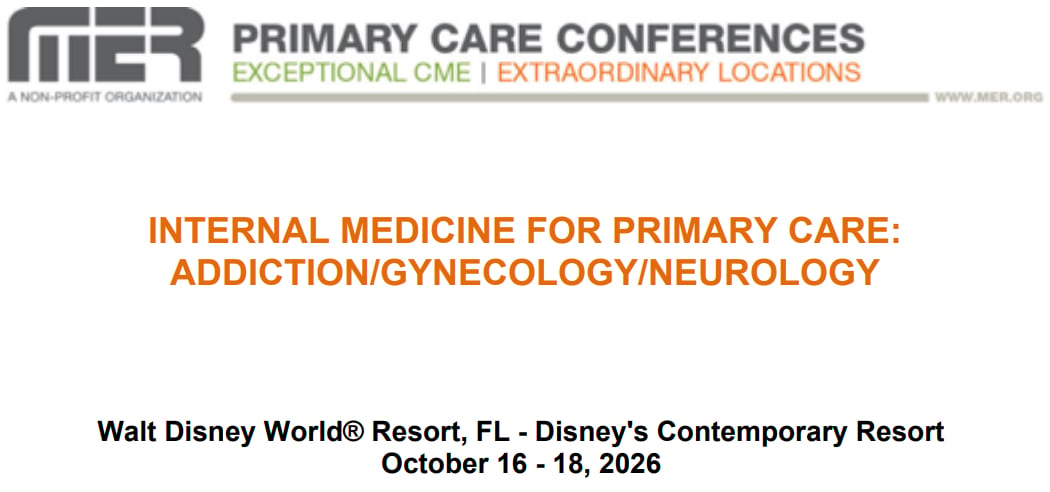
MER Primary Care Conferences Internal Medicine for Primary Care Addiction Gyn Neuro Oct 16-18, 2026
$100.00
This Product is shared via google drive download link, So please share your correct Gmail id while placing the order .Please note that there are no CME points or certificate associated with this course Samples for Courses Can be found here : Free Samples Here!
MER Primary Care Conferences Internal Medicine for Primary Care: Addiction/Gynecology/Neurology – October 16–18, 2026
Conference Information
- Conference Title: Internal Medicine for Primary Care: Addiction/Gynecology/Neurology
- Organizer: Medical Education Resources (MER) – A Non-Profit Organization
- Dates: October 16–18, 2026
- Location: Disney’s Contemporary Resort, Walt Disney World® Resort, Florida, USA
- Specialties: Internal Medicine, Primary Care, Addiction Medicine, Gynecology, Neurology, and Pain Management
Participating Faculty:
- Holly L. Alexandre, MD
- Paul W. Brazis, MD
- Sarah Carpenter, MD
Conference Overview
The MER Primary Care Conferences Internal Medicine for Primary Care: Addiction/Gynecology/Neurology 2026 is a comprehensive medical education program designed to provide primary care physicians, internists, family physicians, and other healthcare professionals with practical clinical updates across several essential medical specialties.
Organized by Medical Education Resources (MER), a non-profit organization, the conference takes place October 16–18, 2026, at Disney’s Contemporary Resort in Walt Disney World Resort, Florida.
The program focuses on evidence-based approaches to evaluating and managing neurological disorders, substance use disorders, chronic pain, women’s health conditions, and common gynecological concerns encountered in primary care practice.
Key educational areas include the assessment of muscle weakness, Parkinson’s disease and movement disorders, migraine headaches, cerebrovascular disease prevention, addiction treatment, opioid-sparing pain management, abnormal uterine bleeding, menopause, and contraceptive counseling.
The conference emphasizes practical diagnostic reasoning, appropriate treatment selection, preventive healthcare, and individualized patient counseling to help clinicians strengthen their ability to manage complex medical conditions in outpatient settings.
Key Topics Covered
1. Neurological Evaluation and Muscle Weakness
Review the use of history-taking and physical examination to distinguish true muscle weakness from nonspecific symptoms. Explore clinical assessment strategies that support accurate neurological diagnosis and appropriate further evaluation.
2. Parkinson’s Disease and Movement Disorders
Examine the cardinal clinical features of Parkinson’s disease and other movement disorders. The educational focus includes recognizing neurological findings and evaluating patients presenting with movement abnormalities.
3. Migraine Headaches and Cerebrovascular Disorders
Explore the differential diagnosis and available treatment options for migraine headaches, alongside prevention and treatment strategies for cerebrovascular disorders.
4. Substance Use Disorders and Addiction Medicine
Review strategies for identifying, assessing, and treating substance use disorders. Topics include the clinical effects of hallucinogens, stimulants, inhalants, sedatives, tobacco, and alcohol.
5. Alcohol Use Disorder Management
Examine approaches to developing individualized treatment plans for Alcohol Use Disorder, with attention to clinical assessment and evidence-based management strategies.
6. Chronic Pain and Opioid-Sparing Treatment
Explore pharmacological and nonpharmacological approaches to pain management, including therapies that may reduce opioid requirements while maintaining appropriate pain control.
7. Preventive Women’s Health and Annual Examinations
Review evidence-based tools and best practices for comprehensive annual women’s health visits, including preventive assessment and essential components of routine gynecological care.
8. Abnormal Uterine Bleeding
Examine clinical approaches to assessing and managing abnormal uterine bleeding, emphasizing diagnostic evaluation and appropriate treatment considerations.
9. Menopausal Transition and Treatment Options
Discuss the menopausal transition, associated clinical considerations, and the potential risks and benefits of available treatment options.
10. Contraceptive Counseling and Shared Decision-Making
Review practical approaches to counseling patients about complex contraceptive decisions, emphasizing individualized care, informed choices, and effective patient communication.
Learning Objectives
Upon completion of this program, participants should be better able to:
- Utilize history and physical examination to distinguish weakness from non-specific symptoms.
- Evaluate weakness and recognize cardinal features of Parkinson’s disease as well as other movement disorders.
- Describe the differential diagnosis and treatment options for migraine headaches.
- Utilize prevention and treatment strategies for cerebrovascular disorders.
- Describe strategies for identifying and treating substance use disorders.
- Review the effects of addictive drugs including hallucinogens, stimulants, inhalants, sedatives, tobacco and alcohol.
- Identify therapies, including nonpharmacological pain treatment strategies, that can reduce the dose of opioids to control pain.
- Develop a treatment plan for Alcohol Use Disorder.
- Identify evidence-based tools to determine best practices in incorporating all necessary elements in the annual women’s health visit.
- Assess and manage abnormal uterine bleeding.
- Discuss menopausal transition and the risks/benefits of treatment options.
- Describe approaches to counseling patients for making complex contraceptive decisions.
Target Audience
This program is targeted to office-based primary care providers and other health professionals seeking clinical updates in primary care medicine.
Recommended for:
- Internists
- Primary Care Physicians
- Family Physicians
- Neurologists
- Addiction Medicine Specialists
- Psychiatrists
- Pain Management Specialists
- Gynecologists
- Obstetricians and Gynecologists (OB-GYNs)
Educational Benefits
- Strengthen neurological examination and diagnostic reasoning skills.
- Improve recognition of Parkinson’s disease and other movement disorders.
- Review evidence-based migraine and cerebrovascular disease management.
- Enhance identification and treatment of substance use disorders.
- Understand the clinical effects of commonly misused substances.
- Explore nonpharmacological and opioid-sparing pain management strategies.
- Develop practical approaches to Alcohol Use Disorder treatment.
- Improve preventive women’s health assessment and annual examination practices.
- Review abnormal uterine bleeding and menopausal management.
- Strengthen patient counseling and shared decision-making regarding contraception.
Product Description
The MER Internal Medicine for Primary Care: Addiction/Gynecology/Neurology October 16–18, 2026 conference provides a comprehensive educational update on neurological disorders, addiction medicine, pain management, and women’s health for primary care professionals.
Presented by Medical Education Resources (MER), this program covers neurological assessment, Parkinson’s disease, movement disorders, migraine headaches, cerebrovascular disease, substance use disorders, Alcohol Use Disorder, and opioid-sparing pain treatment.
The gynecology curriculum addresses preventive women’s healthcare, abnormal uterine bleeding, menopausal transition, and contraceptive counseling.
Designed for internists, primary care physicians, family physicians, neurologists, addiction specialists, psychiatrists, pain management physicians, and gynecologists, this conference supports evidence-based clinical decision-making and comprehensive outpatient care.
Product Summary
- Conference: Internal Medicine for Primary Care: Addiction/Gynecology/Neurology
- Organizer: Medical Education Resources (MER)
- Dates: October 16–18, 2026
- Location: Disney’s Contemporary Resort, Walt Disney World Resort, Florida, USA
- Faculty: Holly L. Alexandre, MD; Paul W. Brazis, MD; Sarah Carpenter, MD
- Clinical Focus: Internal Medicine, Neurology, Addiction Medicine, Gynecology, and Primary Care
- Neurology Topics: Muscle Weakness, Parkinson’s Disease, Movement Disorders, Migraine, and Cerebrovascular Disorders
- Addiction Topics: Substance Use Disorders, Alcohol Use Disorder, Opioid-Sparing Pain Management, and Effects of Addictive Substances
- Gynecology Topics: Annual Women’s Health Visits, Abnormal Uterine Bleeding, Menopause, and Contraceptive Counseling
- Ideal For: Internists, Family Physicians, Primary Care Physicians, Neurologists, Addiction Specialists, and Gynecologists
Short Description
MER Primary Care Conferences Internal Medicine for Primary Care: Addiction/Gynecology/Neurology 2026 is a comprehensive medical education conference organized by Medical Education Resources (MER), held October 16–18, 2026, at Disney’s Contemporary Resort, Walt Disney World Resort, Florida.
The program provides clinically focused updates on Parkinson’s disease, movement disorders, migraine headaches, cerebrovascular disease, substance use disorders, Alcohol Use Disorder, opioid-sparing pain management, abnormal uterine bleeding, menopause, and contraceptive counseling.
Featuring Holly L. Alexandre, MD; Paul W. Brazis, MD; and Sarah Carpenter, MD, this conference is designed for internists, primary care physicians, family physicians, neurologists, addiction medicine specialists, psychiatrists, pain specialists, and gynecologists seeking practical, evidence-based approaches to outpatient medical care.
Topics
Friday, October 16, 2026
-
7:00 am: Check-In and Breakfast
-
7:30 am – 8:30 am | Evaluating Weakness — Paul W. Brazis, MD
-
Using the history and physical examination to distinguish weakness from non-specific symptoms; characteristics of neurological diseases that produce weakness; presentations of representative diseases of the nervous system
-
-
8:30 am – 9:30 am | Parkinson’s Disease & Other Movement Disorders — Paul W. Brazis, MD
-
Epidemiology; cardinal features; secondary features; pathology; neurochemistry; differential diagnosis; treatment; complication; other movement disorders; neuroleptic-induced movement disorders; chorea
-
-
9:30 am – 9:40 am: Coffee Break
-
9:40 am – 10:40 am | Headaches & Migraines — Paul W. Brazis, MD
-
Basic headache mechanisms; headache history: characteristics, precipitating factors, medical conditions; migraine: common tension, classic, treatment, complicated, cluster, sinus; trigeminal neuralgia; Giant Cell Arteritis; brain tumor; subarachnoid hemorrhage; emergency room treatment
-
-
10:40 am – 11:40 am | Substance Use Disorders: Diagnosis and Screening for Primary Care Practitioners — Holly L. Alexandre, MD
-
Essential information and skills necessary for identifying substance use and addiction in the primary care setting; Epidemiology, assessment and screening tools; Practical steps for intervention
-
-
11:40 am – 12:40 pm | Drugs: Review of Addictive Drugs and Their Effects — Holly L. Alexandre, MD
-
This module will review hallucinogens, stimulants, inhalants, sedatives, tobacco and alcohol
-
-
12:40 pm: Session Adjourns
Saturday, October 17, 2026
-
7:00 am: Arrival and Breakfast
-
7:30 am – 8:30 am | The Opioid Crisis and Primary Care Providers — Holly L. Alexandre, MD
-
Update on the opioid crisis; Risk for opioid misuse and addiction; FDA approved medication for treating overdose; FDA approved medication-assisted treatment (MAT) for managing opioid addiction
-
-
8:30 am – 9:30 am | Treatment of Alcohol Use Disorder in Primary Care — Holly L. Alexandre, MD
-
The scope of alcohol related problems and the societal burden of Alcohol Use Disorder; Overview of FDA-approved and more common off-label pharmacotherapies for Alcohol Use Disorder
-
-
9:30 am – 9:40 am: Coffee Break
-
9:40 am – 10:40 am | Cerebrovascular Disorders — Paul W. Brazis, MD
-
Epidemiology; identifying the high-risk patient; treatment effects; transient neurological deficit: carotid, vertebrobasilar; non-specific cerebral symptoms; migraines vs. TIA; treatment options
-
-
10:40 am – 11:40 am | Annual Exam for Women — Sarah Carpenter, MD
-
Best practices in offering annual pelvic examinations in asymptomatic non-pregnant women; Determination of who should be offered a clinical breast exam as a routine part of the annual women’s health exam; The principal elements of the annual women’s health visit: screening, vaccinations, evaluation of health risks and needs, counseling; Evidence-based tools to guide components of the annual women’s health visit based on age and health needs
-
-
11:40 am – 12:40 pm | Abnormal Uterine Bleeding — Sarah Carpenter, MD
-
Overview of normal/abnormal menstrual physiology/profile; Menstrual disturbances; Ovulatory and anovulatory uterine bleeding; Other menstrual abnormalities; Diagnosis and appropriate treatment options
-
-
12:40 pm: Session Adjourns
Sunday, October 18, 2026
-
7:00 am: Arrival and Breakfast
-
7:30 am – 8:30 am | Menopause Transition and Hormone Replacement Therapy — Sarah Carpenter, MD
-
Symptoms of menopause, including hot flashes, night sweats, and atrophy; Menopause syndromes, including osteoporosis, breast cancer, cardiac disease, and colon cancer; Estrogen analogs; Counseling patients in options and alternatives to hormone therapy; Designer estrogens; SERMS; HRTs; Discussion of risks and benefits, especially in breast cancer and CHD
-
-
8:30 am – 9:30 am | Contraception: A Primary Care Review of Best Practice — Sarah Carpenter, MD
-
Coverage of the effectiveness, side effects and non-contraceptive benefits of available contraceptive options in the U.S.; Discussion of contraceptive counseling that is patient-centric including communicating without coercion; Management strategies for medically complex contraceptive decisions (patients with a history of VTE, breast cancer, hypertension)
-
-
9:30 am: Conference Adjourns
Related products
Critical Care - Emergency medicine
The Brigham Board Review in Infectious Diseases Brigham and Women’s Hospital Board Review
Internal Medicine

Critical Care - Emergency medicine

Pediatrics
Critical Care - Emergency medicine
International Symposium on Intensive Care & Emergency Medicine ( ISICEM ) 2020
Critical Care - Emergency medicine

Internal Medicine