
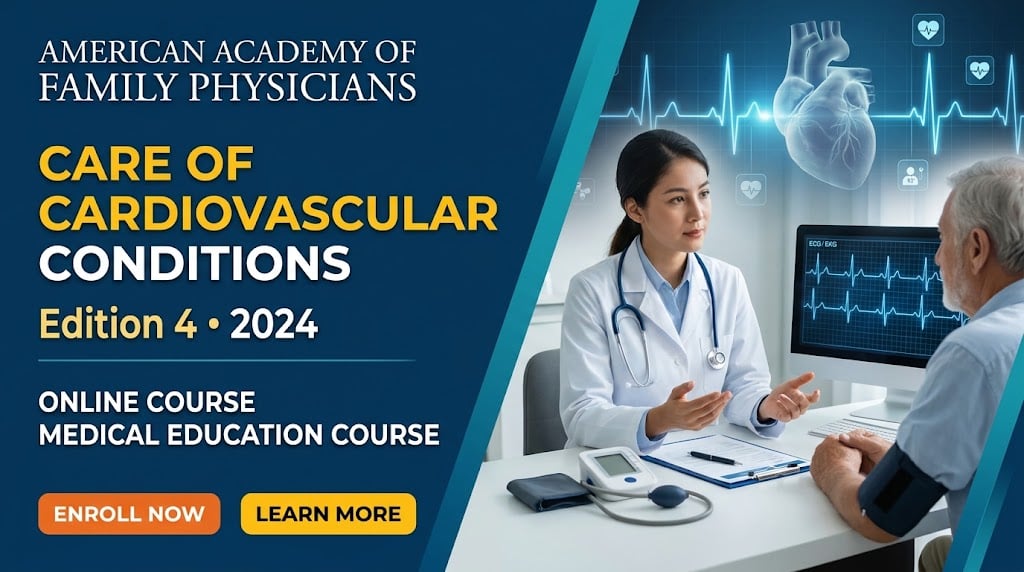
American Academy of Family Physicians Care of Cardiovascular Conditions Edition 4 2024


$80.00
This Product is shared via google drive download link, So please share your correct Gmail id while placing the order .Please note that there are no CME points or certificate associated with this course Samples for Courses Can be found here : Free Samples Here!
AAFP Care of Cardiovascular Conditions (4th Edition)
+ Target Audience: Family medicine physicians, primary care physicians, internal medicine physicians, hospitalists, cardiologists, preventive cardiology specialists, lipidologists, vascular medicine specialists, hematologists, neurologists, endocrinologists, emergency medicine physicians, nephrologists, radiologists, family medicine and internal medicine residents, cardiology fellows, nurse practitioners, physician assistants, and advanced practice providers.
+ Information:
- Course Title: Care of Cardiovascular Conditions (4th Edition)
- Organizer: American Academy of Family Physicians (AAFP)
- Original Format: On-Demand Online Course
- Primary Specialty: Cardiovascular Medicine
- Additional Focus: Family Medicine, Primary Care, and Internal Medicine
- Educational Level: Continuing Medical Education
- Curriculum: 27 Educational Topics
- Language: English
+ Description:
The AAFP Care of Cardiovascular Conditions (4th Edition) is a comprehensive on-demand medical education course designed to strengthen the diagnosis, prevention, and evidence-based management of cardiovascular conditions commonly encountered in family medicine, internal medicine, and primary care.
Organized by the American Academy of Family Physicians (AAFP), the course provides practical education on cardiovascular risk assessment, hypertension, dyslipidemia, coronary artery disease, heart failure, cardiomyopathy, atrial fibrillation, venous thromboembolism, and cerebrovascular disease.
The curriculum also covers cardiovascular imaging, electrocardiogram (ECG) interpretation, perioperative cardiovascular assessment, lipid testing, risk stratification, SGLT2 inhibitors, GLP-1 receptor agonists, renovascular disease, and primary aldosteronism.
Through clinical reviews, expert-led educational presentations, and evidence-based discussions, the course emphasizes early cardiovascular risk identification, preventive care, appropriate diagnostic testing, medication management, and individualized treatment strategies.
Learning Objectives
Upon completion of this educational activity, participants should be able to:
- Apply evidence-based strategies for primary, secondary, and tertiary prevention of cardiovascular disease.
- Assess cardiovascular risk using appropriate clinical evaluation and risk stratification tools.
- Counsel patients regarding lifestyle modifications, medication adherence, and long-term cardiovascular risk reduction.
- Develop individualized diagnostic and treatment plans for hypertension, dyslipidemia, coronary artery disease, heart failure, cardiomyopathy, and atrial fibrillation.
- Evaluate venous thromboembolism, cerebrovascular disease, and related cardiovascular conditions.
- Improve interpretation of electrocardiograms, cardiac imaging studies, laboratory findings, and cardiovascular diagnostic tests.
- Recognize clinical situations requiring specialist referral or multidisciplinary collaboration.
- Incorporate evidence-based pharmacologic and non-pharmacologic treatments into cardiovascular care.
- Apply practical strategies for managing complex cardiovascular comorbidities.
- Identify opportunities to improve cardiovascular care through clinical reflection and translation into practice.
Comprehensive Course Curriculum (27 Topics)
Preventive Cardiology & Lipid Management
1. Statin Use
Review the clinical role of statin therapy in cardiovascular disease prevention, lipid management, and risk reduction.
2. Aspirin in Cardiovascular Primary Prevention
Examine the benefits, limitations, and bleeding risks associated with aspirin use for primary cardiovascular prevention.
3. Hyperlipidemia
Review lipid disorders, cardiovascular risk assessment, and pharmacologic treatment considerations.
4. Non-Pharmacologic Approach to Cardiovascular Disease
Explore lifestyle modifications, nutrition, physical activity, weight management, and behavioral approaches to cardiovascular prevention.
Vascular & Coronary Artery Disease
5. Venous Thromboembolism (VTE)
Review clinical evaluation and management considerations for deep vein thrombosis and pulmonary embolism.
6. Coronary Artery Disease
Examine diagnostic approaches, risk modification, medical management, and long-term care of patients with coronary artery disease.
7. Cerebrovascular Aneurysm
Review clinical considerations in the recognition, evaluation, and management of cerebrovascular aneurysms.
8. Carotid Vessel Disease
Discuss carotid artery disease, vascular risk assessment, diagnostic imaging, and referral considerations.
Hypertension & Cardiometabolic Therapies
9. Hypertension
Review the diagnosis, evaluation, and management of hypertension using evidence-based clinical approaches.
10. Resistant Hypertension
Explore potential secondary causes, diagnostic evaluation, and treatment strategies for difficult-to-control blood pressure.
11. SGLT-2 Inhibitors and GLP-1 Receptor Agonists
Examine the cardiovascular and metabolic applications of these medication classes, including their role in managing relevant comorbidities.
12. Hypertension Emergencies
Review recognition, risk assessment, and urgent management considerations for severe hypertension with acute target-organ injury.
Cardiac Arrhythmias, Cardiomyopathy & Heart Failure
13. Atrial Fibrillation
Review atrial fibrillation diagnosis, rate and rhythm management, stroke prevention, and anticoagulation considerations.
14. Cardiomyopathy
Examine common cardiomyopathy presentations, diagnostic approaches, and management considerations.
15. Heart Failure: Decreasing Readmission
Explore strategies for improving heart failure management, care transitions, follow-up, and prevention of avoidable hospital readmissions.
16. Colchicine in Cardiovascular Disease
Review the cardiovascular applications of colchicine and relevant evidence concerning its use in selected patients.
Cardiovascular Examination & Diagnostic Testing
17. Cardiovascular Physical Examination
Strengthen clinical examination skills and recognition of important cardiovascular findings.
18. Perioperative Evaluation
Review cardiovascular risk assessment and clinical considerations before noncardiac surgery.
19. Advanced Cardiac Imaging
Explore the role of cardiovascular imaging in diagnosis, risk assessment, and treatment planning.
20. Abnormal ECG
Review recognition and interpretation of clinically significant electrocardiographic abnormalities.
21. ECG Interpretation (Part 1, Part 2, Part 3)
A three-part educational review covering foundational and more advanced electrocardiographic interpretation principles.
Medical Technology & Clinical Decision Support
22. Marvelous Medical Apps (Part 1, Part 2, Part 3)
A three-part review of medical applications and digital tools relevant to clinical learning and practice.
Renal & Endocrine Causes of Cardiovascular Disease
23. Renovascular Disease
Review renovascular conditions and their relationship to hypertension and cardiovascular health.
24. Primary Aldosteronism
Examine the clinical recognition and diagnostic evaluation of primary aldosteronism as a cause of secondary hypertension.
Advanced Lipid Assessment & Risk Stratification
25. Advanced Lipid Testing and ASCVD Risk Assessment
Review advanced lipid evaluation and the role of atherosclerotic cardiovascular disease risk assessment in preventive care.
26. Risk Scores
Examine the interpretation and application of cardiovascular risk prediction tools in clinical decision-making.
Clinical Implementation
27. Translation to Practice (T2P)
Review strategies for translating course concepts into practical improvements in patient care, including identification of implementation barriers and opportunities for clinical improvement.
Educational Highlights
- Comprehensive cardiovascular disease review
- Primary and secondary cardiovascular prevention
- Hypertension and resistant hypertension management
- Dyslipidemia and advanced lipid testing
- Coronary and carotid artery disease
- Venous thromboembolism and vascular conditions
- Atrial fibrillation and anticoagulation considerations
- Cardiomyopathy and heart failure management
- Cardiovascular applications of SGLT2 inhibitors and GLP-1 receptor agonists
- Cardiac imaging and ECG interpretation
- Perioperative cardiovascular evaluation
- Renovascular disease and primary aldosteronism
- Cardiovascular risk assessment and clinical decision support
- Practical approaches to improving patient outcomes
Clinical & Educational Value
The AAFP Care of Cardiovascular Conditions (4th Edition) provides a clinically focused cardiovascular medicine review for physicians and healthcare professionals involved in outpatient and inpatient care.
The program integrates preventive cardiology, diagnostic testing, risk stratification, pharmacologic management, and long-term cardiovascular disease treatment.
Its multidisciplinary educational approach supports physicians in understanding common cardiovascular conditions, improving diagnostic reasoning, and applying evidence-based treatment principles in clinical practice.
The course is particularly relevant to primary care professionals managing patients with multiple cardiovascular risk factors and coordinating care with cardiologists and other medical specialists.
Important Access Information
This description summarizes the original AAFP educational curriculum. The contents and completeness of digital educational materials included in the purchased package should be confirmed before purchase.
Official AAFP platform access, interactive services, live participation, CME credits, and certificates are not included unless expressly specified.
Short Description
The AAFP Care of Cardiovascular Conditions (4th Edition) provides comprehensive cardiovascular education covering hypertension, dyslipidemia, coronary artery disease, heart failure, atrial fibrillation, cardiomyopathy, venous thromboembolism, cardiovascular imaging, ECG interpretation, risk assessment, preventive cardiology, and evidence-based treatment strategies.
Related products

USMLE / kaplan and Board Review
Uworld USMLE COMLEX Level 1 Qbank, Updated Jan 2023, System- and Subject-wise (PDF)


Internal Medicine

Critical Care - Emergency medicine
The Brigham Board Review in Infectious Diseases Brigham and Women’s Hospital Board Review
Medical Accounts
Critical Care - Emergency medicine
2022 UPDATES IN THERAPEUTICS: CRITICAL CARE PHARMACY PREPARATORY REVIEW AND RECERTIFICATION COURSE

Internal Medicine
Critical Care - Emergency medicine