
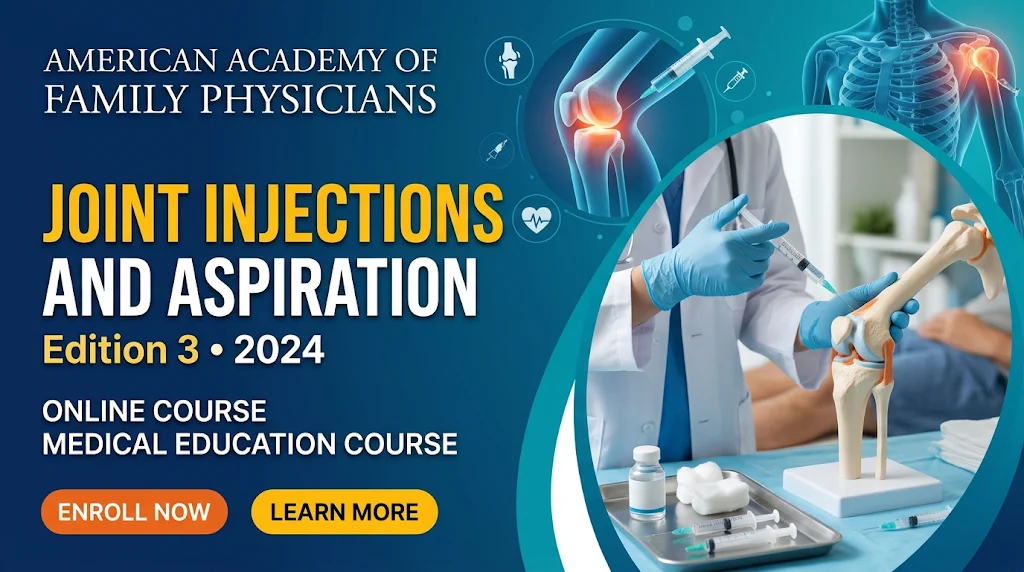
American Academy of Family Physicians Joint Injections and Aspiration Edition 3 2024


$20.00
This Product is shared via google drive download link, So please share your correct Gmail id while placing the order .Please note that there are no CME points or certificate associated with this course Samples for Courses Can be found here : Free Samples Here!
American Academy of Family Physicians Joint Injections and Aspiration (Edition 3)
+ Target Audience: Family medicine physicians, primary care physicians, internal medicine physicians, sports medicine specialists, orthopedic surgeons, rheumatologists, physical medicine and rehabilitation physicians, pain management specialists, geriatricians, emergency medicine physicians, urgent care clinicians, medical residents, nurse practitioners, physician assistants, and healthcare professionals involved in musculoskeletal care.
+ Information:
- Course Title: Joint Injections and Aspiration (Edition 3)
- Organizer: American Academy of Family Physicians (AAFP)
- Original Format: On-Demand Procedural Course
- Primary Focus: Musculoskeletal Joint Injections, Arthrocentesis, and Soft Tissue Procedures
- Additional Focus: Family Medicine, Sports Medicine, Orthopedics, and Pain Management
- Educational Approach: Procedural Demonstrations, Anatomical Models, and Ultrasound-Guided Techniques
- Curriculum: Two Parts, 15 Educational Sections
- Language: English
+ Description:
The AAFP Joint Injections and Aspiration (Edition 3) is a comprehensive procedural medical education course designed to help healthcare professionals develop a structured understanding of musculoskeletal joint injections, diagnostic arthrocentesis, therapeutic aspirations, and soft tissue injection techniques.
Organized by the American Academy of Family Physicians (AAFP), the program combines step-by-step procedural demonstrations, anatomical models, palpation-guided landmarks, and ultrasound-guided approaches to illustrate commonly performed office-based musculoskeletal procedures.
The curriculum reviews clinical indications and contraindications, patient selection, informed consent, injection equipment, corticosteroid and local anesthetic considerations, anatomical landmark identification, potential complications, and post-procedure care.
Coverage includes injection and aspiration techniques involving the shoulder, elbow, wrist, hand, hip, knee, foot, and ankle, alongside synovial fluid evaluation, procedural troubleshooting, documentation, billing, and coding.
Learning Objectives
Upon completion of this educational activity, participants should be better able to:
- Identify diagnostic and therapeutic indications for musculoskeletal joint and soft tissue injections and aspirations.
- Recognize absolute and relative contraindications to common injection procedures.
- Understand procedural risks, safety precautions, and potential complications.
- Select appropriate needles, syringes, equipment, local anesthetics, and corticosteroid preparations.
- Review medication dosages, injection timing, and recommended intervals.
- Identify anatomical landmarks for palpation-guided injections.
- Understand the role of ultrasound guidance in musculoskeletal procedures.
- Recognize procedural challenges and adjust approaches according to anatomical considerations.
- Review injection and aspiration techniques for common upper- and lower-extremity conditions.
- Interpret synovial fluid findings in appropriate clinical contexts.
- Provide appropriate post-injection counseling and follow-up recommendations.
- Apply proper documentation and procedural billing and coding principles.
Comprehensive Course Curriculum
Part 1 – Musculoskeletal Injections: Joint and Soft Tissue
1. Fundamental Principles of Joint Injections and Arthrocentesis
An introduction to the clinical foundations of diagnostic joint aspiration, therapeutic joint injections, and soft tissue procedures.
Key Topics:
- Diagnostic arthrocentesis
- Therapeutic joint injections
- Soft tissue injections
- Common musculoskeletal indications
- Clinical assessment
- Patient selection
- Expected treatment outcomes
- Diagnostic versus therapeutic procedures
2. Indications, Contraindications and Patient Safety
Reviews appropriate patient assessment, procedural eligibility, contraindications, and safety precautions.
Key Topics:
- Clinical indications
- Absolute contraindications
- Relative contraindications
- Informed consent
- Infection prevention
- Procedural safety precautions
- Patient-specific risk assessment
- Recognition of procedural complications
3. Equipment Selection and Procedural Preparation
Examines the equipment, procedural supplies, and preparation techniques required for musculoskeletal injections and aspirations.
Key Topics:
- Needle gauge selection
- Needle length selection
- Syringes and procedural supplies
- Skin preparation
- Clean and aseptic techniques
- Patient positioning
- Anatomical assessment
- Procedure planning
4. Corticosteroids and Local Anesthetics
Reviews commonly used medication preparations and important clinical considerations for injection procedures.
Key Topics:
- Corticosteroid preparations
- Local anesthetic selection
- Medication pharmacology
- Appropriate dosages
- Injection intervals
- Timing considerations
- Medication-related precautions
- Potential adverse effects
5. Palpation-Guided and Ultrasound-Guided Techniques
Introduces anatomical landmark identification and ultrasound-assisted techniques for improving procedural planning and needle placement.
Key Topics:
- Surface anatomy
- Palpation-guided anatomical landmarks
- Ultrasound-guided procedures
- Needle placement techniques
- Recognition of anatomical structures
- Adjustments for challenging anatomy
- Procedural pitfalls
- Image-guided injection considerations
6. Shoulder Injection Procedures
Procedural review of common therapeutic injections involving shoulder structures.
Procedures Covered:
- Subacromial space injections
- Glenohumeral joint injections
- Acromioclavicular joint injections
- Biceps tendon sheath injections
7. Elbow Injection Procedures
Reviews injection approaches relevant to common elbow disorders.
Procedures Covered:
- Lateral epicondylitis
- Medial epicondylitis
- Olecranon bursa procedures
8. Wrist and Hand Injection Procedures
Discusses therapeutic injection procedures for selected wrist and hand conditions.
Procedures Covered:
- De Quervain tenosynovitis
- Carpal tunnel procedures
- Carpometacarpal joint injections
- Trigger finger injections
Part 2 – Musculoskeletal Injections: Joint and Soft Tissue
9. Hip and Greater Trochanteric Region Procedures
Reviews anatomical assessment and injection considerations for the hip and greater trochanteric region.
Procedures Covered:
- Greater trochanteric bursa injections
- Regional anatomical assessment
- Patient positioning
- Needle placement considerations
10. Knee Injection and Aspiration Techniques
Examines diagnostic and therapeutic approaches to knee injections, effusions, and periarticular procedures.
Procedures Covered:
- Intra-articular knee injections
- Knee effusion aspiration
- Pes anserine bursa injections
- Prepatellar bursa procedures
11. Foot and Ankle Injection Procedures
Provides procedural demonstrations and anatomical guidance for commonly encountered foot and ankle conditions.
Procedures Covered:
- Tibiotalar joint injections
- Plantar fascia procedures
- Morton neuroma injections
- Metatarsophalangeal joint injections
12. Synovial Fluid Evaluation
Reviews diagnostic joint aspiration and the interpretation of synovial fluid findings in patients with joint pain, swelling, or effusion.
Key Topics:
- Diagnostic joint aspiration
- Synovial fluid collection
- Clinical interpretation
- Inflammatory versus non-inflammatory findings
- Differential diagnosis
- Appropriate diagnostic evaluation
13. Procedural Challenges and Troubleshooting
Discusses technical difficulties and practical adjustments encountered during musculoskeletal injection and aspiration procedures.
Key Topics:
- Difficult anatomical landmarks
- Needle placement challenges
- Needle resistance
- Anatomical variations
- Procedural adjustments
- Recognition of technical difficulties
- Avoiding common procedural pitfalls
14. Recognition and Management of Complications
Reviews potential adverse effects associated with musculoskeletal injections and the importance of procedural safety.
Potential Complications Reviewed:
- Post-injection flare
- Transient hyperglycemia in patients with diabetes
- Soft tissue atrophy
- Skin depigmentation
- Tendon injury
- Infection
- Other procedure-related adverse events
15. Post-Injection Care and Clinical Follow-Up
Explores appropriate post-procedure counseling, rehabilitation, patient monitoring, and administrative documentation.
Key Topics:
- Post-procedure patient counseling
- Follow-up considerations
- Rehabilitation integration
- Activity modification
- Patient education
- Clinical documentation
- Procedural billing
- Coding requirements
Educational Highlights
- Comprehensive musculoskeletal injection and aspiration review
- Diagnostic arthrocentesis and therapeutic joint injections
- Step-by-step procedural demonstrations
- Anatomical models and surface landmark techniques
- Ultrasound-guided injection approaches
- Corticosteroid and local anesthetic considerations
- Shoulder, elbow, wrist, and hand procedures
- Hip, knee, foot, and ankle procedures
- Synovial fluid evaluation
- Procedural troubleshooting
- Recognition and management of potential complications
- Post-injection patient counseling
- Rehabilitation and follow-up considerations
- Procedural documentation, billing, and coding
Clinical & Educational Value
The AAFP Joint Injections and Aspiration (Edition 3) provides a focused educational review of diagnostic and therapeutic musculoskeletal procedures commonly performed in family medicine, sports medicine, orthopedics, rheumatology, and primary care.
By integrating anatomical instruction, procedural demonstrations, medication considerations, patient selection, ultrasound-guided techniques, and clinical safety principles, the program supports a structured understanding of joint and soft tissue interventions.
Its coverage of upper- and lower-extremity procedures makes it relevant to clinicians seeking to strengthen their knowledge of outpatient musculoskeletal care.
Professional Training Notice: Recorded procedural demonstrations are intended for educational purposes and do not replace supervised clinical training, competency assessment, or applicable professional practice requirements.
Important Access Information
This description summarizes the original AAFP educational curriculum. The number, completeness, and format of digital files included in the purchased package should be confirmed before purchase.
Official AAFP platform access, live procedural training, hands-on supervision, CME credits, and certificates are not included unless expressly stated.
Short Description
The AAFP Joint Injections and Aspiration (Edition 3) provides comprehensive procedural education in musculoskeletal joint injections, diagnostic arthrocentesis, soft tissue injections, anatomical landmarks, ultrasound-guided techniques, corticosteroid administration, synovial fluid evaluation, and outpatient injection procedures involving the shoulder, elbow, wrist, hand, hip, knee, foot, and ankle.
Related products

Critical Care - Emergency medicine

Internal Medicine

Critical Care - Emergency medicine
Critical Care - Emergency medicine
2022 UPDATES IN THERAPEUTICS: CRITICAL CARE PHARMACY PREPARATORY REVIEW AND RECERTIFICATION COURSE

Pediatrics


Critical Care - Emergency medicine