
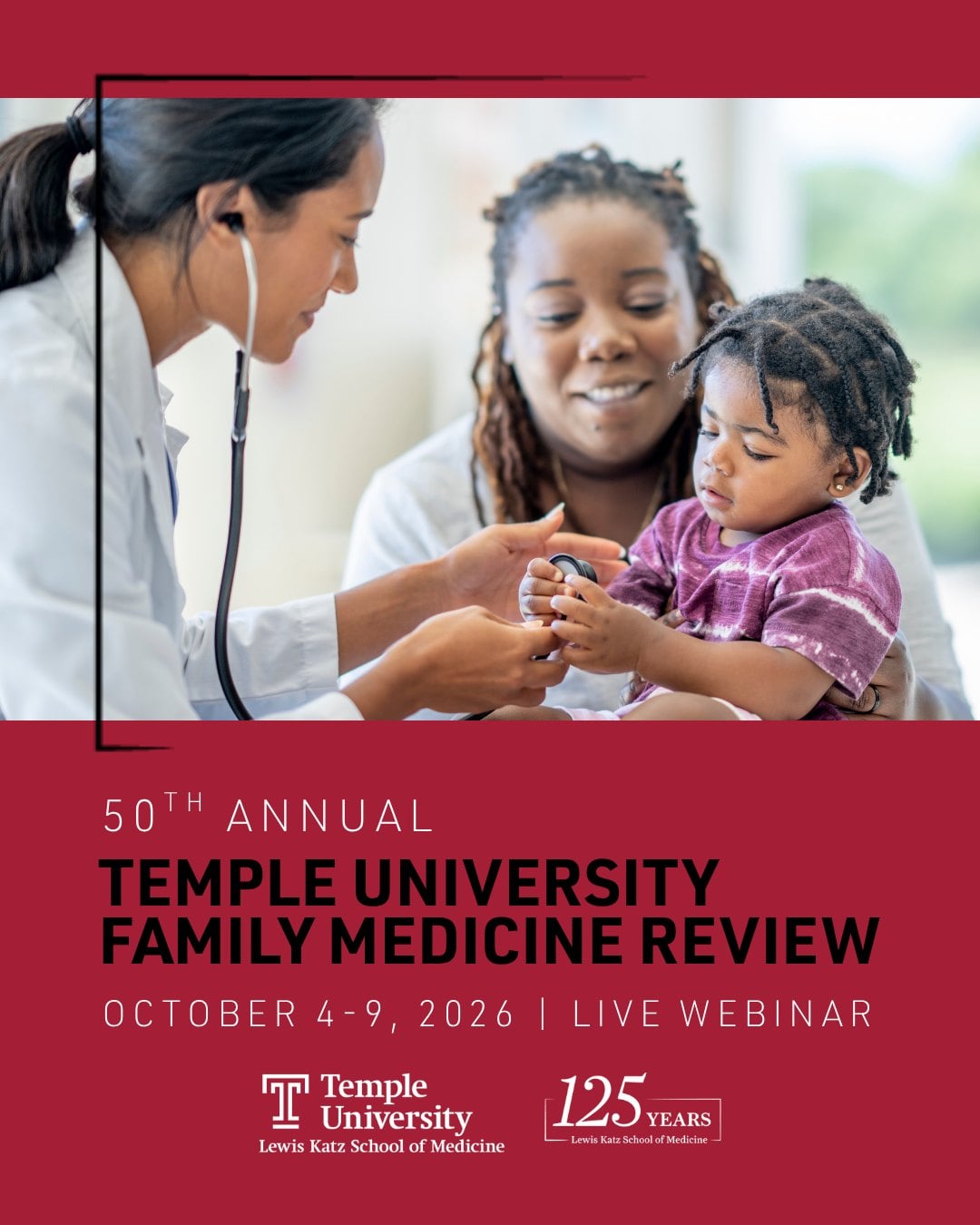
Temple University 50th Annual Family Medicine Review 2026

$120.00
This Product is shared via google drive download link, So please share your correct Gmail id while placing the order .Please note that there are no CME points or certificate associated with this course Samples for Courses Can be found here : Free Samples Here!
Temple University 50th Annual Family Medicine Review 2026
+ Target Audience: Family physicians, primary care physicians, general practitioners, internists, geriatricians, physician assistants, nurse practitioners, nurses, family medicine residents, physicians preparing for ABFM board examinations, and healthcare professionals involved in comprehensive family medicine and primary care.
+ Information:
- Conference Title: 50th Annual Temple University Family Medicine Review (with Optional Preconference Program on Geriatrics)
- Organizer: Temple University Lewis Katz School of Medicine (The Albert J. Finestone, MD Office for Continuing Medical Education) & Lancaster General Health
- Conference Dates: October 4–9, 2026
- Edition: 50th Annual
- Original Format: Live Webinar
- Program Scope: 88 Lectures, Specialty Workshops, and Optional Geriatrics Preconference
- Primary Specialty: Family Medicine and Primary Care
- Additional Focus: Internal Medicine, Geriatrics, Preventive Medicine, and ABFM Board Review
- Educational Focus: Evidence-Based Clinical Updates, Board Examination Preparation, Clinical Decision-Making, and ABFM KSA Activities
+ Course Leadership:
- Nina R. O’Connor, MD: Chair and Professor, Family and Community Medicine
- Menachem Leasy, MD: Course Director; Program Director, Family and Community Medicine Residency; Associate Professor, Clinical Family and Community Medicine
- Arnold I. Meyer, EdD, FACEHP: Senior Director, Office for Continuing Medical Education
+ Description:
The Temple University 50th Annual Family Medicine Review 2026 is a comprehensive, week-long continuing medical education program designed to provide family physicians, general practitioners, internists, and primary care professionals with practical clinical updates and preparation for the American Board of Family Medicine (ABFM) examination.
Celebrating its 50th annual edition, the conference is organized by Temple University Lewis Katz School of Medicine in collaboration with Lancaster General Health. The original program features 88 lectures, specialty workshops, and an optional Geriatrics Preconference.
The curriculum provides a broad review of contemporary family medicine, integrating evidence-based clinical recommendations, diagnostic evaluation, treatment strategies, preventive care, chronic disease management, and practical approaches to common conditions encountered in outpatient and primary care practice.
Major educational areas include geriatrics, artificial intelligence in primary care, public health, preventive medicine, nephrology, urology, neurology, gastroenterology, infectious diseases, pulmonology, allergy and immunology, dermatology, endocrinology, rheumatology, psychiatry, cardiology, otolaryngology, ophthalmology, hematology and oncology, orthopedics, sports medicine, hospice and palliative medicine, pediatrics, and women’s health.
The program emphasizes actionable clinical pearls, board examination preparation, and opportunities for structured clinical knowledge assessment.
Learning Objectives
Following completion of this program, participants should be able to:
- Diagnose and treat common Family Medicine problems using current and latest evidence-based information.
- Prepare to pass the American Board of Family Medicine exam.
- Increase knowledge, competence, and performance through a comprehensive clinical review.
- Master the essentials of geriatric care including mood disorders, polypharmacy, and dementia (Preconference on Geriatrics).
- Elevate skills in managing gait disorders, acute pain, and end-of-life care in older adults (Preconference on Geriatrics).
Comprehensive Educational Topics
1. Geriatric Medicine
Review of important clinical conditions affecting older adults, including cognitive impairment, mood disorders, medication management, mobility limitations, and coordinated long-term care.
Key Topics:
- Geriatric clinical assessment
- Dementia and cognitive disorders
- Mood disorders in older adults
- Polypharmacy and medication review
- Gait and mobility disorders
- Acute pain in older adults
- End-of-life care
- Patient-centered geriatric management
2. Artificial Intelligence in Primary Care
Educational updates on the role of artificial intelligence in clinical medicine, including potential applications in healthcare delivery and medical decision support.
3. Public Health and Preventive Medicine
Review of preventive healthcare, risk factor modification, population health, screening considerations, and evidence-based approaches to disease prevention.
4. Nephrology
Clinical review of kidney-related disorders encountered in family medicine, including diagnostic evaluation, chronic disease considerations, and appropriate specialist referral.
5. Urology
Evaluation and management considerations for common urologic conditions encountered in primary care.
6. Neurology
Clinical approaches to neurological symptoms and disorders commonly encountered in outpatient medicine, with attention to diagnostic assessment and treatment planning.
7. Gastroenterology
Review of common gastrointestinal conditions, diagnostic strategies, and clinical management principles relevant to family medicine.
8. Infectious Diseases
Educational updates on the recognition, diagnosis, prevention, and treatment of infectious conditions commonly encountered in primary care.
9. Pulmonology and Allergy
Review of respiratory and allergic disorders, clinical assessment, treatment strategies, and chronic disease management.
10. Dermatology
Practical approaches to evaluating skin conditions, recognizing important dermatologic findings, and selecting appropriate treatment or referral strategies.
11. Endocrinology and Metabolic Disorders
Clinical updates involving endocrine and metabolic conditions commonly encountered in primary care.
12. Rheumatology
Review of rheumatologic conditions, clinical assessment, differential diagnosis, and management considerations.
13. Psychiatry and Behavioral Health
Recognition and management of common mental health conditions, behavioral concerns, and psychiatric presentations in family medicine.
14. Cardiology
Review of cardiovascular conditions, clinical risk assessment, preventive care, diagnostic evaluation, and management strategies.
15. Otolaryngology (ENT)
Assessment and management considerations for ear, nose, and throat conditions encountered in family medicine.
16. Ophthalmology
Clinical approaches to common eye complaints, recognition of important ocular findings, and appropriate referral considerations.
17. Hematology and Oncology
Review of hematologic and oncologic conditions relevant to primary care, including clinical recognition, diagnostic considerations, and coordinated management.
18. Orthopedics and Sports Medicine
Clinical assessment of musculoskeletal conditions, sports injuries, rehabilitation considerations, and management approaches relevant to outpatient practice.
19. Hospice and Palliative Medicine
Review of symptom management, serious illness care, end-of-life communication, and coordinated patient and family support.
20. Pediatrics
Clinical review of common pediatric conditions, preventive medicine, and child health management relevant to family physicians.
21. Women’s Health (OB/GYN)
Educational coverage of women’s health, reproductive medicine, gynecologic conditions, and related primary care considerations.
Optional Geriatrics Preconference
The original conference includes an optional educational program focused on practical geriatric medicine.
Key Areas:
- Mood disorders affecting older adults
- Polypharmacy
- Dementia
- Gait disorders
- Acute pain management
- End-of-life care
The preconference emphasizes clinical reasoning, individualized care, functional assessment, medication safety, and the management of complex conditions affecting older patients.
ABFM Board Review and Clinical Knowledge Assessment
The symposium is designed to support family medicine board examination preparation through a comprehensive review of clinical concepts, diagnostic principles, and evidence-based patient management.
Educational Focus:
- ABFM board examination preparation
- Clinical knowledge reinforcement
- Evidence-based treatment strategies
- Common family medicine presentations
- Diagnostic decision-making
- Clinical practice updates
- ABFM Knowledge Self-Assessment (KSA) activities
Educational Highlights
- 50th Annual Family Medicine Review
- 88 scheduled educational lectures
- Specialty workshops
- Optional Geriatrics Preconference
- Comprehensive family medicine clinical updates
- ABFM board examination preparation
- ABFM Knowledge Self-Assessment activities
- Geriatric medicine and chronic disease management
- Artificial intelligence in primary care
- Public health and preventive medicine
- Nephrology and urology
- Neurology and gastroenterology
- Infectious diseases and respiratory medicine
- Dermatology and endocrinology
- Rheumatology and behavioral health
- Cardiology and cardiovascular risk management
- Otolaryngology and ophthalmology
- Hematology and oncology
- Orthopedics and sports medicine
- Hospice and palliative medicine
- Pediatrics and women’s health
- Evidence-based clinical decision-making
Clinical & Educational Value
The Temple University 50th Annual Family Medicine Review 2026 provides a comprehensive educational overview of clinical family medicine and contemporary primary care.
The program integrates preventive healthcare, internal medicine, chronic disease management, diagnostic evaluation, behavioral medicine, geriatric care, pediatric medicine, and multidisciplinary clinical updates.
Its extensive specialty coverage supports family physicians and primary care professionals seeking to strengthen clinical knowledge, review evidence-based treatment principles, and prepare for family medicine board examinations.
The optional Geriatrics Preconference provides additional educational emphasis on the complex needs of older adults, including polypharmacy, dementia, mood disorders, mobility concerns, and end-of-life care.
Important Access Information
This description summarizes the original Temple University educational conference and its published scope.
The original program identifies 88 lectures, specialty workshops, and an optional Geriatrics Preconference. However, the supplied information does not contain the complete titles, schedules, or faculty assignments for all 88 lectures.
The conference program does not independently verify that every original lecture, workshop, preconference activity, or ABFM KSA component is included in any separately supplied digital package.
Official conference registration, live participation, access to Temple University’s learning platform, ABFM KSA completion or credit, CME credits, certificates, and official board review benefits are not included unless expressly specified in the purchased package.
Short Description
The Temple University 50th Annual Family Medicine Review 2026 provides comprehensive primary care and family medicine education featuring 88 scheduled lectures, specialty workshops, ABFM board review preparation, and an optional Geriatrics Preconference. Topics span internal medicine, geriatrics, cardiology, endocrinology, neurology, dermatology, infectious diseases, pediatrics, women’s health, preventive medicine, and additional medical specialties.
Topics
SUNDAY, October 4, 2026 — Geriatrics Preconference Program (Optional – Additional Charge)
-
1:00 p.m.: Welcome and Introductions — Menachem Leasy, MD
-
Section 1
-
1:05 p.m.: PC1. Depression and Anxiety in the Geriatric Population
-
1:40 p.m.: PC2. Dementia
-
2:15 p.m.: PC3. Polypharmacy
-
2:50 p.m.: Q & A
-
3:10 p.m.: Break
-
-
Section 2
-
3:40 p.m.: PC4. Clinical Approach to Gait Disorders
-
4:10 p.m.: PC5. Pharmacologic Therapy for Acute Pain
-
4:40 p.m.: PC6. Palliative and End of Life Care
-
5:10 p.m.: Q & A
-
5:35 p.m.: Adjourn
-
SUNDAY, October 4, 2026 — Main Review Conference & Evening Workshops
-
6:20 p.m.: Introduction of the 25th Annual Albert J. Finestone, MD Lecture
-
6:25 p.m.: 1. Artificial Intelligence in Primary Care Medicine
-
7:25 p.m.: Q & A
-
7:40 – 10:15 p.m. — Sunday Evening Workshops
-
7:40 – 8:55 p.m.: 72. Pediatric Immunizations 2026
-
7:40 – 8:55 p.m.: 73. Orthopedics and Sports Medicine Workshop
-
9:00 – 10:15 p.m.: 74. Endocrinology for the Primary Care Physician
-
9:00 – 10:15 p.m.: 75. Hospice and Palliative Medicine
-
MONDAY, October 5, 2026
-
7:25 a.m.: Welcome and Introductory Remarks — Nina R. O’Connor, MD; Menachem Leasy, MD; Arnold I. Meyer, EdD, FACEHP
-
7:40 – 8:40 a.m.: Pre-Course Exam
-
8:40 a.m.: Welcoming Remarks from the Moderator
-
Public Health and Preventive Medicine
-
8:45 a.m.: 2. Adult Immunizations Update – 2026
-
9:20 a.m.: 3. Cancer Screening Update
-
9:55 a.m.: 4. Seasonal Respiratory Viruses
-
10:15 a.m.: Q & A
-
10:35 a.m.: Break
-
-
Nephrology
-
10:50 a.m.: 5. Hypertension Update 2026
-
11:20 a.m.: 6. Chronic Kidney Disease
-
11:45 a.m.: 7. Challenging Hypertension Cases
-
12:10 p.m.: 8. Hyperkalemia, Hypokalemia, Hyponatremia Cases
-
12:30 p.m.: Q & A
-
12:50 p.m.: Lunch
-
-
Urology
-
1:35 p.m.: 9. Prostate Conditions
-
1:55 p.m.: 10. Overactive Bladder
-
2:15 p.m.: 11. Scrotal Anomalies
-
2:35 p.m.: Q & A
-
2:55 p.m.: Break
-
-
Neurology/Geriatrics
-
3:10 p.m.: 12. Alzheimer’s Disease
-
3:30 p.m.: 13. Headaches
-
3:55 p.m.: 14. Stroke Prevention and Addressing Post Stroke Issues
-
4:15 p.m.: Q & A (Part 1)
-
4:35 p.m.: Break
-
4:45 p.m.: 15. Concussions
-
5:05 p.m.: 16. Bell’s Palsy
-
5:30 p.m.: 17. Meningitis
-
5:50 p.m.: Q & A (Part 2)
-
6:10 p.m.: Dinner
-
-
6:55 – 9:30 p.m. — Monday Evening Workshops
-
6:55 – 8:10 p.m.: 76. Neurology Workshop
-
6:55 – 9:30 p.m.: 77. Knowledge Self-Assessment (KSA) on Heart Disease (5-Minute Break Included)
-
8:15 – 9:30 p.m.: 78. Rheumatology Workshop
-
TUESDAY, October 6, 2026
-
7:55 a.m.: Welcoming Remarks from the Moderator
-
Gastroenterology
-
8:00 a.m.: 18. Chronic Constipation
-
8:20 a.m.: 19. Abnormal Liver Enzymes
-
8:45 a.m.: 20. New Therapies and Controversies for H. pylori
-
9:10 a.m.: Q & A
-
9:30 a.m.: Break
-
-
Infectious Diseases
-
9:45 a.m.: 21. Infectious Disease Cases You Can’t Afford to Miss
-
10:05 a.m.: 22. Long COVID
-
10:25 a.m.: 23. Hepatitis A, B, and C
-
10:45 a.m.: Q & A (Part 1)
-
11:05 a.m.: Break
-
11:20 a.m.: 24. Foodborne Illnesses
-
11:40 a.m.: 25. Sexually Transmitted Diseases
-
12:05 p.m.: Q & A (Part 2)
-
12:25 p.m.: Lunch
-
-
Pulmonology
-
1:25 p.m.: 26. Sarcoidosis
-
1:50 p.m.: 27. Pulmonary Embolism
-
2:10 p.m.: 28. Asthma
-
2:40 p.m.: 29. COPD – Review of the COPD GOLD Guidelines
-
3:00 p.m.: Q & A
-
3:20 p.m.: Break
-
-
Dermatology
-
3:35 p.m.: 30. Common Cutaneous Conditions (Part 1)
-
4:00 p.m.: 31. Cultural Issues Affecting Skin Health and Pigmentation Disorders
-
4:30 p.m.: 32. Common Cutaneous Conditions (Part 2)
-
5:00 p.m.: 33. Acne, Psoriasis, and Eczema Cases
-
5:25 p.m.: Q & A
-
5:45 p.m.: Dinner
-
-
6:30 – 9:05 p.m. — Tuesday Evening Workshops
-
6:30 – 7:45 p.m.: 79. Ophthalmology Workshop
-
6:30 – 9:05 p.m.: 80. Knowledge Self-Assessment (KSA) on Diabetes (5-Minute Break Included)
-
7:50 – 9:05 p.m.: 81. Otolaryngology Workshop
-
WEDNESDAY, October 7, 2026
-
7:55 a.m.: Welcoming Remarks from the Moderator
-
Endocrinology and Metabolic Disorders
-
8:00 a.m.: 34. Type 2 Diabetes Update
-
8:35 a.m.: 35. Thyroid Conditions
-
9:00 a.m.: 36. Adrenal Disorders
-
9:25 a.m.: 37. Low Testosterone Levels
-
9:50 a.m.: 38. Challenging Type 2 Diabetes Cases
-
10:15 a.m.: Q & A
-
10:35 a.m.: Break
-
-
Rheumatology
-
10:50 a.m.: 39. Rheumatoid Arthritis
-
11:10 a.m.: 40. Fibromyalgia
-
11:30 a.m.: 41. Women’s Health Rheumatology Cases
-
11:50 a.m.: Q & A
-
12:10 p.m.: Lunch
-
-
Psychiatry
-
12:55 p.m.: 42. Depression
-
1:20 p.m.: 43. Eating Disorders
-
1:40 p.m.: 44. Anxiety
-
2:10 p.m.: 45. Post Traumatic Stress Disorder
-
2:45 p.m.: 46. Psychotropic Medications for the Geriatric Patient
-
3:05 p.m.: Q & A
-
3:25 p.m.: Break
-
-
3:35 – 6:10 p.m. — Wednesday Afternoon Workshops
-
3:35 – 4:50 p.m.: 82. Hematology Cases
-
3:35 – 6:10 p.m.: 83. Knowledge Self-Assessment (KSA) on Hypertension (5-Minute Break Included)
-
4:55 – 6:10 p.m.: 84. Hyperlipidemia, Coronary Artery Disease, and Coronary Risk Assessment Cases
-
THURSDAY, October 8, 2026
-
7:55 a.m.: Welcoming Remarks from the Moderator
-
Cardiology
-
8:00 a.m.: 47. Atherosclerotic Cardiovascular Disease
-
8:30 a.m.: 48. Sports and Exercise Cardiology
-
8:55 a.m.: 49. Secondary Prevention of Heart Disease in Women
-
9:20 a.m.: 50. Heart Failure
-
9:45 a.m.: Q & A
-
10:05 a.m.: Break
-
-
Otolaryngology and Ophthalmology
-
10:15 a.m.: 51. Swallowing Issues
-
10:35 a.m.: 52. Diabetic Retinopathy
-
10:55 a.m.: 53. Evaluating Neck Masses
-
11:25 a.m.: 54. Pediatric Otology Cases
-
11:55 a.m.: Q & A
-
12:15 p.m.: Lunch
-
-
Hematology/Oncology
-
1:00 p.m.: 55. Thrombocytopenia
-
1:25 p.m.: 56. Diagnostic Approach to the Patient with Erythrocytosis/Polycythemia
-
1:50 p.m.: 57. Leukopenia and Leukocytosis
-
2:15 p.m.: 58. Case Studies in Hematology
-
2:35 p.m.: Q & A
-
2:55 p.m.: Break
-
-
Orthopedics/Sports Medicine
-
3:15 p.m.: 59. Elbow and Shoulder Injuries
-
3:45 p.m.: 60. Lower Extremity Issues
-
4:15 p.m.: 61. Low Back Pain Cases
-
4:45 p.m.: 62. Hand and Wrist Injuries
-
5:15 p.m.: Q & A
-
5:35 p.m.: Dinner
-
-
Evening Lecture
-
6:35 p.m.: 63. The Mark A. Connelly Annual Lecture – 50 Years of Advances in Gastroenterology: From Barium Enemas to Biologicals
-
7:35 p.m.: Q & A
-
8:00 p.m.: Adjournment
-
FRIDAY, October 9, 2026
-
7:50 a.m.: Welcoming Remarks from the Moderator
-
Pediatrics
-
7:55 a.m.: 64. Obesity and Weight Management
-
8:20 a.m.: 65. Pediatric EKG Interpretation
-
8:45 a.m.: 66. Malnutrition
-
9:15 a.m.: 67. Pediatric Respiratory Cases
-
9:45 a.m.: Q & A
-
10:05 a.m.: Break
-
-
Women’s Health (OB/GYN)
-
10:20 a.m.: 68. Infertility Issues
-
10:40 a.m.: 69. Unique Cardiology Cases involving Women’s Health
-
11:05 a.m.: 70. Endometriosis and Uterine Fibroids
-
11:30 a.m.: 71. Sexual Dysfunction
-
11:55 a.m.: Q & A
-
12:15 p.m.: Lunch
-
-
1:05 – 3:40 p.m. — Friday Afternoon Workshops
-
1:05 – 2:20 p.m.: 85. Nephrology Workshop
-
1:05 – 2:20 p.m.: 86. Allergy and Pulmonary Workshop
-
2:25 – 3:40 p.m.: 87. Obstetrics and Gynecology Workshop
-
2:25 – 3:40 p.m.: 88. Infectious Disease Workshop
-
-
3:40 p.m.: Break
-
4:00 – 5:00 p.m.: Post-Course Exam
-
5:00 p.m.: Adjournment
Related products
Critical Care - Emergency medicine
Critical Care - Emergency medicine
40th ISICEM International Symposium on Intensive Care & Emergency Medicine 2021

Medical Accounts

Medical Accounts
Critical Care - Emergency medicine
Critical Care - Emergency medicine

Pediatrics