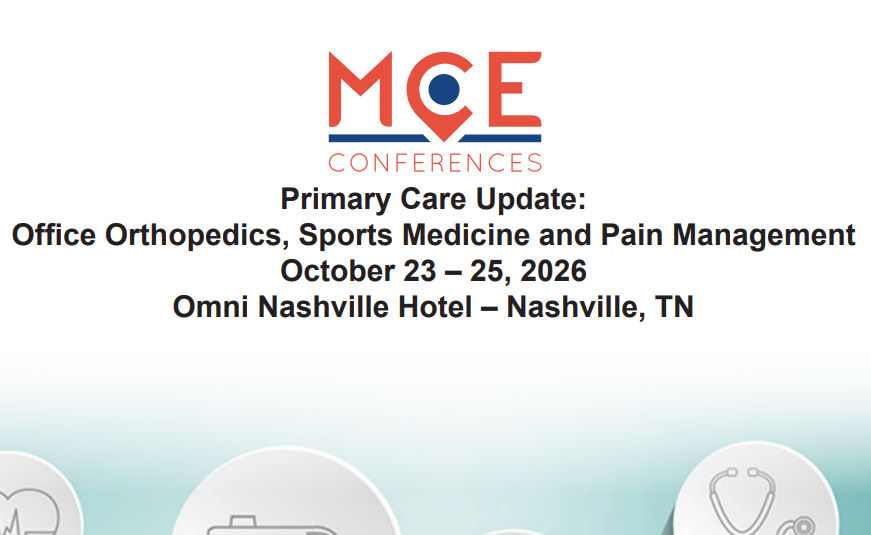
MCE Conferences Primary Care Update Office Orthopedics, Sports Medicine and Pain Management Oct 23, 2026 – Oct 25, 2026
MCE Conferences Primary Care Update: Office Orthopedics, Sports Medicine and Pain Management 2026 is a continuing medical education (CME) conference focused on practical orthopedic assessment, sports medicine, musculoskeletal disorders, and evidence-based pain management in primary care. Held October 23–25, 2026, in Nashville, Tennessee, with on-site and livestream attendance options, this educational program provides clinically relevant approaches to joint examinations, office-based injections, appropriate diagnostic imaging, chronic pain treatment, and safe opioid prescribing.
Target Audience
Primary Care Physicians, Family Physicians, Internists, Orthopedic Specialists, Orthopedic Surgeons, Sports Medicine Physicians, Pain Management Specialists, Anesthesiologists, Physical Medicine and Rehabilitation (PM&R) Specialists, Rheumatologists, Addiction Medicine Specialists, Psychiatrists, Residents, Fellows, and healthcare professionals involved in musculoskeletal medicine, outpatient orthopedic assessment, and chronic pain management.
Course Information
- Conference Title: Primary Care Update: Office Orthopedics, Sports Medicine and Pain Management
- Organizer: MCE Conferences
- Dates: October 23–25, 2026
- Location: Omni Nashville Hotel, Nashville, Tennessee, USA
- Attendance Options: On-Site and Livestream
- Specialties: Primary Care / Family Medicine / Orthopedics / Sports Medicine / Pain Management
- Accreditation: MCE Conferences is accredited by the Accreditation Council for Continuing Medical Education (ACCME) to provide continuing medical education for physicians.
The MCE Conferences Primary Care Update: Office Orthopedics, Sports Medicine and Pain Management 2026 provides a practical educational review of common musculoskeletal conditions and chronic pain disorders frequently encountered in family medicine, internal medicine, sports medicine, and outpatient clinical practice.
The conference emphasizes the importance of accurate clinical evaluation, focused physical examination, and appropriate treatment selection when managing patients with orthopedic complaints, sports-related injuries, and persistent pain.
A major component of the educational program focuses on office-based orthopedic assessment, particularly the evaluation of shoulder and knee disorders. Participants review focused examination techniques, common indications for joint injections, and practical approaches to identifying musculoskeletal abnormalities that may require additional diagnostic investigation or specialist referral.
The curriculum also addresses appropriate use of magnetic resonance imaging (MRI) in orthopedic and sports medicine practice. By emphasizing clinical indications and evidence-based imaging decisions, the conference helps physicians avoid unnecessary diagnostic testing while supporting timely evaluation of clinically significant conditions.
Another central focus is chronic pain management, including the application of CDC opioid prescribing guidelines, individualized treatment planning, and strategies for initiating, adjusting, and tapering opioid therapy. The educational content highlights the importance of balancing symptom control, functional improvement, medication safety, and potential treatment risks.
Additional instruction examines the pharmacologic management of chronic pain, including the mechanisms of action and clinical considerations associated with muscle relaxants and anticonvulsant medications commonly used in different pain conditions.
The conference also explores physical examination techniques for evaluating spine-related pain, helping clinicians recognize relevant musculoskeletal findings and develop structured approaches to patient assessment.
Through expert-led educational sessions, this program supports primary care physicians and other healthcare professionals in improving orthopedic examination skills, making appropriate imaging decisions, and integrating evidence-based pain management strategies into routine clinical practice.
Presenting Faculty
Matthew B. Anastasi, MD, CAQSM
- Lead Primary Care Sports Physician, Arizona State University, Tempe, Arizona
- Assistant Professor of Orthopedics, Mayo Clinic College of Medicine and Science, Arizona
- Consultant, Division of Sports Medicine, Department of Orthopedic Surgery, Mayo Clinic, Phoenix, Arizona
- Team Physician, Arizona Diamondback
Steven P. Stanos, DO
- Clinical Professor, Elson S. Floyd College of Medicine, Washington State University, Spokane, Washington
- Clinical Instructor, Department of Anesthesiology and Pain Medicine, University of Washington, Seattle, Washington
Learning Objectives
At the conclusion of this activity, participants will be able to:
- Discuss common in-office injections for the shoulder and knee.
- Perform a focused knee and shoulder exam in the office.
- Determine appropriate indications for MRI and avoid unnecessary imaging.
- Apply CDC opioid prescribing guidelines to the management of chronic pain, including strategies for initiating, adjusting, and tapering treatment.
- Highlight mechanisms of action of the various muscle relaxers and anticonvulsants commonly used to treat various chronic pain states.
- Apply physical exam techniques used for assessing spine-related pain conditions.
Key Topics Covered
- Primary Care Orthopedics and Musculoskeletal Medicine
- Office-Based Shoulder and Knee Examination
- Common Shoulder and Knee Injection Techniques
- Sports Medicine and Musculoskeletal Injury Assessment
- Evaluation of Common Orthopedic Complaints
- Appropriate MRI Utilization in Musculoskeletal Disorders
- Avoiding Unnecessary Diagnostic Imaging
- Evidence-Based Chronic Pain Management
- CDC Opioid Prescribing Guidelines
- Opioid Therapy Initiation, Adjustment, and Tapering
- Medication Safety in Chronic Pain Treatment
- Muscle Relaxants and Their Mechanisms of Action
- Anticonvulsant Medications in Chronic Pain Management
- Spine-Related Pain Assessment
- Physical Examination Techniques for Spinal Disorders
- Outpatient Musculoskeletal Diagnosis and Treatment
- Integrating Orthopedics and Pain Management into Primary Care
Clinical & Educational Value
This MCE Conferences educational program offers practical knowledge for physicians managing musculoskeletal complaints, sports-related conditions, and chronic pain in outpatient practice.
The conference combines focused orthopedic examination, office-based procedures, diagnostic imaging decisions, and pharmacologic pain management to support efficient, evidence-based clinical care.
It is particularly relevant to family physicians, internists, sports medicine specialists, orthopedic clinicians, and pain management professionals seeking to strengthen their assessment and treatment skills.
Short Description
MCE Conferences Primary Care Update: Office Orthopedics, Sports Medicine and Pain Management, October 23–25, 2026, is a CME conference featuring Matthew B. Anastasi, MD, CAQSM, and Steven P. Stanos, DO. The program covers shoulder and knee examinations, office-based joint injections, MRI indications, chronic pain management, CDC opioid prescribing guidelines, muscle relaxants, anticonvulsants, and spine-related pain assessment. Held at the Omni Nashville Hotel, Nashville, Tennessee, with on-site and livestream attendance options.
Topics
Friday, October 23, 2026
-
7:15 AM: On-Site and Livestream Check-In Opens – Zoom ID: 827 2649 5842 / Password: Oct23
-
7:15 AM – 8:45 AM: Breakfast Provided for Registered Participants
-
7:30 AM – 8:30 AM | 1 – Knee Evaluation, Exam, and Imaging Pearls — Dr. Matthew B. Anastasi
-
Objectives: 1) Highlight key questions to ask for the history of a patient presenting with knee pain 2) Describe pertinent knee physical exam findings 3) List which x-ray views are most important 4) Describe when it is appropriate to order an MRI 5) Discuss when it is appropriate to refer to an orthopedic surgeon 6) Participate in a live knee exam demonstration
-
-
8:30 AM – 8:35 AM: BREAK
-
8:35 AM – 9:35 AM | 2 – Hip and Ankle Evaluations, Exam, and Imaging Pearls — Dr. Matthew B. Anastasi
-
Objectives: 1) Review hip and ankle exam skills 2) Discuss exam findings associated with common hip and ankle conditions 3) Review appropriate imaging modalities for hip and ankle evaluations
-
-
9:35 AM – 9:45 AM: BREAK
-
9:45 AM – 10:45 AM | 3 – Update on Pathophysiology of Pain and Review of Multidisciplinary Approaches in the Management of Fibromyalgia — Dr. Steven P. Stanos
-
Objectives: 1) Review mechanisms of pain perception, including peripheral and central changes, and how they serve as targets for pharmacologic and non-pharmacologic interventions for pain management 2) Describe recent genetic, biochemical, and imaging evidence that supports the etiology of fibromyalgia 3) Highlight the American College of Rheumatology criteria for the diagnosis of fibromyalgia, including the updated 2010 version
-
-
10:45 AM – 10:50 AM: BREAK
-
10:50 AM – 11:50 AM | 4 – Rational Polypharmacy for Chronic Pain Management — Dr. Steven P. Stanos
-
Objectives: 1) Apply an updated pathophysiologic understanding to targeting and treating pain 2) Review the mechanisms of action of the various muscle relaxers and anticonvulsants commonly used to treat various chronic pain states 3) Utilize case examples to better understand titration and adjustment of adjuvant analgesics
-
Saturday, October 24, 2026
-
7:15 AM: Livestream Check-In Opens – Zoom ID: 884 6644 4530 / Password: Oct24
-
7:15 AM – 8:45 AM: Breakfast Provided for Registered Participants
-
7:30 AM – 8:30 AM | 5 – Physical Exam for Low Back Pain: A Hands-On Approach — Dr. Steven P. Stanos
-
Objectives: 1) Discuss how several structures in the lumbar spine may serve as pain generators, including disc, facet joint, myofascial, and ligamentous structures 2) Review basic physical exam techniques used for assessing spine-related pain conditions, with an emphasis on myofascial pain patterns and trigger points 3) Differentiate lumbar radiculopathy signs and symptoms from other causes of low back pain, including facet-mediated, myofascial, and sacroiliac joint pain
-
-
8:30 AM – 8:35 AM: BREAK
-
8:35 AM – 9:35 AM | 6 – Osteoarthritis Update — Dr. Steven P. Stanos
-
Objectives: 1) Develop a deeper understanding of the evolving pathophysiology of OA and the role of the central nervous system 2) Review pharmacologic agents used in treating OA, including NSAIDs, topical analgesics, and opioids 3) Apply rehabilitation principles and simple exercise strategies for knee OA management, including patient resources and a case-based application
-
-
9:35 AM – 9:45 AM: BREAK
-
9:45 AM – 10:45 AM | 7 – Shoulder Evaluation, Exam, and Imaging Pearls — Dr. Matthew B. Anastasi
-
Objectives: 1) Discuss pertinent surface anatomy and review how to perform a focused shoulder exam in the office 2) Recognize rotator cuff pathology and impingement during a physical exam, and discuss corresponding treatment modalities 3) Review shoulder imaging modalities 4) Participate in a live shoulder exam demonstration
-
-
10:45 AM – 10:50 AM: BREAK
-
10:50 AM – 11:50 AM | 8 – Putting it All Together: Case-Based Presentation on Common Sports Medicine Injuries Part I — Dr. Matthew B. Anastasi
-
Objectives: 1) Review common sports injuries and corresponding treatments 2) Highlight the best approach for acute foot and ankle injuries 3) Best options for shoulder instability 4) Review acute hand, wrist, and elbow injury diagnoses and treatment 5) Discuss appropriate treatment for meniscal injuries
-
Sunday, October 25, 2026
-
7:15 AM: Livestream Check-In Opens – Zoom ID: 822 6717 2260 / Password: Oct25
-
7:15 AM – 8:45 AM: Breakfast Provided for Registered Participants
-
7:30 AM – 8:30 AM | 9 – Putting it All Together: Case-Based Presentation on Common Sports Medicine Injuries Part II — Dr. Matthew B. Anastasi
-
Objectives: 1) Review common sports injuries and corresponding treatments 2) Discuss the appropriate treatment for acute soft tissue injuries 3) Review diagnosis and treatment for overuse injuries, including stress fractures 4) Review femoacetabular impingement 5) Discuss when to refer to orthopedic surgery for acute knee injuries
-
-
8:30 AM – 8:35 AM: BREAK
-
8:35 AM – 9:35 AM | 10 – Office Injections — Dr. Matthew B. Anastasi
-
Objectives: 1) Discuss common in-office injections for shoulder and knee 2) Review corticosteroids and anesthetics used for joint injections 3) Discuss appropriate technique and patient positioning for all injections
-
-
9:35 AM – 9:45 AM: BREAK
-
9:45 AM – 10:45 AM | 11 – Update on Opioid Pharmacology, Risk Management Strategies, and Applying the CDC Guidelines in Primary Care — Dr. Steven P. Stanos
-
Objectives: 1) Highlight pharmacologic differences between various opioid products used for chronic pain management 2) Describe risk factors that may help to predict problematic opioid use, including addiction and misuse 3) Review the CDC Guideline for Prescribing Opioids for Chronic Pain and how it can be applied to managing patients in pain, including tapering 4) Utilize urine drug monitoring and prescription monitoring programs, as a more comprehensive monitoring of patients that may require opioid analgesics as part of a pain management regimen
-
-
10:45 AM – 10:50 AM: BREAK
-
10:50 AM – 11:50 AM | 12 – Clinical Challenges: Behavioral Health Integration and What Should You Tell Your Patients About Cannabis Use for Chronic Pain? — Dr. Steven P. Stanos
-
Objectives: 1) Highlight general principles and goals of treatment related to cognitive behavioral therapy and mindfulness training for chronic pain 2) Review nonpharmacologic strategies to calm the nervous system and decrease pain, including relaxation training and biofeedback 3) Discuss the pharmacology of cannabinoids and cannabis, and the evidence for chronic pain use and other medical conditions 4) Discuss the complexities of cannabis use and potential adverse effects, including dependence and addiction
-