ASE Registered Physician in Vascular Interpretation (RPVI) Online Review Course 2023
Introduction
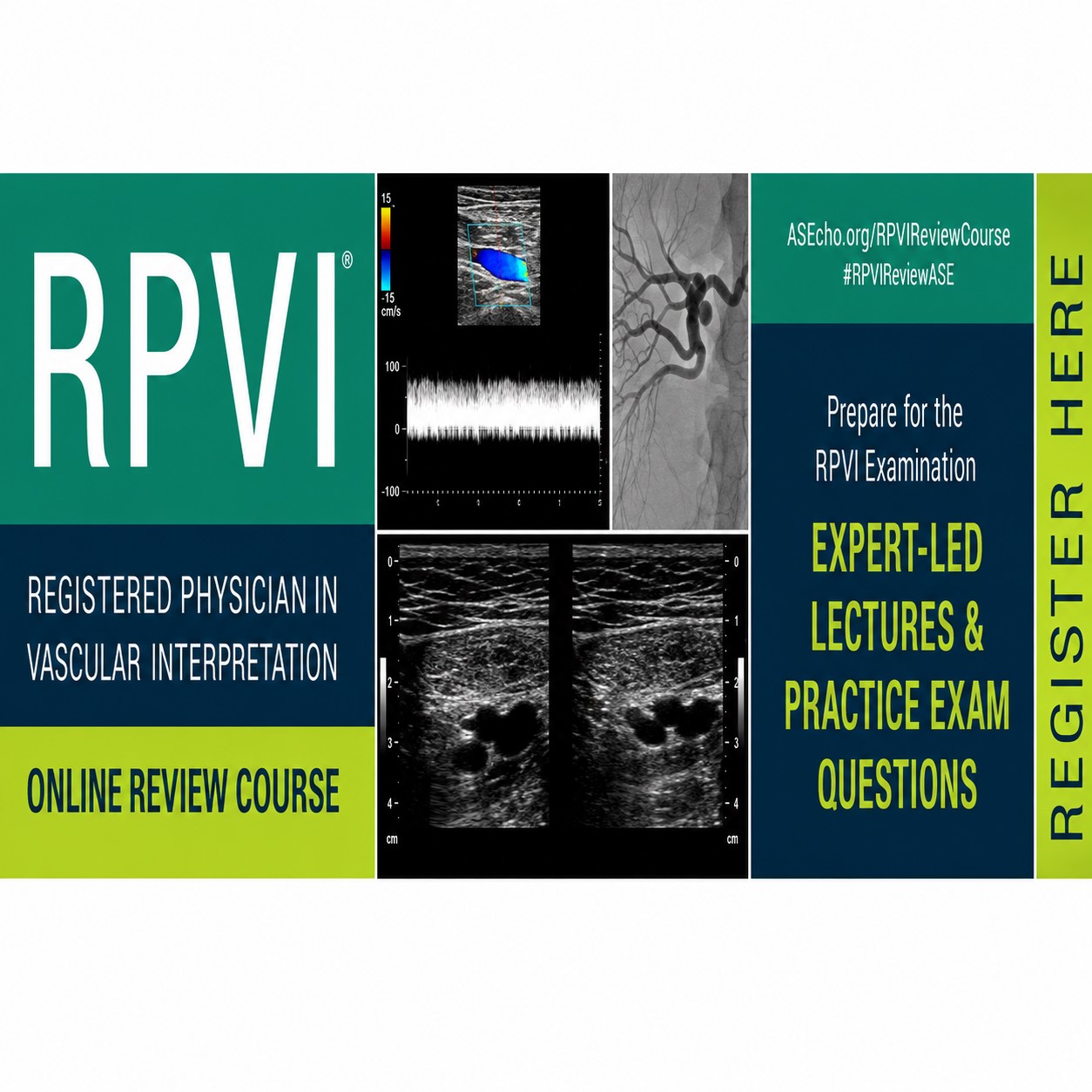
The ASE Registered Physician in Vascular Interpretation (RPVI) Online Review Course 2023 is a focused vascular ultrasound education program designed to help physicians prepare for the RPVI certification examination administered by Alliance for Physician Certification and Advancement. Developed with expert-led instruction and case-based teaching, the course provides comprehensive review material covering core principles of vascular imaging, noninvasive vascular testing, Doppler interpretation, and vascular ultrasound pathology.
The program combines:
- Vascular ultrasound interpretation
- Doppler physics
- Noninvasive vascular imaging
- Arterial and venous ultrasound
- Cerebrovascular imaging
- Peripheral vascular disease assessment
- Case-based vascular studies
- RPVI-style review questions
- Diagnostic vascular protocols
- Board-focused learning strategies
into a structured online educational review system.
The curriculum emphasizes practical interpretation skills and examination preparation while reinforcing real-world vascular imaging knowledge.
Course Overview
📚 Program: ASE RPVI Online Review Course 2023
🎥 Included Content
- 18 Video Lectures
- 18 PDF Slide Presentations
🏛️ Educational focus aligned with the Alliance for Physician Certification and Advancement RPVI examination framework.
The course is designed to provide concentrated review of major vascular interpretation topics through expert presentations, diagnostic case discussions, and practice-style questions.
Educational Focus
The curriculum focuses on:
- Vascular ultrasound interpretation
- Doppler ultrasound principles
- Noninvasive vascular diagnostics
- Peripheral arterial disease evaluation
- Venous duplex interpretation
- Cerebrovascular ultrasound
- Hemodynamic assessment
- Vascular laboratory protocols
- RPVI examination preparation
- Case-based vascular imaging review
The program integrates foundational vascular imaging science with clinically relevant diagnostic interpretation.
Educational Goals
After completing this course, learners strengthen their ability to:
- Interpret vascular ultrasound studies accurately
- Apply Doppler hemodynamic principles
- Recognize normal and abnormal vascular findings
- Evaluate arterial and venous disease using ultrasound
- Understand cerebrovascular duplex imaging
- Apply vascular laboratory diagnostic criteria
- Improve RPVI examination readiness
- Strengthen practical noninvasive vascular interpretation skills
The curriculum emphasizes both board preparation and day-to-day vascular imaging competency.
Fundamentals of Vascular Ultrasound
The course begins with foundational principles required for noninvasive vascular imaging.
Topics Include
- Ultrasound physics
- Doppler principles
- Hemodynamics
- Spectral waveform analysis
- Color Doppler fundamentals
- Duplex imaging techniques
These sessions establish the scientific and technical framework needed for accurate vascular interpretation.
Doppler Physics & Hemodynamics
A major educational component reviews Doppler-based vascular assessment.
Covered Areas
- Doppler frequency shifts
- Flow velocity interpretation
- Waveform morphology
- Resistance patterns
- Turbulent flow recognition
- Hemodynamic significance of stenosis
The curriculum reinforces practical application of Doppler findings in vascular diagnosis.
Cerebrovascular Ultrasound
Dedicated modules review carotid and cerebrovascular imaging.
Topics Include
- Carotid duplex interpretation
- Vertebral artery evaluation
- Cerebrovascular anatomy
- Plaque characterization
- Carotid stenosis grading
- Stroke risk assessment
Participants learn systematic approaches to extracranial cerebrovascular imaging interpretation.
Peripheral Arterial Disease Imaging
The program extensively reviews arterial duplex evaluation.
Educational Topics
- Lower extremity arterial ultrasound
- Peripheral arterial occlusive disease
- ABI interpretation
- Arterial stenosis assessment
- Bypass graft surveillance
- Arterial waveform analysis
The sessions focus on clinically relevant vascular laboratory interpretation.
Venous Duplex Ultrasound
A major section focuses on venous disease evaluation.
Covered Areas
- Deep venous thrombosis imaging
- Venous insufficiency studies
- Venous reflux assessment
- Upper extremity venous ultrasound
- Compression techniques
- Duplex venous protocols
The curriculum strengthens understanding of diagnostic venous imaging techniques.
Abdominal & Visceral Vascular Imaging
The course also reviews abdominal vascular studies and visceral circulation assessment.
Topics Include
- Aortic ultrasound
- Mesenteric artery evaluation
- Renal artery duplex
- Abdominal vascular anatomy
- Aneurysm surveillance
Participants learn practical interpretation strategies for abdominal vascular imaging.
Case-Based Learning
Interactive case discussions are integrated throughout the program.
Learning Components
- Real-world vascular ultrasound cases
- Diagnostic interpretation exercises
- Hemodynamic correlation
- RPVI-style review scenarios
- Clinical decision-making discussions
Case-based teaching reinforces pattern recognition and practical interpretation skills.
Practice Questions & Exam Preparation
A core objective of the course is RPVI examination readiness.
Included Features
- Practice-style review questions
- Board-focused discussions
- High-yield vascular concepts
- Examination-oriented interpretation strategies
The educational structure is designed to strengthen confidence before certification testing.
Teaching Style & Educational Experience
The review course combines:
- Expert vascular imaging lectures
- Doppler interpretation training
- Case-based teaching
- Practical hemodynamic analysis
- Examination-focused review
- Clinical vascular imaging applications
The curriculum emphasizes concise, high-yield education tailored toward noninvasive vascular interpretation.
Why This Course Stands Out
Focused RPVI Preparation
Designed specifically around core RPVI examination topics.
Strong Practical Interpretation Emphasis
Prioritizes real-world vascular ultrasound analysis.
Comprehensive Vascular Coverage
Includes arterial, venous, cerebrovascular, and abdominal vascular imaging.
Case-Based Learning Structure
Uses practical cases to reinforce diagnostic accuracy.
Expert-Led Educational Content
Provides guidance from experienced vascular imaging educators.
Clinical Value
The ASE RPVI Online Review Course 2023 delivers focused noninvasive vascular imaging education through integrated coverage of:
- Doppler ultrasound physics
- Hemodynamic interpretation
- Carotid duplex imaging
- Peripheral arterial disease evaluation
- Venous duplex studies
- Abdominal vascular ultrasound
- Waveform analysis
- Vascular laboratory protocols
- RPVI-style case review
- Examination-focused learning strategies
The combination of video lectures, slide-based review material, and case-oriented instruction makes the course highly useful for clinicians preparing for vascular interpretation certification and improving diagnostic vascular ultrasound skills.
topics are included in the course.
- Vascular Ultrasound Physics
- Image Acquisition
- Carotid Duplex
- Transcranial Doppler
- Visceral Duplex
- Aorto-iliac Duplex
- Noninvasive/Lower Extremity Venous
- Noninvasive/Lower Extremity Arterial Duplex
- Physiological Arterial Studies
- Upper Extremity Arterial Studies
- Upper Extremity Venous
CME Information: The American Society of Echocardiography is accredited by the Accreditation Council for Continuing Medical Education (ACCME) to provide continuing medical education for physicians.
The American Society of Echocardiography designates this article for a maximum of 9.75 AMA PRA Category 1 Credit(s)™. Physicians should claim only the credit commensurate with the extent of their participation in the activity.
Successful completion of this CME activity enables the participant to earn MOC points in the American Board of Internal Medicine’s (ABIM) Maintenance of Certification (MOC) program, the American Board of Pediatrics (ABP) MOC program, and/or the American Board of Anesthesiology’s (ABA) Maintenance of Certification in Anesthesiology Program® or MOCA 2.0®. It is ASE’s responsibility to submit participant completion information to ACCME for the purpose of granting ABIM and ABP MOC points and/or ABA MOCA 2.0®. Participants should claim only the credit commensurate with the extent of their participation in the activity. Physicians will earn MOC and/or MOCA 2.0 points equivalent to the amount of CME credits claimed for the activity.
ARDMS, CCI, and Sonography Canada recognize ASE’s certificates and have agreed to honor the CME credit hours toward their registry requirements for sonographers.
- Release Date: March 14, 2023
Program Agenda
- Aorto-Iliac Duplex
R. LeLeiko - Arterial Physiologic Studies
E. Kim - Basic Vascular Ultrasound Physics
M. Saric - Carotid Artery Duplex
D. Kadian-Dodov - Doppler Vascular Ultrasound Physics
M. Saric - Lower Extremity Arterial Duplex
A. Aday - Lower Extremity Venous Duplex
M. Vorsanger - Renal and Mesenteric Duplex Ultrasound
B. Wells - The TCD and TCI Examination
L. Raber - Upper Extremity Arterial Studies
S. Henkin - Upper Extremity Venous
F. Shamoun
Image Acquisitions
- Instrumentation Settings
C. Mitchell - Cerebrovascular Ultrasound
C. Mitchell - Abdominal Aorta
C. Mitchell - Mesenteric Arteries
C. Mitchell - Renal Arteries
C. Mitchell - Peripheral Arterial Lower Extremity
C. Mitchell - Peripheral Venous
C. Mitchell