
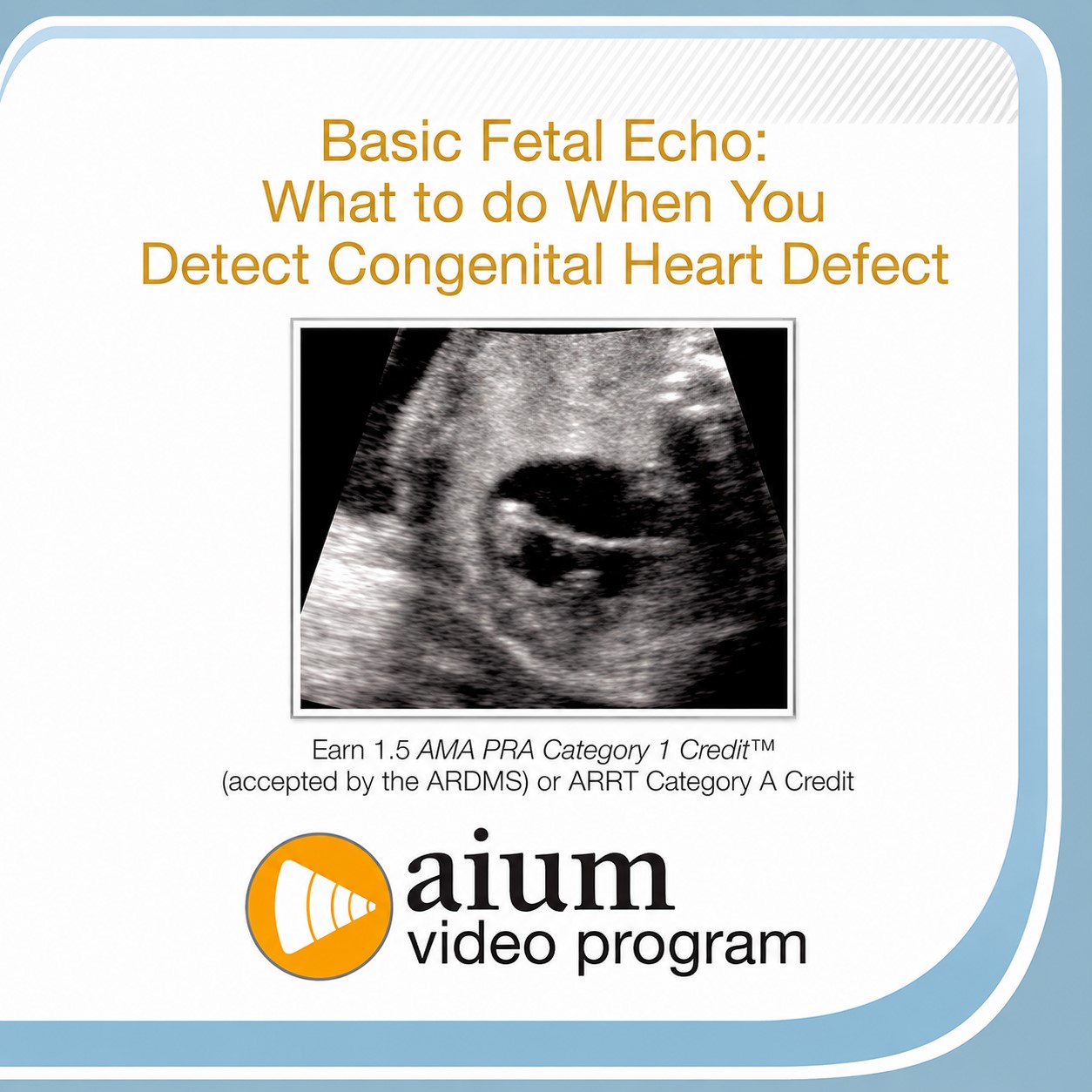
AIUM Basic Fetal Echo: What to do When You Detect Congenital Heart Defect

Original price was: $175.00.$15.00Current price is: $15.00.
Samples for Courses Can be found here : Free Samples Here!
Provider : AIUM (American Institute of Ultrasound in Medicine)
Fetal Echocardiography
This topic focuses on the evaluation of the fetal heart with ultrasound imaging, including assessment of structural and functional aspects of the fetal cardiovascular system and feto-placental circulation.
AIUM Basic Fetal Echo: What to Do When You Detect a Congenital Heart Defect
Practical Guidance for Prenatal Detection and Management of Congenital Heart Disease
Overview
AIUM Basic Fetal Echo: What to Do When You Detect a Congenital Heart Defect is a focused educational program from the American Institute of Ultrasound in Medicine designed to help healthcare professionals recognize, evaluate, and appropriately manage fetal cardiac abnormalities identified during prenatal ultrasound examinations.
This course provides a practical framework for sonographers, maternal-fetal medicine specialists, obstetricians, pediatric cardiologists, and fetal imaging professionals who encounter congenital heart defects (CHDs) during routine fetal screening or targeted fetal echocardiography.
Participants learn how to systematically assess abnormal fetal cardiac findings, determine the severity of congenital defects, understand referral pathways, communicate findings effectively with families, and coordinate multidisciplinary prenatal care to optimize maternal and neonatal outcomes.
Course Specifications
Format
- CME Video Lecture
- Case-Based Learning
- Fetal Echocardiography Review
- Practical Clinical Guidance
Educational Level
Beginner to Intermediate
Organizer
American Institute of Ultrasound in Medicine
Specialty
Fetal Echocardiography and Prenatal Cardiology
Learning Objectives
Upon completion of this activity, participants should be able to:
- Recognize common congenital heart defects during fetal ultrasound examinations.
- Identify abnormal findings requiring referral for fetal echocardiography.
- Perform a systematic evaluation of the fetal heart.
- Differentiate major congenital cardiac abnormalities from normal variants.
- Understand the clinical implications of prenatal cardiac diagnoses.
- Communicate findings effectively to patients and families.
- Coordinate multidisciplinary prenatal care.
- Develop appropriate follow-up and delivery planning strategies.
- Improve prenatal detection and management of congenital heart disease.
Core Topics Covered
Fundamentals of Fetal Cardiac Screening
Review of the essential components of fetal heart evaluation.
Topics Include
- Standard Cardiac Screening Views
- Four-Chamber View Assessment
- Outflow Tract Evaluation
- Three-Vessel View
- Three-Vessel Trachea View (3VT)
- Cardiac Situs and Axis
Participants learn how congenital heart defects may first be detected during routine obstetric ultrasound examinations.
Recognition of Congenital Heart Defects
A practical approach to identifying abnormal findings.
Common Defects Discussed
- Ventricular Septal Defects (VSD)
- Atrial Septal Defects (ASD)
- Tetralogy of Fallot
- Transposition of the Great Arteries
- Hypoplastic Left Heart Syndrome
- Coarctation of the Aorta
- Double Outlet Right Ventricle
- Pulmonary Atresia
- Ebstein Anomaly
Emphasis is placed on recognizing key sonographic clues that warrant further evaluation.
What To Do After Detection
One of the most important sections of the course focuses on next-step management.
Topics Include
- Confirming Abnormal Findings
- Repeat Imaging Strategies
- Referral to Fetal Cardiology
- Indications for Comprehensive Fetal Echocardiography
- Genetic Evaluation Considerations
- Additional Fetal Assessment
Participants learn how to avoid delayed diagnosis and ensure appropriate referral pathways.
Fetal Echocardiography Evaluation
Review of the role of specialized fetal cardiac imaging.
Topics Include
- Comprehensive Cardiac Assessment
- Doppler Evaluation
- Cardiac Function Assessment
- Rhythm Evaluation
- Severity Classification
Prenatal Counseling
Guidance on communicating diagnoses to families.
Topics Include
- Explaining Congenital Heart Defects
- Discussing Prognosis
- Counseling Regarding Outcomes
- Family Support Resources
- Shared Decision-Making
The course emphasizes compassionate and effective patient communication.
Multidisciplinary Care Planning
Management of congenital heart disease often requires coordinated care.
Team Members Include
- Maternal-Fetal Medicine Specialists
- Pediatric Cardiologists
- Neonatologists
- Pediatric Cardiac Surgeons
- Genetic Counselors
- Obstetric Providers
Participants learn how multidisciplinary planning improves neonatal outcomes.
Delivery Planning
Important considerations for pregnancies affected by congenital heart disease.
Topics Include
- Timing of Delivery
- Delivery Location Selection
- Neonatal Cardiac Care Requirements
- Transfer Planning
- Postnatal Evaluation
Postnatal Considerations
Review of neonatal management strategies.
Topics Include
- Immediate Newborn Assessment
- Echocardiographic Confirmation
- Medical Stabilization
- Surgical Planning
- Long-Term Follow-Up
Case-Based Learning
The course incorporates real-world fetal cardiac cases demonstrating:
Examples
- Simple Congenital Heart Defects
- Complex Congenital Heart Disease
- Diagnostic Pitfalls
- Prenatal Counseling Scenarios
- Multidisciplinary Care Coordination
Educational Features
Practical Clinical Focus
Concentrates on what clinicians should do after identifying an abnormal fetal heart finding.
Evidence-Based Guidance
Reflects contemporary recommendations in fetal cardiology and prenatal diagnosis.
Real-World Application
Designed to improve detection, referral, and management in everyday clinical practice.
Case-Based Teaching
Uses representative cases to reinforce learning objectives.
Target Audience
Physicians
- Maternal-Fetal Medicine Specialists
- Obstetricians and Gynecologists
- Pediatric Cardiologists
- Radiologists
- Neonatologists
Sonographers
- Obstetric Sonographers
- Fetal Echocardiography Sonographers
- Diagnostic Medical Sonographers
Advanced Practice Providers
- Nurse Practitioners
- Physician Assistants
Trainees
- OB/GYN Residents
- Maternal-Fetal Medicine Fellows
- Pediatric Cardiology Fellows
Why This Course Stands Out
Practical Approach
Focuses not only on recognizing abnormalities but also on appropriate next steps after detection.
Prenatal Management Emphasis
Addresses referral pathways, counseling, and multidisciplinary care planning.
Ideal for Screening Providers
Especially useful for clinicians performing routine obstetric ultrasound examinations.
Patient-Centered Care
Highlights communication and family counseling alongside diagnostic skills.
AIUM Educational Quality
Developed by one of the leading organizations in ultrasound education.
Fetal Echocardiography
This topic focuses on the evaluation of the fetal heart with ultrasound imaging, including assessment of structural and functional aspects of the fetal cardiovascular system and feto-placental circulation.

Education
Topics:
– Introduction
– Genetic Counseling & Testing in Fetal Heart Disease
– Surveillance of Cardiac Lesions That May Progress In Utero
– Indications for Timed Delivery
Only logged in customers who have purchased this product may leave a review.
Related products

Internal Medicine
Anesthesiology & pain medicine

Critical Care - Emergency medicine
The Brigham Board Review in Infectious Diseases Brigham and Women’s Hospital Board Review

Critical Care - Emergency medicine
Anesthesiology & pain medicine
Professional, Business, and OR Management Issues 2021 Module 7
Critical Care - Emergency medicine
ECHO-Guided Life Support Using ultrasound to categorise shock and guide initial management
Reviews
There are no reviews yet.