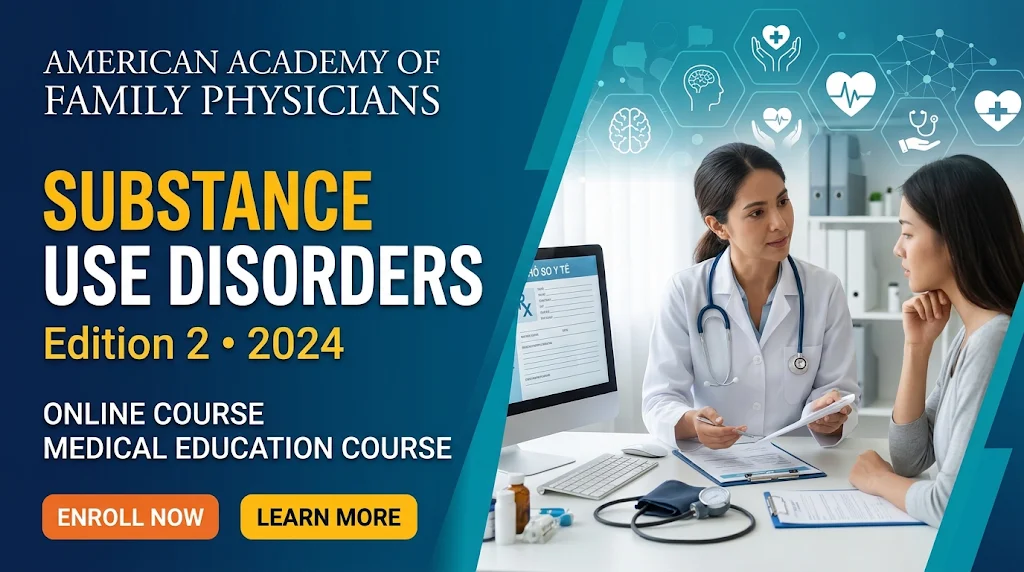

American Academy of Family Physicians Substance Use Disorders Edition 2 2024
AAFP Substance Use Disorders | Addiction Medicine | Primary Care Education | Opioid Use Disorder | Behavioral Health | Evidence-Based Addiction Treatment | 2024
Target Audience
Family Physicians, Primary Care Physicians, Internists, Addiction Medicine Specialists, Addiction Psychiatrists, Psychiatrists, Behavioral Health Specialists, Pain Management Specialists, Medical Toxicologists, Clinical Pathologists, Pulmonologists, Hepatologists, Gastroenterologists, Infectious Disease Specialists, Public Health and Preventive Medicine Specialists, Emergency Medicine Physicians, Urgent Care Physicians, and Hospitalists.
This educational program is particularly suitable for family physicians, primary care professionals, nurse practitioners, physician assistants, and other clinicians involved in identifying, treating, and supporting patients with substance use disorders (SUDs).
Information
American Academy of Family Physicians Substance Use Disorders Edition 2 2024 is a comprehensive on-demand medical education program developed by the American Academy of Family Physicians (AAFP) to strengthen clinical knowledge and practical skills in the diagnosis, treatment, and longitudinal management of substance use disorders in primary care settings.
Released in March 2024, the second edition features 18 educational modules addressing the complex medical, psychological, behavioral, and social factors associated with addiction and substance use.
Substance use disorders represent significant public health challenges, and family physicians play an essential role in early identification, clinical assessment, treatment initiation, ongoing patient support, and coordination of multidisciplinary addiction care.
The curriculum emphasizes a patient-centered, non-stigmatizing, and trauma-informed approach to addiction medicine. Participants explore the neurobiology of addiction, lived patient experiences, motivational interviewing techniques, social determinants of health, and practical strategies for establishing trust and improving patient engagement.
A major component of the program focuses on opioid use disorder (OUD), including patient assessment, buprenorphine initiation and maintenance, interpretation of toxicology testing, treatment monitoring, and coordination of ongoing care.
The educational materials also address alcohol use disorder, stimulant use disorder, nicotine dependence, smoking cessation, electronic cigarette use, and emerging psychoactive substances encountered in contemporary clinical practice.
Additional sessions explore co-occurring psychiatric conditions, including sleep disturbances, anxiety, and depression, alongside harm-reduction strategies, stigma reduction, behavioral health integration, and community recovery resources.
The course examines the impact of drug policies on clinical practice and addresses educational considerations related to DEA and Medication Access and Training Expansion (MATE) Act requirements in the context of its 2024 release.
Through video and audio lectures, clinical case studies, presentation handouts, and a clinical reflection session, the program provides a structured educational resource for healthcare professionals seeking to integrate addiction medicine into comprehensive primary care practice.
Course Details
- Course Title: American Academy of Family Physicians Substance Use Disorders Edition 2 2024
- Official Program Title: Substance Use Disorders Edition 2
- Organizer: American Academy of Family Physicians (AAFP)
- Release Date: March 2024
- Edition: Second Edition
- Course Year: 2024
- Educational Modules: 18
- Original Course Format: On-Demand Online Course
- Educational Materials: Video and audio lectures, clinical case studies, downloadable presentation handouts, and clinical reflection session
- Primary Specialty: Family Medicine and Primary Care
- Secondary Specialty: Addiction Medicine and Psychiatry
- Language: English
Learning Objectives
Upon completion of this educational activity, participants should be better able to:
- Apply DSM-5-TR criteria for substance use disorder (SUD) diagnosis.
- Address social determinants of health (SDoH) and co-occurring mental health disorders, such as sleep disturbances, anxiety, and depression.
- Use motivational interviewing and trauma-informed care principles to foster trust and patient engagement.
- Address stigma and bias in clinical care and apply practical harm-reduction strategies.
- Manage the most common substance use disorders seen in primary care—including opioid use disorder (initiation and maintenance of buprenorphine), alcohol use disorder, stimulant use disorder, nicotine/e-cigarette use, and emerging psychoactive substances.
- Interpret urine and clinical toxicology test results accurately and use them to guide patient-centered interventions.
- Coordinate multidisciplinary care effectively with behavioral health, social services, and community recovery resources while navigating drug policies and DEA/MATE Act requirements addressed in the course.
Topics – Curriculum Overview
Foundations of Addiction Medicine
- Neurobiology of addiction.
- Understanding substance use disorders.
- Lived patient perspectives on addiction and recovery.
- DSM-5-TR diagnostic criteria for substance use disorders.
- Medical, psychological, behavioral, and social factors associated with addiction.
- Social determinants of health in addiction medicine.
Patient Assessment and Treatment Planning
- Initial patient intake and clinical assessment.
- Identification of substance use disorders in primary care.
- Patient-centered treatment planning.
- Clinical assessment of individual patient needs.
- Care coordination and multidisciplinary addiction management.
- Integration of substance use disorder treatment into primary care practice.
Motivational Interviewing and Trauma-Informed Care
- Principles of motivational interviewing.
- Trauma-informed approaches to addiction treatment.
- Building trust and therapeutic relationships.
- Improving patient engagement.
- Supporting patients throughout treatment and recovery.
- Non-stigmatizing communication in clinical practice.
Opioid Use Disorder (OUD)
- Clinical assessment of opioid use disorder.
- Evidence-based management of opioid use disorder.
- Buprenorphine initiation.
- Buprenorphine maintenance therapy.
- Ongoing patient assessment and treatment monitoring.
- Patient-centered approaches to opioid addiction treatment.
- Coordination of opioid use disorder care within primary care settings.
Toxicology Testing and Clinical Interpretation
- Urine toxicology testing.
- Interpretation of clinical toxicology results.
- Integration of toxicology findings into clinical decision-making.
- Application of testing results to patient-centered interventions.
- Clinical monitoring in substance use disorder management.
Co-Occurring Psychiatric Disorders
- Identification of co-occurring mental health conditions.
- Sleep disturbances in patients with substance use disorders.
- Anxiety and substance use disorders.
- Depression and substance use disorders.
- Integration of behavioral health and addiction medicine.
- Clinical management of psychiatric comorbidities.
Stigma, Bias, and Harm Reduction
- Understanding addiction-related stigma.
- Recognizing bias in clinical care.
- Non-stigmatizing approaches to substance use disorders.
- Practical harm-reduction strategies.
- Patient-centered addiction care.
- Supporting treatment engagement and recovery.
Alcohol Use Disorder (AUD)
- Clinical identification and assessment of alcohol use disorder.
- Diagnostic considerations in primary care.
- Evidence-based treatment approaches.
- Pharmacologic and behavioral management principles.
- Ongoing patient support and recovery-oriented care.
Stimulant Use Disorder
- Recognition of stimulant use disorders.
- Clinical assessment of patients with stimulant-related conditions.
- Behavioral and supportive treatment approaches.
- Harm-reduction considerations.
- Coordination of ongoing addiction care.
Tobacco, Nicotine Dependence, and E-Cigarettes
- Nicotine dependence.
- Tobacco use assessment.
- Smoking cessation strategies.
- Electronic cigarettes and nicotine use.
- Patient counseling and behavioral interventions.
- Clinical management of nicotine-related substance use disorders.
Emerging Psychoactive Substances
- Emerging substances encountered in clinical practice.
- Clinical recognition of evolving substance use patterns.
- Assessment considerations for patients using emerging psychoactive substances.
- Patient-centered intervention and harm reduction.
Drug Policy and Regulatory Considerations
- Impact of drug policies on addiction medicine.
- Drug policy considerations in primary care practice.
- DEA-related educational considerations.
- Medication Access and Training Expansion (MATE) Act training considerations addressed in the 2024 curriculum.
Multidisciplinary Care and Recovery Support
- Coordination with behavioral health professionals.
- Integration of medical and psychological care.
- Collaboration with social services.
- Community-based recovery resources.
- Longitudinal patient support.
- Multidisciplinary approaches to substance use disorder treatment.
Clinical Case Studies and Reflection
- Case-based application of addiction medicine principles.
- Integration of diagnostic and therapeutic knowledge.
- Patient-centered clinical decision-making.
- Reflection on addiction-related clinical experiences.
- Application of educational concepts to everyday primary care practice.
Key Features
- Comprehensive second-edition AAFP substance use disorders curriculum.
- 18 educational modules.
- On-demand video and audio lectures.
- Clinical case studies and presentation handouts.
- Clinical reflection session.
- DSM-5-TR diagnostic criteria for substance use disorders.
- Neurobiology of addiction and patient perspectives.
- Motivational interviewing and trauma-informed care.
- Opioid use disorder assessment and buprenorphine treatment.
- Urine and clinical toxicology interpretation.
- Management of co-occurring psychiatric conditions.
- Alcohol and stimulant use disorder education.
- Smoking cessation and electronic cigarette use.
- Emerging psychoactive substances.
- Addiction-related stigma and harm-reduction strategies.
- Drug policy and MATE Act educational considerations.
- Multidisciplinary addiction care and community recovery support.
- Practical clinical applications for family medicine and primary care.
Why Choose AAFP Substance Use Disorders Edition 2 2024?
The AAFP Substance Use Disorders Edition 2 course offers a structured, multidisciplinary approach to addiction medicine specifically relevant to family physicians and primary care professionals.
By combining diagnostic principles, pharmacologic treatment, behavioral interventions, motivational interviewing, and harm-reduction strategies, the curriculum helps clinicians develop a comprehensive understanding of addiction and its associated clinical challenges.
Its emphasis on trauma-informed care, psychiatric comorbidities, stigma reduction, and patient engagement makes it particularly valuable for healthcare professionals seeking to provide compassionate and individualized care to patients with substance use disorders.
The integration of clinical case studies and reflection-based learning reinforces the application of addiction medicine principles to everyday medical practice, including outpatient care, behavioral health integration, and longitudinal patient management.
Frequently Asked Questions
Who should study AAFP Substance Use Disorders Edition 2 2024?
The course is primarily designed for family physicians, primary care physicians, internists, addiction medicine specialists, psychiatrists, nurse practitioners, physician assistants, and other healthcare professionals involved in substance use disorder management.
How many educational modules are included?
The program features 18 educational modules covering addiction medicine, diagnostic assessment, pharmacologic and behavioral treatment, harm reduction, and multidisciplinary patient care.
Does the course cover opioid use disorder and buprenorphine?
Yes. The curriculum addresses opioid use disorder, including buprenorphine initiation and maintenance, clinical assessment, and ongoing patient management.
Does the program cover alcohol and stimulant use disorders?
Yes. Both alcohol use disorder and stimulant use disorder are included, alongside nicotine dependence, electronic cigarette use, and emerging psychoactive substances.
Are psychiatric comorbidities covered?
Yes. The program discusses co-occurring mental health conditions, including sleep disturbances, anxiety, and depression, within the context of substance use disorder treatment.
Does the course include motivational interviewing?
Yes. Motivational interviewing, trauma-informed care, patient engagement, stigma reduction, and practical harm-reduction strategies are important components of the curriculum.
Does the program discuss DEA and MATE Act requirements?
Yes. The educational content addresses DEA and MATE Act training considerations as part of the original 2024 curriculum. Eligibility for recognized training credit or regulatory compliance should be confirmed separately with the official educational provider.
What educational materials are included in the original course?
The original program includes video and audio lectures, clinical case studies, downloadable presentation handouts, and a clinical reflection session.
Who developed this educational program?
The course was developed by the American Academy of Family Physicians (AAFP).
Topics
-
01. What is Addiction & What is Addiction: Case Studies — Elizabeth Salisbury-Afshar, MD, MPH, FAAFP, DFASAM, FACPM
-
02. Considering the Patient Perspective — Brandon George
-
03. Trauma-Informed Care — David O’Gurek, MD, FAAFP
-
04. Principles of Motivational Interviewing — David O’Gurek, MD, FAAFP
-
05. Evidence Base for Treatment of Opioid Use Disorder (OUD) — Elizabeth Salisbury-Afshar, MD, MPH, FAAFP, DFASAM, FACPM
-
06. Intake Assessment and Care Coordination — David O’Gurek, MD, FAAFP
-
07. Treatment of OUD with Buprenorphine, Part 1: Initiation of Treatment — Nicole Gastala, MD
-
08. Treatment of OUD with Buprenorphine, Part 2: Follow-up Visits and Maintenance — Margaret Lowenstein, MD, MPhil, MSHP
-
09. Interpretation of Toxicology Results — Anika Alvanzo, MD, MS, DFASAM, FACP
-
10. Managing Common Comorbidities: Sleep, Anxiety, Depression — Sky Lee, MD, AAHIVS
-
11. Addressing Harm and Stigma
-
12. Alcohol Use Disorder — Joyce Troxler, MD
-
13. Stimulant Use Disorder: The Tools in Our Mailbox — Hannah Snyder, MD
-
14. Smoking Cessation and E-Cigarettes — Marie-Elizabeth Ramas, MD, FAAFP
-
15. Harm Reduction: Any Positive Change — Elizabeth Salisbury-Afshar, MD, MPH, FAAFP, DFASAM, FACPM
-
16. Drug Policy Impact
-
17. Emerging Psychoactive Substances — Jasleen Salwan, MD, MPH
-
18. Addiction Medicine Reflection Session — Lee Radosh, MD, FAAFP, FASAM