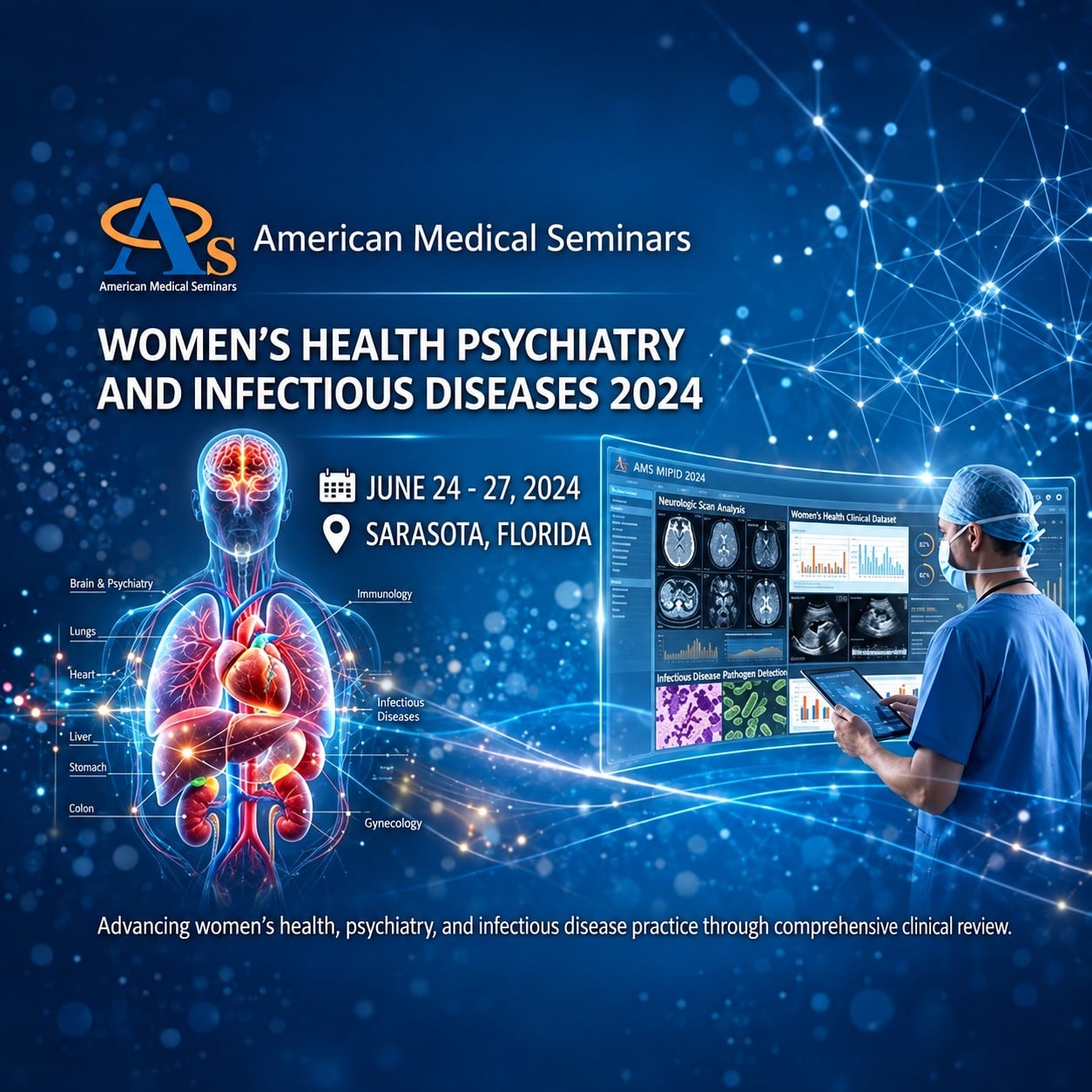
AMS Women’s Health, Psychiatry and Infectious Diseases 2024

Comprehensive Women’s Health, Mental Health & Infectious Disease Clinical Update
The American Medical Seminars (AMS) Women’s Health, Psychiatry and Infectious Diseases 2024 program provides a practical, evidence-based review of common clinical challenges encountered in women’s healthcare, psychiatric medicine, and infectious disease management. Designed to enhance diagnostic accuracy and therapeutic decision-making, this multidisciplinary course delivers clinically relevant updates that can be immediately applied in both outpatient and inpatient practice.
Held from June 24–27, 2024 in Sarasota, Florida, this educational program focuses on the integration of women’s health, behavioral medicine, and infectious disease care, helping clinicians address complex patient presentations through current guidelines, case-based discussions, and real-world management strategies.
Program Overview
Modern clinicians frequently encounter overlapping issues involving women’s health, psychiatric disorders, and infectious diseases. This course offers a comprehensive review of these critical areas while emphasizing practical approaches that improve patient outcomes and clinical efficiency.
Participants will gain updated knowledge in:
- Women’s preventive healthcare
- Gynecologic disorders
- Menopause and hormonal health
- Depression and anxiety disorders
- Bipolar disorder and psychiatric emergencies
- Infectious disease diagnosis and treatment
- Respiratory infections
- Skin and soft tissue infections
- Emerging infectious diseases
- Evidence-based prescribing
- Outpatient and inpatient management strategies
The curriculum is structured to provide immediately applicable clinical insights for physicians and advanced practice providers caring for diverse patient populations.
Learning Objectives
Upon completion of this activity, participants will be able to:
- Apply evidence-based approaches to common women’s health conditions.
- Recognize and manage psychiatric disorders frequently encountered in primary care and hospital medicine.
- Utilize current guidelines for diagnosing and treating infectious diseases.
- Develop comprehensive management plans for patients with overlapping medical and psychiatric conditions.
- Improve clinical decision-making using case-based diagnostic strategies.
- Integrate preventive care recommendations into routine practice.
- Identify emerging infectious disease threats and appropriate treatment approaches.
- Optimize patient outcomes through multidisciplinary care strategies.
Women’s Health Updates
A major component of the program focuses on practical women’s healthcare issues commonly encountered in primary care and hospital medicine.
Topics include:
- Preventive women’s healthcare
- Gynecologic disorders
- Menopause management
- Hormonal health
- Reproductive health concerns
- Health screening recommendations
- Female-specific risk factors
- Evidence-based treatment strategies
Faculty review current clinical guidelines and practical management approaches for female patients across different stages of life.
Psychiatry Essentials
Mental health disorders remain among the most common conditions managed by primary care and hospital-based clinicians.
Key psychiatric topics include:
- Major depressive disorder
- Anxiety disorders
- Bipolar disorder
- Mood disorders
- Psychiatric emergencies
- Behavioral health assessment
- Psychopharmacology updates
- Integrated mental health care
Participants learn practical strategies for recognizing, evaluating, and treating psychiatric conditions in everyday clinical practice.
Infectious Disease Updates
The infectious disease component provides focused reviews of common and emerging infections encountered in outpatient and inpatient settings.
Covered areas include:
- Respiratory tract infections
- Skin and soft tissue infections
- Community-acquired infections
- Emerging pathogens
- Antibiotic selection
- Antimicrobial stewardship
- Diagnostic evaluation strategies
- Prevention and infection control
Faculty emphasize evidence-based approaches to diagnosis, treatment, and risk reduction.
Case-Based Clinical Learning
Throughout the program, expert faculty utilize real-world patient cases to illustrate diagnostic reasoning and management principles.
Topics include:
- Complex outpatient presentations
- Hospital-based infectious diseases
- Women’s health case discussions
- Psychiatric diagnostic challenges
- Multidisciplinary treatment approaches
- Clinical decision-making frameworks
This practical format helps clinicians translate educational content directly into patient care.
Evidence-Based Clinical Practice
The course emphasizes the application of current guidelines and evidence-based medicine across all educational sessions.
Participants review:
- Updated diagnostic algorithms
- Current treatment recommendations
- Best practice guidelines
- Risk stratification methods
- Medication safety considerations
- Quality improvement strategies
The program is designed to strengthen clinical confidence while improving patient outcomes.
Target Audience
This course is ideal for:
- Internal Medicine Physicians
- Family Medicine Physicians
- Hospitalists
- General Practitioners
- Infectious Disease Physicians
- Nurse Practitioners
- Physician Assistants
- Residents and Fellows
- Advanced Practice Providers
- Allied Healthcare Professionals
+ Topics:
Day 1
Chronic Venous Insufficiency
Upon completion of this session, the participant should be able to:
- Apply appropriate diagnostic and therapeutic approaches in the management of patients across the entire spectrum of venous disease
Pelvic Phlebology
Upon completion of this session, the participant should be able to:
- Identify causes and sequelae of CVI unique to the pelvic anatomy in female patients
Medical evaluation of the psychiatric patient
Attendees of this presentation should be able to:
- Evaluate the medical clearance process
- Utilize protocols for the evaluation of psychiatric patients
- Consider the role of verbal de-escalation in the treatment of psychiatric patients
- Determine the appropriate treatment for psychiatric patients in the emergency setting
Depression
Attendees of this presentation should be able to:
- Review signs and symptoms of depression
- Assess the presentation of depression across the lifespan
- Consider pharmacological and non-pharmacological treatment options for depression
Substance Use Disorders
Attendees of this presentation should be able to:
- Evaluate the risk factors leading to substance abuse and addiction
- Utilize several screening tools for substance abuse and addiction
- Review the medical and psychiatric consequences and comorbidities of substance abuse
- Utilize biological and psychosocial treatments for substance abuse
Day 2
Dealing with Difficult Patients
Attendees of this presentation should be able to:
- Describe why some patients and family members might be difficult to deal with difficult people
- Recognize and respond to difficult individuals identify various types of difficult people
- Implement techniques to deal with difficult patients and family members
- Evaluate how medical and psychiatric illness affects difficult people
Anxiety Disorders
Attendees of this presentation should be able to:
- Review the impact of anxiety disorders
- Compare the diagnostic criteria for panic disorder, agoraphobia, general anxiety disorders and social anxiety disorder.
- Evaluate treatment options for anxiety disorders
Provider Wellness
Attendees of this presentation should be able to:
- Identify and define stress and how it affects us
- Differentiate, diagnose and treat PTSD and Burnout
- Understand and deal with the affects of COVID on physician wellness
Pelvic Pain and Endometriosis
Upon completion of this session, the participant should be able to:
- Analyze pelvic pain in the clinical setting of endometriosis and differentiate between dysmenorrhea, non-menstrual pelvic pain and pain with intercourse
- Discuss non-endometriotic causes of pelvic pain
- Discuss the potential value of micro-RNA in diagnosis and treatment
Polycystic Ovarian Syndrome
Upon completion of this session, the participant should be able to:
- Develop a cost-effective thorough plan for assessing PCOS and its sequelae in patients who do and do not want to conceive
- Discuss diagnostic criteria for PCOS and different phenotypes
Day 3
Abnormal Uterine Bleeding
Upon completion of this session, the participant should be able to:
- Identify and classify the etiology of abnormal uterine bleeding
- Define the correct terminology used in patients with abnormal uterine bleeding
- Discussed treatments in the management of patients with abnormal uterine bleeding
Office Urogynecology
Upon completion of this session, the participant should be able to:
- Appreciate the independent subspecialty of urogynecology as distinguished from general gynecology, urology, and colon-rectal surgery.
- Prepare a patient for an appointment with a urogynecologist.
- Describe various surgical (including pessaries) and medical treatments for urine incontinence, recurrent UTIs and obstetrical anal sphincter injuries.
Vaginitis Revisited
Upon completion of this session, the participant should be able to:
- Identify routine as well as challenging causes of vulvar symptoms of burning, itching or pain
- Expand upon vaginitis related to infection, estrogen deprivation and dermatological skin changes
TB and Non-TB Mycobacterial infection Update 2024
Attendees of this presentation will be able to:
- Stratify their suspicion for tuberculosis vs. Non-TB mycoacteria based on the patient’s residence in or origin from a high TB-incidence country.
- Evaluate the trends in frequency of TB vs. Non-TB mycobacteria.
- Compare and contrast the environmental reservoir of non-TB mycobacteria.
Skin & Soft Tissue Infections
Attendees of this presentation will be able to:
- Accurately distinguish between cellulitis and venous stasis dermatitis.
- Determine how the microbiology of diabetic foot ulcer differs from that of cellulitis.
Day 4
Infectious Complications of Opiate Addiction Epidemic
Attendees of this presentation will be able to:
- Evaluate the trends in opioid use, overdoses and deaths in the US and assess the reasons for the opioid epidemic in our country.
- Develop strategies to accurately identify injection site abscess
- Recognize the appearance of septic emboli to the lungs in IV drug users
Covid-19, Lessons Learned and Long Covid
Attendees of this presentation will be able to:
- Identify key features of Covid-19 pneumonitis such as ground-glass infiltrates and lymphopenia.
- Evaluate the roles of key treatments such as remdesivir, dexamethasone, and monoclonal antibody therapies for Covid-19.
- Analyze the differences between Covid-19 vaccines available in the U.S.
- Develop self-care strategies to help care providers cope with the stress of a Covid-19 outbreak in their community.
Osteoporosis Understood
Upon completion of this session, the participant should be able to:
- Identify demographic risk factors for osteoporosis, pathophysiology, diagnosis and medical treatment
Anemia in Pregnancy
Upon completion of this session, the participant should be able to:
- Define anemia in pregnancy and differentiate between physiological, acquired and inherited disease
- Discuss the diagnostic workup of anemia and oral and parenteral treatments including blood transfusion and associated sequelae.
HPV and Cervical Cytology
Upon completion of this session, the participant should be able to:
- Review HPV and understand the different serotypes
- Differentiate Metaplasia from Dysplasia
- Appreciate the histopathology of cervical dysplasia
- Understand the role of the Pap test as a screening tool and colposcopy as a diagnostic study