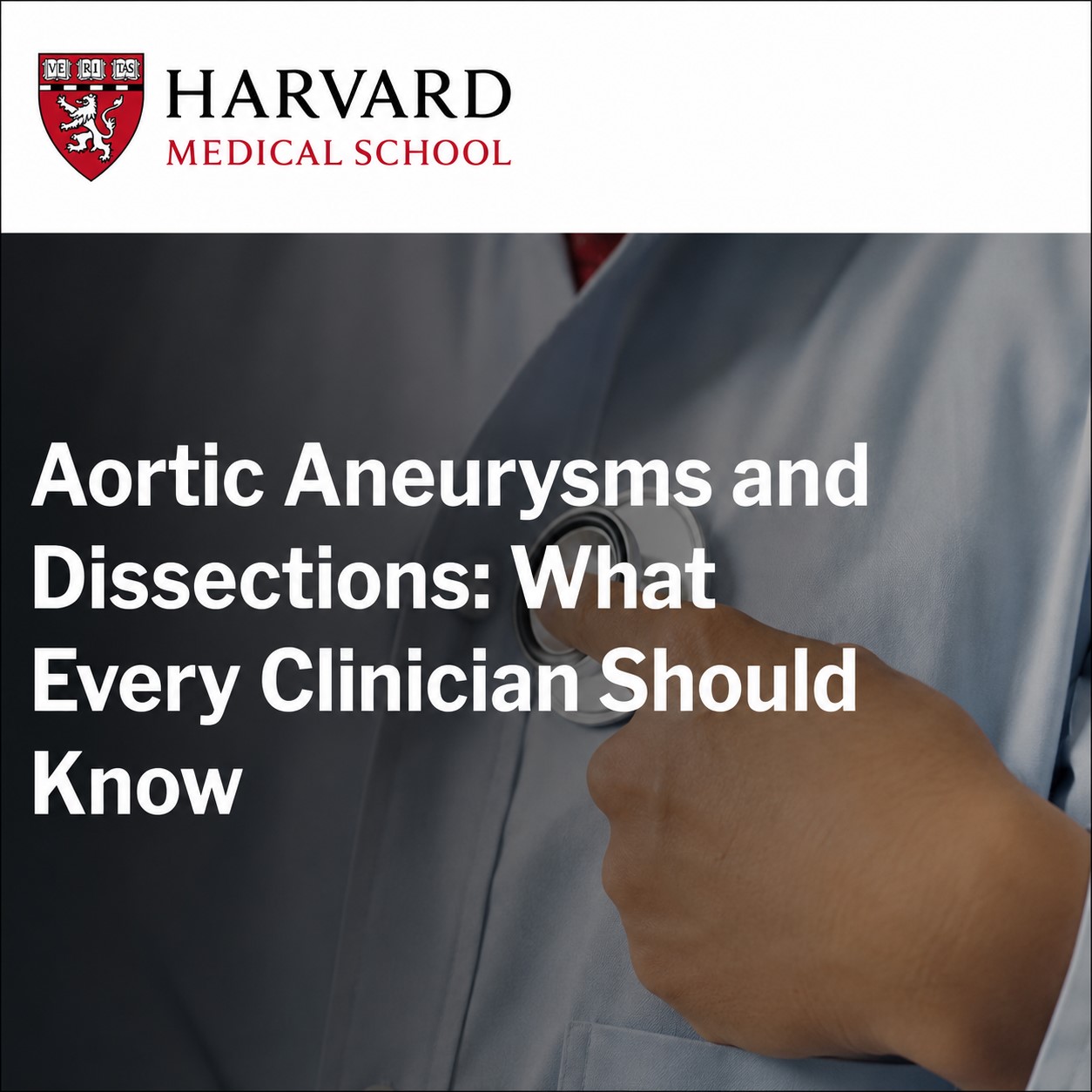
Harvard Aortic Aneurysms and Dissections: What Every Clinician Should Know 2022
Comprehensive CME Course on Aortic Disease, Aneurysms, and Acute Aortic Syndromes
Overview
Harvard Aortic Aneurysms and Dissections: What Every Clinician Should Know 2022 is a comprehensive CME program focused on the diagnosis, management, surveillance, and treatment of aortic aneurysms, aortic dissections, and other acute aortic syndromes.
Directed by leading experts from Massachusetts General Hospital, this one-day educational conference provides clinicians with practical guidance on recognizing aortic disease, understanding genetic and risk factors, selecting appropriate imaging modalities, determining indications for intervention, and managing patients throughout long-term follow-up.
The course is organized into three major sections covering ascending aortic aneurysms, descending thoracic and abdominal aortic aneurysms, and acute aortic syndromes, making it an excellent resource for both specialists and frontline clinicians.
Course Specifications
Format
- 23 Video Lectures
- 19 PDF Presentations
Course Date
December 2, 2022
File Size
4.61 GB
Educational Level
Intermediate to Advanced
Specialty
Aortic Disease & Vascular Medicine
Course Directors
- Arminder Jassar
- Matthew Eagleton
- Eric Isselbacher
Learning Objectives
Upon completion of this course, participants should be able to:
- Discuss the etiology and pathophysiology of aortic aneurysms.
- Recognize inherited and genetic causes of aortic disease.
- Identify patients at risk for aortic aneurysm and dissection.
- Select appropriate imaging studies for diagnosis and surveillance.
- Determine indications for surgical and endovascular intervention.
- Diagnose acute aortic syndromes rapidly and accurately.
- Implement evidence-based medical management strategies.
- Develop long-term surveillance plans for patients with aortic disease.
Core Topics Covered
Ascending Aortic Aneurysms
Topics Include
- Ascending Aortic Anatomy
- Aortic Root Disease
- Thoracic Aortic Aneurysms
- Risk Stratification
- Genetic Syndromes
- Surgical Thresholds
- Long-Term Follow-Up
Participants learn contemporary approaches to managing proximal aortic pathology.
Descending Thoracic and Abdominal Aortic Aneurysms
Topics Include
- Descending Thoracic Aortic Aneurysm
- Abdominal Aortic Aneurysm (AAA)
- Screening Recommendations
- Natural History of Disease
- Endovascular Repair (EVAR)
- Open Surgical Repair
- Surveillance Protocols
Aortic Dissection
A major focus of the course.
Topics Include
- Stanford Classification
- Type A Aortic Dissection
- Type B Aortic Dissection
- Emergency Diagnosis
- Medical Stabilization
- Surgical Management
- Endovascular Treatment
Special emphasis is placed on early recognition and rapid intervention.
Acute Aortic Syndromes
Topics Include
- Intramural Hematoma
- Penetrating Aortic Ulcer
- Acute Aortic Injury
- Aortic Rupture
- Differential Diagnosis of Chest Pain
Genetics and Hereditary Aortic Disorders
Topics Include
- Marfan Syndrome
- Loeys-Dietz Syndrome
- Vascular Ehlers-Danlos Syndrome
- Familial Thoracic Aortic Aneurysm
- Genetic Testing
- Family Screening
Understanding hereditary risk factors is a key component of modern aortic disease management.
Imaging of Aortic Disease
Topics Include
- Echocardiography
- Computed Tomography Angiography (CTA)
- Magnetic Resonance Angiography (MRA)
- Aortic Measurements
- Imaging Surveillance
Participants learn how imaging guides diagnosis and treatment decisions.
Medical Management
Topics Include
- Blood Pressure Control
- Beta-Blocker Therapy
- ARBs and ACE Inhibitors
- Lifestyle Modification
- Exercise Recommendations
- Risk Factor Reduction
Surgical and Endovascular Treatment
Topics Include
- Open Aortic Surgery
- Aortic Root Replacement
- Ascending Aortic Repair
- TEVAR
- EVAR
- Hybrid Procedures
Long-Term Surveillance
Topics Include
- Imaging Follow-Up
- Postoperative Monitoring
- Prevention of Disease Progression
- Lifelong Management Strategies
Educational Features
Comprehensive Aortic Disease Curriculum
Covers the entire spectrum of thoracic and abdominal aortic pathology.
Multidisciplinary Faculty
Includes expertise from cardiology, vascular surgery, cardiac surgery, emergency medicine, and imaging specialists.
Evidence-Based Approach
Integrates current guidelines and contemporary clinical practice.
Practical Clinical Focus
Emphasizes real-world diagnosis, referral decisions, and patient management.
Target Audience
Physicians
- Cardiologists
- Vascular Medicine Specialists
- Vascular Surgeons
- Cardiothoracic Surgeons
- Emergency Physicians
- Family Medicine Physicians
- Internal Medicine Physicians
- Critical Care Physicians
- Trauma Surgeons
Advanced Practice Providers
- Nurse Practitioners
- Physician Assistants
Nurses
- Cardiac Nurses
- Critical Care Nurses
- Vascular Nurses
Trainees
- Cardiology Fellows
- Vascular Surgery Fellows
- Internal Medicine Residents
- Emergency Medicine Residents
Why This Course Stands Out
- Focuses exclusively on aortic aneurysms and dissections.
- Covers both acute emergencies and chronic disease management.
- Strong emphasis on genetics and hereditary aortic disorders.
- Practical guidance on imaging, intervention, and surveillance.
- Taught by internationally recognized aortic disease experts.
Topics:
- Agenda.pdf
Aortic Aneurysms Nomenclature, Etiology, Natural History.mp4
Aortic Aneurysms Nomenclature, Etiology, Natural History.pdf
Classification and Nomenclature.mp4
Classification and Nomenclature.pdf
Course Intro.mp4
Critical Care Transport.mp4
Critical Care Transport.pdf
Descending Thoracic Aorta, Thoracic Aortic Aneurysm (TAA) and Abdominal Aortic Aneurysm.mp4
Descending Thoracic Aorta, Thoracic Aortic Aneurysm (TAA) and Abdominal Aortic Aneurysm.pdf
Genetics of Aortic Disease Who to Screen, How to Screen, and When.mp4
Genetics of Aortic Disease Who to Screen, How to Screen, and When.pdf
Imaging of the Aorta Which Modality to Choose, How to Interpret Reports.mp4
Imaging of the Aorta Which Modality to Choose, How to Interpret Reports.pdf
Initial Management, Lines, and Drugs.mp4
Initial Management, Lines, and Drugs.pdf
Initial Presentation, Differential Diagnosis and Work Up.mp4
Initial Presentation, Differential Diagnosis and Work Up.pdf
Management of Acute Type B Dissections.mp4
Management of Acute Type B Dissections.pdf
Medical Therapy, Pre-Op Surveillance, and Post-Op Management.mp4
Medical Therapy, Pre-Op Surveillance, and Post-Op Management.pdf
Operative Strategies for Abdominal Aortic Aneurysm (AAA) Open and Endovascular.mp4
Operative Strategies for Abdominal Aortic Aneurysm (AAA) Open and Endovascular.pdf
Operative Strategies for Descending Aorta and Thoracoabdominal Aortic Aneurysm (TAAA) Open and Endovascular.mp4
Operative Strategies for Descending Aorta and Thoracoabdominal Aortic Aneurysm (TAAA) Open and Endovascular.pdf
Patient Has an Aortic Dissection – What Else Do You Need to Know.mp4
Patient Has an Aortic Dissection – What Else Do You Need to Know.pdf
Referral Process, Dissection App and Direct to OR Pathway.mp4
Referral Process, Dissection App and Direct to OR Pathway.pdf
Root and Ascending Aortic Aneurysms When to Intervene.mp4
Root and Ascending Aortic Aneurysms When to Intervene.pdf
Ruptured Abdominal Aortic Aneurysm (AAA).mp4
Ruptured Abdominal Aortic Aneurysm (AAA).pdf
Session I Panel Discussion and Q&A- Ascending Aortic Aneurysms.mp4
Session II Panel Discussion and Q&A- Descending Aortic and Thoracoabdominal Aortic Aneurysms.mp4
Session III Panel Discussion and Q&A- AORTIC DISSECTION AND OTHER ACUTE AORTIC SYNDROMES 1.mp4
Session III Panel Discussion and Q&A- AORTIC DISSECTION AND OTHER ACUTE AORTIC SYNDROMES 2.mp4
Surgery for Acute Type A Aortic Dissection.mp4
Surgery for Acute Type A Aortic Dissection.pdf
Surgery for the Aortic Root Ascending Aorta and the Aortic Arch.mp4
Surgery for the Aortic Root Ascending Aorta and the Aortic Arch.pdf