
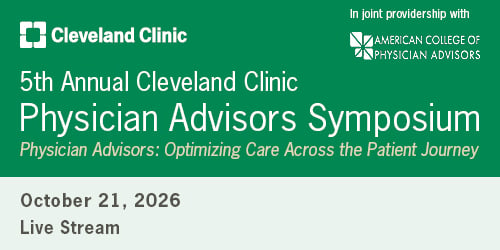
Cleveland Clinic 5th Annual Physician Advisors Symposium 2026


$30.00
This Product is shared via google drive download link, So please share your correct Gmail id while placing the order .Please note that there are no CME points or certificate associated with this course Samples for Courses Can be found here : Free Samples Here!
Cleveland Clinic 5th Annual Physician Advisors Symposium 2026
Healthcare Management, Physician Advisory Services, Revenue Cycle Management, Patient Flow & Quality Improvement
Target Audience
Physicians, Physician Advisors, Hospitalists, Nurses, Nurse Practitioners, Healthcare Administrators, Medical Directors, Utilization Management Professionals, Revenue Cycle Specialists, Clinical Documentation Specialists, and healthcare professionals involved in hospital operations, patient care coordination, and healthcare leadership.
Information
Cleveland Clinic 5th Annual Physician Advisors Symposium 2026 is a professional medical education event presented by Cleveland Clinic, in joint providership with the American College of Physician Advisors (ACPA).
Held on October 21, 2026, the symposium explores the increasingly important role of physician advisors in improving the patient journey, supporting effective hospital operations, strengthening interdisciplinary collaboration, and optimizing healthcare resource utilization.
The program addresses contemporary challenges in healthcare administration, including patient throughput, admission decisions, discharge planning, prior authorization, payer-provider relationships, insurance denials, clinical documentation, utilization review, and healthcare leadership.
Through expert-led presentations, case-oriented discussions, and a multidisciplinary panel, the symposium examines practical approaches to improving care coordination, patient experience, operational efficiency, and organizational performance.
Special attention is given to the evolving responsibilities of physician advisors, including their contributions to clinical decision-making, regulatory compliance, revenue cycle processes, patient safety, and hospital-wide improvement initiatives.
Product Details
| Information | Details |
|---|---|
| Course Title | 5th Annual Physician Advisors Symposium |
| Organizer | Cleveland Clinic |
| Joint Provider | American College of Physician Advisors (ACPA) |
| Event Date | October 21, 2026 |
| Original Format | Live-Streamed Educational Symposium |
| Primary Specialty | Healthcare Management & Physician Advisory Services |
| Additional Focus | Hospital Administration, Revenue Cycle Management & Quality Improvement |
| Language | English |
| Educational Approach | Expert Lectures, Q&A Sessions & Panel Discussions |
Digital Materials Notice: This listing summarizes the original educational symposium. Any recordings or supporting educational materials offered by the store are separate from official event registration. Live participation, access to the Cleveland Clinic learning platform, CME credits, and certificates are not included unless expressly specified in the purchased package.
Course Overview
Physician advisors play a critical role in connecting clinical care with healthcare administration, utilization management, patient safety, and organizational performance.
As hospitals and healthcare systems navigate evolving regulatory requirements, complex payer relationships, increasing operational demands, and changing reimbursement models, physician advisors help support informed medical decision-making and effective coordination between clinical and administrative teams.
The Cleveland Clinic Physician Advisors Symposium 2026 provides an educational review of these responsibilities, highlighting strategies for improving hospital throughput, reducing avoidable denials, optimizing authorization workflows, and supporting patient-centered care.
The curriculum explores the physician advisor’s role throughout the patient journey, from emergency department admission decisions to discharge planning and post-hospital care coordination.
Additional sessions examine professional ethics, leadership development, organizational strategy, and the transition of physician advisors into broader healthcare management roles.
Learning Objectives
Upon completion of this educational activity, participants should be better able to:
- Describe how physician advisors contribute to optimizing care throughout the patient journey.
- Evaluate operational factors influencing hospital efficiency, patient throughput, and patient experience.
- Review admission decision-making and appropriate resource utilization.
- Examine hospital command center models and innovative patient flow strategies.
- Understand care coordination and discharge planning processes.
- Review prior authorization workflows and their implications for patient care.
- Identify strategies for reducing avoidable insurance denials.
- Improve communication and collaboration between healthcare providers and payers.
- Explain the physician advisor’s role within interdisciplinary healthcare teams.
- Support appropriate clinical documentation and utilization review.
- Recognize professional boundaries and ethical challenges associated with physician advisory services.
- Examine the evolving role of physician advisors in healthcare leadership and organizational strategy.
Core Educational Topics
Physician Advisor Roles and Responsibilities
- Physician advisory services
- Clinical and administrative collaboration
- Utilization management
- Healthcare resource optimization
- Clinical documentation
- Patient-centered care
- Operational performance
Patient Journey Optimization
- Hospital admission decisions
- Emergency department patient flow
- Inpatient care progression
- Hospital throughput
- Discharge planning
- Patient experience
- Care transitions
Hospital Operations and Efficiency
- Hospital command center models
- Patient flow management
- Operational bottlenecks
- Healthcare coordination
- Scheduling considerations
- Resource utilization
- Organizational performance improvement
Prior Authorization and Revenue Cycle Management
- Prior authorization
- Insurance denials
- Denial prevention
- Payer-provider collaboration
- Revenue cycle management
- Utilization review
- Clinical documentation improvement
Patient Experience and Quality Improvement
- Patient-centered healthcare delivery
- Coordination of care
- Healthcare quality improvement
- Avoidable delays in treatment
- Communication between clinical and administrative teams
- Patient safety
Ethics and Professional Leadership
- Physician advisor ethics
- Professional boundaries
- Organizational responsibility
- Leadership development
- Healthcare management
- Strategic decision-making
- Physician executive roles
Detailed Symposium Program
Wednesday, October 21, 2026
The original symposium schedule includes a five-minute Q&A period following each presentation.
Opening Sessions
| Time | Session | Faculty |
|---|---|---|
| 9:30 AM | Live Stream Opens | — |
| 10:00 AM | Welcome and Introductions | Ahmad Kilani, MD, MBA, MLS, MSIT, ACPA-C |
| 10:05 AM | Patient Journey through the Healthcare System | Lisa Yerian, MD |
Session 1 – Patient Journey
11:00 AM – Introduction to the Patient Journey
Faculty: Sumana Narasimhan, MD, ACPA-C
An introduction to patient journey optimization and the role of physician advisors in improving coordination and continuity of care.
11:10 AM – Emergency Department: Admit or Not Admit? That Is the Question
Faculty: Scott Ceule, MD, FACP, FAAP, ACPA-C
Reviews clinical and operational considerations influencing emergency department admission decisions and appropriate utilization of hospital services.
11:40 AM – Optimizing Hospital Throughput and Discharge Planning: The Strategic Role of the Physician Advisor
Faculty:
- Tiffany Ferguson, LMSW, ACM, ACPA-C
- Ritu Prasad, MD, CHCQM-PHYADV
Examines the physician advisor’s contributions to hospital throughput, discharge planning, and care coordination.
12:10 PM – Innovative Ideas for Hospital Throughput
Faculty:
- Jodi-Ann Chin, MD
- Thomas Martin, MD
Explores approaches to improving patient flow, healthcare operations, and hospital efficiency.
12:40 PM – Lunch Break
1:15 PM – Guiding the Authorization Approval, Guarding the Experience
Faculty:
- Rob McDaniel
- Dan Medve
Focuses on prior authorization processes and their relationship to patient experience and healthcare delivery.
1:45 PM – Impact of Denials on Patient Experience and Strategies for Mitigation
Faculty:
- Suzanne Miller, MSN, RN
- Michelle Schill
Reviews insurance denial challenges and approaches to reducing their impact on patients and healthcare organizations.
2:15 PM – Breaking Down the Walls: Building Effective Payer–Provider Collaboration
Faculty: David M. Johnson, MD, MBA, CPE
Examines strategies for strengthening communication and collaboration between healthcare providers and insurance payers.
2:45 PM – Break
Session 2 – General Topics
3:00 PM – The Physician Advisor: Professional Boundaries and Ethical Dilemmas, Navigating the Gray Zone
Faculty:
- Paul Ford, PhD
- Patrick Schmitt, DO
Explores ethical considerations, professional responsibilities, and complex decision-making challenges encountered by physician advisors.
3:45 PM – From Bedside to Boardroom
Faculty:
- Ahmed Abuabdou, MBBS, MBA, ACPA-C
- Michael Taylor, MD
Reviews the evolving role of physician advisors in organizational leadership, healthcare strategy, and system-level improvement.
4:15 PM – Role of Physician Advisors Panel Discussion
Moderator: Nicholas Libertin, MD
Panelists:
- Ahmad Kilani, MD, MBA, MLS, MSIT, ACPA-C
- Meana Gerges, MD, MBA, SFHM, ACPA-C
- Andrew Maigur, MD, CHCQM-PHYADV, CMPC, CCDS, ACPA-C
- Kevin Perry, MD
A multidisciplinary discussion of physician advisor responsibilities, collaboration, and emerging challenges in healthcare administration.
5:00 PM – Closing Remarks and Adjournment
Faculty: Ahmad Kilani, MD, MBA, MLS, MSIT, ACPA-C
Educational Highlights
- Physician advisor leadership and professional development
- Healthcare management and hospital operations
- Patient journey optimization
- Emergency department admission decisions
- Hospital throughput and discharge planning
- Care coordination
- Prior authorization workflows
- Revenue cycle management
- Insurance denial prevention and mitigation
- Payer-provider collaboration
- Clinical documentation improvement
- Utilization management and review
- Physician advisor ethics
- Interdisciplinary healthcare collaboration
- Organizational strategy and healthcare quality improvement
Clinical & Educational Value
Cleveland Clinic 5th Annual Physician Advisors Symposium 2026 provides a focused educational review of physician advisory services and their contributions to healthcare management.
The symposium integrates patient care coordination, hospital operations, utilization management, clinical documentation, revenue cycle processes, and professional leadership.
Its program is particularly relevant to physicians, healthcare administrators, and clinical leaders seeking to understand how physician advisors support operational efficiency, appropriate resource utilization, and patient-centered care.
The educational sessions highlight opportunities for collaboration between clinical professionals, administrative teams, and healthcare payers while addressing practical challenges encountered in modern healthcare systems.
Related products

Medical Accounts

Critical Care - Emergency medicine

Internal Medicine
Critical Care - Emergency medicine
2022 UPDATES IN THERAPEUTICS: CRITICAL CARE PHARMACY PREPARATORY REVIEW AND RECERTIFICATION COURSE

Critical Care - Emergency medicine
Critical Care - Emergency medicine
International Symposium on Intensive Care & Emergency Medicine ( ISICEM ) 2020