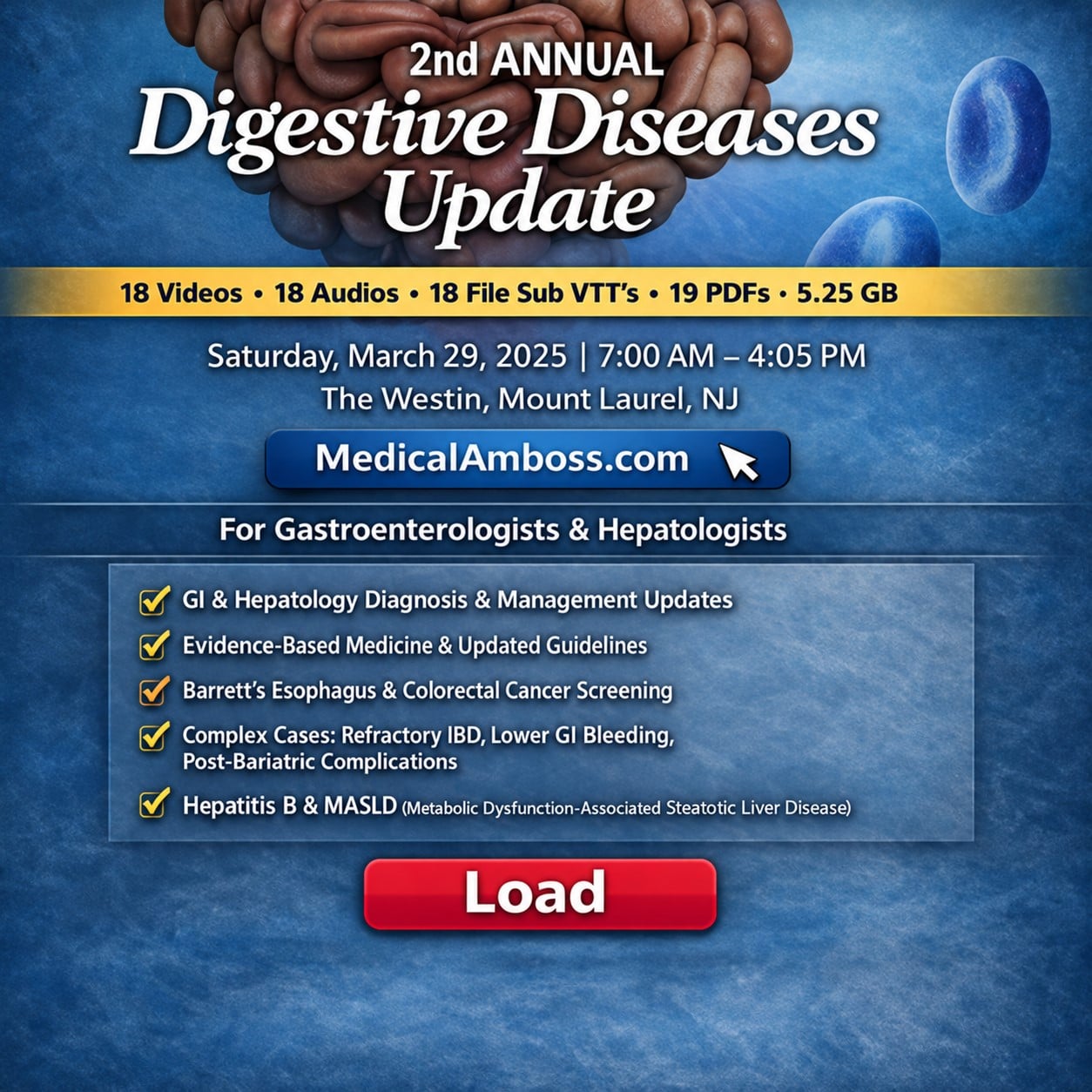
Cooper University Health Care 2nd Annual Digestive Diseases Update 2025
Comprehensive Gastroenterology & Hepatology Update for Clinical Practice
The Cooper University Health Care 2nd Annual Digestive Diseases Update 2025 is a comprehensive educational conference designed to provide clinicians with the latest evidence-based advances in the diagnosis, treatment, and management of gastrointestinal and liver diseases. Led by expert faculty from Cooper University Health Care, this one-day program bridges the gap between evolving clinical guidelines and real-world patient care, delivering practical strategies that can be immediately applied in daily practice.
The conference covers the full spectrum of digestive diseases, including esophageal disorders, gastric conditions, small bowel pathology, colorectal diseases, inflammatory bowel disease, hepatology, gastrointestinal bleeding, and bariatric surgery complications. Special emphasis is placed on quality improvement, evidence-based decision-making, and the clinical pearls and pitfalls that influence patient outcomes.
Through expert lectures, case-based discussions, and guideline-focused reviews, participants gain a modern understanding of digestive disease management while strengthening their ability to navigate complex clinical scenarios.
Product Details
- Format: 18 Videos + 18 Audios + 18 Subtitle Files (.VTT) + 19 PDFs
- Total Size: 5.25 GB
- Course Date: March 29, 2025
- Location: The Westin, Mount Laurel, New Jersey
- Access: On-Demand
Program Overview
This conference delivers practical updates across the major subspecialties of gastroenterology and hepatology.
Key areas of focus include:
- Esophageal disorders
- Gastric diseases
- Small bowel pathology
- Colorectal disorders
- Inflammatory bowel disease (IBD)
- Hepatology
- Hepatitis B
- MASLD (Metabolic Dysfunction-Associated Steatotic Liver Disease)
- Gastrointestinal bleeding
- Bariatric surgery complications
- Endoscopy quality improvement
- Colorectal cancer screening
- Barrett’s Esophagus surveillance
The curriculum emphasizes evidence-based medicine, updated guidelines, and high-value clinical care.
Learning Objectives
Upon completion of this activity, participants will be able to:
- Apply updated diagnostic and therapeutic strategies for common gastrointestinal and liver diseases.
- Utilize evidence-based clinical guidelines to improve patient outcomes.
- Implement quality indicators for Barrett’s Esophagus surveillance and colorectal cancer screening.
- Evaluate and manage complex inflammatory bowel disease cases.
- Diagnose and treat acute lower gastrointestinal bleeding.
- Manage complications following bariatric surgery.
- Apply modern treatment algorithms for Hepatitis B.
- Integrate current approaches to MASLD diagnosis and management.
Core Topics Covered
Esophageal Disorders
Sessions review modern approaches to:
- Dysphagia evaluation
- Gastroesophageal reflux disease (GERD)
- Barrett’s Esophagus
- Esophageal cancer surveillance
- Functional esophageal disorders
Participants learn practical strategies for diagnosis and treatment.
Gastric & Upper GI Disorders
Faculty discuss:
- Functional upper GI disorders
- Peptic disease
- Gastric motility disorders
- Endoscopic evaluation
- Diagnostic challenges
Evidence-based management approaches are emphasized throughout.
Small Bowel Diseases
Topics include:
- Malabsorption syndromes
- Small bowel inflammatory disorders
- Advanced diagnostic modalities
- Endoscopic evaluation techniques
Participants gain updated insights into small bowel pathology.
Inflammatory Bowel Disease (IBD)
A major component of the conference focuses on:
- Crohn’s disease
- Ulcerative colitis
- Refractory IBD management
- Advanced biologic therapies
- Monitoring and surveillance strategies
Experts review contemporary treatment algorithms and challenging clinical cases.
Colorectal Disease & Cancer Screening
Dedicated sessions address:
- Colorectal cancer prevention
- Screening guidelines
- Surveillance recommendations
- Polyp detection and management
- Quality indicators in colonoscopy
Faculty discuss strategies to improve screening outcomes and procedural quality.
Acute Lower GI Bleeding
Participants review:
- Diagnostic evaluation
- Risk stratification
- Endoscopic management
- Hospital-based treatment strategies
- Clinical decision-making pathways
Practical case-based learning supports real-world application.
Hepatology & Chronic Liver Disease
The hepatology curriculum covers:
- Chronic liver disease management
- Cirrhosis
- Liver fibrosis assessment
- Emerging liver therapies
- Hepatic complications
Current evidence and clinical guidelines are thoroughly reviewed.
Hepatitis B
Sessions focus on:
- Screening recommendations
- Diagnostic evaluation
- Antiviral treatment strategies
- Long-term monitoring
- Prevention of complications
Participants gain updated knowledge on modern hepatitis management.
MASLD (Metabolic Dysfunction-Associated Steatotic Liver Disease)
Experts discuss:
- Disease pathogenesis
- Risk assessment
- Non-invasive diagnostics
- Lifestyle interventions
- Pharmacologic treatment options
The course highlights evolving approaches to one of the most common liver diseases worldwide.
Bariatric Surgery Complications
Topics include:
- Post-surgical GI complications
- Nutritional concerns
- Endoscopic management
- Revisional strategies
- Long-term follow-up care
Faculty provide practical guidance for managing increasingly common bariatric patients.
Quality Improvement in Gastroenterology
A unique feature of the conference is its focus on quality metrics.
Topics include:
- Endoscopy quality indicators
- Ambulatory surgery center performance
- Patient safety initiatives
- Quality benchmarking
- Practice optimization
Participants learn how quality measures improve patient outcomes and practice performance.
Educational Features
✔ Comprehensive Gastroenterology & Hepatology Review
✔ Evidence-Based Clinical Guidelines
✔ Barrett’s Esophagus & CRC Screening Updates
✔ Advanced IBD Management
✔ Hepatitis B & MASLD Education
✔ GI Bleeding & Bariatric Complication Reviews
✔ Endoscopy Quality Improvement Strategies
✔ Practical Clinical Pearls & Pitfalls
Target Audience
This course is ideal for:
- Gastroenterologists
- Hepatologists
- Gastroenterology Fellows
- Internal Medicine Physicians
- Family Medicine Physicians
- GI Surgeons
- Nurse Practitioners
- Physician Assistants
- Endoscopy Nurses
- Gastroenterology Nurses
- Residents and Fellows
Why This Course Stands Out
✔ Covers the entire spectrum of digestive disease management
✔ Strong emphasis on practical clinical application
✔ Features nationally recognized Cooper faculty
✔ Focuses on guideline implementation and quality improvement
✔ Reviews complex and challenging GI cases
✔ Includes updates on MASLD, Hepatitis B, and IBD
✔ Addresses both outpatient and inpatient gastroenterology care
✔ Designed for multidisciplinary digestive disease teams
Clinical & Educational Value
The Cooper University Health Care 2nd Annual Digestive Diseases Update 2025 delivers a practical and comprehensive review of modern gastroenterology and hepatology. Through expert-led discussions covering gastrointestinal disorders, inflammatory bowel disease, liver disease, colorectal cancer prevention, endoscopy quality measures, and emerging therapies, participants gain valuable clinical insights that can immediately improve patient care and practice outcomes.
+ Topics:
- 7:45 AM – 8:00 AM Opening Remarks
- ESOPHAGEAL & GASTRIC DISORDERS Moderator: Anthony Infantolino, M.D. 8:00 AM – 8:20 AM Nonvariceal Upper GI Bleeding (UGIB): Diagnosis and Management Anthony Infantolino, M.D.
- 8:20 AM – 8:40 AM Approach to the Patient with Dysphagia Adam B. Elfant, M.D.
- 8:40 AM – 9:00 AM Quality Indicators in Management of Barrett’s Esophagus Michael S. Smith, M.D.
- 9:00 AM – 9:20 AM Management of Functional Upper GI Disorders Rachel S. Frank, M.D.
- 9:20 AM – 9:40 AM Management of Gastric Intestinal Metaplasia and Neoplasia Daniel A. Baik, M.D.
- 9:40 AM – 9:45 AM Questions and Answer Period
- 9:45 AM – 10:05 AM Break and Exhibits
- SMALL BOWEL /COLONIC DISORDERS Moderator: Apeksha Shah, M.D. 10:05 AM – 10:25 AM Management of Acute Lower GI Bleeding (LGIB) Christina Tofani, M.D.
- 10:25 AM – 10:45 AM Medical and Nutritional Management of Irritable Bowel Syndrome (IBS) Tara L. Lautenslager, M.D.
- 10:45 AM – 11:05 AM Refractory Inflammatory Bowel Disease (IBD): Options for Management Thomas A. Judge, M.D.
- 11:05 AM – 11:25 AM The GI Consult for the Post-bariatric Surgery Patient Rohit A. Patel, M.D.
- 11:25 AM – 11:45 AM Diagnosis and Management of Common Anorectal Disorders Steven J. McClane, M.D.
- 11:45 AM – 11:50 AM Questions and Answer Period
- 11:50 AM – 12:30 PM Lunch and Exhibits
- 12:30 PM – 1:10 PM KEYNOTE: Diagnosis and Management of Eosinophilic Esophagitis (EOE) – 2025 Update David A. Katzka, M.D.
- PANCREATIC /HEPATOBILIARY DISORDERS Moderator: Adam B. Elfant, M.D. 1:10 PM – 1:30 PM Evaluation and Management of Chronic Pancreatitis Adib Chaaya, M.D.
- 1:30 PM – 1:50 PM Advances in Diagnosis and Management of Biliary Malignancy David E. Loren, M.D.
- 1:50 PM – 2:10 PM Update on Metabolic Dysfunction-associated Fatty Liver Disease (MAFLD)/Metabolic Dysfunction-associated Steatotic Liver Disease (MASLD) Simona Rossi, M.D.
- 2:10 PM – 2:30 PM Medical Management of Obesity Krysta M. Contino, M.D.
- 2:30 PM – 2:50 PM Management of Hepatitis B (HBV): The Forgotten Hepatitis Christopher W. Deitch, M.D.
- 2:50 PM – 2:55 PM Questions and Answer Period
- 2:55 PM – 3:15 PM Break and Exhibits
- QUALITY CRC SCREENING Moderator: Steven R. Peikin, M.D. 3:15 PM – 3:35 PM Leveling the Playing Field for Colorectal Cancer (CRC) Screening Kathy N. Williams, M.D.
- 3:35 PM – 3:55 PM Improving Quality in Ambulatory Surgery Centers (ASC) and Hospital-based Endoscopy Units Joshua P. DeSipio, M.D.
- 3:55 PM – 4:05 PM Questions and Answer Period
- 4:05 PM Adjournment