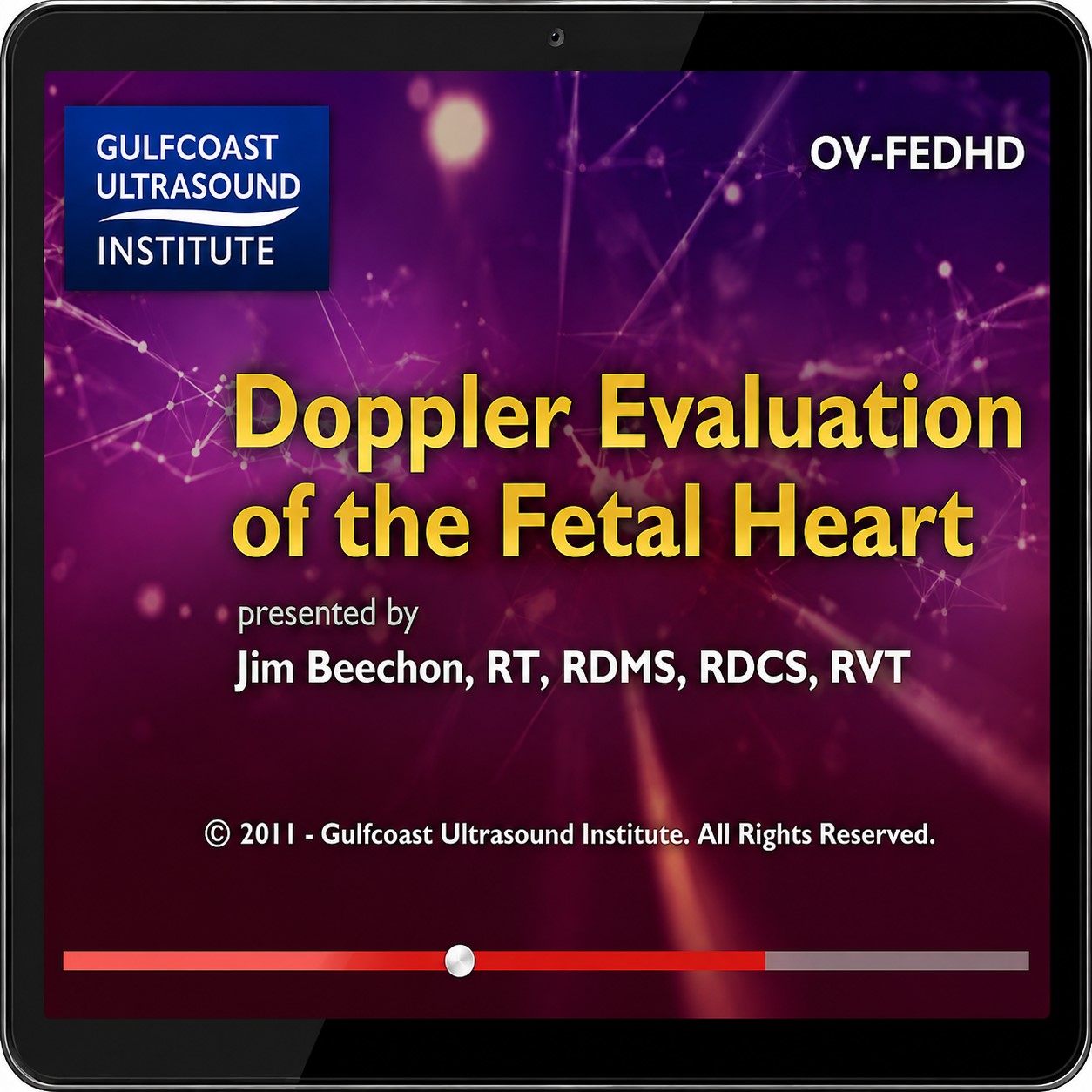
Gulfcoast Doppler Evaluation of the Fetal Heart (Videos + Course Materials)
Ultrasound Evaluation of the Fetal Heart: Basic and Advanced Techniques
The Gulfcoast Doppler Evaluation of the Fetal Heart online course is a comprehensive educational program designed to provide healthcare professionals with the knowledge and practical skills necessary to perform and interpret fetal echocardiography and Doppler ultrasound examinations. Developed by leading ultrasound educators, this course combines foundational concepts with advanced diagnostic techniques to help clinicians confidently assess fetal cardiac anatomy, physiology, rhythm disturbances, and congenital heart abnormalities.

Using a combination of high-quality lectures, PowerPoint presentations, still-frame images, cine clips, Doppler demonstrations, and real-world case studies, participants learn systematic approaches to fetal cardiac screening and diagnostic evaluation based on current AIUM (American Institute of Ultrasound in Medicine) practice guidelines.
Course Overview
Congenital heart disease is one of the most common fetal abnormalities and remains a leading cause of neonatal morbidity and mortality. Early prenatal detection through ultrasound and Doppler evaluation can significantly improve perinatal management, delivery planning, and postnatal outcomes.
This course provides a detailed review of fetal cardiac anatomy, circulation, screening protocols, Doppler assessment, and advanced imaging techniques. Participants learn how to obtain standard cardiac views, evaluate blood flow patterns, recognize normal and abnormal Doppler waveforms, and identify common fetal cardiac pathologies.
The curriculum is designed to bridge the gap between theory and clinical practice, allowing learners to immediately apply new skills in obstetric and fetal imaging settings.
Target Audience
This course is ideal for:
Physicians
- Maternal-Fetal Medicine Specialists
- Obstetricians and Gynecologists
- Radiologists
- Pediatric Cardiologists
- Fetal Cardiologists
- Family Medicine Physicians involved in Obstetric Care
Sonographers
- Obstetric Sonographers
- Fetal Echocardiography Sonographers
- Diagnostic Medical Sonographers
Advanced Practice Providers
- Physician Assistants
- Nurse Practitioners
Other Healthcare Professionals
- Ultrasound Technologists
- Maternal-Fetal Medicine Trainees
- Residents and Fellows
Learning Objectives
Upon completion of this course, participants should be able to:
- Understand fetal cardiac anatomy and circulation
- Apply AIUM fetal cardiac screening guidelines
- Perform systematic fetal heart examinations
- Obtain standard cardiac screening views accurately
- Utilize Doppler ultrasound for fetal cardiac assessment
- Recognize normal fetal cardiac blood flow patterns
- Evaluate fetal arrhythmias using Doppler techniques
- Identify common congenital heart defects prenatally
- Interpret abnormal Doppler findings
- Integrate fetal cardiac ultrasound findings into clinical management
Course Topics
❤️ Fetal Cardiac Anatomy and Physiology
Topics Covered
- Embryology of the Fetal Heart
- Normal Cardiac Development
- Fetal Circulation
- Cardiac Chambers
- Great Vessels
- Fetal Hemodynamics
Participants gain a solid understanding of fetal cardiovascular structure and function, providing the foundation necessary for accurate ultrasound interpretation.
🫀 Fetal Cardiac Screening Protocols
AIUM-Based Screening Guidelines
Areas Covered
- Standard Fetal Heart Examination
- Cardiac Screening Recommendations
- Systematic Examination Approach
- Documentation Standards
Clinical Focus
- Early Detection of Congenital Heart Disease
- Quality Assurance in Fetal Cardiac Imaging
🩻 Standard Cardiac Imaging Views
Essential Screening Views
Four-Chamber View
Topics include:
- Chamber Anatomy
- Cardiac Axis
- Septal Assessment
- Ventricular Evaluation
Outflow Tract Views
Participants learn to evaluate:
- Left Ventricular Outflow Tract (LVOT)
- Right Ventricular Outflow Tract (RVOT)
- Great Artery Relationships
Three-Vessel Trachea View (3VT)
Coverage includes:
- Vessel Identification
- Spatial Relationships
- Detection of Outflow Tract Abnormalities
🌊 Doppler Fundamentals
Basic Doppler Principles
Topics Covered
- Spectral Doppler Physics
- Color Doppler Imaging
- Pulse-Wave Doppler
- Doppler Optimization Techniques
Key Learning Areas
- Doppler Angle Correction
- Sample Volume Placement
- Velocity Measurements
- Flow Direction Assessment
📈 Normal Doppler Evaluation
Fetal Cardiac Doppler Assessment
Sample Sites Reviewed
- Mitral Valve
- Tricuspid Valve
- Aortic Valve
- Pulmonary Valve
- Ductus Venosus
- Umbilical Vein
- Great Arteries
Topics Include
- Normal Waveform Characteristics
- Physiologic Blood Flow Patterns
- Gestational Age Variations
⚡ Fetal Arrhythmia Evaluation
Diagnosis of Rhythm Disturbances
Areas Covered
- Fetal Bradycardia
- Fetal Tachycardia
- Premature Atrial Contractions
- Premature Ventricular Contractions
- Supraventricular Tachycardia (SVT)
- Heart Block
Doppler Applications
Participants learn how Doppler techniques can be used to assess atrial and ventricular contractions and determine arrhythmia mechanisms.
🧬 Congenital Heart Disease
Prenatal Detection of Cardiac Abnormalities
Topics Covered
- Ventricular Septal Defects (VSD)
- Atrial Septal Defects (ASD)
- Tetralogy of Fallot
- Transposition of the Great Arteries
- Hypoplastic Left Heart Syndrome
- Coarctation of the Aorta
- Double Outlet Right Ventricle
Diagnostic Strategies
- Screening Findings
- Doppler Clues
- Differential Diagnosis
🔬 Advanced Fetal Echocardiography Techniques
Enhanced Diagnostic Evaluation
Topics Include
- Detailed Cardiac Assessment
- Functional Evaluation
- Hemodynamic Analysis
- Complex Congenital Heart Disease
Clinical Applications
- High-Risk Pregnancy Screening
- Follow-Up Imaging
- Referral Decision-Making
📚 Case-Based Learning
A major strength of the course is its extensive use of clinical cases.
Real-World Cases Include
- Normal Fetal Hearts
- Congenital Cardiac Defects
- Fetal Arrhythmias
- Abnormal Doppler Findings
Educational Benefits
- Pattern Recognition
- Practical Interpretation Skills
- Clinical Correlation
🎓 Teaching Methods
The course utilizes a variety of educational formats to maximize learning:
Video Lectures
Expert faculty explain concepts in a structured and practical manner.
PowerPoint Presentations
High-yield illustrations and diagrams simplify complex anatomy and physiology.
Still Images
Detailed image review for recognition of normal and abnormal findings.
Cine Clips
Dynamic demonstrations of fetal cardiac motion and blood flow.
Case Presentations
Real clinical examples reinforce learning objectives.
Educational Highlights
AIUM Guideline-Based Curriculum
Content aligned with current ultrasound practice standards.
Beginner to Advanced Coverage
Suitable for learners at multiple experience levels.
Practical Clinical Focus
Designed to facilitate immediate application in clinical practice.
Expert Faculty Instruction
Learn from experienced fetal ultrasound and echocardiography specialists.
Why This Course Stands Out
✔ Comprehensive Fetal Heart Ultrasound Training
✔ AIUM Guideline-Based Education
✔ Basic and Advanced Doppler Techniques
✔ Four-Chamber, Outflow Tract & 3VT Views
✔ Fetal Arrhythmia Assessment
✔ Congenital Heart Disease Detection
✔ Extensive Case-Based Learning
✔ High-Quality Cine Clips and Imaging Examples
✔ Practical Clinical Applications
✔ Suitable for Physicians and Sonographers
✔ Confidence-Building Educational Approach
✔ 12-Month Course Access
Who Should Take This Course?
Ideal for:
- Maternal-Fetal Medicine Specialists
- Obstetricians
- Radiologists
- Pediatric Cardiologists
- Sonographers
- Physician Assistants
- Nurse Practitioners
- Ultrasound Technologists
- Residents and Fellows
Clinical & Educational Value
The Gulfcoast Doppler Evaluation of the Fetal Heart course provides a complete foundation in fetal cardiac ultrasound and Doppler imaging. Through expert instruction, detailed imaging demonstrations, and practical case-based learning, participants develop the skills needed to perform accurate fetal heart examinations, recognize congenital abnormalities, assess fetal arrhythmias, and integrate Doppler findings into clinical decision-making.