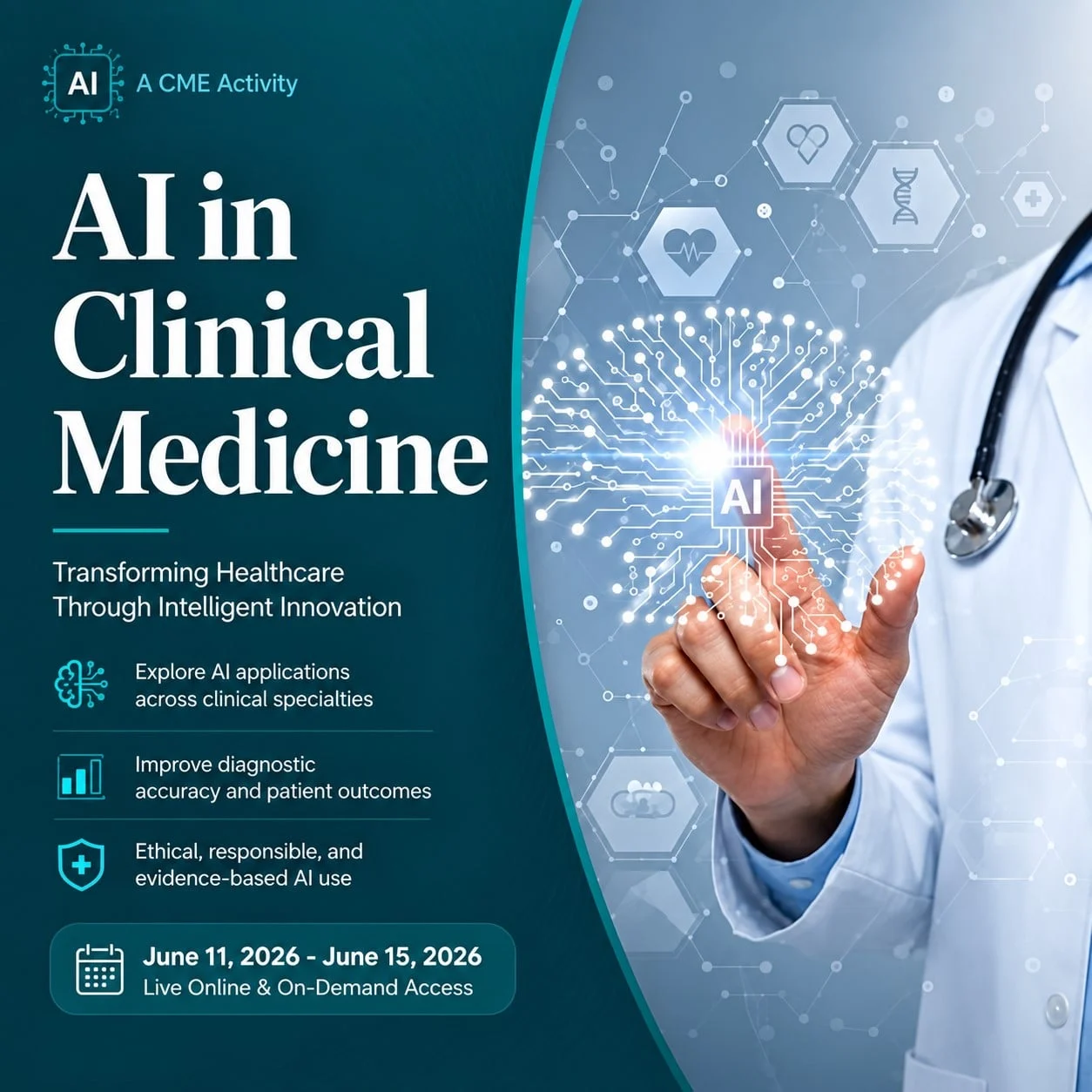
Harvard AI in Clinical Medicine 2026
Overview
Artificial intelligence (AI) is transforming healthcare at an unprecedented pace, changing how clinicians diagnose diseases, interpret medical data, monitor patients, and make treatment decisions. As healthcare systems continue to generate vast amounts of digital information through electronic health records, medical imaging, wearable technologies, and genomic data, AI is becoming an essential tool for improving efficiency, precision, and patient outcomes.
Harvard AI in Clinical Medicine 2026 is a comprehensive educational program designed to help healthcare professionals understand both the opportunities and challenges of integrating AI into everyday clinical practice. Rather than focusing solely on technical concepts, the course emphasizes practical applications that clinicians can evaluate and implement in real-world healthcare settings.

During this immersive live online program, participants will learn from leading physicians, researchers, academic faculty, and industry innovators who are actively shaping the future of artificial intelligence in medicine. Through expert lectures, specialty-focused sessions, panel discussions, and real-world clinical case studies, learners will explore how AI is influencing diagnosis, predictive analytics, clinical documentation, medical imaging, personalized treatment planning, healthcare operations, and medical education.
The course also examines critical topics including responsible AI implementation, ethical decision-making, algorithmic bias, regulatory frameworks, patient privacy, data security, and quality assurance. Participants will gain a balanced understanding of both the capabilities and limitations of AI while developing practical strategies for incorporating these technologies into clinical workflows.
Whether you are beginning your AI journey or looking to expand your understanding of emerging healthcare technologies, this course provides valuable insights into how artificial intelligence is reshaping modern medicine across multiple specialties.
Learning Objectives
Upon completion of this course, participants will be able to:
- Define the unique opportunities and challenges associated with integrating artificial intelligence into specialized areas of healthcare.
- Discuss the ethical considerations, limitations, and potential biases of AI algorithms used in clinical decision-making, diagnosis, and treatment planning.
- Review the current regulatory landscape surrounding artificial intelligence and understand its impact on healthcare delivery.
- Evaluate the long-term quality, reliability, and clinical performance of AI technologies and their influence on patient outcomes.
- Develop practical strategies for incorporating AI into medical education, including content generation, learner assessment, and alignment with educational objectives.
Target Audience
This program is designed for clinicians and healthcare professionals working in hospitals, academic institutions, outpatient practices, and healthcare organizations who want to understand how artificial intelligence is transforming clinical medicine.
The course is especially valuable for:
- Pathologists
- Endocrinologists
- Ophthalmologists
- Nurses
- Gastroenterologists
- Intensivists
- Radiologists
- Surgeons
- Anesthesiologists
- Oncologists
- Pulmonologists
- Cardiologists
- Psychiatrists
- Physicians
- Nurse Practitioners
- Physician Assistants
- Clinical Leaders
- Allied Health Professionals
Topics
- Keynote: How Artificial Intelligence Is Transforming Clinical Care
- Machine Learning, Deep Learning, and Large Language Models for Healthcare
- Foundations of Artificial Intelligence in Clinical Medicine
- Medical Data and Digital Health Infrastructure
- AI-Powered Clinical Documentation and Ambient Medical Scribes
- Artificial Intelligence in Medical Education
- AI-Assisted Clinical Research and Scientific Discovery
- Drug Discovery and Precision Medicine
- Artificial Intelligence in Personalized Oncology
- Clinical Decision Support Systems
- Predictive Analytics and Patient Outcome Prediction
- Artificial Intelligence in Diagnostic Medicine
- AI Applications in Medical Imaging
- Artificial Intelligence in Radiology
- Artificial Intelligence in Pathology
- Artificial Intelligence in Ophthalmology
- Artificial Intelligence in Gastroenterology
- Artificial Intelligence in Critical Care Medicine
- Artificial Intelligence in Cardiology
- Artificial Intelligence in Pulmonology
- Artificial Intelligence in Surgery
- Artificial Intelligence in Anesthesiology
- Artificial Intelligence in Psychiatry
- Remote Patient Monitoring and Digital Health
- Brain–Computer Interfaces and Emerging Neurotechnologies
- Responsible AI, Ethics, and Algorithmic Bias
- AI Regulation, Governance, and Healthcare Policy
- Privacy, Security, and Trustworthy Artificial Intelligence
- Evaluating AI Performance, Safety, and Clinical Reliability
- Barriers to AI Implementation in Healthcare Systems
- Real-World Clinical Case Studies
- Specialty Breakout Sessions
- Interactive Expert Panel Discussions
- Future Directions of Artificial Intelligence in Clinical Medicine
Why Attend
Harvard AI in Clinical Medicine 2026 offers a practical, evidence-based introduction to one of the fastest-growing areas of healthcare innovation. Participants will gain valuable insight into current AI technologies, understand their clinical applications across multiple specialties, and explore strategies for responsible implementation in everyday medical practice.
The program combines expert instruction with real-world examples, allowing healthcare professionals to evaluate emerging technologies while developing a deeper understanding of their impact on diagnosis, patient care, clinical workflows, research, and medical education.
Conclusion
Harvard AI in Clinical Medicine 2026 provides an in-depth exploration of how artificial intelligence is transforming healthcare across clinical practice, research, and education. Through expert-led lectures, multidisciplinary discussions, specialty-focused sessions, and practical case studies, participants will develop a comprehensive understanding of AI technologies and their growing role in modern medicine. This course serves as an excellent educational resource for healthcare professionals seeking to stay current with one of the most significant advancements in contemporary clinical practice.
4. Topics
-
Keynote: Paging Dr. A.I.: How AI is Changing the Face of Clinical Care
-
Learning the AI Lingo: Machine Learning, Deep Learning, and Large Language Models
-
A Look Into the Black Box: Technical Background for Clinicians
-
Medical Data as the Backbone of AI
-
Chatbots in Health Care: A Historical Expedition
-
AI Learning Revolution: Transforming Medical Education
-
Ambient Scribes
-
An AI designed drug for IPF: from preclinical development to phase II in under 3 years
-
Precision Medicine: AI and Personalized Treatment in Oncology
-
AI Powered Drug Repositioning and Clinical Trial Design
-
Keynote: Ethics and AI in Healthcare
-
AI for Pioneering Leadership in the Digital Era
-
Law and Regulation in AI
-
Telemetry/Mhealth for early detection of heart failure exacerbation
-
Brain computer interfaces and decoding speech
-
Can Chat bots improve mental health?
-
Bias in Risk Stratification for allocation and policy
-
Robust, Fair and private AI
-
Algorithmic bias in clinical scores and implications for AI
-
But I Want it Now!: Barriers to Clinical AI Implementation
-
How Can I Help You? Clinical Decision Support in the EHR
-
Implementing AI in your small practice
-
Hidden risks of AI in your practice
-
Money Talks: How AI Can Help You Improve Your Bottom Line
-
AI and Reducing Healthcare Provider Burnout
-
Why AI may be good for our health but hurt our wallets
-
Study Hall – Clinical Applications: Pathology
-
Study Hall – Clinical Applications: Endocrinology
-
Study Hall – Clinical Applications: Ophthalmology
-
Study Hall – Clinical Applications: Nursing
-
Study Hall – Clinical Applications: Gastroenterology
-
Study Hall – Clinical Applications: Critical Care
-
Study Hall – Clinical Applications: Radiology
-
Study Hall – Clinical Applications: Surgery or Anesthesia
-
Virtual demonstrations: Ambient Scribe from Abridge
-
Virtual demonstrations: Leveraging clinician’s expertise with Agentic AI
-
Virtual demonstrations: Evidence search using OpenEvidence
-
Virtual demonstrations: Doctronic
-
Virtual demonstrations: Uptodate Expert AI
-
Virtual demonstrations: Glasshealth’s clinical decision support platform