
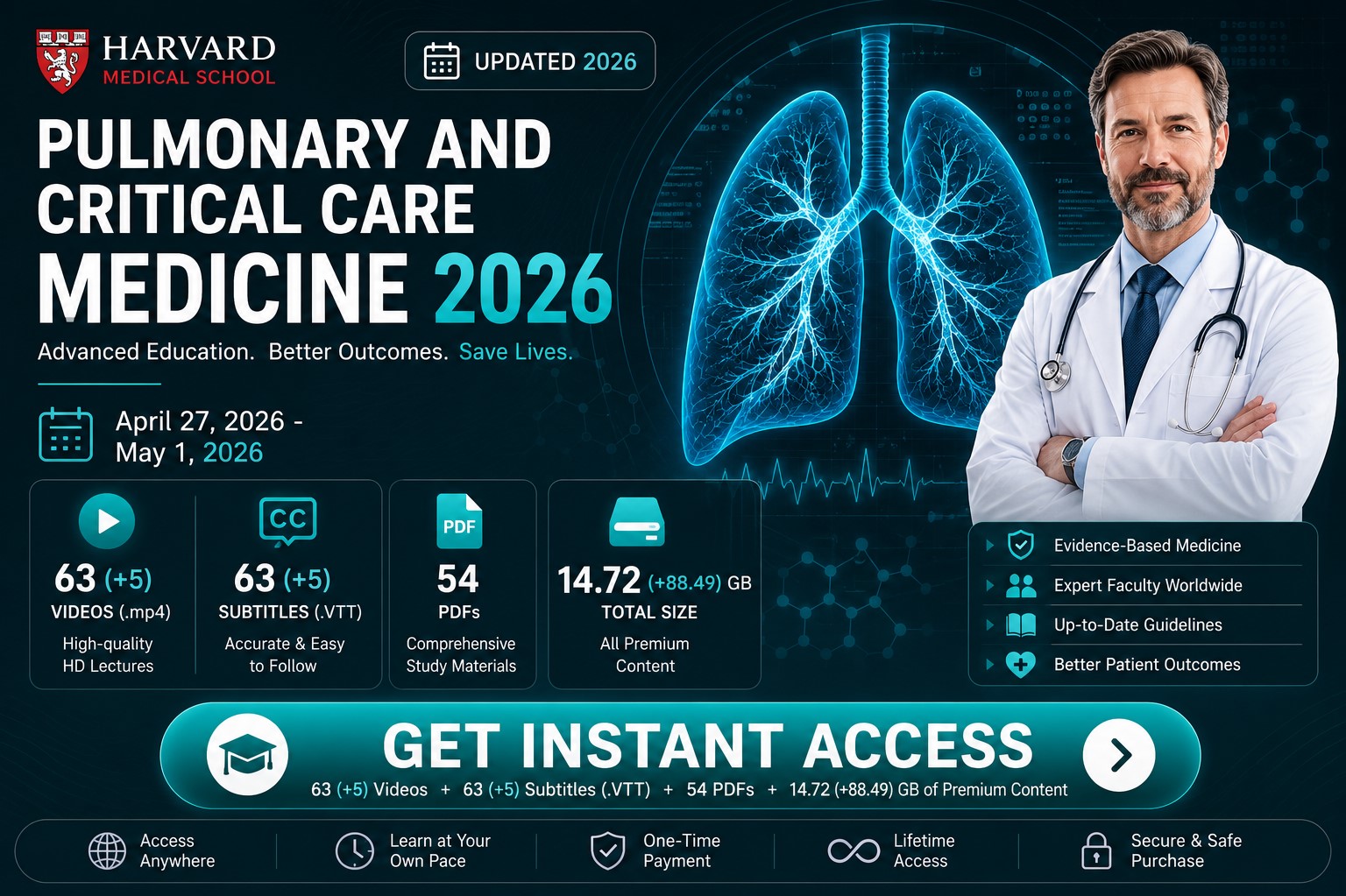
Harvard Pulmonary And Critical Care Medicine 2026
Original price was: $1,475.97.$120.00Current price is: $120.00.
Review the Harvard Pulmonary and Critical Care Medicine 2026 materials covering respiratory and intensive care topics.
Delivery Information: This Product is shared via google drive download link. Please use your correct Gmail address at checkout.
Please note: there are no CME points or certificate associated with this course.
Samples for Courses Can be found here: Free Samples Here!
Harvard Pulmonary and Critical Care Medicine 2026 (Videos)
Comprehensive Updates in Pulmonary Medicine, Critical Care, Mechanical Ventilation, ARDS, COPD, Asthma, Interstitial Lung Disease, Sepsis, ICU Management, and Evidence-Based Respiratory Care
Stay at the forefront of respiratory and intensive care medicine with Harvard Pulmonary and Critical Care Medicine 2026, an advanced continuing medical education (CME) program developed by Harvard Medical School. This comprehensive course delivers an evidence-based review of contemporary pulmonary and critical care medicine, integrating the latest clinical research, international practice guidelines, and multidisciplinary management strategies for patients with acute and chronic respiratory diseases as well as life-threatening critical illnesses.
Designed for physicians who care for hospitalized and critically ill patients, the program features internationally recognized faculty from pulmonary medicine, critical care, infectious diseases, thoracic imaging, anesthesiology, emergency medicine, and respiratory therapy. Through expert lectures, clinical case discussions, and guideline-focused reviews, participants strengthen their ability to diagnose, evaluate, and manage complex pulmonary disorders while improving outcomes for critically ill patients.
The curriculum emphasizes practical bedside decision-making, advanced respiratory support, mechanical ventilation, intensive care management, and evidence-based therapies for common and complex pulmonary diseases encountered in both inpatient and outpatient settings.
Product Details
- Course: Harvard Pulmonary and Critical Care Medicine 2026
- Provider: Harvard Medical School
- Format: Videos
- Language: English
- Educational Level: Intermediate to Advanced
- Learning Format: Expert Lectures, Clinical Case Discussions, Evidence-Based Reviews
Course Overview
Pulmonary and critical care medicine continues to evolve rapidly with advances in respiratory support technologies, precision medicine, critical care monitoring, antimicrobial therapy, and multidisciplinary ICU management. Clinicians must remain current with evolving guidelines to deliver optimal care for patients suffering from respiratory failure, chronic lung disease, severe infections, and multisystem critical illness.
Harvard Pulmonary and Critical Care Medicine 2026 provides a comprehensive review of both pulmonary medicine and critical care through practical, evidence-based education. Participants learn modern diagnostic approaches, advanced therapeutic strategies, and ICU best practices that can be immediately incorporated into everyday clinical practice.
The course combines foundational respiratory physiology with contemporary management of acute respiratory failure, chronic pulmonary disorders, sepsis, shock, mechanical ventilation, extracorporeal life support, and intensive care medicine.
What You’ll Learn
After completing this course, participants will be able to:
- Diagnose and manage common and complex pulmonary diseases using current evidence-based guidelines.
- Optimize treatment of patients with acute respiratory failure and critical illness.
- Apply advanced principles of invasive and non-invasive mechanical ventilation.
- Recognize and treat acute respiratory distress syndrome (ARDS).
- Manage COPD, asthma, pneumonia, and interstitial lung diseases using contemporary therapies.
- Improve diagnosis and management of sepsis and septic shock.
- Integrate multidisciplinary approaches into intensive care practice.
- Apply the latest clinical research to improve ICU patient outcomes.
Comprehensive Topics Covered
Pulmonary Medicine
Review the diagnosis and treatment of common and advanced respiratory diseases.
Topics include:
- Chronic obstructive pulmonary disease (COPD)
- Asthma
- Chronic cough
- Bronchiectasis
- Pulmonary infections
- Respiratory physiology
- Pulmonary function testing
Critical Care Medicine
Strengthen clinical decision-making in the management of critically ill patients.
Topics include:
- Intensive care medicine
- Shock
- Multiorgan failure
- ICU protocols
- Hemodynamic monitoring
- Critical illness
- Organ support
Acute Respiratory Failure
Develop practical strategies for managing respiratory emergencies.
Topics include:
- Hypoxemic respiratory failure
- Hypercapnic respiratory failure
- Oxygen therapy
- Respiratory support
- Airway management
- Escalation of care
Mechanical Ventilation
Master evidence-based ventilator management in critically ill patients.
Topics include:
- Invasive mechanical ventilation
- Non-invasive ventilation (NIV)
- Ventilator modes
- Lung-protective ventilation
- Ventilator weaning
- Ventilator-associated complications
Acute Respiratory Distress Syndrome (ARDS)
Review current recommendations for diagnosis and treatment.
Topics include:
- ARDS diagnosis
- Lung-protective strategies
- Prone positioning
- Recruitment maneuvers
- Adjunctive therapies
- ECMO considerations
Interstitial Lung Disease (ILD)
Explore contemporary approaches to diffuse parenchymal lung disease.
Topics include:
- Idiopathic pulmonary fibrosis
- Connective tissue disease-associated ILD
- Hypersensitivity pneumonitis
- High-resolution CT interpretation
- Antifibrotic therapy
Pulmonary Infections
Improve management of infectious respiratory diseases.
Topics include:
- Community-acquired pneumonia
- Hospital-acquired pneumonia
- Opportunistic infections
- Tuberculosis
- Antimicrobial stewardship
Pulmonary Vascular Disease
Review pulmonary circulation disorders.
Topics include:
- Pulmonary embolism
- Pulmonary hypertension
- Right ventricular failure
- Diagnostic imaging
- Evidence-based treatment
Sepsis & Critical Illness
Enhance recognition and treatment of severe infections.
Topics include:
- Sepsis
- Septic shock
- Early goal-directed therapy
- Vasopressor management
- Organ dysfunction
- ICU resuscitation
Sleep & Respiratory Disorders
Review common sleep-related breathing disorders.
Topics include:
- Obstructive sleep apnea
- Central sleep apnea
- Obesity hypoventilation syndrome
- Sleep diagnostics
- CPAP therapy
Learning Objectives
Upon completion of this educational activity, participants will be able to:
- Apply evidence-based diagnostic strategies for pulmonary diseases.
- Optimize management of critically ill patients in the ICU.
- Utilize current recommendations for mechanical ventilation and ARDS.
- Improve diagnosis and treatment of COPD, asthma, pneumonia, and ILD.
- Implement contemporary sepsis management protocols.
- Integrate multidisciplinary approaches into pulmonary and critical care practice.
- Improve patient safety and clinical outcomes through guideline-directed care.
Educational Highlights
- Pulmonary Medicine
- Critical Care Medicine
- Intensive Care Unit (ICU)
- Mechanical Ventilation
- Acute Respiratory Distress Syndrome (ARDS)
- Chronic Obstructive Pulmonary Disease (COPD)
- Asthma
- Interstitial Lung Disease (ILD)
- Pulmonary Fibrosis
- Pneumonia
- Pulmonary Embolism
- Pulmonary Hypertension
- Sepsis
- Septic Shock
- Respiratory Failure
- Non-Invasive Ventilation (NIV)
- Extracorporeal Membrane Oxygenation (ECMO)
- Evidence-Based Medicine
- Multidisciplinary Critical Care
- Continuing Medical Education (CME)
Why This Course Stands Out
Harvard Pulmonary and Critical Care Medicine 2026 provides a comprehensive, evidence-based review of both respiratory medicine and intensive care from internationally recognized Harvard faculty. Combining cutting-edge clinical research with practical bedside management, the course prepares clinicians to confidently manage complex pulmonary diseases, respiratory failure, critical illness, and modern ICU challenges. Its multidisciplinary approach, emphasis on current guidelines, and focus on improving patient outcomes make it an essential educational resource for physicians involved in pulmonary and critical care medicine.
Target Audience
This educational activity is ideal for:
- Pulmonologists
- Critical Care Physicians
- Intensivists
- Internal Medicine Physicians
- Hospitalists
- Emergency Medicine Physicians
- Anesthesiologists
- Respiratory Therapists
- Infectious Disease Specialists
- Fellows and Residents in Pulmonary & Critical Care Medicine
- Nurse Practitioners
- Physician Assistants
- ICU Nurses
- Healthcare Professionals involved in respiratory and critical care
Why Choose This Course?
Whether you specialize in pulmonary medicine, intensive care, internal medicine, emergency medicine, or hospital medicine, Harvard Pulmonary and Critical Care Medicine 2026 offers an outstanding review of contemporary respiratory and critical care practice. Featuring internationally recognized faculty, evidence-based lectures, multidisciplinary case discussions, and practical ICU management strategies, this course equips clinicians with the knowledge needed to improve diagnosis, optimize treatment, and deliver high-quality care to patients with complex pulmonary diseases and life-threatening critical illness.
Related products
Internal Medicine

Internal Medicine

Internal Medicine

Anesthesiology & pain medicine
Internal Medicine
Medical Accounts

USMLE / kaplan and Board Review
Uworld USMLE COMLEX Level 1 Qbank, Updated Jan 2023, System- and Subject-wise (PDF)
Critical Care - Emergency medicine