Harvard Update in Hospital Medicine 2025
Introduction
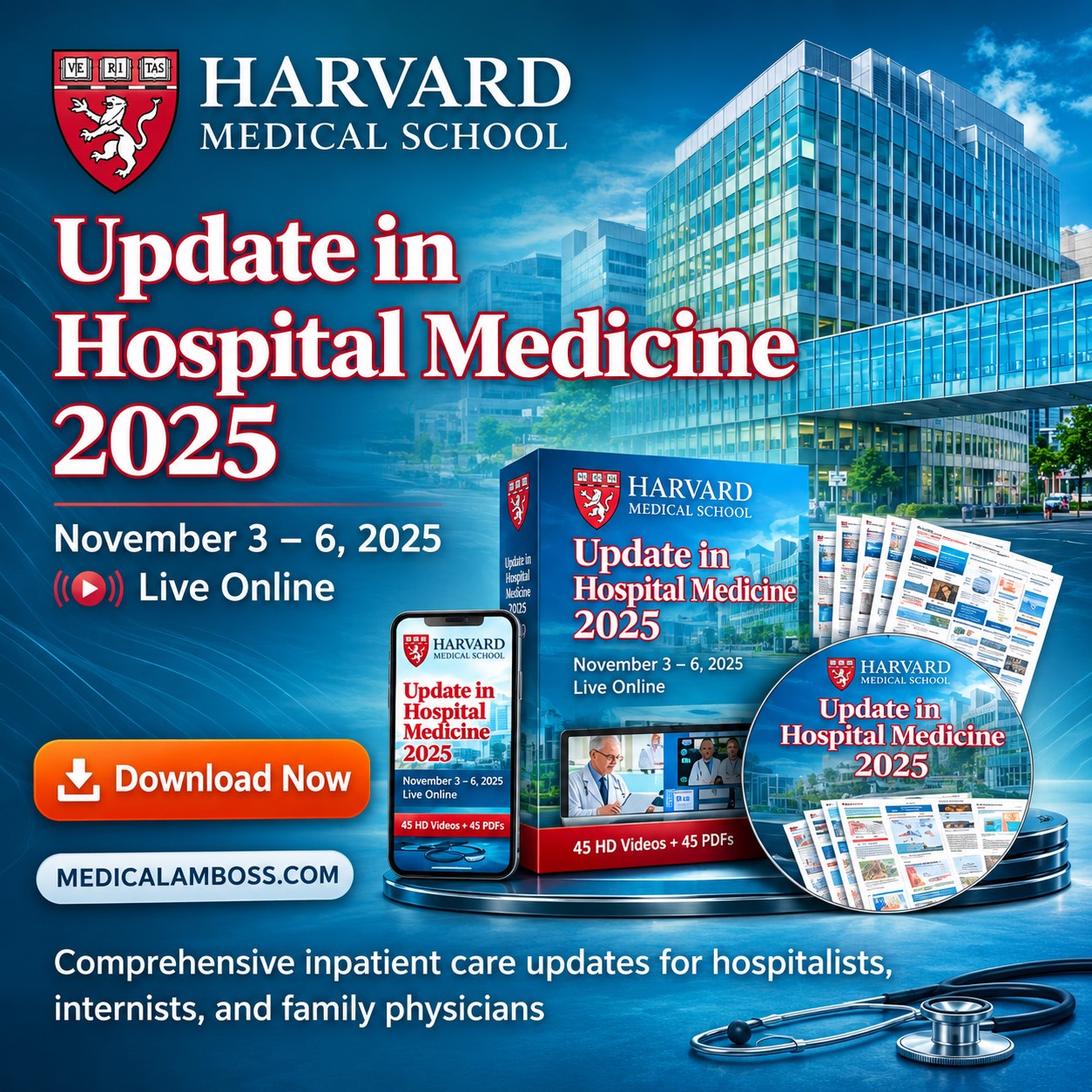
The Harvard Update in Hospital Medicine 2025 course is an advanced live-streamed educational program from Harvard Medical School designed to provide hospitalists, internists, family physicians, and inpatient clinicians with comprehensive updates in modern hospital medicine and acute care management. Held November 3–6, 2025, this intensive four-day course delivers practical, evidence-informed education focused on improving inpatient outcomes, strengthening diagnostic reasoning, and optimizing management strategies for common and high-risk conditions encountered in hospitalized patients.
Structured around a highly practical case-based learning model, the curriculum integrates updated clinical guidelines, expert opinion, emerging therapies, and contemporary diagnostic approaches across cardiology, infectious diseases, endocrinology, nephrology, neurology, critical care, geriatrics, and perioperative medicine. Faculty members include leading hospitalists and subspecialists recognized among the top educators at Harvard Medical School.
Through live-streamed lectures, interactive electronic Q&A sessions, and flexible remote learning technologies, participants gain direct access to clinically actionable insights relevant to modern inpatient medicine and multidisciplinary hospital care.
Files Included
The Harvard Update in Hospital Medicine 2025 educational package includes comprehensive inpatient medicine learning materials optimized for self-paced review and continuing medical education.
Included resources:
- 45 video lectures
- 45 downloadable PDF presentations
- Live-streamed educational sessions
- Case-based inpatient medicine discussions
- Guideline-focused hospital medicine reviews
- Diagnostic interpretation educational modules
- Infectious disease and critical care updates
- Acute care pharmacology discussions
Total course size: 17.8 GB
These materials support long-term review of hospital medicine, acute care management, and multidisciplinary inpatient clinical decision-making.
Why This Course Is Important
Hospital medicine continues to evolve rapidly due to expanding clinical evidence, updated guidelines, new pharmacologic therapies, antimicrobial stewardship challenges, and increasingly complex inpatient populations with multiple comorbidities. Hospitalists are now expected to integrate acute cardiovascular management, infectious disease protocols, perioperative assessment, critical care medicine, pain management, anticoagulation strategies, and substance use disorder treatment into fast-paced multidisciplinary care environments.
At the same time, advances in imaging, artificial intelligence-assisted diagnostics, anticoagulant therapies, infectious disease management, and inpatient pharmacology continue to reshape best practices in modern hospital medicine.
Harvard Update in Hospital Medicine 2025 addresses these challenges through an evidence-informed educational framework emphasizing practical inpatient management, rapid diagnostic reasoning, guideline interpretation, and real-world clinical application. The curriculum is specifically designed to help clinicians translate emerging evidence into safer, more effective hospital-based patient care.
What Participants Will Learn
Participants completing this course will strengthen their understanding of contemporary hospital medicine, acute care decision-making, and evidence-informed inpatient management.
Learning objectives include:
- Applying updated guidelines in heart failure, atrial fibrillation, anticoagulation, and perioperative medicine
- Improving diagnostic interpretation of ECGs, radiology studies, laboratory abnormalities, and electrolyte disorders
- Managing common infectious diseases including bacteremia, pneumonia, UTI, skin infections, and drug-resistant organisms
- Understanding evolving approaches to opioid use disorder, alcohol withdrawal, and inpatient pain management
- Evaluating modern strategies in stroke care, syncope risk stratification, and thromboembolism management
- Integrating updated critical care and ICU sedation evidence into patient management
- Applying best practices for diabetes, endocrinology, nephrology, and chronic disease management in hospitalized patients
- Understanding emerging pharmacologic therapies and updated treatment protocols
- Strengthening communication strategies for serious illness discussions and palliative care integration
The curriculum integrates cardiology, infectious diseases, critical care, endocrinology, neurology, nephrology, geriatrics, and hospital medicine into a clinically practical educational experience.
Full Course Topics & Lectures
Cardiovascular Medicine
Heart Failure
Atrial Fibrillation
Acute Coronary Syndromes
Coronary Imaging
Stroke/TIA
Venous Thromboembolism
Anticoagulation Updates
Reduced-Dose Anticoagulation in High Bleeding Risk Patients
DAPT vs. SAPT
Factor XI Inhibitors
Breakthrough Stroke Management
Stroke Risk in New-Onset Atrial Fibrillation
NSTEMI Management in Older Adults
Infectious Diseases & Antibiotic Stewardship
Bacteremia
Pneumonia
Drug-Resistant Infections
Skin and Soft Tissue Infections
C. difficile
UTI
Antibiotics
MSSA Bacteremia Treatment Updates
ESBL Culture Interpretation
Oral Fecal Microbiota Therapy
IV-to-Oral Antibiotic Transition Strategies
Duration of Antibiotics for Uncomplicated Bacteremia
HIV Protection with Lenacapavir
Diabetic Foot Infection Guidelines
Pulmonary & Critical Care Medicine
COPD
Critical Care
ICU Delirium and Sedation Strategies
Propofol vs. Dexmedetomidine
Endocrinology & Metabolic Medicine
Diabetes
Difficult Hyperglycemia Cases
Endocrinology Updates
Nephrology & Electrolyte Disorders
Acute Kidney Injury
End-Stage Renal Disease
Electrolyte Disorders
Cystatin C and GFR Assessment
Gastroenterology & Hepatology
GI Bleed
Pancreatobiliary Disease
Cirrhosis
Neurology & Syncope
Stroke and Thrombolysis
Syncope Risk Stratification
Headache and Neurologic Evaluation
Pain Management & Substance Use Disorders
Pain Management
Inpatient Pain Management: State of the Art
Opioid Use Disorder
Microdosing Protocols for Buprenorphine Induction
Suzetrigine for Acute Pain
Alcohol Withdrawal
Phenobarbital Protocols vs. CIWA
Pain Management in Substance Use Disorders
Rheumatology & Immunology
Rheumatology
Giant Cell Arteritis Diagnosis Without Biopsy
Dermatology & Allergy
Dermatology
Allergy Medicine
Skin Infection Mimics
Geriatrics & Palliative Care
Geriatrics
Delirium
Serious Illness Conversations
Pain and Palliative Care
Antipsychotics and Delirium Guidelines
Women’s Health & Pregnancy Medicine
Pregnancy
HELLP Syndrome and Medical Complications in Pregnancy
Diagnostic Interpretation Workshops
ECG Interpretation
Radiology Interpretation
Laboratory Interpretation
Rapid-Fire Diagnostic Challenges
Educational Experience & Learning Features
The Harvard Update in Hospital Medicine 2025 course combines evidence-informed inpatient medicine education with highly practical case-based learning and real-time expert discussion.
Educational features include:
- 45 expert-led video lectures
- 45 downloadable PDF educational presentations
- Live-streamed interactive learning sessions
- Electronic Q&A and audience interaction
- Case-based hospital medicine discussions
- Guideline-focused inpatient medicine reviews
- Acute care pharmacology updates
- Diagnostic interpretation workshops
- Critical care and infectious disease educational modules
- Flexible remote learning access
The curriculum integrates hospital medicine, acute care management, infectious disease, cardiology, critical care, and diagnostic reasoning into a clinically practical educational platform.
Who Should Take This Course
The Harvard Update in Hospital Medicine 2025 course is intended for clinicians involved in inpatient medicine and acute care management.
This course is especially valuable for:
- Hospitalists
- Internal medicine physicians
- Family medicine physicians
- Nurse practitioners
- Physician assistants
- Residents and fellows
- Acute care clinicians
- Physicians managing hospitalized patients
The curriculum is particularly relevant for clinicians seeking updated expertise in inpatient medicine, diagnostic reasoning, acute care therapeutics, infectious disease management, and evidence-informed hospital medicine practice.
Clinical Applications & Practice Benefits
The course provides clinically relevant education focused on improving inpatient management strategies, diagnostic interpretation, and multidisciplinary hospital care.
Participants gain practical insight into:
- Contemporary management of heart failure and atrial fibrillation
- Sepsis, bacteremia, pneumonia, and antimicrobial stewardship strategies
- Stroke care and anticoagulation decision-making
- Acute pain management and substance use disorder treatment
- ICU delirium prevention and sedation management
- Diabetes and electrolyte disorder management in hospitalized patients
- Risk stratification and diagnostic reasoning in syncope and acute illness
- Rapid interpretation of ECGs, radiology studies, and laboratory abnormalities
- Serious illness communication and palliative care integration
The educational content strengthens clinical confidence while supporting improved patient outcomes in modern hospital medicine practice.
Professional Summary
The Harvard Update in Hospital Medicine 2025 course from Harvard Medical School delivers one of the most comprehensive and clinically practical reviews available in contemporary hospital medicine and acute inpatient care.
From heart failure, atrial fibrillation, sepsis, bacteremia, COPD, diabetes, and anticoagulation to critical care, substance use disorders, stroke management, infectious diseases, and diagnostic interpretation, the curriculum explores the evolving landscape of inpatient medicine through expert-led teaching and case-based discussion.
Its combination of practical inpatient management strategies, updated guideline reviews, diagnostic workshops, and multidisciplinary acute care education makes this course a valuable educational resource for hospitalists, internists, family physicians, and clinicians caring for hospitalized patients.
+ Topics:
Monday, November 3, 2025
- 9:45am to 10:00am Welcome and Introductions
- 10:00am to 10:50am Can’t-Miss Radiology Diagnoses Jennifer W. Uyeda, MD
- 10:50am to 11:50am Anticoagulation and Hypercoagulable States Jean M. Connors, MD
- 11:50am to 12:00pm Break
- 12:00pm to 12:50pm Rapid-Fire Hematology Cases Alfred Lee, MD, PhD
- 12:50pm to 1:40pm Break
- 1:40pm to 2:25pm Inpatient Management of Patients with Psychiatric Disease Sejal B. Shah, MD
- 2:25pm to 3:10pm Best Practices in Delirium Management Shoshana Streiter, MD
- 3:10pm to 3:20pm Break
- 3:20pm to 4:15pm Update in Atrial Fibrillation Yee-Ping Sun, MD
- 4:15pm to 5:00pm Updates in the Diagnosis and Management of C. diff John J. Ross, MD, CM, FIDSA
- 5:00pm to 5:10pm Break
- 5:10pm to 6:05pm Improving the Evaluation and Management of Syncope Kapil Kumar, MD
- 6:05pm Study Hall Time for self-paced study of any of the pre-recorded sessions. Supplementary Sessions
- Rapid-Fire Electrolyte Cases for the Hospitalist: Na, Ca David A. Krakow, MD
- Rapid-Fire Lab Interpretation for the Hospitalist David A. Krakow, MD
- Pregnancy: What a Hospitalist Needs to Know Meghan Rudder, MD
- Current Approaches in the Management of Venous Thromboembolism Samuel Z. Goldhaber, MD
- ECG: Can’t-Miss Diagnoses Sanjay Divakaran, MD
- Acute Kidney Injury: Cases for the Hospitalist Emily S. Robinson, MD, MPH
- Inpatient Endocrinology Pearls J. Carl Pallais, MD, MPH
- Alcohol Withdrawal: A Case-Based Approach for the Hospitalist Lisa W. Vercollone, MD
- Inpatient Management of Opioid Use Disorder Lisa W. Vercollone, MD
Tuesday, November 4, 2025
- 9:45am to 10:40am Evidence-Based Management of Acute Coronary Syndromes Marc S. Sabatine, MD, MPH
- 10:40am to 11:20am Updates in Allergy and Immunology Paige G. Wickner, MD, MPH
- 11:20am to 11:30am Break
- 11:30am to 12:15pm Difficult Dermatology Cases for the Hospitalist Alexandra P. Charrow, MD
- 12:15pm to 1:05pm Break
- 1:05pm to 1:55pm Skin and Soft Tissue Infections and Common Mimics Adam D. Lipworth, MD
- 1:55pm to 2:40pm Pain Pointers: Practical Approaches to Managing Acute Pain in the Hospital Morgan C. Esperance, MD
- 2:40pm to 2:50pm Break
- 2:50pm to 3:35pm Goals of Care Conversations in Hospital Medicine Richard E. Leiter, MD
- 3:35pm to 4:25pm Current Strategies and Common Questions in the Management of Urinary Tract Infections Sigal Yawetz, MD
- 4:25pm to 4:35pm Break
- 4:35pm to 5:20pm CKD and ESRD Management for the Hospitalist Gearoid M. McMahon, MBBCh
- 5:20pm to 6:05pm Management of Critical Illness Before ICU Transfer Rebecca M. Baron, MD
- 6:05pm to 7:00pm Recent Advances in Heart Failure Management Anju Nohria, MD
- 7:00pm Study Hall Time for self-paced study of any of the pre-recorded sessions. Supplementary Sessions
- Rapid-Fire Electrolyte Cases for the Hospitalist: Na, Ca David A. Krakow, MD
- Rapid-Fire Lab Interpretation for the Hospitalist David A. Krakow, MD
- Pregnancy: What a Hospitalist Needs to Know Meghan Rudder, MD
- Current Approaches in the Management of Venous Thromboembolism Samuel Z. Goldhaber, MD
- ECG: Can’t-Miss Diagnoses Sanjay Divakaran, MD
- Acute Kidney Injury: Cases for the Hospitalist Emily S. Robinson, MD, MPH
- Inpatient Endocrinology Pearls J. Carl Pallais, MD, MPH
- Alcohol Withdrawal: A Case-Based Approach for the Hospitalist Lisa W. Vercollone, MD
- Inpatient Management of Opioid Use Disorder Lisa W. Vercollone, MD
Wednesday, November 5, 2025
- 9:45am to 10:45am Cirrhosis for the Hospitalist Anna E. Rutherford, MD, MPH
- 10:45am to 11:35am GI Bleed: What a Hospitalist Needs to Know Tyler M. Berzin, MD, MS
- 11:35am to 11:45am Break
- 11:45am to 12:30pm Care of the Hospitalized Patient with HIV Paul E. Sax, MD
- 12:30pm to 1:20pm Break
- 1:20pm to 2:10pm Evidence-Based Management of COPD Scott L. Schissel, MD, PhD
- 2:10pm to 3:00pm Antibiotics: A Comprehensive Update and Pearls for the Hospitalist – Part I Jennifer A. Johnson, MD
- 3:00pm to 3:10pm Break
- 3:10pm to 4:00pm Antibiotics: A Comprehensive Update and Pearls for the Hospitalist – Part II Jennifer A. Johnson, MD
- 4:00pm to 4:50pm Inpatient Diagnosis and Management of Pneumonia Michael Klompas, MD
- 4:50pm to 5:00pm Break
- 5:00pm to 5:45pm Management of Bacteremia Michael Klompas, MD
- 5:45pm to 6:35pm Do I Really Need Meropenem? Common ID Curbsides Hayden S. Andrews, MD
- 6:35pm Study Hall Time for self-paced study of any of the pre-recorded sessions. Supplementary Sessions
- Rapid-Fire Electrolyte Cases for the Hospitalist: Na, Ca David A. Krakow, MD
- Rapid-Fire Lab Interpretation for the Hospitalist David A. Krakow, MD
- Pregnancy: What a Hospitalist Needs to Know Meghan Rudder, MD
- Current Approaches in the Management of Venous Thromboembolism Samuel Z. Goldhaber, MD
- ECG: Can’t-Miss Diagnoses Sanjay Divakaran, MD
- Acute Kidney Injury: Cases for the Hospitalist Emily S. Robinson, MD, MPH
- Inpatient Endocrinology Pearls J. Carl Pallais, MD, MPH
- Alcohol Withdrawal: A Case-Based Approach for the Hospitalist Lisa W. Vercollone, MD
- Inpatient Management of Opioid Use Disorder Lisa W. Vercollone, MD
Thursday, November 6, 2025
- 9:45am to 10:30am Choosing the Best View: Patient-Centered Cardiovascular Imaging for Coronary Artery Disease Diana Lopez, MD
- 10:30am to 11:15am Centering Equity in Hospital Medicine Michelle Morse, MD, MPH and Bram Wispelwey, MD, MS, MPH
- 11:15am to 11:25am Break
- 11:25am to 12:20pm State-of-the-Art Management of Pancreatitis and Biliary Tract Disease Linda S. Lee, MD
- 12:20pm to 1:10pm Break
- 1:10pm to 2:10pm Evidence-Based Approaches to Inpatient Hyperglycemia Nadine E. Palermo, DO
- 2:10pm to 3:00pm Stroke in Hospital Medicine Alexis T. Roy, MD
- 3:00pm to 3:10pm Break
- 3:10pm to 3:55pm Let’s Rheuminate: Answers to Common Questions in Inpatient Rheumatology Michael A. Diiorio, MD
- 3:55pm to 4:45pm Current and Emerging Concepts for Preoperative Evaluation Adam C. Schaffer, MD
- 4:45pm to 4:55pm Break
- 4:55pm to 5:40pm Challenges and Conundrums in Hospital Medicine Elizabeth M. Petersen, MD, MPH
- 5:40pm Study Hall Time for self-paced study of any of the pre-recorded sessions. Supplementary Sessions
- Rapid-Fire Electrolyte Cases for the Hospitalist: Na, Ca David A. Krakow, MD
- Rapid-Fire Lab Interpretation for the Hospitalist David A. Krakow, MD
- Pregnancy: What a Hospitalist Needs to Know Meghan Rudder, MD
- Current Approaches in the Management of Venous Thromboembolism Samuel Z. Goldhaber, MD
- ECG: Can’t-Miss Diagnoses Sanjay Divakaran, MD
- Acute Kidney Injury: Cases for the Hospitalist Emily S. Robinson, MD, MPH
- Inpatient Endocrinology Pearls J. Carl Pallais, MD, MPH
- Alcohol Withdrawal: A Case-Based Approach for the Hospitalist Lisa W. Vercollone, MD
- Inpatient Management of Opioid Use Disorder Lisa W. Vercollone, MD