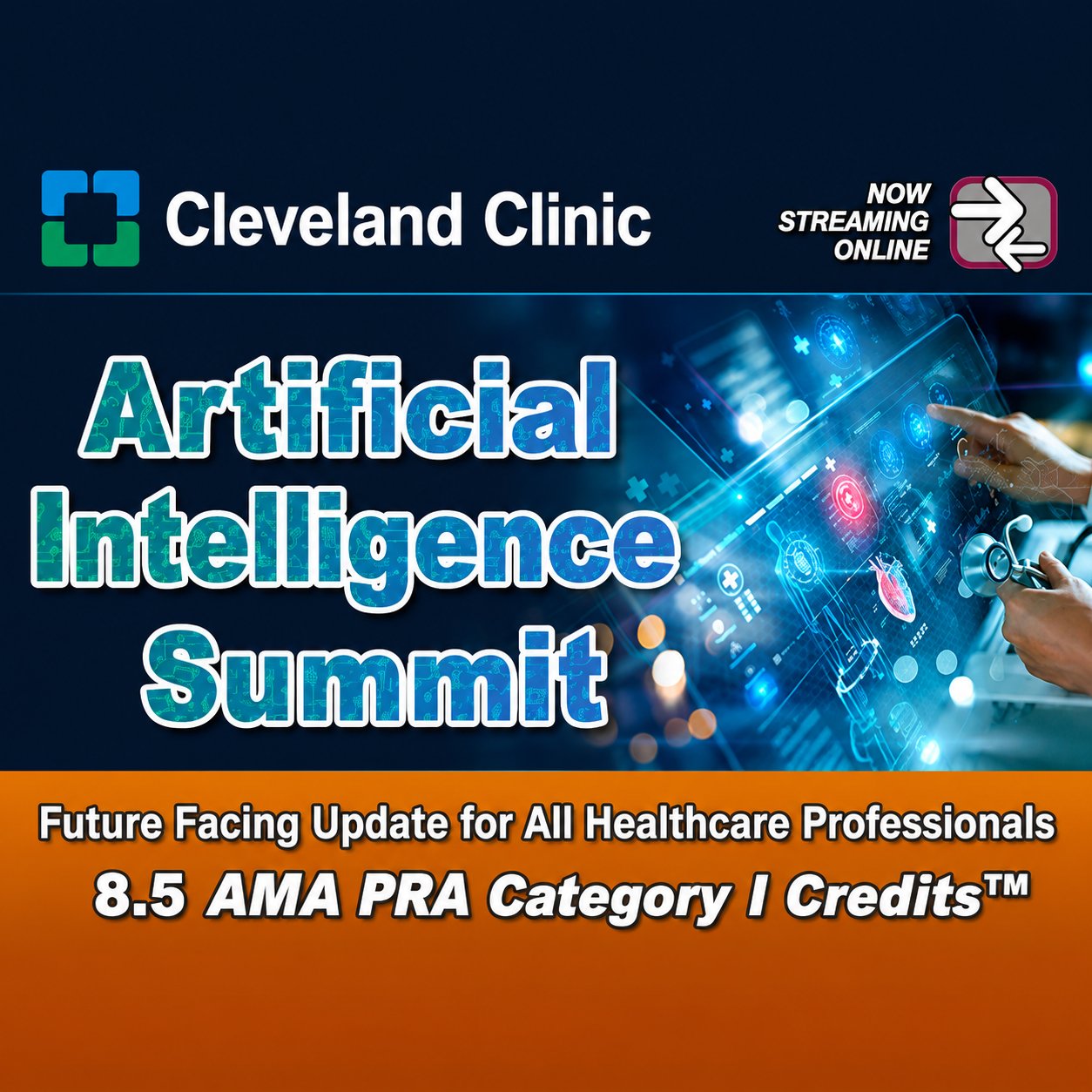
Meetings By Mail – Cleveland Clinic Artificial Intelligence Summit 2025

Artificial Intelligence in Healthcare, Clinical Practice & Medical Innovation
Overview
The Cleveland Clinic Artificial Intelligence Summit 2025 is a comprehensive healthcare technology program focused on the transformative role of Artificial Intelligence (AI) across modern medicine. Designed for clinicians, healthcare administrators, educators, researchers, and technology leaders, the summit explores how AI is reshaping patient care, clinical decision-making, medical education, healthcare operations, and precision medicine.
Featuring leading experts in healthcare AI, the program provides practical guidance on implementing AI responsibly while addressing important challenges related to ethics, governance, regulation, transparency, and patient safety.
The course emphasizes real-world applications of AI in both outpatient and inpatient settings, highlighting innovations that improve efficiency, reduce complications, enhance diagnostics, and personalize treatment strategies.
Course Features
- Artificial Intelligence in Healthcare
- Clinical AI Applications
- Precision Medicine Updates
- Healthcare Innovation & Digital Transformation
- AI Ethics & Governance
- Medical Education Technology
- Nursing & Pharmacy AI Applications
- Research & Data Science Integration
- Patient-Centered AI Solutions
- Case-Based Expert Discussions
Learning Objectives
Upon completion of this activity, participants will be able to:
- Understand current and emerging applications of AI in healthcare.
- Evaluate opportunities and limitations of AI technologies.
- Apply AI tools to improve clinical decision-making and patient outcomes.
- Recognize ethical and regulatory considerations surrounding AI.
- Explore AI applications in research, education, nursing, and pharmacy.
- Integrate AI-driven approaches into clinical workflows.
- Assess the role of AI in precision medicine and personalized care.
- Develop strategies for responsible AI implementation.
Core Topics Covered
Artificial Intelligence in Clinical Medicine
The summit provides a broad overview of AI applications in everyday medical practice.
Topics Include
- Clinical decision support
- Diagnostic assistance
- Predictive analytics
- Risk stratification
- Workflow optimization
- Patient outcome improvement
Participants learn how AI is increasingly becoming part of routine healthcare delivery.
Precision Medicine
A major focus of the conference is AI-driven personalized healthcare.
Covered Areas
- Genomic medicine
- Individualized treatment planning
- Predictive modeling
- Biomarker analysis
- Population health management
- Personalized risk assessment
Faculty discuss how AI supports more precise and patient-specific care.
Outpatient Care Applications
The program explores AI tools designed for ambulatory practice.
Topics Include
- Primary care support
- Chronic disease management
- Preventive medicine
- Remote monitoring
- Patient engagement platforms
- Clinical workflow enhancement
These technologies aim to improve access, efficiency, and continuity of care.
Acute Care & Hospital Medicine
Dedicated sessions review AI implementation in inpatient settings.
Topics Include
- Early warning systems
- Clinical deterioration prediction
- Hospital operations
- Critical care applications
- Emergency medicine support
- Resource optimization
AI is increasingly used to improve safety and operational efficiency within hospitals.
AI in Surgery
The conference highlights advances in surgical innovation.
Covered Topics
- Surgical planning
- Computer-assisted procedures
- Intraoperative decision support
- Outcome prediction
- Complication reduction
- Future robotic integration
Participants gain insight into how AI is transforming procedural medicine.
Reducing Complications & Improving Outcomes
A key objective of healthcare AI is improving patient safety.
Topics Include
- Predictive risk modeling
- Complication prevention
- Quality improvement
- Readmission reduction
- Clinical surveillance
- Outcome measurement
These applications help clinicians identify risks earlier and intervene proactively.
AI Ethics & Governance
One of the most important sections addresses responsible AI use.
Areas Covered
- Ethical principles
- Algorithmic bias
- Transparency
- Accountability
- Patient privacy
- Regulatory considerations
Faculty emphasize the importance of balancing innovation with patient protection.
AI in Medical Education
The summit examines how technology is reshaping healthcare training.
Topics Include
- AI-assisted learning
- Simulation technologies
- Educational analytics
- Personalized education
- Competency assessment
- Future training models
These innovations are changing how healthcare professionals acquire knowledge and skills.
AI in Research
The conference reviews AI’s role in accelerating scientific discovery.
Covered Areas
- Clinical research
- Data analysis
- Trial optimization
- Predictive modeling
- Literature synthesis
- Translational medicine
Researchers gain insight into how AI can enhance research productivity and efficiency.
Nursing & Allied Health Applications
Specialized sessions focus on multidisciplinary healthcare teams.
Topics Include
- Nursing workflow support
- Clinical documentation
- Patient monitoring
- Care coordination
- Allied health integration
- Workforce optimization
The emphasis is on improving patient care across the healthcare continuum.
Pharmacy & Medication Management
AI applications in medication safety and pharmacy practice are also reviewed.
Topics Include
- Medication optimization
- Drug interaction detection
- Precision pharmacotherapy
- Clinical decision support
- Medication adherence
- Pharmaceutical research
These technologies support safer and more effective medication management.
Healthcare Leadership & Digital Transformation
The summit addresses organizational implementation strategies.
Topics Include
- Health system innovation
- Technology adoption
- Change management
- Digital transformation
- Leadership strategies
- Future healthcare models
Healthcare leaders learn how to guide AI integration successfully.
Target Audience
This course is ideal for:
- Physicians
- Primary Care Physicians
- Specialists
- Nurses
- Nurse Practitioners
- Physician Assistants
- Pharmacists
- Healthcare Administrators
- Health Technology Leaders
- Medical Educators
- Clinical Researchers
- Healthcare Informatics Professionals
Why This Course Stands Out
✔ Comprehensive healthcare AI curriculum
✔ Developed by Cleveland Clinic experts
✔ Covers both clinical and operational AI applications
✔ Strong focus on ethics and governance
✔ Reviews AI across multiple medical specialties
✔ Addresses outpatient and inpatient care
✔ Includes research and education innovations
✔ Practical implementation strategies
✔ Relevant for clinicians and healthcare leaders
✔ Future-focused healthcare technology education
+ Topics:
Session 1: AI Opportunities in Healthcare – Big Picture
| Keynote: Transformational AI Opportunities in Healthcare | David C. Rhew, MD |
| Panel Discussion: AI Innovation, Ethics and Governance – What Does it Take to Be Ready to Safely Innovate? | Scott Steele, MD, Ben Shahshahani, PhD, Nikhil Buduma, Jeremy David and Michael R. Pinsky, MD |
| AI-Powered Revenue Cycle: Driving Efficiency, Accuracy and Innovation | Tracy Peffley, RHIA and Nicholas Judd, MBA, RHIA |
| Panel Discussion: AI Evaluation – What Does Success Look Like? | Nancy Albert, PhD, Jianying Hu, PhD, Anant Madabhushi, PhD, Susannah Rose, PhD and Andrea Sikora, PharmD |
Session 2: Patient Focused AI
| AI in the Outpatient Setting | Sarah Hatchett, MBA, Jennifer Owens, MS, Nikhil Buduma |
| Use of AI in Acute Care: Redefining Health and Disease | Michael R. Pinsky, MD |
| AI Benefits and Risks for Patients, Caregivers and Health Systems | Raymond Ng, PhD |
| Person-Centered AI: Ethical Innovation and the Future of Patient Experience | Susannah Rose, PhD |
Session 3: AI for Precision Medicine and Surgery
| Interpreter of Maladies: Application of Artificial Intelligence for Precision Medicine | Anant Madabhushi, PhD |
| Utilizing AI for Surgical Planning | John Weaver,MD |
| Surgical Navigation 2.0: From Analog to Autonomous | Giovanni E. Cacciamani, MSc, MD |
| AI in the OR: Personalizing Care, Lowering Complications and Automating Surgery | Christopher Weight, MD, MS |
Session 4: AI in Research & Education
| Impact of AI on Biomedical Research | Jianying Hu, PhD |
| AI in Medical Education | Neil Mehta, MBBS, MS |
| AI Pedagogy in Medical Education | Anthony C. Chang, MD, MBA, MPH |
Session 5: Responsible AI, Nursing and Pharma
| Responsible AI in a Healthcare System | Nigam Shah, MBBS, PhD |
| Impact of AI on Nursing: the Practice, the Utilization and the Workload | Nelita Iuppa, DNP, MS, RN-BC, Nancy Albert, PhD, CCNS, CCRN, Jennifer Owens, MS, and Kim Svoboda, RN-BC, MBA |
| Intersection of AI and Pharmacy: the Need for Medication Data Infrastructure | Andrea Sikora, PharmD |