
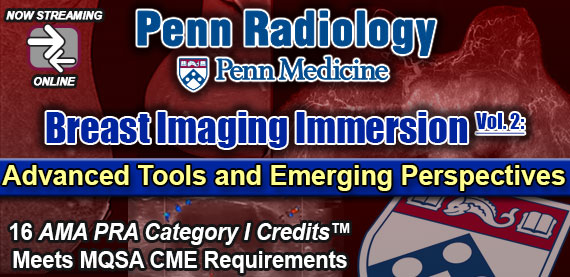
Meetings By Mail Penn Radiology Breast Imaging Immersion Vol.2 2026
$35.00
Samples for Courses Can be found here : Free Samples Here!
This Product is shared via google drive download link, So please share your correct Gmail id while placing the order .Please note that there are no CME points or certificate associated with this course
Meetings By Mail – Penn Radiology Breast Imaging Immersion Vol. 2 (2026) (Videos)
Advanced Breast Imaging, Contrast-Enhanced Mammography, Breast MRI, AI, Ultrasound & Multimodality Breast Cancer Diagnosis
Advance your expertise in breast imaging with Meetings By Mail – Penn Radiology Breast Imaging Immersion Vol. 2 (2026), a comprehensive educational program delivering an evidence-based update on the latest innovations in breast imaging and breast cancer diagnosis.
Released on May 12, 2026, this advanced course features renowned Penn Radiology faculty presenting practical, case-based instruction on cutting-edge imaging technologies including contrast-enhanced mammography (CEM), abbreviated breast MRI, whole-breast ultrasound, artificial intelligence (AI), PET-CT, breast cancer biology, risk prediction, axillary lymph node evaluation, and image-guided breast biopsy.
Designed around real clinical scenarios, the course emphasizes accurate interpretation, multimodality imaging correlation, current screening strategies, diagnostic confidence, and multidisciplinary breast cancer management.
Product Details
- Course: Meetings By Mail – Penn Radiology Breast Imaging Immersion Vol. 2 (2026)
- Provider: Meetings By Mail
- Institution: Penn Radiology
- Release Date: May 12, 2026
- Format: Videos
- Language: English
- Educational Level: Advanced
- Learning Format: Expert Lectures, Case-Based Learning, Clinical Imaging Review
Course Overview
Modern breast imaging continues to evolve rapidly with advances in supplemental screening, functional imaging, artificial intelligence, and minimally invasive diagnostic techniques. Radiologists must integrate multiple imaging modalities while understanding breast cancer biology, individualized risk assessment, and multidisciplinary treatment planning.
Penn Radiology Breast Imaging Immersion Vol. 2 (2026) provides an intensive review of contemporary breast imaging practice through practical clinical cases and evidence-based instruction. Faculty demonstrate how to optimize multimodality imaging interpretation using digital mammography, contrast-enhanced mammography, abbreviated breast MRI, ultrasound, PET-CT, and image-guided interventions while highlighting diagnostic pearls, common pitfalls, and emerging technologies.
The course bridges diagnostic imaging with surgical oncology and breast cancer management, helping clinicians improve accuracy, confidence, and patient outcomes.
What You’ll Learn
After completing this course, participants will be able to:
- Apply advanced breast imaging techniques to improve diagnostic accuracy.
- Utilize contrast-enhanced mammography and abbreviated breast MRI in appropriate clinical settings.
- Integrate whole-breast ultrasound into supplemental breast cancer screening.
- Evaluate breast cancer biology and incorporate individualized risk prediction into imaging strategies.
- Interpret challenging breast imaging cases using a multimodality approach.
- Apply current concepts in axillary lymph node assessment and image-guided biopsy.
- Understand the expanding role of artificial intelligence in breast imaging workflows.
Comprehensive Topics Covered
Breast Imaging Fundamentals
Strengthen diagnostic interpretation skills.
Topics include:
- Breast imaging
- Breast cancer detection
- Breast screening
- Diagnostic breast imaging
- Breast radiology
- Imaging interpretation
- Clinical decision-making
Digital Mammography & Tomosynthesis
Improve mammographic interpretation.
Topics include:
- Digital mammography
- Digital breast tomosynthesis (DBT)
- Screening mammography
- Diagnostic mammography
- Breast density
- Architectural distortion
- Calcifications
Contrast-Enhanced Mammography (CEM)
Master emerging breast imaging technology.
Topics include:
- Contrast-enhanced mammography
- Functional breast imaging
- Breast lesion characterization
- Diagnostic evaluation
- Supplemental screening
- Contrast imaging
- Clinical applications
Abbreviated Breast MRI
Expand MRI expertise.
Topics include:
- Abbreviated breast MRI
- Breast MRI
- High-risk screening
- Problem-solving MRI
- Breast lesion evaluation
- MRI interpretation
- Advanced imaging
Whole-Breast Ultrasound
Optimize ultrasound evaluation.
Topics include:
- Whole-breast ultrasound
- Screening ultrasound
- Diagnostic ultrasound
- Targeted breast ultrasound
- Supplemental screening
- Breast lesion characterization
- Sonographic interpretation
Artificial Intelligence in Breast Imaging
Explore the future of breast imaging.
Topics include:
- Artificial intelligence (AI)
- Machine learning
- Computer-aided detection
- Workflow optimization
- Image analysis
- Decision support
- Emerging technologies
Faculty discuss both the opportunities and limitations of AI integration into clinical breast imaging practice.
Breast Cancer Biology & Risk Prediction
Strengthen personalized screening strategies.
Topics include:
- Breast cancer biology
- Risk prediction
- Risk stratification
- Personalized screening
- High-risk patients
- Precision imaging
- Preventive strategies
Ductal Carcinoma In Situ (DCIS)
Improve recognition of early breast cancer.
Topics include:
- DCIS
- Non-invasive breast cancer
- Mammographic findings
- Calcification patterns
- Diagnosis
- Imaging-pathology correlation
- Management considerations
PET-CT in Breast Imaging
Understand advanced oncologic imaging.
Topics include:
- PET-CT
- Breast cancer staging
- Functional imaging
- Metastatic disease
- Response assessment
- Hybrid imaging
- Clinical applications
Axillary Lymph Node Evaluation
Enhance staging accuracy.
Topics include:
- Axillary ultrasound
- Lymph node assessment
- Nodal staging
- Breast cancer staging
- Regional disease
- Surgical planning
- Imaging correlation
Image-Guided Breast Biopsy
Master minimally invasive procedures.
Topics include:
- Ultrasound-guided biopsy
- Stereotactic biopsy
- MRI-guided biopsy
- Multimodality biopsy
- Breast intervention
- Tissue sampling
- Procedural techniques
Case-Based Breast Imaging
Develop real-world diagnostic confidence.
Topics include:
- Challenging breast cases
- Diagnostic pitfalls
- Imaging pearls
- Clinical reasoning
- Multimodality interpretation
- Evidence-based practice
- Multidisciplinary care
Learning Objectives
Upon completion of this educational activity, participants will be able to:
- Apply advanced multimodality breast imaging techniques in daily clinical practice.
- Integrate abbreviated breast MRI, contrast-enhanced mammography, whole-breast ultrasound, and PET-CT into diagnostic workflows.
- Improve diagnostic accuracy through evidence-based interpretation of complex breast imaging cases.
- Evaluate breast cancer biology, individualized risk prediction, and supplemental screening strategies.
- Utilize multimodality image-guided biopsy techniques for accurate tissue diagnosis.
- Understand the expanding role of artificial intelligence in breast imaging interpretation and workflow optimization.
- Correlate imaging findings with surgical and oncologic management to support multidisciplinary patient care.
Educational Highlights
- Breast Imaging
- Mammography
- Digital Breast Tomosynthesis (DBT)
- Contrast-Enhanced Mammography (CEM)
- Breast MRI
- Abbreviated Breast MRI
- Whole-Breast Ultrasound
- Artificial Intelligence (AI)
- PET-CT
- Breast Cancer Biology
- Risk Prediction
- DCIS
- Breast Cancer Screening
- Axillary Lymph Node Imaging
- Image-Guided Breast Biopsy
- Diagnostic Radiology
- Breast Oncology
- Multidisciplinary Breast Care
- Continuing Medical Education (CME)
Why This Course Stands Out
Penn Radiology Breast Imaging Immersion Vol. 2 (2026) delivers a highly practical, case-based review of modern breast imaging by combining established diagnostic techniques with the latest advances in AI, contrast-enhanced mammography, abbreviated MRI, and multimodality intervention. Led by internationally recognized Penn Radiology faculty, the course emphasizes real-world interpretation skills, multidisciplinary collaboration, and evidence-based imaging strategies that can be immediately applied to clinical practice.
Target Audience
This educational activity is ideal for:
- Breast Radiologists
- General Radiologists
- Breast Imaging Specialists
- Radiology Residents
- Breast Imaging Fellows
- Breast Surgeons
- Surgical Oncologists
- Medical Oncologists
- Radiologic Technologists
- Physician Assistants
- Nurse Practitioners
- Healthcare Professionals involved in breast imaging and breast cancer diagnosis
Why Choose This Course?
Whether you specialize in breast imaging or interpret breast studies as part of a general radiology practice, Meetings By Mail – Penn Radiology Breast Imaging Immersion Vol. 2 (2026) provides an outstanding update on advanced imaging techniques, evidence-based screening strategies, and multidisciplinary breast cancer care. Through expert-led lectures, challenging clinical cases, and practical imaging guidance, participants gain the skills needed to improve diagnostic accuracy, confidently manage complex cases, and enhance patient outcomes.
+ Topics:
Session 1: AI, Abbreviated MRI and More
| Clinical Implementation of AI | Habib Rahbar, MD |
| Abbreviated Breast MRI: The Why and How of Clinical Implementation | Emily Conant, MD |
| AI for Breast Cancer Detection: Where Do We Stand? | Emily Conant, MD |
| Case Series: Challenging Multimodality Cases | Cindy Lee, MD, CMQ |
| Questions and Answers | Multiple Faculty |
Session 2: Contrast Enhanced Mammography
| Screening and Diagnostic Contrast Enhanced Mammography | Margarita L. Zuley, MD |
| So, You Want to Start CEM? | Margarita L. Zuley, MD |
| Case Series: CEM | Margarita L. Zuley, MD |
| Supplemental Screening: Ab-MRI vs. CEM | Habib Rahbar, MD |
| Questions and Answers | Multiple Faculty |
Session 3: DCIS and Breast Cancer Updates
| Breast Cancer Risk Prediction: Breast Density & Beyond… | Emily Conant, MD |
| Basics of Breast Cancer Biology for the Imager | Emily Conant, MD |
| PET-CT for Breast Cancer: Fluorodeoxyglucose and Fluoroestradiol | Sophia O’Brien, MD, MSEd |
| Imaging of DCIS: Controversies and Opportunities | Habib Rahbar, MD |
| Questions and Answers | Multiple Faculty |
Session 4: Diagnosis and Management Challenges
| Overdiagnosis or Underdiagnosis | Peter R. Eby, MD |
| Updates in Axillary Lymph Node Management | Habib Rahbar, MD |
| The Audit is Your Friend | Peter R. Eby, MD |
| Unknown Cases | Peter R. Eby, MD |
| Questions and Answers | Multiple Faculty |
Session 5: Biopsy and Multimodality Perspectives
| MR-Guided Biopsy: How I Do It | Peter R. Eby, MD |
| CEM-Guided Breast Biopsy | Margarita L. Zuley, MD |
| Case Review: Symptomatic Patients and Special Clinical or Challenging Scenarios | Habib Rahbar, MD |
| Questions and Answers | Multiple Faculty |
Related products
Critical Care - Emergency medicine
Gulfcoast Ultrasound-Guided Upper Extremity Nerve Blocks for Emergency Medicine
Critical Care - Emergency medicine
2020 Radiology After Five: How to Make Night and Weekend Call a Success!
Cardiology
Cardiology

Critical Care - Emergency medicine