
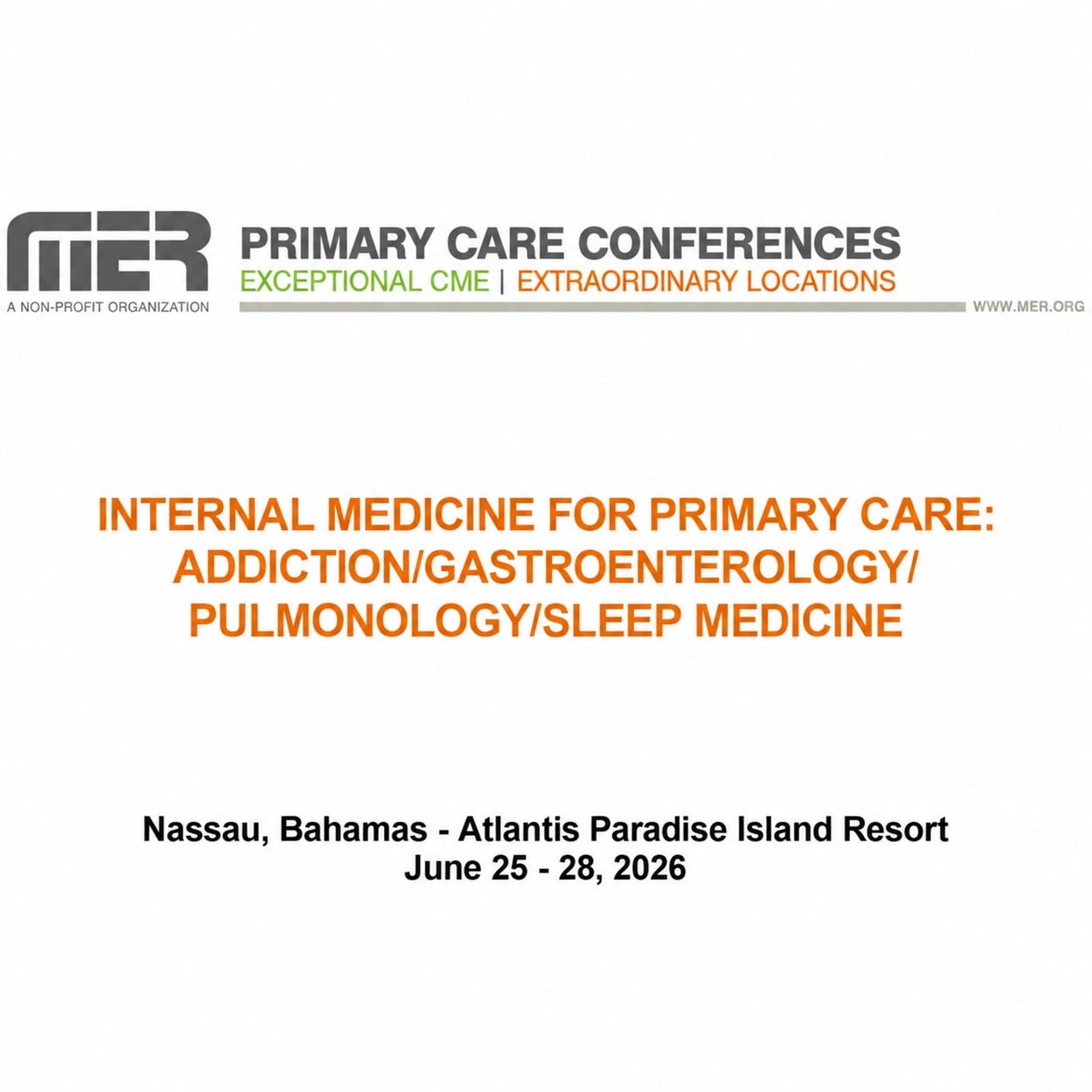
MER Primary Care Conferences Internal Medicine for Primary Care Addiction Gastro Pulm Sleep Med Jun 25-28, 2026
$120.00
Primary care educational materials covering addiction medicine, gastroenterology, pulmonology and sleep medicine.
Delivery Information: This Product is shared via google drive download link. Please use your correct Gmail address at checkout.
Please note: there are no CME points or certificate associated with this course.
Samples for Courses Can be found here: Free Samples Here!
MER Primary Care Conferences Internal Medicine for Primary Care Addiction Gastro Pulm Sleep Med Jun 25-28, 2026
Internal Medicine for Primary Care: Addiction / Gastroenterology / Pulmonology / Sleep Medicine
The Internal Medicine for Primary Care: Addiction/Gastroenterology/Pulmonology/Sleep Medicine conference is an educational program organized by Medical Education Resources (MER), a non-profit organization providing continuing medical education for healthcare professionals.
The conference is scheduled for June 25–28, 2026, at Atlantis Paradise Island Resort, Nassau, Bahamas. The program provides practical, evidence-based updates across addiction medicine, gastroenterology, pulmonology, and sleep medicine, with a focus on conditions frequently encountered in primary care.
Course Details
- Course: Internal Medicine for Primary Care: Addiction/Gastroenterology/Pulmonology/Sleep Medicine
- Organizer: Medical Education Resources (MER)
- Dates: June 25–28, 2026
- Location: Atlantis Paradise Island Resort, Nassau, Bahamas
- Specialties: Internal Medicine, Primary Care, Addiction Medicine, Gastroenterology, Pulmonology, Sleep Medicine
Course Overview
This multidisciplinary primary care program covers important clinical conditions in pulmonary medicine, sleep medicine, gastroenterology, and addiction medicine.
The curriculum emphasizes practical diagnosis and management strategies, current treatment recommendations, and evidence-based approaches that can be incorporated into everyday clinical practice.
Pulmonology
Topics include:
- Asthma diagnosis and management
- Evidence-based treatment of common respiratory infections
- Current management of COPD
- Diagnosis and screening of lung nodules
- Lung cancer treatment strategies
Sleep Medicine
The program addresses common sleep and circadian disorders, including:
- Basic mechanisms of sleep
- Circadian rhythm disorders
- Insomnia
- Restless legs syndrome (RLS)
- Excessive sleepiness
- Obstructive sleep apnea
- Parasomnias
- Other special sleep-related conditions
Participants will develop practical therapeutic approaches to common sleep complaints encountered in primary care.
Gastroenterology
Key gastroenterology topics include:
- Current treatment recommendations for lower GI bleeding
- Colonoscopic colorectal cancer screening
- Colorectal cancer surveillance
- Diagnostic testing for celiac disease
- Medications and toxins associated with liver injury
Addiction Medicine
The addiction medicine component focuses on:
- Neurobiology of addiction
- FDA-approved medications for addiction treatment
- Selecting appropriate pharmacologic treatment
- Chronic pain and addiction
- Behavioral addictions
- Evidence-based approaches to chronic brain disorders associated with behavioral addictions
Learning Objectives
Upon completion of this program, participants should be better able to:
- Diagnose and manage patients with asthma.
- Develop evidence-based treatment strategies for common respiratory infections.
- Describe current therapeutic management of COPD.
- Discuss diagnostic and screening strategies for lung nodules and lung cancer.
- Explain the basic mechanisms of sleep and circadian rhythm disorders.
- Develop therapeutic plans for insomnia and restless legs syndrome.
- Review treatment options for excessive sleepiness and obstructive sleep apnea.
- Describe medical issues related to RLS, parasomnias, and other sleep disorders.
- Apply current treatment recommendations for lower GI bleeding.
- Discuss guidelines for colorectal cancer screening and surveillance.
- Recommend appropriate diagnostic testing for celiac disease.
- Recognize medications and toxins commonly associated with liver injury.
- Describe the neurobiology of addiction.
- Identify FDA-approved medications used in addiction treatment and understand their roles.
- Discuss treatment options for patients with chronic pain and addiction.
- Apply evidence-based treatment strategies for behavioral addictions.
Target Audience
This program is targeted toward office-based primary care providers and healthcare professionals seeking current updates in primary care medicine.
4. Topics
Pulmonology
-
Asthma: The medical impact of asthma; fundamental role of inflammation, with possible scarring and irreversible loss of lung function; practical points of diagnosis; goal setting management based on levels of severity; risk factors for mortality and treatment in the acute setting; management options for the difficult to control asthmatic patient.
-
Controversies in the Treatment of Common Respiratory Infections: Acute and chronic bronchitis; pneumonia (community versus hospital-acquired); role of the Pneumonia Severity Index score in determining indication for hospitalization; cost-effective use of antibiotics; clinical significance of drug resistance; guidelines for management.
-
COPD: Definition; pathophysiology; early detection and intervention; risk reduction; management update including new modalities (including lung volume reduction surgery) and the role of inhaled corticosteroids and domiciliary oxygen.
-
Lung Cancer Screening & Pulmonary Nodules: Appropriate use of the new lung cancer screening recommendations; Fleischner Society guidelines and American College of Chest Physician Lung Cancer guidelines; approach to definitive evaluation and management strategies.
Sleep Medicine
-
How Sleep Works: The drivers of sleep and integration of how these drivers can be used to improve sleep; Basic principles of sleep drive, circadian rhythm and sleep associations will be discussed; Related to cases to highlight these principles.
-
Approach to the Patient Who Can’t Sleep: Discussion of Insomnia, one of the most common complaints related to sleep; Determination of the underlying contributors; Review of a straight forward way to approach the complaint of inability to sleep and construction of therapeutic plans directed at the underlying issues; Common presentations of insomnia and the approach to restless legs syndrome.
-
Evaluation and Treatment of the Excessively Sleepy Patient: Daytime sleepiness impairs approximately 15% of adults from getting the most out of their day; Review of the common and less common causes of daytime sleepiness including, behavioral insufficient sleep, narcolepsy, idiopathic hypersomnia and sleep related breathing disorders; The approach and therapeutic options for each disorder.
-
Restless Legs Syndrome and Other Nocturnal Events: This lecture will review the recent changes in our understanding and approach to Restless Legs Syndrome and Periodic Limb Movements of Sleep including newer treatment paradigms; In addition, the lecture will review the approach to evaluating and treating other nocturnal events.
Gastroenterology
-
Management of Lower GI Bleeding- From Occult to Massive: The correct use and interpretation of tests for occult blood in the stool will be discussed in relation to lower GI bleeding; focus on the utility of different diagnostic and management approached to the spectrum of patients presenting with hematochezia.
-
Colorectal Cancer Screening and Surveillance: Reviews the most recent recommendations for CRC screening in the general population at average risk for CRC.
-
Celiac Disease and Chronic Diarrhea: Millions of Americans are now on a gluten free diet; Only some of them actually have Celiac disease; We will review the workup of diarrhea and malabsorption with a focus on celiac disease; We will discuss how to diagnose celiac disease when a patient is already on a gluten free diet and an appropriate differential diagnosis.
-
Drug Induced Liver Injury (DILI): A primary care approach to evaluating and managing a wide range of drug-induced liver injury including hepatic inflammation, jaundice, and hepatocellular necrosis.
Addiction
-
Introduction to Addiction: Neurobiology, Screening, and Diagnosis: This module will introduce the disease model of addiction, its neurobiology, and some of the tools easily used in the primary care setting to identify who is at risk for addiction.
-
Pharmacotherapy for Alcohol and Opioid Use Disorders: Role of Primary Care: This presentation will review the FDA approved medications for alcohol and opioid addiction treatment and examine the role of primary care with respect to each of them.
-
Chronic Pain and Addiction: Primary Care Pearls: Epidemiology of pain; risk factors and comorbidity; pain management concepts; patient factors affecting the analgesic response; the relationship between stress and chronic pain; the range of therapeutic options for management including non-pharmacologic approaches.
-
Gaming, Gambling & Social Media: Management of Behavioral Addiction: Behavioral addictions to gaming, gambling and social media are poorly understood and thus under-diagnosed and under-treated; They are chronic brain disorders with specific risk factors and require appropriate screening, diagnosis and evidence-based treatment.
Related products

Internal Medicine

Internal Medicine

Critical Care - Emergency medicine
Critical Care - Emergency medicine
Critical Care - Emergency medicine

Pediatrics