
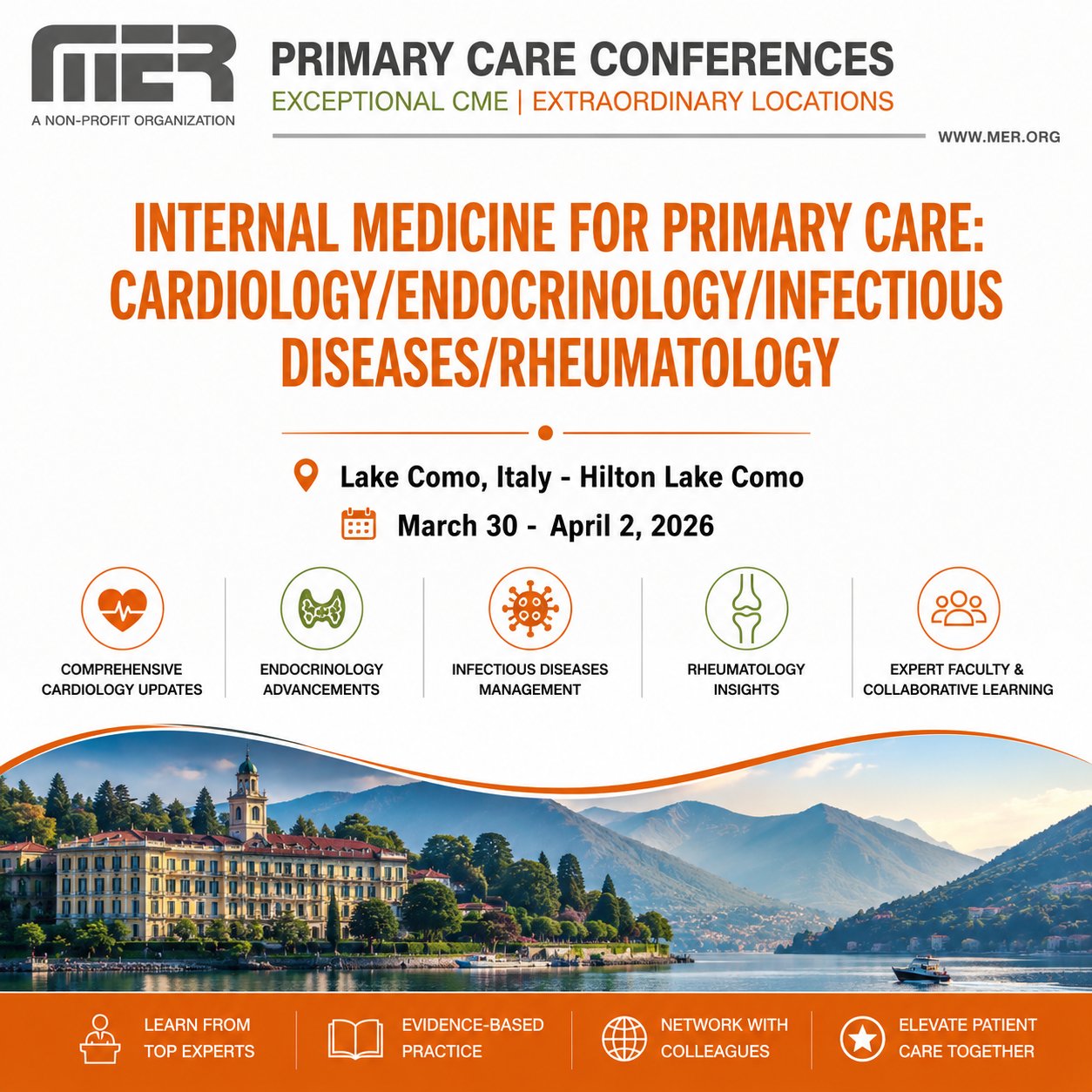
MER Primary Care Conferences Internal Medicine for Primary Care Cardio Endo ID Rheum Mar 30 – Apr 02, 2026
$150.00
MER Primary Care 2026: Practical cardiology, endocrinology, infectious disease and rheumatology updates for primary care clinicians.
Delivery Information: This Product is shared via google drive download link. Please use your correct Gmail address at checkout.
Please note: there are no CME points or certificate associated with this course.
Samples for Courses Can be found here: Free Samples Here!
MER Primary Care Conferences Internal Medicine for Primary Care Cardio Endo ID Rheum Mar 30 – Apr 02, 2026
Internal Medicine for Primary Care 2026 – Cardiology, Endocrinology, Infectious Diseases & Rheumatology
Full Course Description
Internal Medicine for Primary Care 2026 – Cardiology, Endocrinology, Infectious Diseases & Rheumatology is a focused educational program designed to help clinicians strengthen everyday diagnostic and treatment decisions across four essential areas of adult medicine.
The program provides clinically relevant updates for office-based physicians and healthcare professionals managing common and complex conditions in primary care. It combines practical diagnostic frameworks, current guideline-based treatment strategies, risk assessment, differential diagnosis, and patient-specific management planning.
The course covers high-value topics in cardiovascular medicine, diabetes and endocrine disorders, musculoskeletal and inflammatory diseases, and common infectious diseases seen in outpatient practice.
Participants will review approaches to coronary artery disease risk assessment, hypertension management, heart failure treatment, arrhythmias, atrial fibrillation, dyslipidemia, and individualized cardiovascular care. Endocrinology sessions address type 2 diabetes, thyroid dysfunction, osteoporosis, bisphosphonate therapy, and lipid disorders.
Rheumatology content focuses on inflammatory arthritis, osteoarthritis, gout, pseudogout, fibromyalgia, and practical differential diagnosis based on clinical findings and laboratory workup. Infectious disease topics include skin and soft tissue infections, respiratory infections, diarrheal illness, emerging infections, zoonotic disease, and vaccine-preventable disease resurgence.
This course is ideal for clinicians who want a structured, practical review of evidence-based internal medicine for daily primary care practice.
Original Conference Dates
March 30, 2026 – April 2, 2026
Learning Objectives
After completing this program, learners should be able to:
- Develop individualized treatment plans for patients with type 2 diabetes.
- Interpret dyslipidemia diagnostic criteria and choose patient-specific treatment strategies.
- Assess the benefits and risks of bisphosphonate therapy in osteoporosis.
- Recognize and evaluate abnormal thyroid function.
- Differentiate inflammatory arthritis using clinical presentation and laboratory findings.
- Apply current evidence to the management of osteoarthritis.
- Diagnose and treat gout and pseudogout.
- Compare pharmacologic options for fibromyalgia, including benefits and adverse effects.
- Review the microbiology and management of skin and soft tissue infections.
- Identify common pathogens causing respiratory tract infections.
- Evaluate diarrhea severity and determine when treatment is necessary.
- Recognize emerging infectious diseases, zoonoses, and vaccine-preventable disease resurgence.
- Evaluate patients with suspected coronary artery disease using appropriate work-up and risk assessment.
- Apply current concepts in hypertension diagnosis and treatment.
- Use evidence-based strategies for heart failure management.
- Review diagnostic and treatment approaches for arrhythmias and atrial fibrillation.
Who Should Study This Course?
This program is suitable for:
- Internists
- Primary care physicians
- Family medicine physicians
- General practitioners
- Cardiologists
- Endocrinologists
- Rheumatologists
- Infectious disease physicians
- Physician assistants
- Nurse practitioners
- Other office-based healthcare professionals
Main Topics Included
Cardiology
- Coronary artery disease evaluation and risk assessment
- Hypertension diagnosis and treatment
- Heart failure management
- Arrhythmias and atrial fibrillation
- Dyslipidemia diagnosis and individualized treatment
- Evidence-based cardiovascular risk reduction
Endocrinology
- Type 2 diabetes treatment planning
- Dyslipidemia and lipid management
- Osteoporosis treatment
- Bisphosphonate benefits and risks
- Thyroid function abnormalities
- Practical endocrine management in primary care
Rheumatology
- Differential diagnosis of inflammatory arthritis
- Osteoarthritis treatment strategies
- Gout and pseudogout
- Fibromyalgia pharmacologic management
- Clinical and laboratory evaluation of rheumatologic symptoms
Infectious Diseases
- Skin and soft tissue infections
- Respiratory tract infections
- Common bacterial and viral pathogens
- Diarrheal illness assessment and treatment
- Emerging infectious diseases
- Zoonotic infections and animal exposure risks
- Resurgence of vaccine-preventable diseases
Why This Course Is Valuable
This program is especially useful for clinicians who manage a wide range of adult medical conditions in outpatient and primary care settings. It focuses on practical decision-making, common diagnostic challenges, current evidence, and treatment strategies that can be applied directly in daily practice.
The content supports a patient-centered approach to chronic disease management, acute outpatient conditions, cardiovascular risk reduction, musculoskeletal complaints, endocrine disorders, and infectious disease assessment.
4. Topics
Endocrinology
-
Type 2 Diabetes Mellitus: Diagnosis and treatment; lessons from the DCCT; managing diabetic emergencies; screening; pre-diabetes.
-
Lipid Metabolism and Treatment: Review of the most recent American Heart Association Dietary and Lipid Guidelines; Discussion of the most recent ADA guidelines for lipid management for both primary and secondary CV prevention; Detail of treatments for elevated triglycerides and the lack of cardiovascular benefit from fish oil.
-
Osteoporosis: Review the epidemiology and pathophysiology of osteoporosis along with interpretation of DEXA scans and FRAX risk assessment; up-to-date therapeutic options.
-
Disorders of Thyroid Function: Prevalence, diagnosis and treatment options of hypothyroidism and hyperthyroidism.
Rheumatology
-
Differential Diagnosis of Inflammatory Arthritis: Clinical presentation and laboratory work-up and treatment for rheumatoid arthritis, systemic lupus erythematosus, spondyloarthropathies (SPA), infectious arthritis and systemic sclerosis; Treatment of RA with DMARDs; Treatment principles of SLE, Sjogren’s, SPA and PMR.
-
Osteoarthritis: Pathogenesis, diagnosis and treatment.
-
Crystal Disease: Gout & Pseudogout: Properly diagnosing and treating crystal diseases such as gout and pseudogout.
-
Fibromyalgia: Differential diagnosis and treatment of this difficult-to-manage pain syndrome; Treatment options of anti-epileptics and SNRI’s.
Infectious Diseases
-
Skin & Soft Tissue Infections: Presentation on important skin and soft-tissue infections and their prompt recognition, emphasizing evaluation and management strategies.
-
Respiratory Tract Infections: Discussion highlighting critical points regarding the diagnosis and management of pneumonia and bronchitis – with a focus on the impact of multidrug resistant pathogens.
-
Gastrointestinal Infections & Clostridiodes Difficile: Presentation on important enteric pathogens and their recognition, diagnosis and management; special emphasis on clostridiodes difficile colitis and related updates from the ID and infection control literature.
-
Emerging Infectious Diseases: Novel influenza viruses, resurgence of vaccine-preventable diseases, zoonoses and disease related to animal exposures (including vectors such as mosquitoes that bear west Nile virus and dengue), bioterrorism and food/waterborne illness.
Cardiology
-
Work-up of Patients with Suspected CAD: Risk factor evaluation and risk assessment models; Test selection including ECG, echo, nuclear and newer imaging modalities (including discussion of appropriate use criteria–AUC); The usefulness of CT scanning; The role of bio markers and EBCT; Suspected CAD in special populations (women, diabetics, the elderly).
-
Hypertension: The 2017 AHA/ACC Hypertension Guidelines; The 2024 ESC Guidelines for hypertension; Approaches to treatment thresholds and goals; Choices for initial and combination therapy; Resistant hypertension; Treating special populations: diabetics, the elderly, patients with renal failure.
-
Heart Failure: Etiologies and stages of heart failure; ACC/AHA Heart Failure Guidelines; Heart failure with reduced EF (HFrEF) and heart failure with preserved EF (HFpEF); Determining patients for referral using biomarkers, eg NT Pro BNP; Treatment options: ACE inhibitors, ARBs, ARNI, beta blockers, mineralocorticoid receptor antagonists, SGLT2i; The role of devices in treatment and antiplatelet drugs; Issues related to the hospitalized patient with acute decompensated heart failure and readmissions.
-
Arrhythmias: Types and symptoms of arrhythmias; Approach to the patient: when to treat, when to refer, when to admit; Evaluation of the patient with palpitations; Atrial fibrilation: the use of anticoagulants indications, CVA risk scores, warfarin vs newer oral anticoagulants, controlling heart rate vs rhythm; Ventricular and other arrhythmias: when are they serious.
Related products

Internal Medicine
Cardiology
Endocrine and Nutrition
Comprehensive Care for Persons with Diabetes 2022: A Certificate Program
Nephrology / Urology
Endocrine and Nutrition
Harvard The Blackburn Course in Obesity Medicine Treating Obesity 2023
Endocrine and Nutrition
Endocrine and Nutrition

Endocrine and Nutrition