
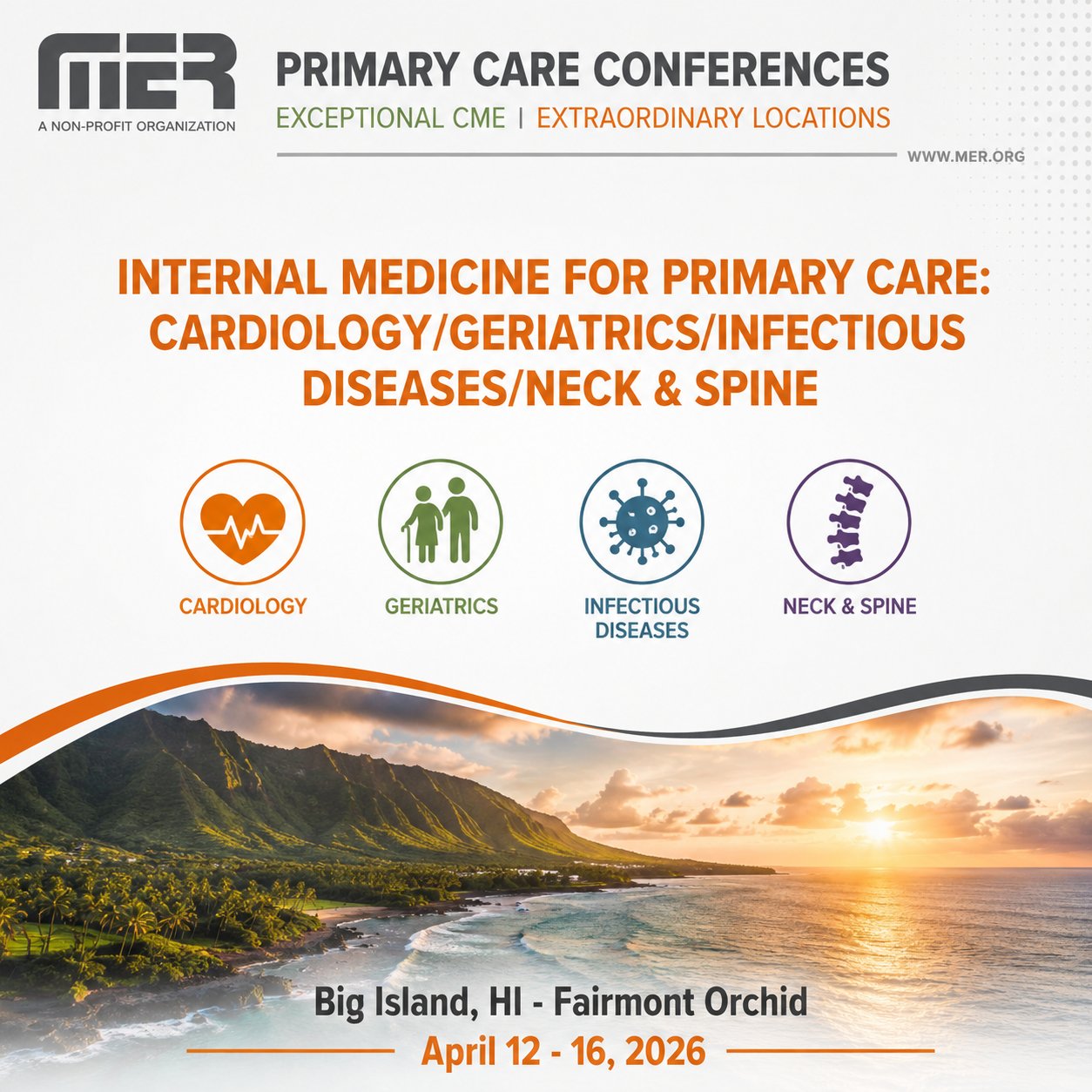
MER Primary Care Conferences Internal Medicine for Primary Care Cardio Geri ID Neck & Spine Apr 12-16, 2026

Original price was: $1,395.00.$130.00Current price is: $130.00.
MER Primary Care Cardio Geri ID Spine 2026 covers cardiology, geriatrics, infectious diseases and neck and spine disorders.
Delivery Information: This Product is shared via google drive download link. Please use your correct Gmail address at checkout.
Please note: there are no CME points or certificate associated with this course.
Samples for Courses Can be found here: Free Samples Here!
MedicalAmboss File Scope: This listing summarizes the official educational program for reference. Provider registration, live participation, streaming access, CME or MOC credit, certificates, apps, accounts, and post-course access are not represented as included unless they are explicitly present in the listed store files. MedicalAmboss.
MER Primary Care Cardio Geri ID Spine 2026
Comprehensive Updates in Cardiovascular Medicine, Geriatric Care, Infectious Diseases, Spine Disorders, and Evidence-Based Primary Care
Stay at the forefront of modern primary care with MER Primary Care Conferences – Internal Medicine for Primary Care: Cardiology, Geriatrics, Infectious Diseases & Neck & Spine 2026, an advanced continuing medical education (CME) program presented by Medical Education Resources (MER). This comprehensive conference delivers practical, evidence-based updates across four essential disciplines frequently encountered in outpatient and office-based practice, helping clinicians improve diagnostic accuracy, optimize treatment decisions, and enhance patient outcomes.
Held April 12–16, 2026, at the Fairmont Orchid, Big Island, Hawaii, this multidisciplinary program brings together nationally recognized faculty to review current clinical guidelines, emerging therapies, and best practices in cardiovascular medicine, geriatric medicine, infectious diseases, and cervical and lumbar spine disorders. Through expert-led lectures, real-world clinical cases, and evidence-based discussions, participants gain practical strategies that can be immediately incorporated into everyday patient care.
Designed specifically for primary care providers and internal medicine clinicians, the course emphasizes early diagnosis, risk assessment, preventive care, and multidisciplinary management of common and complex medical conditions affecting adult and elderly populations.
Product Details
- Course: Internal Medicine for Primary Care: Cardiology, Geriatrics, Infectious Diseases & Neck & Spine 2026
- Provider: Medical Education Resources (MER)
- Conference Dates: April 12–16, 2026
- Location: Fairmont Orchid, Big Island, Hawaii, USA
- Format: Videos
- Language: English
- Educational Level: Intermediate to Advanced
Course Overview
Primary care physicians routinely manage patients with cardiovascular disease, age-related disorders, infectious illnesses, and musculoskeletal complaints involving the cervical and lumbar spine. As clinical guidelines continue to evolve, healthcare professionals must remain current with modern diagnostic strategies, preventive medicine, pharmacologic therapies, and multidisciplinary management approaches.
This comprehensive MER conference delivers clinically relevant updates across these core specialties, providing practical guidance on cardiovascular risk reduction, coronary artery disease, hypertension, heart failure, cognitive disorders, dementia care, geriatric assessment, antimicrobial stewardship, immunization strategies, spine evaluation, neck pain, lumbar disorders, and neurological examination techniques.
Faculty emphasize evidence-based recommendations that improve clinical decision-making while enhancing patient safety and long-term outcomes.
What You’ll Learn
After completing this course, participants will be able to:
- Apply current evidence-based guidelines for hypertension, coronary artery disease, and heart failure.
- Perform comprehensive cardiovascular risk assessment and preventive management.
- Conduct comprehensive geriatric evaluations and recognize age-related medical conditions.
- Diagnose and manage dementia, Alzheimer’s disease, and cognitive impairment.
- Evaluate cervical and lumbar spine disorders using physical examination and neurologic assessment.
- Implement evidence-based management strategies for common infectious diseases.
- Optimize antimicrobial therapy through antimicrobial stewardship principles.
- Recommend individualized immunization strategies based on patient-specific risk factors.
Comprehensive Topics Covered
Cardiovascular Medicine
Review current recommendations for preventing, diagnosing, and managing cardiovascular disease in primary care.
Topics include:
- Coronary artery disease (CAD)
- Acute chest pain evaluation
- Hypertension
- Heart failure
- Lipid management
- Cholesterol guidelines
- Cardiovascular risk assessment
- Lifestyle modification
- Diagnostic testing
- Preventive cardiology
Faculty discuss contemporary evidence-based treatment strategies designed to improve long-term cardiovascular outcomes.
Geriatric Medicine
Develop practical approaches to caring for older adults with complex medical conditions.
Topics include:
- Comprehensive geriatric assessment
- Cognitive impairment
- Alzheimer’s disease
- Dementia
- Functional assessment
- Abnormal gait evaluation
- Falls prevention
- Urinary incontinence
- Lower urinary tract symptoms (LUTS)
- Cardiovascular disease prevention in older adults
Participants learn patient-centered approaches for improving quality of life while preserving independence in aging populations.
Infectious Diseases
Strengthen your understanding of common outpatient infections using current antimicrobial recommendations and preventive strategies.
Topics include:
- Skin and soft tissue infections (SSTIs)
- Respiratory tract infections
- Genitourinary infections
- Antimicrobial stewardship
- Antibiotic selection
- Immunization guidelines
- Prevention strategies
- Emerging resistance patterns
Faculty emphasize responsible antimicrobial prescribing and individualized patient management.
Neck & Spine Disorders
Review practical evaluation and management of common cervical and lumbar spine conditions encountered in primary care.
Topics include:
- Cervical spine disorders
- Lumbar spine disorders
- Acute spinal pain
- Neck pain
- Low back pain
- Neurologic examination
- Range of motion assessment
- Observation and palpation
- Functional assessment
- Referral indications
Participants learn systematic examination techniques and evidence-based treatment approaches for musculoskeletal and neurologic spine conditions.
Office-Based Clinical Practice
Enhance daily clinical decision-making through practical, guideline-based management strategies covering prevention, diagnosis, treatment, follow-up care, and multidisciplinary coordination.
Learning Objectives
Upon completion of this educational activity, participants will be able to:
- Identify evidence-based treatment options for cervical and lumbar spine disorders.
- Perform neurologic and musculoskeletal examinations of the cervical spine.
- Evaluate gait abnormalities and functional decline in older adults.
- Conduct comprehensive geriatric assessments.
- Diagnose and manage dementia, Alzheimer’s disease, and urinary disorders in elderly patients.
- Apply antimicrobial stewardship principles in outpatient practice.
- Recommend individualized immunization strategies.
- Implement current guidelines for hypertension, coronary artery disease, heart failure, and cardiovascular risk reduction.
Educational Highlights
- Internal Medicine
- Primary Care
- Cardiology
- Preventive Cardiology
- Coronary Artery Disease
- Heart Failure
- Hypertension
- Lipid Management
- Geriatric Medicine
- Dementia
- Alzheimer’s Disease
- Comprehensive Geriatric Assessment
- Infectious Diseases
- Antimicrobial Stewardship
- Immunizations
- Skin & Soft Tissue Infections
- Respiratory Infections
- Genitourinary Infections
- Cervical Spine Disorders
- Lumbar Spine Disorders
- Neck Pain
- Low Back Pain
- Neurologic Examination
- Case-Based Learning
- Evidence-Based Medicine
- Continuing Medical Education (CME)
Why This Course Stands Out
MER Internal Medicine for Primary Care: Cardiology, Geriatrics, Infectious Diseases & Neck & Spine 2026 combines four high-impact clinical specialties into one practical educational program specifically designed for office-based healthcare professionals. Rather than focusing on subspecialty-level care alone, the curriculum emphasizes evidence-based diagnosis, preventive medicine, guideline-directed therapy, and real-world patient management strategies that clinicians can immediately apply in everyday practice.
Target Audience
This educational activity is ideal for:
- Internists
- Primary Care Physicians
- Family Medicine Physicians
- Cardiologists
- Geriatricians
- Infectious Disease Physicians
- Neck & Spine Surgeons
- Hospitalists
- Nurse Practitioners
- Physician Assistants
- Internal Medicine Residents
- Family Medicine Residents
- Healthcare Professionals involved in adult primary care
Why Choose This Course?
Whether you manage cardiovascular disease, elderly patients, infectious illnesses, or musculoskeletal disorders, MER Primary Care Conferences – Internal Medicine for Primary Care: Cardiology, Geriatrics, Infectious Diseases & Neck & Spine 2026 delivers a comprehensive, evidence-based review of today’s most important clinical updates. Featuring nationally recognized faculty, practical case-based discussions, and guideline-driven recommendations, this program provides clinicians with the knowledge and confidence needed to deliver exceptional patient care across multiple disciplines.
4. Topics
-
Geriatrics – Approach to the Geriatric Patient: Review demographics of aging and changes in the older patient. Apply the 4Ms and age-friendly framework for older adults. Discuss what matters and advance care planning. Tailor medication use in older adults, including review of risky medications, alternatives, and deprescribing. Integrate geriatric principles into the annual wellness visit.
-
Geriatrics – Urological Disorders in the Older Adult: Review of two very common conditions seen in the elderly population: benign prostatic hyperplasia (BPH), and urinary incontinence. Pathogenesis, clinical symptoms, recommended evaluation and management options for BPH. Review of the anatomy and mechanism of normal urinary function, causes of incontinence, the evaluation and management.
-
Geriatrics – Vascular Disorders in the Older Adult: Peripheral vascular disease. DVT/thromboembolic disease. Abdominal aortic aneurysm and related disorders.
-
Geriatrics – Alzheimer’s Disease and Dementias: Approaches to brain health and dementia risk reduction. Early detection and diagnosis, including clinical evaluation and biomarkers. Various types of dementia. Current treatment options for dementia.
-
Geriatrics – Approach to Care for Individuals with Dementia and Family Caregivers: Care planning in dementia including advance care planning and driving. Engaging and supporting family caregivers. Review of common behavior disorders in dementia. Communication and behavioral techniques for behavior disorders in patients with dementia. Review of the potential adverse effects of the psychotropic medications usually used to manage behavior.
-
Neck & Spine – Diagnosis and Treatment of Lumbar Spine Disorders: A practical approach to the diagnosis and early management of lumbar spine disorders will be presented. Anatomy, differential diagnosis, as well as physical examination concepts will be covered.
-
Neck & Spine – Physical Examination of the Lumbar Spine, Hip, and Sacroiliac Joint: Exam techniques will be demonstrated and discussed.
-
Neck & Spine – Nonpharmacologic Treatment of Acute and Chronic Spinal Pain: Strategies for triage and nonpharmacologic management of spine and pain patients will be presented. Guidelines for the use of imaging and other diagnostic tools, manual therapies, as well as psychological and other approaches to pain management.
-
Neck & Spine – Diagnosis and Treatment of Cervical Spine and Select Upper Extremity Disorders: A practical approach to the diagnosis and early management of cervical spine and selected upper extremity disorders will be presented. Anatomy, differential diagnosis, as well as physical examination concepts will be covered.
-
Neck & Spine – Physical Examination of the Cervical Spine and UE Entrapment Neuropathies: Exam techniques will be demonstrated and discussed.
-
Infectious Diseases – Skin & Soft Tissue Infections: Presentation on important skin and soft-tissue infections and their prompt recognition, emphasizing evaluation and management strategies.
-
Infectious Diseases – Respiratory Tract Infections: Discussion highlighting critical points regarding the diagnosis and management of pneumonia and bronchitis – with a focus on the impact of multidrug resistant pathogens.
-
Infectious Diseases – Genitourinary Infections: Presentation on a relevant and clinically practical approach to the patient with genitourinary complaints focusing on the latest guidelines for the range of urinary tract infections and highlights of selected and important sexually-transmitted disease syndromes.
-
Infectious Diseases – Immunizations: Presentation on key vaccine preventable diseases and their presentations with an emphasis on the latest recommendations including newest schedules, safety and efficacy information.
-
Infectious Diseases – Antimicrobial Stewardship and Multidrug Resistance: Definition of an antimicrobial stewardship program (ASP). Concepts of the antimicrobial stewardship program. Four goals of antimicrobial stewardship. Most recent additions to the antimicrobial armamentarium.
-
Cardiology – Acute Coronary Syndromes, The Patient with Acute Chest Pain: Diagnosis and initial evaluation in the primary care setting, urgent care clinic and emergency department. Initial workup, treatment, and follow-up. Diagnosing and treating ST segment elevation and non-ST segment elevation Mls. The role of drug therapy–primary vs adjunctive to PCI. Follow up after acute coronary syndromome.
-
Cardiology – Primary & Secondary Prevention of CAD: Definitions. AHA/ACC and other lipid guidelines updates. HDL Cholesterol: The good cholesterol?. Metabolic syndrome and/or obesity. Who needs treatment and how much. The role of lifestyle changes, exercise and cardiac rehabilitation. Drug therapy updates. Risk calculation.
-
Cardiology – Work-up of Patients with Suspected CAD: Risk factor evaluation and risk assessment models. Test selection including ECG, echo, nuclear and newer imaging modalities (including discussion of appropriate use criteria–AUC). The usefulness of CT scanning. The role of bio markers and EBCT. Suspected CAD in special populations (women, diabetics, the elderly).
-
Cardiology – Heart Failure: Etiologies and stages of heart failure. ACC/AHA Heart Failure Guidelines. Heart failure with reduced EF (HFrEF) and heart failure with preserved EF (HFpEF). Determining patients for referral using biomarkers, eg NT Pro BNP. Treatment options: ACE inhibitors, ARBS, ARNI, beta blockers, mineralocorticoid receptor antagonists, SGLT2i. The role of devices in treatment and antiplatelet drugs. Issues related to the hospitalized patient with acute decompensated heart failure and readmissions.
-
Cardiology – Hypertension: The 2017 AHA/ACC Hypertension Guidelines. The 2024 ESC Guidelines for hypertension. Approaches to treatment thresholds and goals. Choices for initial and combination therapy. Resistant hypertension. Treating special populations: diabetics, the elderly, patients with renal failure.
Related products

Critical Care - Emergency medicine

Internal Medicine
Critical Care - Emergency medicine
40th ISICEM International Symposium on Intensive Care & Emergency Medicine 2021

Critical Care - Emergency medicine

Critical Care - Emergency medicine
Critical Care - Emergency medicine
Critical Care - Emergency medicine
Internal Medicine