
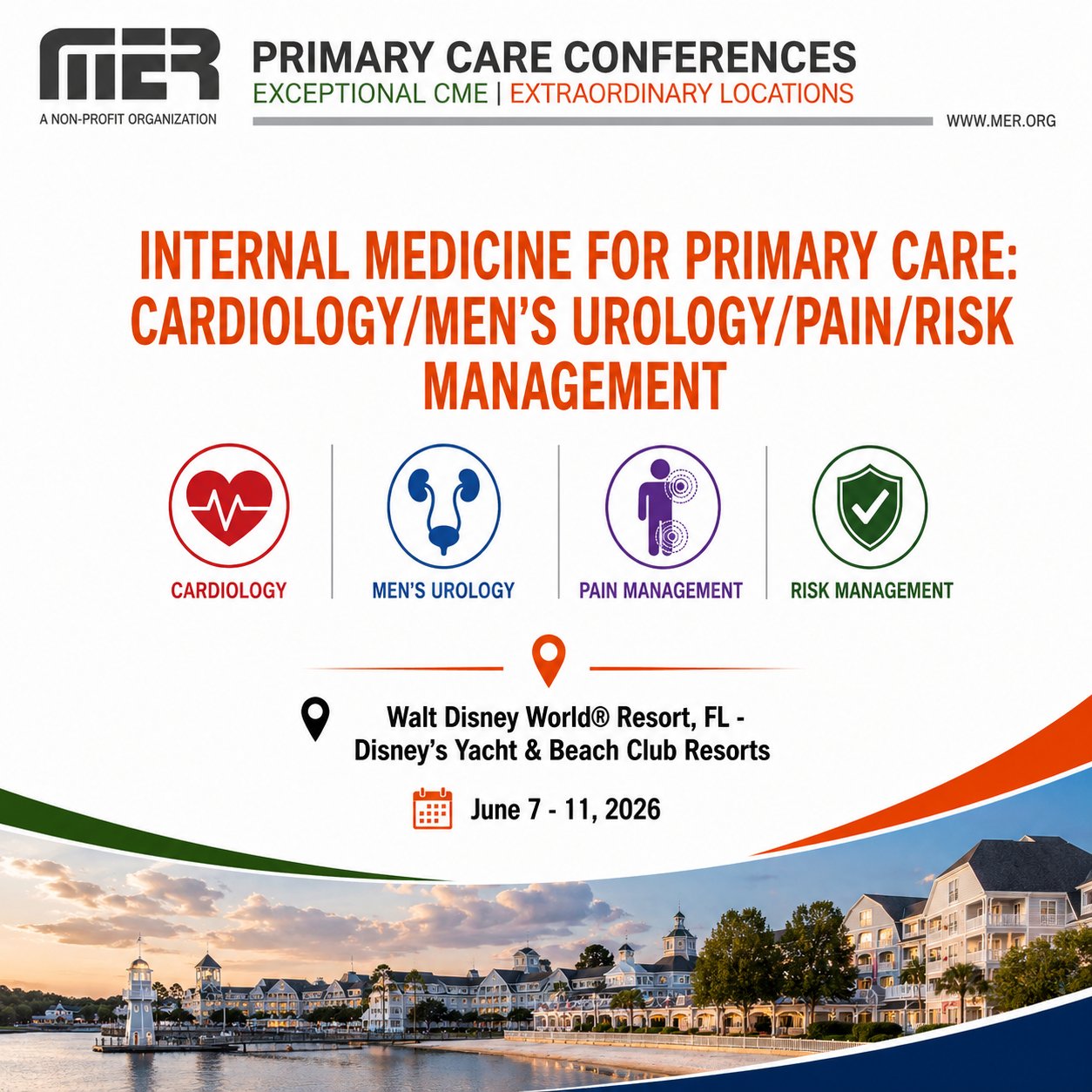
MER Primary Care Conferences Internal Medicine for Primary Care Cardio Mens Uro Pain Risk Mgmt 2026

Original price was: $1,495.00.$120.00Current price is: $120.00.
Review cardiology, men's urology, pain medicine, and risk-management topics in this 2026 primary care program.
Delivery Information: This Product is shared via google drive download link. Please use your correct Gmail address at checkout.
Please note: there are no CME points or certificate associated with this course.
Samples for Courses Can be found here: Free Samples Here!
MER Primary Care Conferences – Internal Medicine for Primary Care: Cardiology, Men’s Urology, Pain & Risk Management 2026
Comprehensive Primary Care Updates in Cardiovascular Medicine, Men’s Health, Pain Management & Medical Risk Reduction
The MER Internal Medicine for Primary Care: Cardiology, Men’s Urology, Pain & Risk Management 2026 conference provides a focused, evidence-based review of four critical areas commonly encountered in primary care practice. Designed specifically for office-based clinicians, this program delivers practical diagnostic strategies, treatment updates, and risk-reduction techniques that can be immediately applied in patient care.
Held at Disney’s Yacht & Beach Club Resorts at Walt Disney World® Resort, the conference combines expert-led lectures with clinically relevant discussions covering cardiovascular disease prevention, hypertension, heart failure, arrhythmias, men’s sexual health, prostate disorders, chronic pain management, malpractice prevention, documentation strategies, and the growing role of artificial intelligence in healthcare.
Participants receive up-to-date guidance based on current evidence and clinical guidelines, helping improve patient outcomes while reducing clinical and legal risks.
Product Details
- Course: Internal Medicine for Primary Care: Cardiology / Men’s Urology / Pain / Risk Management
- Provider: Medical Education Resources (MER)
- Location: Disney’s Yacht & Beach Club Resorts, Walt Disney World® Resort, Florida
- Dates: June 7–11, 2026
- Format: Conference Video Recordings
- Course Year: 2026
Program Overview
This multidisciplinary primary care program focuses on four high-impact clinical areas:
- Cardiology
- Men’s Urology
- Pain Management
- Risk Management
The curriculum emphasizes practical clinical decision-making, guideline updates, patient safety, and evidence-based management strategies relevant to everyday primary care practice.
Learning Objectives
Upon completion of this activity, participants will be able to:
- Apply current evidence-based approaches to chest pain evaluation and management.
- Implement updated lipid and cholesterol guidelines for cardiovascular disease prevention.
- Utilize contemporary treatment strategies for heart failure and hypertension.
- Diagnose and manage common cardiac arrhythmias, including atrial fibrillation.
- Develop effective opioid and non-opioid pain management plans.
- Evaluate and treat fibromyalgia and chronic low back pain.
- Manage common men’s health and urologic conditions.
- Differentiate benign prostate disorders from prostate cancer.
- Recognize and manage sexually transmitted infections in men.
- Implement risk-reduction strategies to decrease malpractice exposure.
- Improve documentation, informed consent, and shared decision-making processes.
- Utilize artificial intelligence tools to enhance clinical efficiency and patient care.
Core Topics Covered
Cardiology for Primary Care
The cardiovascular curriculum reviews:
- Acute chest pain evaluation
- Coronary artery disease prevention
- Hyperlipidemia management
- Cholesterol treatment guidelines
- Hypertension management
- Heart failure therapy
- Atrial fibrillation
- Cardiac arrhythmias
- Cardiovascular risk reduction
Faculty provide practical strategies for managing cardiovascular conditions commonly encountered in outpatient practice.
Men’s Urology & Sexual Health
Specialized sessions focus on:
- Male sexual health
- Erectile dysfunction
- Testosterone-related issues
- Benign prostatic hyperplasia (BPH)
- Prostate cancer screening
- Testicular cancer
- Urologic disorders in primary care
- Sexually transmitted infections in men
Participants gain practical approaches for diagnosing and managing common male health concerns.
Pain Management
The pain medicine section covers:
- Chronic pain evaluation
- Opioid prescribing strategies
- Non-opioid pain management
- Fibromyalgia treatment
- Musculoskeletal pain
- Low back pain management
- Activity modification
- Physical therapy integration
- Current pain management controversies
Emphasis is placed on balancing symptom control with patient safety.
Risk Management & Medical Liability
This important track reviews:
- Medical malpractice prevention
- Documentation best practices
- Informed consent
- Shared decision-making
- Communication errors
- Cognitive bias in healthcare
- Medical gaslighting awareness
- System-based risk reduction
Participants learn strategies to minimize legal exposure while improving patient trust and outcomes.
Artificial Intelligence in Clinical Practice
Emerging topics include:
- AI-assisted clinical workflows
- Documentation support
- Clinical decision-making tools
- Patient communication enhancement
- Improving healthcare efficiency
Faculty discuss practical applications of AI within modern primary care settings.
Educational Features
✔ Evidence-Based Primary Care Updates
✔ Cardiology Guideline Reviews
✔ Men’s Health & Urology Updates
✔ Practical Pain Management Strategies
✔ Medical Risk Reduction Techniques
✔ Documentation & Liability Protection
✔ AI Applications in Healthcare
✔ Immediate Clinical Practice Relevance
Target Audience
This course is ideal for:
- Primary Care Physicians
- Family Medicine Physicians
- Internal Medicine Physicians
- Nurse Practitioners
- Physician Assistants
- Advanced Practice Providers
- General Practitioners
- Ambulatory Care Clinicians
- Residents & Fellows
- Other Healthcare Professionals Interested in Primary Care Updates
Why This Course Stands Out
✔ Focused on high-yield topics frequently encountered in primary care
✔ Practical, office-based clinical applications
✔ Combines medical management with risk-reduction education
✔ Reviews current cardiovascular and men’s health guidelines
✔ Addresses both opioid and non-opioid pain strategies
✔ Covers malpractice prevention and documentation improvement
✔ Includes emerging AI tools for healthcare practice
✔ Designed specifically for busy outpatient clinicians
Clinical & Educational Value
The MER Internal Medicine for Primary Care: Cardiology, Men’s Urology, Pain & Risk Management 2026 course provides a practical review of four essential areas of primary care medicine. Through evidence-based lectures and clinically focused discussions, participants gain updated knowledge on cardiovascular disease, men’s health, chronic pain management, patient safety, malpractice prevention, and healthcare innovation. The program equips clinicians with actionable strategies that improve patient care, clinical efficiency, and risk management.
+ Topics:
*Note: these are continuous video recordings during the conference, they include individual lectures mentioned in the Detail section below
- Orlando, FL – June 7, 2026 (Day 1).mp4
- Orlando, FL – June 8, 2026 (Day 2).mp4
- Orlando, FL – June 9, 2026 (Day 3).mp4
- Orlando, FL – June 10, 2026 (Day 4).mp4
- Orlando, FL – June 11, 2026 (Day 5).mp4
* Detail:
- Sunday, June 7, 2026
- 2:30 pm Check-In
- 3:00 pm – 4:00 pm – Cardiology Acute Coronary Syndromes: The Patient with Acute Chest Pain
- Diagnosis and initial evaluation in the primary care setting, urgent care clinic and emergency department; Initial workup, treatment, and follow-up; Diagnosing and treating ST segment elevation and non-ST segment elevation MIs; The role of drug therapy–primary vs adjunctive to PCI; Follow up after acute coronary syndromome
- 4:00 pm – 5:00 pm – Cardiology Primary & Secondary Prevention of CAD
- Definitions; AHA/ACC and other lipid guidelines updates; HDL Cholesterol: The good cholesterol?; Metabolic syndrome and/or obesity; Who needs treatment and how much; The role of lifestyle changes, exercise and cardiac rehabilitation; Drug therapy updates; Risk calculation
- 5:00 pm – 6:00 pm – Cardiology Heart Failure
- Etiologies and stages of heart failure; ACC/AHA Heart Failure Guidelines; Heart failure with reduced EF (HFrEF) and heart failure with preserved EF (HFpEF); Determining patients for referral using biomarkers, eg NT Pro BNP; Treatment options: ACE inhibitors, ARBs, ARNI, beta blockers, mineralocorticoid receptor antagonists, SGLT2i; The role of devices in treatment and antiplatelet drugs; Issues related to the hospitalized patient with acute decompensated heart failure and readmissions
- 6:00 pm Session Adjourns
- Monday, June 8, 2026
- 7:00 am Arrival and Breakfast
- 7:30 am – 8:30 am – Pain Opioid Pharmacologic Options in Pain Management
- Overall safety and efficacy; Selecting and monitoring patients; Pain contracts; Regulatory issues; Urine drug testing
- 8:30 am – 9:30 am – Pain Non-Opioid Pharmacologic Options in Pain Management
- NSAID’s; Acetaminophen; Topicals; Injections; Antidepressants; Anticonvulsants; Medical marijuana
- 9:30 am – 9:40 am Coffee Break
- 9:40 am – 10:40 am – Pain Controversies in Pain Management
- Urine drug testing, cannabinoids
- 10:40 am – 11:40 am – Cardiology Hypertension
- The 2017 AHA/ACC Hypertension Guidelines; The 2024 ESC Guidelines for hypertension; Approaches to treatment thresholds and goals; Choices for initial and combination therapy; Resistant hypertension; Treating special populations: diabetics, the elderly, patients with renal failure
- 11:40 am – 12:40 pm – Cardiology Arrhythmias
- Types and symptoms of arrhythmias; Approach to the patient: when to treat, when to refer, when to admit; Evaluation of the patient with palpitations; Atrial fibrilation: the use of anticoagulants indications, CVA risk scores, warfarin vs newer oral anticoagulants, controlling heart rate vs rhythm; Ventricular and other arrhythmias: when are they serious
- 12:40 pm Session Adjourns
- Tuesday, June 9, 2026
- 7:00 am Arrival and Breakfast
- 7:30 am – 8:30 am – Men’s Urology Androgen Replacement and Sexual Function
- Treatment algorithm and safety profiles for the treatment of erectile dysfunction; testosterone supplementation for the treatment of ED or hypogonadism
- 8:30 am – 9:30 am – Men’s Urology Prostate Cancer Screening and Treatment
- Review and clarification of the often confusing and political literature regarding prostate cancer screening, risks, and benefits of screening for prostate cancer and strategies for decreasing the risk of over treatment
- 9:30 am – 9:40 am Coffee Break
- 9:40 am – 10:40 am – Men’s Urology Sexually Transmitted Infections in Men
- Presenting symptoms, lesions, latencies, diagnostic work-ups and therapies of the common sexually transmitted diseases
- 10:40 am – 11:40 am – Pain Fibromyalgia
- Differential diagnosis and treatment of this difficult-to-manage pain syndrome; Treatment options of anti-epileptics and SNRI’s
- 11:40 am – 12:40 pm – Pain Non-surgical Treatment of Low Back Pain
- Comprehensive overview of various options for activity modification; The role and maximum benefit of physical therapy and the various modalities; Medications; Discussion of interventional treatments
- 12:40 pm Session Adjourns
- Wednesday, June 10, 2026
- 7:00 am Arrival and Breakfast
- 7:30 am – 8:30 am – Risk Management
- The Anatomy of Medical Malpractice
- Identify the key elements of a malpractice claim in the practice setting; Assess the risk of malpractice in common and unusual situations; Identify risk management strategies for preventing claims
- 8:30 am – 9:30 am – Risk Management Risky Business: Consent and Communication
- Describe the necessary elements of an informed consent process; Discover why the shared decision making process represents and opportunity rather than an obligation for the provider; Discuss the importance of early disclosure of unanticipated outcomes; Learn methods to disclose and reconcile events with patients, families and providers
- 9:30 am – 9:40 am Coffee Break
- 9:40 am – 10:40 am – Risk Management Documentation: Effective Strategies and Pitfalls
- Articulate major patient safety and lawsuit risk areas abetted by the quality of documentation; Discuss what is considered adequate documentation in a given clinical encounter; Anticipate when more thorough documentation and direct communication with other providers may reduce adverse outcomes; Describe clinical situations where documentation may enhance shared decision making to improve patient safety
- 10:40 am – 11:40 am – Men’s Urology Benign Male Genitourinary Conditions
- Appropriate primary medical management of lower urinary tract symptoms (LUTS) (also known as BPH) as well as identification of patients with complex or refractory cases that warrant referral; diagnosis and treatment of epididymitis, testicular pain, prostatitis and other benign findings
- 11:40 am – 12:40 pm – Men’s Urology Male Malignancies (Prostate & Testicular)
- Biology and treatment options using current medical technology of prostate cancer; evaluation and treatment of testicular cancer and long-term ramifications after cure
- 12:40 pm Session Adjourns
- Thursday, June 11, 2026
- 7:00 am Arrival and Breakfast
- 7:30 am – 8:30 am – Risk Management Medical Gaslighting: What It Is and How to Avoid It
- Medical gaslighting is recognized as a serious patient safety concern. The term describes situations in which a patient’s symptoms, concerns, or lived experience are minimized, dismissed, or misattributed by a clinician—often unintentionally. The impact can be significant: delays in diagnosis, erosion of trust, and preventable adverse outcomes. This discussion will explore how cognitive biases, communication breakdowns, and system pressures contribute to these experiences.
- 8:30 am – 9:30 am – Risk Management AI in Medicine: Promise, Practice, and Pitfalls
- Artificial Intelligence is rapidly transforming medicine, from clinical decision support and imaging to communication, documentation, and administrative work flows. AI-driven tools promise to enhance efficiency and patient outcomes, but they also introduce new challenges. This session will explore how AI works, examine its clinical, social, and operational applications, and discuss the evolving legal and patient safety implications, including risks for medical liability.
- 9:30 am Conference Adjourns
Related products
Critical Care - Emergency medicine

Critical Care - Emergency medicine

Family medicine

Critical Care - Emergency medicine
The Brigham Board Review in Infectious Diseases Brigham and Women’s Hospital Board Review

Medical Accounts

Pediatrics

Critical Care - Emergency medicine