
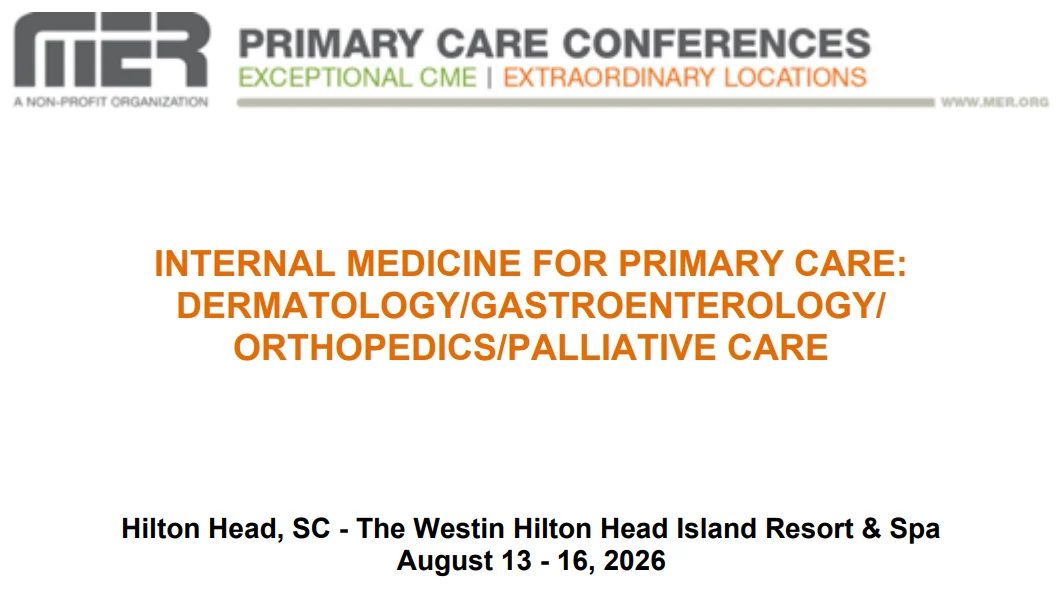
MER Primary Care Conferences Internal Medicine for Primary Care Derm Gastro Ortho Palliative Aug 13-16, 2026

$130.00
MER Primary Care 2026 spans dermatology, gastroenterology, orthopedics and palliative care for common outpatient and serious-illness decisions.
Delivery Information: This Product is shared via google drive download link. Please use your correct Gmail address at checkout.
Please note: there are no CME points or certificate associated with this course.
Samples for Courses Can be found here: Free Samples Here!
MedicalAmboss File Scope: This listing provides only the downloadable files described on this page. Provider registration, live or streaming access, platform features, CME or other credit, certificates, and related subscription benefits are not included unless explicitly stated in the product files section. MedicalAmboss.
MER Primary Care 2026: Derm/Gastro/Ortho/Palliative
Dermatology • Gastroenterology • Orthopedics • Palliative Care
August 13–16, 2026 | The Westin Hilton Head Island Resort & Spa | Hilton Head, South Carolina
Strengthen your approach to common clinical problems across dermatology, gastroenterology, orthopedics, and palliative care with MER Primary Care Conferences Internal Medicine for Primary Care Derm Gastro Ortho Palliative Aug 13-16, 2026, an educational program organized by Medical Education Resources (MER).
The Internal Medicine for Primary Care: Dermatology/Gastroenterology/Orthopedics/Palliative Care conference is scheduled to take place from August 13 to August 16, 2026, at The Westin Hilton Head Island Resort & Spa in Hilton Head, South Carolina.
This primary care program brings together practical clinical updates across four areas frequently encountered by office-based physicians:
- Dermatology
- Gastroenterology
- Orthopedics
- Palliative Care
- Internal Medicine
- Primary Care
Major clinical topics include:
- Lower GI bleeding
- Colorectal cancer screening and surveillance
- Celiac disease
- Hepatitis B
- Hepatitis C
- Cutaneous manifestations of internal disease
- Acne and acneiform eruptions
- Benign and malignant skin tumors
- Pre-cancerous and cancerous skin lesions
- Medicare hospice benefit
- Palliative symptom management
- Prognosis in serious illness
- Goals of care
- Shoulder injuries
- Wrist, hand, and finger injuries
- Knee anatomy and function
- Foot and ankle injuries and pain syndromes
Course Details
- Course: Internal Medicine for Primary Care: Dermatology/Gastroenterology/Orthopedics/Palliative Care
- Provider: Medical Education Resources – MER
- Year: 2026
- Dates: August 13–16, 2026
- Venue: The Westin Hilton Head Island Resort & Spa
- Location: Hilton Head, South Carolina, USA
- Primary Focus: Internal Medicine / Primary Care
- Specialties: Dermatology / Gastroenterology / Orthopedics / Palliative Care
- Language: English
Course Overview
Primary care physicians routinely encounter patients whose clinical problems extend across multiple medical specialties.
This MER program focuses on practical updates relevant to office-based primary care, including gastrointestinal disorders, common dermatologic conditions, musculoskeletal injuries, and important principles of palliative medicine.
The curriculum addresses clinical situations such as:
- Lower gastrointestinal bleeding
- Colorectal cancer screening
- Evaluation for celiac disease
- Hepatitis B and hepatitis C
- Acne and acneiform disorders
- Skin tumors and suspicious skin lesions
- Palliative symptom management
- Prognostic discussions
- Goals-of-care conversations
- Shoulder injuries
- Hand and wrist injuries
- Knee assessment
- Chronic foot and ankle problems
The combination of these specialties provides a broad review of conditions commonly encountered in primary care and outpatient medicine.
Learning Objectives
Upon completion of this program, participants should be better able to:
Gastroenterology
- List current treatment recommendations for the management of lower GI bleeding.
- Discuss the guidelines for colonoscopic colorectal cancer screening and surveillance.
- Recommend appropriate testing for the workup of celiac disease.
- List current treatment recommendations for HBV and HCV.
Dermatology
- Identify cutaneous findings that serve as surrogates of internal diseases.
- Describe the step-wise approach for the diagnosis and treatment of acne and acneiform eruptions.
- Differentiate benign and malignant skin tumors and employ appropriate interoffice procedures.
- Detect pre-cancerous and cancerous skin lesions.
Palliative Care
- List details about the Medicare hospice benefit.
- Describe the primary care approach to palliative medicine including symptom management.
- Recognize the importance of prognosis in decision making for seriously ill patients.
- Define and establish goals of care with patients and their families.
Orthopedics
- Diagnose and treat shoulder injuries.
- Diagnose and treat wrist, hand, and finger injuries.
- Describe the anatomy and function of the knee joint.
- Recognize chronic injuries and pain syndromes to the foot and ankle.
GASTROENTEROLOGY
Lower GI Bleeding
The gastroenterology component includes an update on the management of lower gastrointestinal bleeding, with attention to current treatment recommendations relevant to clinical practice.
Colorectal Cancer Screening & Surveillance
The curriculum reviews guidelines related to:
- Colonoscopic colorectal cancer screening
- Surveillance strategies
- Primary care application of screening recommendations
Colorectal cancer prevention and surveillance remain important components of adult primary care.
Celiac Disease
The program addresses appropriate testing in the evaluation of patients for celiac disease.
The objective is to help clinicians select an appropriate diagnostic workup when celiac disease is suspected.
Hepatitis B & Hepatitis C
The gastroenterology content also includes current treatment recommendations related to:
- Hepatitis B – HBV
- Hepatitis C – HCV
These topics are particularly relevant to clinicians involved in screening, evaluation, and longitudinal management of patients with viral hepatitis.
DERMATOLOGY
Cutaneous Findings of Internal Disease
Skin findings may provide important clues to underlying systemic disease.
The program reviews cutaneous findings that can serve as clinical indicators of internal medical conditions.
Acne & Acneiform Eruptions
The dermatology curriculum includes a step-wise approach to:
- Diagnosis
- Clinical assessment
- Treatment of acne
- Management of acneiform eruptions
Benign & Malignant Skin Tumors
Participants review the differentiation of:
- Benign skin tumors
- Malignant skin tumors
The objective also addresses appropriate office-based procedures when applicable.
Pre-Cancerous & Cancerous Skin Lesions
The program emphasizes recognition of:
- Pre-cancerous skin lesions
- Cancerous skin lesions
Early identification of suspicious lesions is an important component of primary and preventive care.
PALLIATIVE CARE
Medicare Hospice Benefit
The palliative medicine component includes information about the Medicare hospice benefit and its relevance to patients requiring end-of-life care.
Palliative Medicine in Primary Care
Primary care clinicians frequently participate in the care of patients with serious or advanced illness.
The program addresses a primary care approach to palliative medicine, including:
- Symptom management
- Patient-centered care
- Communication
- Care planning
Prognosis & Clinical Decision-Making
Understanding prognosis can play an important role when making decisions for seriously ill patients.
The course emphasizes recognizing the importance of prognosis within clinical decision-making.
Goals of Care
The curriculum addresses how clinicians can define and establish goals of care together with:
- Patients
- Families
Goals-of-care discussions are an important part of aligning medical decisions with the needs and priorities of seriously ill patients.
ORTHOPEDICS
Shoulder Injuries
The orthopedic portion includes the diagnosis and treatment of common shoulder injuries encountered in clinical practice.
Wrist, Hand & Finger Injuries
The program also reviews injuries affecting:
- Wrist
- Hand
- Fingers
with an emphasis on diagnosis and treatment.
Knee Anatomy & Function
Understanding the structure of the knee is fundamental to evaluating knee complaints.
The curriculum includes a review of:
- Knee anatomy
- Knee joint function
Foot & Ankle Injuries and Pain Syndromes
Participants also review chronic injuries and pain syndromes affecting the:
- Foot
- Ankle
These problems are frequently encountered in primary care and musculoskeletal practice.
Cross-Specialty Clinical Focus
One of the key features of this MER primary care program is its combination of several specialties within one educational activity.
Internal Medicine + Gastroenterology
Primary care clinicians frequently participate in the initial evaluation and ongoing management of:
- GI bleeding
- Colorectal cancer screening
- Celiac disease
- Viral hepatitis
Internal Medicine + Dermatology
Patients commonly present first to primary care with:
- Acne
- Skin eruptions
- Suspicious lesions
- Cutaneous manifestations of systemic illness
Internal Medicine + Orthopedics
Musculoskeletal complaints represent an important part of outpatient medicine, including:
- Shoulder injuries
- Hand and wrist injuries
- Knee problems
- Foot and ankle pain
Internal Medicine + Palliative Care
Primary care physicians can play an important role in:
- Symptom management
- Prognostic discussions
- Hospice-related care
- Goals-of-care discussions
Major Gastroenterology Topics
- Lower GI Bleeding
- Colorectal Cancer Screening
- Colonoscopic Surveillance
- Celiac Disease
- Celiac Disease Testing
- Hepatitis B
- HBV Management
- Hepatitis C
- HCV Management
Major Dermatology Topics
- Cutaneous Manifestations of Internal Disease
- Acne
- Acneiform Eruptions
- Benign Skin Tumors
- Malignant Skin Tumors
- Pre-Cancerous Skin Lesions
- Cancerous Skin Lesions
- Office-Based Dermatologic Procedures
Major Palliative Care Topics
- Medicare Hospice Benefit
- Palliative Medicine
- Symptom Management
- Serious Illness
- Prognosis
- Clinical Decision-Making
- Goals of Care
- Patient and Family Communication
Major Orthopedics Topics
- Shoulder Injuries
- Wrist Injuries
- Hand Injuries
- Finger Injuries
- Knee Anatomy
- Knee Joint Function
- Foot Injuries
- Ankle Injuries
- Chronic Foot and Ankle Pain Syndromes
Who Should Take This Course?
This program is targeted to office-based primary care providers and other health professionals seeking updates in primary care medicine.
It is particularly relevant for:
- Primary Care Physicians
- Internal Medicine Physicians
- Dermatologists
- Gastroenterologists
- Orthopedists
- Palliative Care Specialists
- Office-Based Clinicians
- Healthcare Professionals involved in primary care
Why This Course Is Useful
MER Primary Care Conferences Internal Medicine for Primary Care Derm Gastro Ortho Palliative Aug 13-16, 2026 combines four clinical areas that frequently intersect with everyday primary care.
The program can help learners review:
- Management of lower GI bleeding
- Colorectal cancer screening and surveillance
- Celiac disease testing
- HBV and HCV treatment recommendations
- Cutaneous manifestations of internal diseases
- Acne and acneiform eruptions
- Benign and malignant skin tumors
- Recognition of pre-cancerous and cancerous lesions
- Medicare hospice benefits
- Palliative symptom management
- Prognosis in serious illness
- Goals-of-care discussions
- Shoulder injuries
- Wrist, hand, and finger injuries
- Knee anatomy and function
- Chronic foot and ankle injuries and pain syndromes
The curriculum can be summarized as:
GI Care → Skin Disorders → Musculoskeletal Medicine → Palliative Care
within a practical Internal Medicine and Primary Care framework.
Product Information
- Product: MER Primary Care Conferences Internal Medicine for Primary Care Derm Gastro Ortho Palliative Aug 13-16, 2026
- Provider: Medical Education Resources – MER
- Dates: August 13–16, 2026
- Venue: The Westin Hilton Head Island Resort & Spa
- Location: Hilton Head, South Carolina
- Primary Focus: Internal Medicine / Primary Care
- Specialties: Dermatology / Gastroenterology / Orthopedics / Palliative Care
- Available From: MedicalAmboss.com
Short Description
MER Primary Care Conferences Internal Medicine for Primary Care Derm Gastro Ortho Palliative Aug 13-16, 2026 provides focused primary care updates across dermatology, gastroenterology, orthopedics, and palliative medicine.
The program covers lower GI bleeding, colorectal cancer screening and surveillance, celiac disease, HBV and HCV, acne and acneiform eruptions, benign and malignant skin tumors, pre-cancerous and cancerous skin lesions, hospice care, palliative symptom management, prognosis, goals of care, shoulder injuries, wrist and hand injuries, knee anatomy, and chronic foot and ankle disorders.
Topics
- Lower GI Bleeding: Current treatment recommendations for the management of lower gastrointestinal bleeding.
- Colorectal Cancer Screening and Surveillance: Guidelines for colonoscopic colorectal cancer screening and surveillance.
- Celiac Disease: Appropriate testing for the workup of suspected celiac disease.
- HBV and HCV: Current treatment recommendations for hepatitis B and hepatitis C.
- Cutaneous Findings of Internal Disease: Identification of skin findings that may serve as indicators of internal diseases.
- Acne and Acneiform Eruptions: Step-wise approaches to diagnosis and treatment.
- Benign and Malignant Skin Tumors: Differentiation of skin tumors and appropriate office-based procedures.
- Pre-Cancerous and Cancerous Skin Lesions: Recognition of potentially pre-cancerous and cancerous lesions.
- Medicare Hospice Benefit: Important details related to the Medicare hospice benefit.
- Primary Care Palliative Medicine: Symptom management and the primary care approach to palliative medicine.
- Prognosis in Serious Illness: The importance of prognosis in clinical decision-making.
- Goals of Care: Defining and establishing goals of care with patients and their families.
- Shoulder Injuries: Diagnosis and treatment of shoulder injuries.
- Wrist, Hand, and Finger Injuries: Diagnosis and treatment of common upper-extremity injuries.
- Knee Joint: Anatomy and function of the knee joint.
- Foot and Ankle Disorders: Recognition of chronic injuries and pain syndromes involving the foot and ankle.
Thursday, August 13, 2026
-
Management of Lower GI Bleeding- From Occult to Massive (Gastroenterology): The correct use and interpretation of tests for occult blood in the stool will be discussed in relation to lower GI bleeding; focus on the utility of different diagnostic and management approached to the spectrum of patients presenting with hematochezia.
-
Colorectal Cancer Screening and Surveillance (Gastroenterology): Reviews the most recent recommendations for CRC screening in the general population at average risk for CRC.
-
Celiac Disease and Chronic Diarrhea (Gastroenterology): Millions of Americans are now on a gluten free diet. Only some of them actually have Celiac disease. We will review the workup of diarrhea and malabsorption with a focus on celiac disease; We will discuss how to diagnose celiac disease when a patient is already on a gluten free diet and an appropriate differential diagnosis.
-
Skin Manifestations of Systemic Disease (Dermatology): Skin will often reflect signs of systemic diseases, be useful for diagnosis, or suffer from a complication of disease or its treatment; Diagnosis of rheumatologic, endocrine, gastrointestinal, and psychologic conditions based on cutaneous findings.
-
Acne and Acneiform Eruptions (Dermatology): Identification of noninflammatory open or closed comedones and inflammatory lesions; Determination of treatment therapies based on acne grading scale; Bacterial folliculitis, drug-induced acne, hidradenitis suppurativa, miliaria, perioral dermatitis, pseudofolliculitis barbae, rosacea, seborrheic dermatitis; Topical and systemic therapy.
Friday, August 14, 2026
-
Hepatitis B and C Management (Gastroenterology): HBV screening: whom to screen, whom to vaccinate; management of patients with decompensated hepatitis B related liver disease; treatment in special populations.
-
Benign Skin Tumors (Dermatology): Proper diagnosis and treatment of common benign tumors; Biopsies and histopathologic examination; Nevi, seborrheic keratosis keloids, hemangiomas and miscellaneous tumors; When to refer.
-
Premalignant and Malignant Skin Tumors (Dermatology): Recognition of precursors of malignancies; Excisional and punch biopsies; Actinic keratosis, Bowen’s disease, squamous cell carcinoma, basal cell carcinoma, melanoma and other selected tumors; Risk reduction education.
-
Medicare Hospice Benefit (Palliative): Which patients are eligible? What is palliative care? What does the Medicare benefit provide for patients and families?
-
Palliative Care for the PCP: Symptom Management (Palliative): Symptom management; Symptom management of dyspnea and cough, pain, nausea and vomiting, constipation, and agitation, at the end of life.
Saturday, August 15, 2026
-
The Shoulder: Anatomy, Common Injuries, and Exam Techniques (Orthopedics): Rotator cuff syndrome; impingement, frozen shoulder; subacromial bursitis; bicipital tendonitis; A-C joint disease.
-
Wrist, Hand, and Fingers (Orthopedics): Carpal tunnel, CMC arthritis thumb, ganglion cyst, trigger finger, de Quervains disease.
-
The Knee: Anatomy, Common Injuries, and Exam Techniques (Orthopedics): ACL, meniscus, MRI; common sports injuries; osteoarthritis and hyaluronan; bursitis: prepatellar, pesanserine; baker’s cyst; joint injection/X-ray interpretation; pediatrics.
-
Ankle and Foot (Orthopedics): This presentation will address a series of common acute and chronic injuries and pain syndromes to the foot and ankle as they would present in the primary care setting. The focus will be on developing a working differential diagnosis based on the historical mechanism of injury and exam findings.
Sunday, August 16, 2026
-
Prognostication for the PCP (Palliative): Estimating life expectancy for patients with life-limiting illnesses such as CHF, Alzheimer’s dementia, Parkinson’s disease, end stage renal disease.
-
Addressing Goals of Care (Palliative): Definition of POA, DNR, DNI, DNH, MOLST, POLST; Techniques on how to address goals of care, both in acute crisis as well as when the patient has chronic issues.
Related products

Internal Medicine
Cardiology
Critical Care - Emergency medicine
2022 UPDATES IN THERAPEUTICS: CRITICAL CARE PHARMACY PREPARATORY REVIEW AND RECERTIFICATION COURSE

Internal Medicine

Critical Care - Emergency medicine

Medical Accounts

Internal Medicine

Internal Medicine