
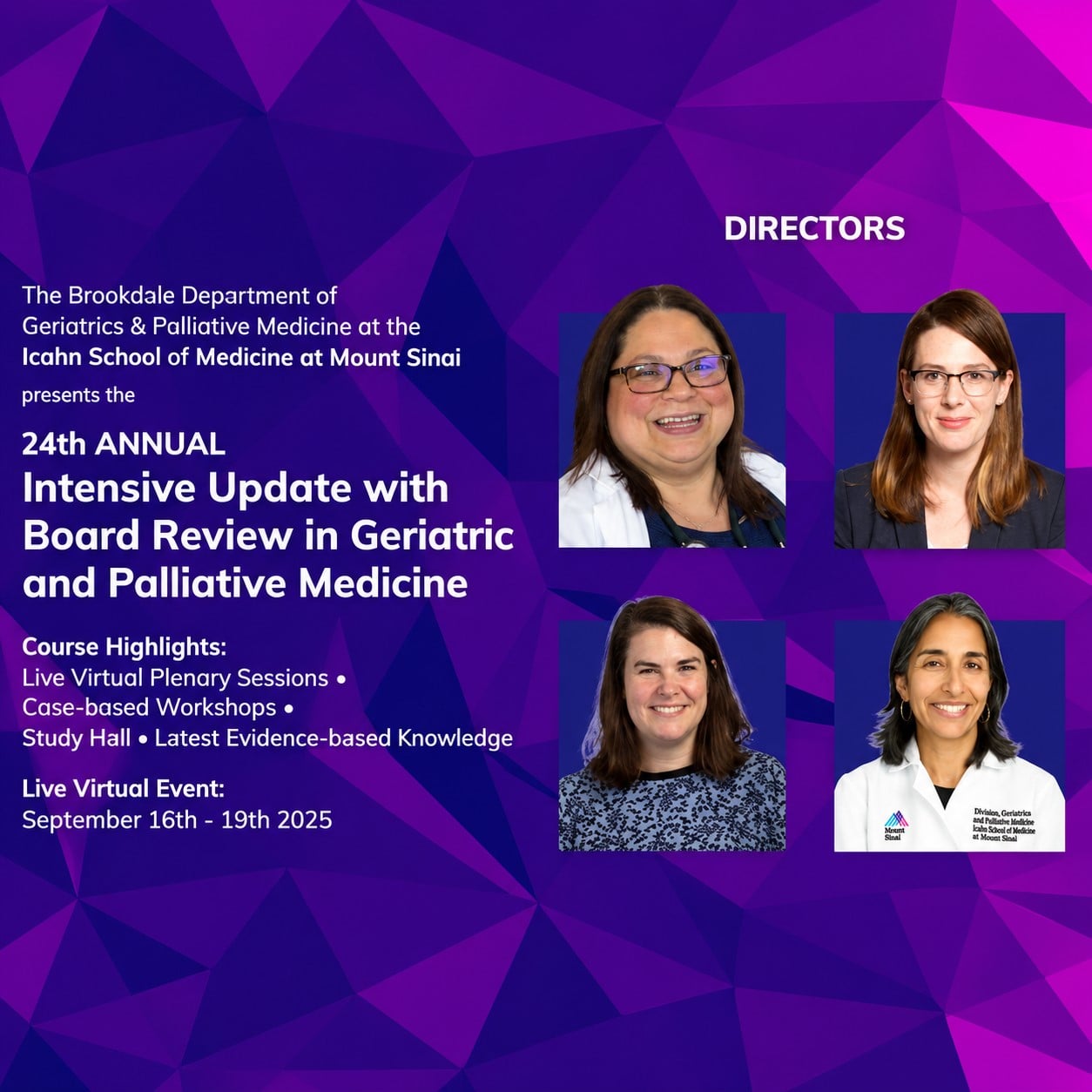
Mount Sinai 24th Annual Intensive Update with Board Review in Geriatric and Palliative Medicine 2025

Original price was: $1,395.00.$100.00Current price is: $100.00.
This Product is shared via google drive download link, So please share your correct Gmail id while placing the order .Please note that there are no CME points or certificate associated with this course Samples for Courses Can be found here : Free Samples Here!
Mount Sinai 24th Annual Intensive Update with Board Review in Geriatric and Palliative Medicine 2025
Comprehensive Geriatrics, Palliative Care & Board Review Program
The Mount Sinai 24th Annual Intensive Update with Board Review in Geriatric and Palliative Medicine 2025 is a comprehensive, evidence-based educational program designed to provide clinicians with the latest advances in geriatric medicine, palliative care, symptom management, and serious illness communication. Developed by the renowned Brookdale Department of Geriatrics and Palliative Medicine at the Icahn School of Medicine at Mount Sinai, this intensive board review course delivers practical clinical guidance for caring for older adults with complex medical, functional, cognitive, and psychosocial needs.
Combining expert-led lectures, interactive board review sessions, and case-based workshops, the course equips participants with the knowledge and skills necessary to manage multimorbidity, polypharmacy, frailty, dementia, chronic illness, end-of-life care, and palliative emergencies across diverse healthcare settings.
Product Details
- Course Date: September 16–19, 2025
- Format: 110 Videos (.mp4) + 110 Subtitle Files (.vtt) + 117 PDFs
- Size: 52.4 GB
- Access: On-Demand
- Provider: Icahn School of Medicine at Mount Sinai
- Board Review: Included
Program Overview
As populations age worldwide, clinicians increasingly encounter older adults with multiple chronic conditions, functional impairments, cognitive decline, and complex care needs. Effective management requires an integrated approach that combines geriatric medicine principles with high-quality palliative care.
This intensive update provides a comprehensive review of:
- Geriatric Medicine
- Palliative Medicine
- Board Review Preparation
- Multimorbidity Management
- Polypharmacy & Deprescribing
- Dementia Care
- Delirium
- Frailty
- Symptom Management
- Serious Illness Communication
- Advance Care Planning
- End-of-Life Care
- Ethics in Healthcare
- Hospice Medicine
- Quality of Life Interventions
The curriculum is designed for both board examination preparation and immediate clinical application.
Learning Objectives
Upon completion of this activity, participants will be able to:
- Develop comprehensive interdisciplinary care plans for older adults with multimorbidity.
- Implement safe medication management and deprescribing strategies.
- Recognize and manage common geriatric syndromes and palliative care challenges.
- Improve symptom control in patients with serious and life-limiting illnesses.
- Facilitate effective goals-of-care discussions and advance care planning.
- Assess decision-making capacity and navigate ethical dilemmas.
- Apply evidence-based approaches to dementia, osteoporosis, heart failure, and movement disorders.
- Integrate holistic interventions to enhance patient comfort and quality of life.
Geriatric Medicine Updates
The course delivers an extensive review of common and complex conditions affecting older adults.
Topics include:
- Frailty
- Falls prevention
- Functional decline
- Sarcopenia
- Geriatric assessment
- Mobility disorders
- Aging physiology
- Preventive geriatric care
Faculty provide practical strategies to improve health outcomes and maintain independence in aging populations.
Multimorbidity & Complex Chronic Disease Management
Managing multiple chronic illnesses is a central challenge in geriatric care.
Topics include:
- Heart failure in older adults
- Diabetes management
- Hypertension
- Chronic kidney disease
- Osteoporosis
- Cardiovascular disease
- Complex care coordination
- Comprehensive treatment planning
Participants learn evidence-based approaches to balancing competing medical priorities.
Polypharmacy & Deprescribing
Medication-related complications are a major source of morbidity among older adults.
Topics include:
- Polypharmacy risk reduction
- Deprescribing frameworks
- Medication reconciliation
- Beers Criteria updates
- Adverse drug event prevention
- Shared decision-making
Experts discuss practical methods to optimize medication regimens while reducing harm.
Dementia & Cognitive Disorders
Dedicated sessions focus on the diagnosis and management of cognitive impairment.
Topics include:
- Alzheimer’s disease
- Vascular dementia
- Lewy body dementia
- Behavioral symptoms of dementia
- Delirium recognition
- Capacity assessment
- Caregiver support
- Long-term care planning
Faculty emphasize patient-centered strategies for improving quality of life.
Palliative Care Essentials
A major focus of the course is comprehensive palliative care across serious illnesses.
Topics include:
- Symptom management
- Total pain assessment
- Dyspnea management
- Nausea and vomiting
- Fatigue
- Anxiety and depression
- Palliative care emergencies
- Serious illness care
Participants learn practical approaches to improving comfort and quality of life.
Advance Care Planning & Serious Illness Communication
Effective communication remains one of the most important skills in palliative medicine.
Topics include:
- Goals-of-care discussions
- Advance directives
- Prognostic communication
- Family meetings
- Shared decision-making
- Cultural considerations
- End-of-life discussions
Faculty provide structured communication frameworks applicable to daily practice.
Hospice & End-of-Life Care
The course reviews best practices for caring for patients nearing the end of life.
Topics include:
- Hospice eligibility
- End-of-life symptom management
- Ethical decision-making
- Withdrawal of life-sustaining treatment
- Spiritual care
- Family support
- Bereavement considerations
Clinicians gain confidence in providing compassionate, patient-centered care.
Ethics, Capacity & Decision-Making
Complex ethical situations frequently arise in geriatric and palliative care.
Topics include:
- Decision-making capacity
- Surrogate decision-makers
- Ethical dilemmas
- Informed consent
- Guardianship issues
- Healthcare ethics
Participants learn practical frameworks for navigating difficult clinical situations.
Integrative & Quality-of-Life Interventions
The conference also explores supportive interventions that improve well-being.
Topics include:
- Medical cannabis
- Expressive arts therapy
- Complementary therapies
- Quality-of-life enhancement
- Psychosocial support
- Holistic care models
These approaches complement traditional medical management and support patient-centered care.
Board Review Preparation
An important component of the program is comprehensive board review.
Features include:
- Board-style questions
- Case-based discussions
- Clinical pearls
- High-yield review sessions
- Examination preparation strategies
- Comprehensive Q&A sessions
The curriculum is designed to support both certification and recertification preparation.
Target Audience
This course is ideal for:
- Geriatricians
- Palliative Care Physicians
- Family Medicine Physicians
- Internal Medicine Physicians
- Hospice Physicians
- Geriatric Fellows
- Palliative Care Fellows
- Nurse Practitioners
- Physician Assistants
- Nurses
- Healthcare Professionals Caring for Older Adults
4. Topics
- 000 Welcome and Morning Announcements
- 001 Geriatrics, Palliative Care, and the Future of Healthcare
- 002 Movement Disorders Diagnosis and Treatment
- 003 De-Prescribing in the Context of Multi-Comorbidities
- 004 Beyond Alzheimer’s Dementia
- 005 Approach to Decision Making for Patients Who Lack Capacity
- 006 Hospice – There’s Always Something We Can Do
- 007 Prognostication of Chronic Disease
- 008 End-of-Life Symptom
- 009 Stepping Safely – A Guide to Geriatric Fall Evaluation for Healthy Aging
- 010 Models of Care at Home – Hospital and Palliative Care at Home
- 011 Basic Opioids 101
- 012 Geriatrics 5Ms – From Concept to Practice
- 013 Buprenorphine for Pain
- 014 Symptom Management II – Hiccups, Pruritus, Xerostomia, Fatigue, and Bowel Obstruction
- 015 Home Care
- 016 Annual Wellness Visit
- 017 Thyroid Disease in the Elderly Person
- 018 Low Back Pain
- 019 Identifying and Treating Osteoporosis
- 020 What is Geriatric Surgery Co-Management
- 021 Geriatrics and Palliative Care in the Nursing Home Setting
- 022 Nutrition-Hydration in Serious Illness
- 023 Assessing Capacity in Adult Patients
- 024 Care of Older Adults through Specialized Managed Care Models
- 025 Geriatric Nephrology & Renal Palliative Care
- 026 Perioperative Management
- 027 Integrative Therapies for Patient and Self Care
- 028 Stroke
- 029 Medical Decision Making
- 030 Update in Dementia
- 031 Principles of Geriatric Rehabilitation
- 032 Late Life Depression
- 033 Advance Care Planning – Trends and Clinical Practice
- 034 Symptom Management I – Constipation, SOB, Nausea and Anorexia
- 035 Prevention in Older Adults
- 036 Time Based and Billing Documentation
- 037 Surgical Emergencies
- 038 Chemotherapy Related Toxicity and Oncologic Complications
- 039 Palliative Care Emergencies
- 040 Clinician Well-being in Geriatrics and Palliative Medicine
- 041 Benign Prostatic Hyperplasia (BPH) & Prostate Cancer
- 042 Anemia
- 043 Grief, Bereavement and Psychosocial Issues
- 044 Advanced Pain Management – PCA & Methadone Use
- 045 Navigating Family Meetings
- 046 Musculoskeletal Medicine
- 047 Geriatric Care of Older Adults with HIV
- 048 Geriatric Emergencies
- 049 Office-Based Dementia Screening – Beyond the MMSE
- 050 Management of Heart Failure
- 051 Palliative Care in ALS
- 052 Sleep in the Elderly
- 053 Anxiety in Palliative Care Populations
- 054 Diagnosis and Evaluation of Peripheral Vascular Disease
- 055 The Era of Telemedicine for the Ambulatory Setting
- 056 Serious Illness Communication
- 057 Medicare and Medicaid Payment
- 058 Pediatric Palliative Care
- 059 Pain Management 101
- 060 Medication Management
- 061 Integrative Medicine in Geriatrics and Palliative Medicine
- 062 Maximizing Accessto Palliative Care Among Patients with Heart Failure
- 063 Caregiving
- 064 Hazards of Hospitalization
- 065 Oral Care for Older Adults – An Frequently Overlooked Issue
- 066 CAD Management – Cardiac and Perioperative Risk Assessment
- 067 Urinary Incontinence
- 068 Caring for Older Drivers
- 069 Wound Care
- 070 Physiology of Aging
- 071 Palliative Care in Hematological Malignancies – Bone Marrow Transplantation
- 072 Asthma and COPD
- 073 Atrial Fibrillation Management
- 074 Palliative Care for Pulmonary Disease
- 075 Overview of Gynecological Malignancies – Clinical Presentation and Treatment Options
- 076 Hearing Loss and Health in Older Adults
- 077 Discontinuing Life Sustaining Treatments (LST) – Withdrawal of Non-Beneficial Treatments While Maintaining Care
- 078 Geriatric Dermatology
- 079 The Life-Improving Benefits of Outpatient Palliative Care and Supportive Oncology
- 080 Frailty
- 081 Interventional Pain
- 082 Palliative Radiation Therapy
- 083 Hematologic Malignancies in the Elderly – Case Studies
- 084 Clinical Quality In The Nursing Home
- 085 Delirium – Are You Confused
- 086 Cardiovascular Disease – Part 1
- 087 Cardiovascular Disease – Part 2
- 088 AC Indications & Contraindications
- 089 Substance Use Disorder Care for Geriatrics and Palliative Medicine
- 090 All You Need is Love – Human Connection and Health
- 091 Don’t Kill Granny – Becoming a Better Doctor for Older Adults and the Seriously Ill
- 092 Hypertension in Older Adults
- 093 Use of Adjuvants for Pain Management
- 094 Overview of Medical Assistance in Dying
- 095 High Risk Ambulatory Geriatrics – The ALIGN Program
- 096 Crystal Arthropathies
- 097 Infectious Disease – Pneumonia, UTI’s and C-Dif
- 098 Management of Behavioral and Psychological Symptoms of Dementia
- 099 Managing Aortic Stenosis, Mitral Regurgitation & Antibiotic Prophylaxis
- 100 Addressing Total Pain – The Role of Interdisciplinary Teams
- 101 Geriatric Assessment Tools
- 102 Medical Cannabis – It’s High Time We Review the Evidence
- 103 Oncology – Breast, Lung & Colon Cancers
- 104 Digital Technology for Health Promotion and Disease Prevention in Older Adults
- 105 Hepatology for Geriatrics and Palliative Care Clinicians
- 106 Feeding and Swallowing Disorders
- 107 Anorexia, Cachexia and Weight Loss
- 108 Diabetes Overview
- 109 Management of Constipation and Fecal Incontinence in Older Adults
- 110 Expressive Arts Therapy and Child Life in the Support of Patients and Families
Related products
Critical Care - Emergency medicine

Critical Care - Emergency medicine
Critical Care - Emergency medicine
40th ISICEM International Symposium on Intensive Care & Emergency Medicine 2021
Family medicine

Internal Medicine

Medical Accounts