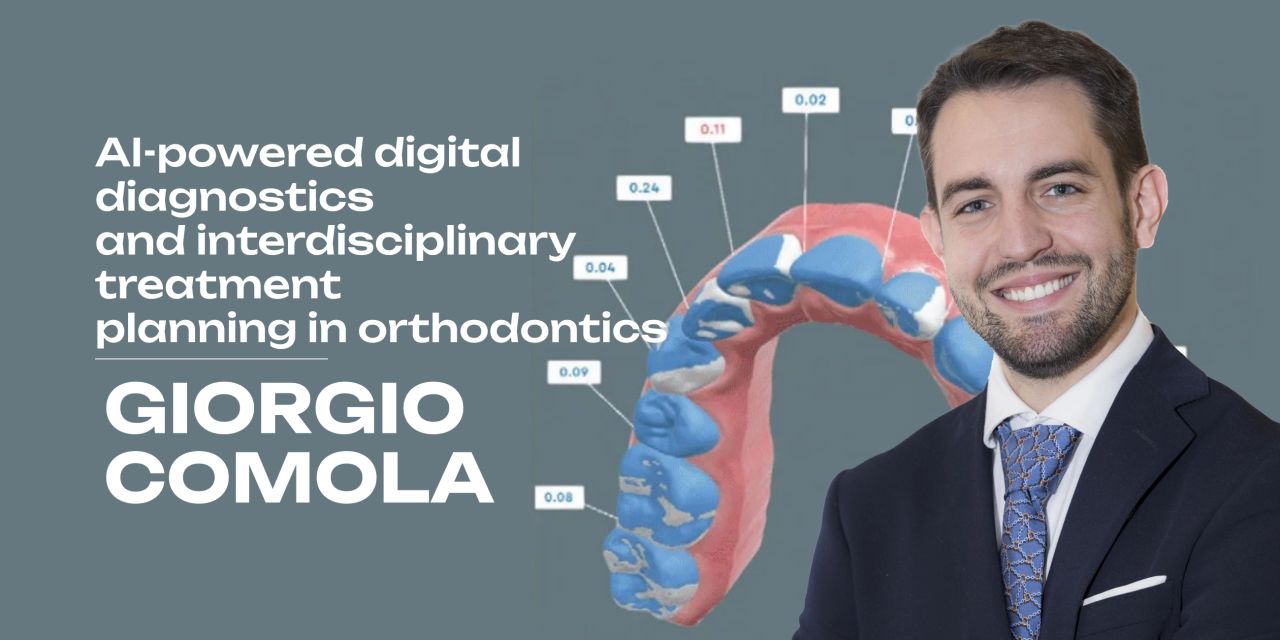
OHI-S AI-Powered Digital Diagnostics & Interdisciplinary Treatment Planning in Orthodontics
3 Lessons | 2 Hours 44 Minutes | 2.25 CE Credits | Instructor: Giorgio Comola
Master a structured approach to AI-powered orthodontic diagnostics, digital treatment planning, aligner orthodontics, and interdisciplinary case management with this comprehensive OHI-S online course.
OHI-S AI-Powered Digital Diagnostics and Interdisciplinary Treatment Planning in Orthodontics explores how modern digital tools can transform large amounts of clinical information into organized, clinically meaningful treatment strategies.
Rather than using intraoral scans, radiographs, facial photographs, digital models, occlusal information, and virtual setups as isolated records, the course demonstrates how these data sources can be integrated into a unified diagnostic workflow.
Across three lessons, Giorgio Comola explains how artificial intelligence and digital workflows can support orthodontic diagnosis, identify risks and treatment limitations, improve aligner planning, and coordinate orthodontic tooth movement with restorative, prosthetic, periodontal, implant, surgical, functional, and esthetic objectives.
The course emphasizes a treatment philosophy that begins with the desired final rehabilitation and works backward to determine the orthodontic movements needed to achieve a more predictable result.
Course Details
- Course: AI-Powered Digital Diagnostics and Interdisciplinary Treatment Planning in Orthodontics
- Provider: OHI-S
- Instructor: Giorgio Comola
- Format: Online Course
- Lessons: 3
- Duration: 2 Hours 44 Minutes
- CE Credits: 2.25 CE Credits
- Language: English
- Specialty: Orthodontics / Digital Dentistry
- Focus: AI Diagnostics, Aligner Planning, Digital Orthodontics & Interdisciplinary Treatment Planning
Course Overview
Digital orthodontics has evolved far beyond simply obtaining an intraoral scan or creating a virtual setup.
Modern clinicians increasingly need to interpret multiple sources of information simultaneously, including:
- Intraoral scans
- Digital dental models
- Radiographs
- Facial photographs
- Smile analysis
- Occlusal relationships
- Functional information
- Periodontal considerations
- Restorative requirements
- Prosthetic objectives
- Implant positioning
- Surgical considerations
The challenge is not simply collecting these records.
The real challenge is determining how they should influence diagnosis and treatment.
This course presents a structured digital workflow designed to help clinicians connect diagnostic information with final functional, restorative, and esthetic goals.
Who Should Enroll?
This course is designed for dental clinicians involved in digital orthodontics, aligner treatment planning, interdisciplinary dentistry, and comprehensive restorative rehabilitation.
It is particularly relevant for:
- Orthodontists
- Prosthodontists
- Periodontists
- Oral Surgeons
- Restorative Dentists
- Cosmetic Dentists
- Implant Dentists
- General Dentists performing orthodontic treatment
- Aligner Providers
- Digital Dentistry Clinicians
- Dental Technicians
- Dental Laboratory Professionals
- Clinicians managing interdisciplinary rehabilitation cases
Learning Objectives
Upon completion of the course, participants should be better able to:
- Understand the role of AI-assisted diagnostics in modern orthodontics.
- Apply AI-supported tools to orthodontic clinical decision-making.
- Recognize where artificial intelligence can assist diagnosis and where clinical judgment remains essential.
- Integrate intraoral scans, digital models, radiographs, facial analysis, smile analysis, and occlusal information.
- Organize multiple digital records into a structured diagnostic workflow.
- Identify diagnostic risks before treatment planning begins.
- Recognize treatment limitations and potential clinical compromises.
- Develop digital treatment plans for aligner orthodontics.
- Connect planned tooth movements with final restorative objectives.
- Incorporate prosthetic requirements into orthodontic planning.
- Coordinate orthodontic tooth movement around future implant positions.
- Integrate periodontal limitations and objectives into digital treatment planning.
- Use digital setups as interdisciplinary communication tools.
- Incorporate facial, smile, functional, and esthetic goals into orthodontic planning.
- Improve communication between orthodontists, prosthodontists, periodontists, surgeons, restorative dentists, and technicians.
- Anticipate compromises before clinical treatment begins.
- Improve treatment predictability through digital planning.
- Develop a repeatable workflow from initial diagnosis to final rehabilitation.
Course Curriculum
Lesson 1: AI-Powered Digital Diagnostics in Orthodontics
The first lesson introduces the evolution of digital orthodontic diagnostics and explores how artificial intelligence can support clinical decision-making.
The objective is not to replace clinical judgment with software, but to understand how AI-supported tools can help clinicians recognize patterns, organize information, and identify potential diagnostic concerns.
Topics Include
- Evolution of digital orthodontic records
- Digital diagnosis in orthodontics
- AI-assisted orthodontic diagnosis
- Artificial intelligence in dentistry
- Digital clinical decision-making
- Intraoral scans
- Digital dental models
- Radiographic records
- Facial analysis
- Smile analysis
- Occlusal assessment
- Functional assessment
- Treatment objectives
- Diagnostic pattern recognition
- Risk identification
- Treatment limitations
- Clinical judgment in AI-assisted workflows
AI in Orthodontic Diagnosis
Artificial intelligence can potentially assist clinicians with organizing and interpreting complex diagnostic information.
The course explores:
- Where AI can support clinical decision-making
- AI-assisted identification of diagnostic patterns
- Identification of potential risks
- Integration of digital information
- Limitations of AI
- Importance of clinician interpretation
- Relationship between automated analysis and clinical judgment
AI is therefore positioned as a clinical support tool rather than a replacement for professional diagnosis and decision-making.
Building a Structured Digital Diagnostic Workflow
One of the central concepts of the course is transforming separate digital records into a unified diagnostic picture.
A structured workflow may include:
Intraoral Scan → Radiographic Analysis → Facial Assessment → Smile Analysis → Occlusal Evaluation → Functional Assessment → Risk Identification → Treatment Objectives
This approach helps clinicians move beyond simply collecting digital records toward clinically meaningful data integration.
Lesson 2: Beyond the Scan – AI and Digital Diagnostics in Modern Orthodontics
From Data Integration to Clinical Decision-Making
The second lesson examines the difference between obtaining digital records and actually using those records to improve treatment decisions.
Modern orthodontic practices can collect large volumes of data, but increased data availability does not automatically produce better treatment planning.
The course focuses on connecting:
- Anatomy
- Function
- Esthetics
- Facial characteristics
- Occlusion
- Digital records
- Treatment limitations
- Final treatment objectives
Digital Record Integration
Participants learn how to integrate:
Intraoral Scans
Digital scans provide detailed information regarding:
- Tooth position
- Dental arches
- Interarch relationships
- Available space
- Occlusal relationships
- Digital setup possibilities
Radiographic Records
Radiographs provide information that cannot be determined from surface scans alone.
They may contribute to evaluating:
- Root positions
- Bone structures
- Dental relationships
- Pathology
- Anatomical limitations
- Risks associated with planned tooth movement
Facial & Smile Analysis
Orthodontic planning should not focus exclusively on dental alignment.
Facial and smile assessment can help determine:
- Esthetic treatment goals
- Incisor positioning objectives
- Smile characteristics
- Facial proportions
- Soft tissue relationships
- Overall treatment direction
Occlusal & Functional Assessment
Treatment planning should also account for:
- Occlusal relationships
- Functional requirements
- Interarch coordination
- Final restorative objectives
Translating Digital Findings Into Clinical Decisions
The course demonstrates how digital information can influence actual treatment decisions.
The clinician should be able to move from:
Digital Data → Clinical Interpretation → Risk Assessment → Treatment Strategy
Important considerations include:
- Is the proposed movement biologically realistic?
- Will orthodontic movement support the final restorative treatment?
- Are periodontal limitations present?
- Will the proposed alignment improve facial and smile objectives?
- Are future implant positions being considered?
- Does the virtual setup correspond with the clinical situation?
- Are compromises being identified before treatment?
Digital Visualization & Patient Communication
Digital records can also improve communication with patients.
Three-dimensional visualization can help clinicians explain:
- Current dental conditions
- Treatment objectives
- Tooth movement
- Treatment limitations
- Potential risks
- Alternative approaches
- Expected outcomes
Visual communication may help patients better understand complex orthodontic treatment plans.
Practical Digital Diagnosis Checklist
The program provides a structured approach to reviewing records before orthodontic or aligner treatment.
Important considerations include:
- Are all necessary records available?
- Have scans been reviewed clinically?
- Have radiographic findings been incorporated?
- Has facial analysis been performed?
- Has smile analysis been completed?
- Have occlusal relationships been assessed?
- Have functional objectives been considered?
- Have treatment risks been identified?
- Have final restorative objectives been defined?
- Has the digital plan been clinically verified?
The goal is to create a repeatable diagnostic workflow for everyday clinical practice.
Lesson 3: The Digital Treatment Blueprint – Interdisciplinary Planning for Predictable Orthodontic Outcomes
The third lesson connects digital diagnosis with comprehensive interdisciplinary treatment planning.
Complex dental rehabilitation may involve multiple specialties, including:
- Orthodontics
- Prosthodontics
- Restorative Dentistry
- Periodontics
- Implant Dentistry
- Oral Surgery
- Dental Laboratory Technology
Orthodontic tooth movement should therefore be planned with the final multidisciplinary result in mind.
Define the Final Goal First
A central principle of interdisciplinary treatment planning is defining the desired endpoint before deciding how teeth should move.
The final goal may involve:
- Prosthetic rehabilitation
- Veneers
- Crowns
- Dental implants
- Periodontal treatment
- Esthetic rehabilitation
- Functional improvement
- Smile enhancement
Once the final outcome is established, orthodontic movements can be designed around those objectives.
Digital Treatment Blueprint
The course presents a treatment philosophy that can be summarized as:
Final Restorative Goal → Facial & Smile Analysis → Occlusal Objectives → Digital Setup → Orthodontic Tooth Movement → Interdisciplinary Coordination → Final Rehabilitation
This reverse-planning approach allows clinicians to use orthodontics as one component of a broader restorative and functional treatment strategy.
Digital Treatment Planning for Aligner Orthodontics
Clear aligner treatment planning requires more than automatically accepting a software-generated tooth arrangement.
Clinicians should evaluate:
- Sequence of tooth movement
- Space creation
- Anchorage requirements
- Root positioning
- Occlusal relationships
- Restorative requirements
- Periodontal limits
- Implant requirements
- Biological limitations
- Final esthetic objectives
Digital setups should therefore be considered clinical planning tools, not automatic treatment prescriptions.
Aligner Orthodontics & Restorative Dentistry
Orthodontic movement can be used to create better restorative conditions before final rehabilitation.
Examples may include creating:
- Appropriate restorative space
- Improved tooth position
- Better dental proportions
- Improved alignment before veneers or crowns
- Better occlusal relationships
- Improved implant space
- More favorable restorative contours
The orthodontic plan should support the eventual restorative procedure rather than create additional limitations.
Orthodontics & Prosthodontics
Prosthetic objectives may influence:
- Tooth position
- Tooth inclination
- Interarch relationships
- Space management
- Occlusal design
- Final tooth proportions
Coordination between orthodontists and prosthodontists can therefore improve interdisciplinary treatment planning.
Orthodontics & Implant Dentistry
Future implant placement should be considered before orthodontic treatment is completed.
Important considerations include:
- Mesiodistal implant space
- Root divergence
- Bone availability
- Prosthetic emergence
- Occlusal position
- Final restoration dimensions
Digital planning can help coordinate orthodontic movement with the desired implant-supported restoration.
Orthodontics & Periodontics
Periodontal anatomy may place important biological limitations on orthodontic tooth movement.
Planning should consider:
- Bone support
- Gingival conditions
- Periodontal phenotype
- Recession risk
- Planned periodontal procedures
- Biological boundaries of movement
Interdisciplinary planning helps clinicians recognize these issues before treatment.
Orthodontics & Oral Surgery
Some complex cases may require surgical intervention.
Digital planning can help coordinate orthodontics with surgical objectives and determine when orthodontic movement alone may be insufficient.
Digital Setups as Interdisciplinary Communication Tools
A digital setup is not useful only for the orthodontist.
It can also facilitate communication between:
- Orthodontists
- Prosthodontists
- Periodontists
- Oral Surgeons
- Implant Dentists
- Restorative Dentists
- Dental Technicians
The entire clinical team can evaluate the same proposed treatment outcome before irreversible procedures begin.
Facial, Smile & Esthetic Objectives
Orthodontic treatment should not be limited to producing straight teeth.
A comprehensive plan should also consider:
- Facial proportions
- Smile characteristics
- Incisor display
- Dental proportions
- Soft tissue relationships
- Occlusion
- Function
- Esthetic objectives
Digital treatment planning allows these factors to be evaluated simultaneously.
Identifying Treatment Limitations
An important benefit of structured diagnosis is identifying potential compromises before treatment.
The course emphasizes evaluation of:
- Biological limitations
- Skeletal limitations
- Periodontal limitations
- Restorative limitations
- Prosthetic limitations
- Implant-related requirements
- Functional concerns
- Esthetic compromises
Recognizing these factors early allows the interdisciplinary team to adapt the treatment strategy before problems develop.
Improving Treatment Predictability
Predictability depends on more than digital technology.
It requires a structured relationship between:
Accurate Records + Clinical Diagnosis + Risk Assessment + Digital Planning + Interdisciplinary Communication + Clinical Judgment
Using this framework can help reduce unexpected compromises and improve coordination throughout treatment.
Key Clinical Topics Covered
- AI in orthodontics
- Artificial intelligence in dentistry
- AI-powered dental diagnostics
- Digital orthodontics
- Digital orthodontic diagnosis
- Digital treatment planning
- Intraoral scanning
- Digital dental models
- Radiographic analysis
- Facial analysis
- Smile analysis
- Occlusal assessment
- Functional assessment
- 3D orthodontic planning
- Clear aligners
- Aligner orthodontics
- Aligner treatment planning
- Digital setup
- Orthodontic risk assessment
- Interdisciplinary dentistry
- Prosthodontic orthodontic planning
- Restorative orthodontics
- Periodontal orthodontics
- Implant orthodontics
- Surgical orthodontic planning
- Smile design
- Facial-driven orthodontics
- Digital dentistry
- Comprehensive dental rehabilitation
- Interdisciplinary case planning
- Dental treatment predictability
Why This Course Is Useful
OHI-S AI-Powered Digital Diagnostics & Interdisciplinary Treatment Planning in Orthodontics is particularly valuable because it connects digital technology with actual clinical decision-making.
The program does not treat AI, intraoral scanning, aligners, or digital setups as isolated technologies.
Instead, it connects them into a complete workflow:
Diagnosis → Data Integration → Risk Assessment → Final Treatment Goal → Digital Setup → Interdisciplinary Planning → Orthodontic Treatment → Final Rehabilitation
The course can help clinicians:
- Improve digital diagnostic workflows
- Understand practical applications of AI in orthodontics
- Better integrate multiple diagnostic records
- Improve clear aligner treatment planning
- Identify risks before treatment
- Coordinate orthodontics with restorative dentistry
- Plan orthodontic movement around implants
- Incorporate periodontal considerations
- Improve communication with interdisciplinary teams
- Improve patient communication through digital visualization
- Recognize treatment limitations earlier
- Create more structured treatment plans
- Improve predictability in complex rehabilitation cases
4. Short Description
OHI-S AI-Powered Digital Diagnostics & Interdisciplinary Treatment Planning in Orthodontics is a 3-lesson, 2-hour 44-minute online course with 2.25 CE Credits, presented by Giorgio Comola.
The course covers AI-assisted orthodontic diagnosis, intraoral scans, radiographs, facial and smile analysis, digital aligner planning, risk assessment, 3D setups, and interdisciplinary coordination with prosthodontics, periodontics, implant dentistry, oral surgery, and restorative dentistry.
Ideal for orthodontists and dental professionals seeking a structured digital workflow from initial diagnosis to final rehabilitation.
Topics
Lesson 1. AI-Powered Digital Diagnostics in Orthodontics
-
The evolution of digital orthodontic records
-
Connecting scans, radiographs, facial analysis, occlusion, and treatment objectives
-
AI in Orthodontic Diagnosis:
-
Where AI can support clinical decision-making
-
AI-assisted identification of risks and diagnostic patterns
-
The limits of AI and the role of clinical judgment
-
-
Building a Structured Digital Diagnostic Workflow:
-
Intraoral scans and digital models
-
Radiographic and facial records
-
Occlusal and functional assessment
-
Integrating multiple data sources into one diagnostic picture
-
Lesson 2. Beyond the Scan: AI and Digital Diagnostics in Modern Orthodontics. From Data Integration to Clinical Decision-Making
-
The evolution of digital orthodontic records
-
Why collecting data is not the same as understanding it
-
Connecting scans, radiographs, facial analysis, occlusion, and treatment objectives
-
AI in Orthodontic Diagnosis:
-
Where AI can support clinical decision-making
-
AI-assisted identification of risks and diagnostic patterns
-
The limits of AI and the role of clinical judgment
-
-
Building a Structured Digital Diagnostic Workflow:
-
Intraoral scans and digital models
-
Radiographic and facial records
-
Occlusal and functional assessment
-
Integrating multiple data sources into one diagnostic picture
-
-
Translating digital findings into clinical decisions
-
Connecting anatomy, function, esthetics, and treatment objectives
-
Using digital tools to improve treatment predictability
-
Preventing problems before they appear during treatment
-
Digital Visualization and Patient Communication:
-
Making complex diagnostic findings easier to understand
-
Using 3D visualization to explain treatment limitations and risks
-
Improving patient engagement and treatment acceptance
-
-
Practical Digital Diagnosis Checklist:
-
Key records to review before treatment
-
Essential diagnostic questions
-
Final verification before starting aligner or orthodontic treatment
-
Creating a repeatable workflow for daily clinical practice
-
Lesson 3. The Digital Treatment Blueprint: Interdisciplinary Planning for Predictable Orthodontic Outcomes
-
Principles of interdisciplinary digital treatment planning
-
Defining the final prosthetic, restorative, and esthetic goal
-
Integrating facial, smile, and occlusal analysis
-
Planning tooth movement around prosthetic and implant requirements
-
Digital setup as a tool for interdisciplinary communication
-
Coordinating orthodontic, periodontal, surgical, and restorative objectives
-
Identifying treatment limitations and the need for interdisciplinary intervention
-
Anticipating clinical compromises through digital planning
-
Step-by-step workflow for interdisciplinary case planning
-
From digital treatment blueprint to final rehabilitation