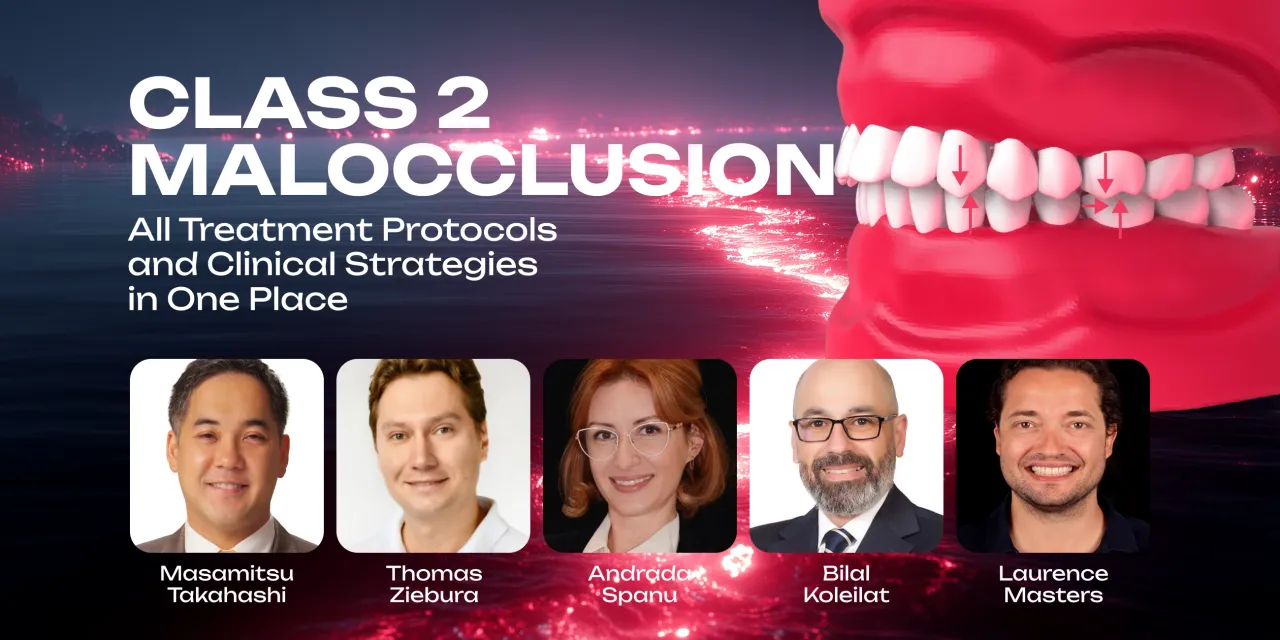
OHI-S Class 2 Malocclusion. All Treatment Protocols and Clinical Strategies in One Place 7 lessons 6h 49min

$65.00
Explore Class II orthodontic planning in seven OHI-S lessons, listed at 6 hours 49 minutes. Topics include vertical and occlusal-plane control, gummy smile, camouflage, functional appliances, TAD mechanics, and CBCT assessment. Clinical examples cover growing and non-growing patients, with the complete lesson outlines and faculty retained below.
Delivery Information: This Product is shared via google drive download link. Please use your correct Gmail address at checkout.
Please note: there are no CME points or certificate associated with this course.
Samples for Courses Can be found here: Free Samples Here!
Class II correction requires a plan that accounts for growth, skeletal relationships, dental compensation, and vertical control. This OHI-S course compares approaches for growing and non-growing patients through seven lessons on diagnosis and treatment mechanics. It examines gummy smile management, camouflage, functional appliances, elastics, and TAD-supported distalization or retraction. Additional sessions address CBCT assessment of biological limits and the influence of the occlusal plane on treatment planning. Clinical examples bring these choices together across deep bite, severe overjet, subdivision, extraction, and non-extraction cases. The full lesson outlines below retain the original topics, with each instructor and listed duration.
Course details: Seven English-language lessons; listed total duration 6 hours 49 minutes. Individual lesson times below are retained as supplied. Intended for clinicians with an interest in advanced orthodontic treatment planning.
Access: This package provides educational recordings rather than an OHI-S account or subscription. Official OHI-S CE participation and platform services are not included.
Topics
Lesson 1. Gummy Smile Management in Class 2 Malocclusion
Faculty: Masamitsu Takahashi
Duration: 41 Minutes
-
Diagnosis and assessment of the need for vertical control
-
Methods of vertical dimension control: advantages and disadvantages
-
Vertical control of anterior teeth. Improvement or prevention of gummy smile
-
Treatment approaches for gummy smile correction
-
Clinical application of high-pull J-hook headgear
-
Application of 2×4 intrusion arch mechanics
-
Influence of TAD vertical position on the occlusal plane
-
Extraction treatment mechanics in Class 2 cases
Lesson 2. Class 2 and Vertical Dimension Control in Orthodontic Treatment
Faculty: Masamitsu Takahashi
Duration: 1 Hour 1 Minute
-
Diagnosis and assessment of the need for vertical control
-
Influence of TAD vertical positioning on the occlusal plane
-
Effect of lever arm length on incisor inclination
-
Relationship between TAD vertical position, lever arm length, incisor inclination, and overbite
-
Methods for controlling the vertical dimension of occlusion: advantages and disadvantages
-
Vertical control of the molar region
-
Difference between intrusion by rotation of occlusal plane applying biomechanics and absolute intrusion
-
Effect of the vertical position of TADs on the inclination of the occlusal plane
-
Retention and relapse following vertical dimension control
Lesson 3. Camouflage Treatment of Class 2 Malocclusion: Clinical Protocols
Faculty: Thomas Ziebura
Duration: 50 Minutes
-
Retraction of upper anterior teeth in Class 2 cases and associated facial profile changes
-
Functional appliance therapy strategies in growing patients
-
Protocols for Class 2 correction using intermaxillary elastics
-
Clinical application and biomechanics of Herbst and Herbst-type appliances
-
Elastic-supported and hybrid Herbst appliance derivatives
-
Treatment protocols for Class 2 Division 2 malocclusions
Lesson 4. The Role of TADs in Class 2 Orthodontic Treatment
Faculty: Thomas Ziebura
Duration: 54 Minutes
-
Protocols for Class 2 correction through molar distalization techniques
-
Design and customization of distalization mechanics protocols
-
Posterior anchorage reinforcement strategies and stabilization techniques
-
En-masse retraction protocols for anterior teeth control
-
Sagittal correction protocols through molar intrusion mechanics
Lesson 5. Role of CBCT in Class 2 Malocclusion Diagnosis and Treatment Planning
Faculty: Andrada Spanu
Duration: 52 Minutes
-
Tooth angulation in relation to the alveolar bone using CBCT
-
Correlation between CBCT and cephalometric (teleradiographic) analysis
-
Assessment of bone limitations based on CBCT findings
-
Extraction vs distalization for camouflage treatment: CBCT-based decision-making process
-
Root resorption: assessment and implications on CBCT imaging
-
Finishing phase guided by CBCT evaluation
-
Temporomandibular disorders (TMD) assessment using CBCT
Lesson 6. Vertical Dimension and Occlusal Plane Control in Class 2 Malocclusion Treatment
Faculty: Laurence Masters
Duration: 57 Minutes
-
Role of vertical dimension and occlusal plane angulation in Class 2 diagnosis and treatment planning
-
Cephalometric and clinical indicators of vertical excess and deficiency in Class 2 cases
-
Influence of occlusal plane control on mandibular positioning, facial aesthetics, and long-term stability
-
Comparison of conventional, skeletal anchorage–assisted, and hybrid vertical control approaches
-
Biomechanical strategies for vertical dimension control using fixed appliances, aligners, and TADs
-
Effects of vertical control on soft tissue harmony and smile aesthetics
-
Case-based applications of occlusal plane modification in Class 2 correction
-
Integration of vertical control principles in comprehensive treatment planning for adolescent and adult patients
Lesson 7. Simplified Mechanics for the Treatment of Class 2 Malocclusion in Growing and Non-Growing Patients
Faculty: Bilal Koleilat
Duration: 1 Hour 32 Minutes
-
Etiology of Class 2 malocclusion with emphasis on occlusal plane and mandibular deficiency
-
Treatment principles in growing vs non-growing patients: diagnostic differentiation and decision-making
-
Early use of intermaxillary elastics and bite ramps in Class 2 deep bite and open bite cases
-
Vertical and transverse control strategies in Class 2 correction
-
Functional appliance therapy during the pubertal growth spurt for skeletal modification
-
Fixed appliance strategies in non-growing patients: extraction and non-extraction protocols
-
Use of TADs in severe non-growing Class 2 cases
-
Simplified biomechanics: reduced wire sequences and non-compliance treatment approaches
-
Clinical case applications:
-
Deep bite and severe overjet in growing patients
-
Deep bite with gummy smile in growing patients
-
Class 2 subdivision cases in growing patients
-
Class 2 treatment with premolar extractions in non-growing patients
-
Class 2 non-extraction treatment with TADs in non-growing patients
-
Class 2 treatment with extractions and gummy smile correction in non-growing patients
-
Related products
Family medicine

Critical Care - Emergency medicine
Chestnet Pediatric Pulmonary Board Review On Demand 2022 ( VIDEOS)

Critical Care - Emergency medicine
Medical Accounts

Critical Care - Emergency medicine