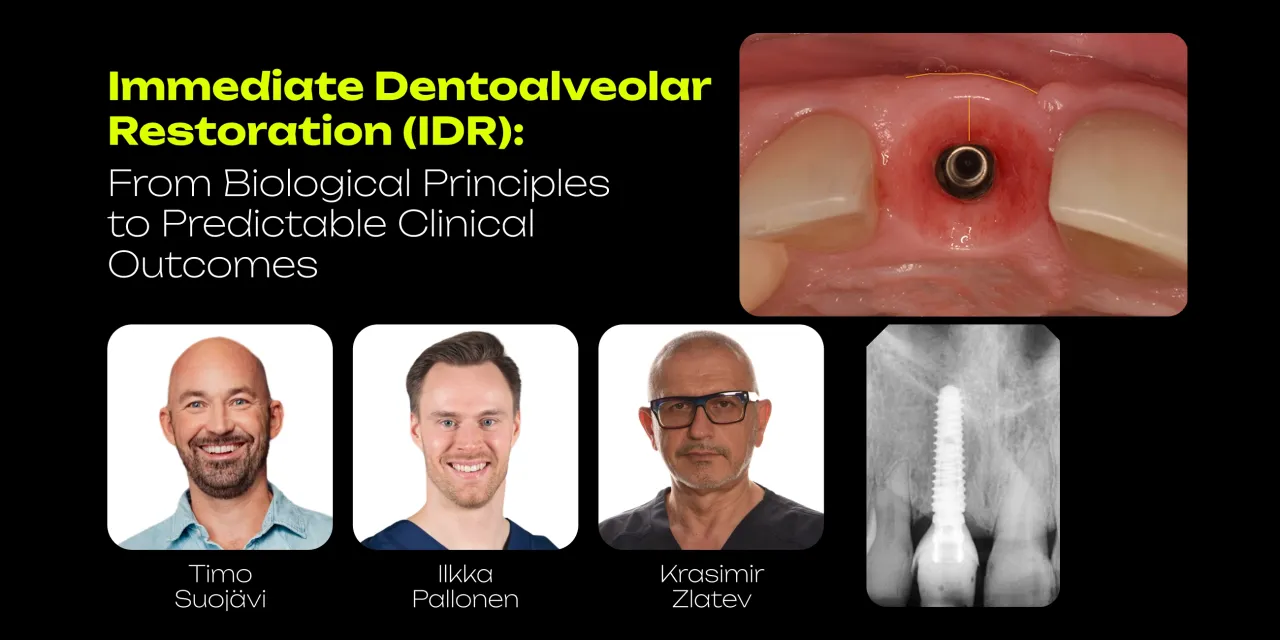
OHI-S Immediate Dentoalveolar Restoration (IDR) From Biological Principles to Predictable Clinical Outcomes 4 lessons 2h 43min
$30.00
This Product is shared via google drive download link, So please share your correct Gmail id while placing the order .Please note that there are no CME points or certificate associated with this course Samples for Courses Can be found here : Free Samples Here!
OHI-S Immediate Dentoalveolar Restoration (IDR)
From Biological Principles to Predictable Clinical Outcomes
4 Lessons | 2 Hours 43 Minutes | Immediate Implant Placement & Dentoalveolar Reconstruction
Master the biological reasoning, clinical decision-making, surgical workflow, and prosthetically driven planning behind Immediate Dentoalveolar Restoration (IDR) with this comprehensive OHI-S implantology course.
Immediate Dentoalveolar Restoration (IDR): From Biological Principles to Predictable Clinical Outcomes presents a structured approach to preserving and reconstructing the dentoalveolar complex at the time of tooth extraction instead of waiting for post-extraction tissue collapse and treating the resulting defect later.
Presented by:
- Timo Suojarvi
- Ilkka Pallonen
- Krasimir Zlatev
the program integrates:
- Biological principles
- Immediate implant placement
- Extraction socket assessment
- Buccal plate reconstruction
- Alveolar bone preservation
- Defect classification
- Minimally invasive extraction
- CBCT-based planning
- Maxillary tuberosity bone harvesting
- Autogenous bone grafting
- Graft stabilization
- Implant positioning
- Surgical guides
- Immediate provisionalization
- Prosthetically driven treatment planning
The central philosophy is:
Preserve and Reconstruct the Dentoalveolar Complex at Extraction Rather Than Treating Collapse After It Occurs
Course Details
- Course: Immediate Dentoalveolar Restoration (IDR): From Biological Principles to Predictable Clinical Outcomes
- Provider: OHI-S
- Faculty: Timo Suojarvi, Ilkka Pallonen, Krasimir Zlatev
- Lessons: 4
- Official Duration: 2 Hours 43 Minutes
- Language: English
- Official OHI-S CE: 2 CE Credits
- Primary Specialty: Implantology
- Additional Specialty: Oral & Maxillofacial Surgery
- Main Focus: Immediate Dentoalveolar Restoration
- Clinical Focus: Immediate Implant Placement + Bone Reconstruction + Prosthetic Planning
What Is Immediate Dentoalveolar Restoration?
Tooth extraction initiates biological remodeling of the alveolar process.
Traditional treatment may involve:
Extraction → Healing → Ridge Collapse / Remodeling → Later Augmentation → Implant Placement
The IDR concept instead aims to intervene during the extraction appointment when clinically appropriate:
Assessment → Minimally Invasive Extraction → Immediate Implant Placement → Dentoalveolar Reconstruction → Graft Stabilization → Immediate Provisional Planning
The objective is to preserve or reconstruct the architecture needed for stable hard- and soft-tissue outcomes.
Why IDR Represents a Different Treatment Philosophy
Immediate Dentoalveolar Restoration should not simply be considered another name for immediate implant placement.
Conventional immediate implantation may focus primarily on placement of the implant into a fresh extraction socket.
IDR adds a broader reconstructive strategy involving:
- Existing socket morphology
- Buccal plate condition
- Bone deficiency
- Soft-tissue architecture
- Implant position
- Autogenous grafting
- Prosthetic emergence
- Provisional restoration
The treatment therefore becomes:
Biologically Driven + Surgically Reconstructive + Prosthetically Planned
Biological Foundations of IDR
Understanding post-extraction biology is fundamental to the IDR concept.
Following extraction, changes can occur in:
- Buccal bone
- Alveolar ridge dimensions
- Socket anatomy
- Gingival architecture
- Soft-tissue contour
The magnitude and clinical relevance of these changes vary according to:
- Socket anatomy
- Buccal plate thickness
- Existing bone defects
- Soft-tissue phenotype
- Tooth position
- Infection
- Trauma during extraction
Preserving the Dentoalveolar Complex
Rather than considering the implant independently, IDR evaluates the complete dentoalveolar unit.
This includes:
- Bone
- Soft tissue
- Implant
- Prosthetic restoration
The goal is to create a stable relationship among all components.
Buccal Plate Reconstruction
The buccal plate is particularly important in the esthetic zone.
Deficiency or loss of the facial plate can influence:
- Ridge contour
- Soft-tissue support
- Gingival margin
- Emergence profile
- Final esthetics
IDR therefore includes strategies for reconstructing facial bone when clinically indicated.
LESSON 1
Immediate Dentoalveolar Restoration (IDR): Biological Foundations and Treatment Philosophy
Faculty: Timo Suojarvi & Ilkka Pallonen
Official Lesson Duration: 36 Minutes
The first lesson establishes the biological and conceptual foundation of IDR.
Topics include:
- Evolution of Immediate Dentoalveolar Restoration
- Biological principles of immediate dentoalveolar reconstruction
- Preservation of the dentoalveolar complex following extraction
- Buccal plate reconstruction
- Ridge preservation
- Indications for IDR
- Clinical objectives
- Biologically driven treatment philosophy
- Clinical cases
Evolution of Immediate Dentoalveolar Restoration
Immediate implant therapy has evolved from focusing mainly on implant survival toward broader objectives involving:
- Hard-tissue preservation
- Soft-tissue stability
- Esthetic integration
- Prosthetic predictability
IDR reflects this evolution by combining implantation and reconstruction within one coordinated treatment strategy.
Biological Principles
Successful immediate reconstruction requires respect for:
- Blood supply
- Bone vitality
- Tissue preservation
- Primary stability
- Graft stability
- Soft-tissue support
Technical execution should follow biological requirements rather than forcing anatomy to match a predetermined procedure.
Indications and Clinical Objectives
The fundamental question is not:
“Can an implant be placed immediately?”
but:
“Can immediate implant placement and reconstruction be performed predictably in this specific defect?”
Important considerations include:
- Socket anatomy
- Defect morphology
- Bone availability
- Implant stability
- Esthetic demands
- Soft tissues
- Prosthetic plan
Clinical Cases
Case analysis helps demonstrate how biological principles affect actual decisions involving:
- Extraction
- Implant placement
- Bone reconstruction
- Prosthetic planning
This case-based component is important because IDR protocols cannot be applied identically to every extraction socket.
LESSON 2
Clinical Decision-Making and Treatment Planning in the IDR Concept
Faculty: Timo Suojarvi & Ilkka Pallonen
Official Lesson Duration: 28 Minutes
The second lesson moves from biological concepts to patient selection and treatment planning.
Major topics include:
- IDR vs. conventional immediate implant placement
- Case selection
- Indication criteria
- Defect morphology
- Biological prerequisites
- Surgical factors
- Prosthetic factors
- Implant positioning
- Graft stabilization
- Restorative planning
- Clinical workflow
- Representative cases
IDR vs. Conventional Immediate Implant Placement
A key distinction is:
Immediate Implant Placement
Primarily describes the timing of implant placement after extraction.
Immediate Dentoalveolar Restoration
Describes a more comprehensive reconstructive philosophy involving:
Extraction + Implant + Bone Architecture + Graft + Soft Tissue + Prosthetic Restoration
Case Selection
Predictability begins with selecting the appropriate case.
Assessment should consider:
- Tooth prognosis
- Extraction socket anatomy
- Remaining bone walls
- Buccal plate integrity
- Defect size
- Available apical and palatal bone
- Soft-tissue characteristics
- Esthetic demands
- Implant stability potential
- Prosthetic requirements
Defect Analysis
Not all extraction sockets present the same reconstructive challenge.
Defects can differ in:
- Number of missing bone walls
- Buccal bone loss
- Vertical extent
- Horizontal extent
- Soft-tissue support
- Infection
- Remaining socket anatomy
Defect morphology should determine the reconstructive strategy.
Biological Prerequisites
Before selecting IDR, clinicians need to evaluate whether the surgical site provides adequate biological conditions for:
- Stable implant placement
- Graft vascularization
- Tissue healing
- Reconstructive stability
Surgical and Prosthetic Factors
IDR emphasizes that surgery and prosthetics should not be planned independently.
The implant position must support:
- Bone reconstruction
- Soft tissue
- Emergence profile
- Final restoration
A useful workflow is:
Final Restoration → Desired Implant Position → Surgical Reconstruction
rather than:
Place Implant First → Solve Prosthetic Problems Later
Implant Positioning
Correct three-dimensional implant positioning is critical.
Assessment includes:
- Mesiodistal position
- Buccolingual position
- Apicocoronal depth
- Implant angulation
Improper positioning can compromise:
- Bone thickness
- Soft tissues
- Esthetics
- Prosthetic design
Graft Stabilization
A bone graft cannot be considered only as material occupying a defect.
Its position and stability influence:
- Healing
- Integration
- Contour
- Reconstructive outcome
The course therefore emphasizes graft stabilization within the IDR workflow.
Restorative Planning
Immediate dentoalveolar reconstruction is closely connected to the prosthetic endpoint.
Planning should consider:
- Crown position
- Emergence profile
- Implant trajectory
- Provisional restoration
- Tissue support
LESSON 3
Clinical Foundations of Immediate Dentoalveolar Restoration (IDR)
Faculty: Krasimir Zlatev
Official Lesson Duration: 40 Minutes
Lesson 3 expands the clinical foundation of IDR.
Major topics include:
- Biological decision-making pathway
- Post-extraction bone remodeling
- Alveolar resorption
- Extraction socket classification
- Case selection
- Implant selection
- Alveolar bone defect classification
- IDR biological and surgical principles
- Maxillary tuberosity grafting
- Surgical guide application
- Provisional crown planning
Post-Extraction Alveolar Remodeling
Extraction results in remodeling of the surrounding alveolar bone.
Particular attention is given to:
- Facial plate changes
- Ridge resorption
- Loss of contour
Understanding these biological changes explains why proactive reconstruction may be useful in carefully selected cases.
Extraction Socket Classification
Socket classification helps transform clinical observation into a structured treatment decision.
Instead of viewing every extraction site simply as:
“A socket ready for an implant”
the clinician evaluates the specific defect pattern.
This can influence:
- IDR indication
- Grafting strategy
- Implant selection
- Surgical sequence
Alveolar Bone Defect Classification
The course includes classification of alveolar bone defects according to José Carlos da Rosa, whose work is closely associated with the development of Immediate Dentoalveolar Restoration.
Classification provides a framework for adapting the procedure to the anatomical defect rather than applying one technique indiscriminately.
Implant Selection
Implant selection should account for:
- Socket dimensions
- Available native bone
- Primary stability requirements
- Planned prosthetic position
- Reconstructive needs
Implant diameter or length should not be selected in isolation from the complete IDR plan.
Maxillary Tuberosity Bone Grafting
One of the defining surgical elements discussed in the course is the use of autogenous bone harvested from the maxillary tuberosity.
The biological rationale for this donor site is presented as part of the IDR workflow.
Why the Maxillary Tuberosity?
Depending on the clinical situation, the maxillary tuberosity may provide autogenous tissue for reconstruction near implant sites.
The course examines:
- Biological rationale
- Harvesting considerations
- Graft preparation
- Application within extraction defects
Autogenous Bone
Autogenous grafting uses tissue harvested from the same patient.
Its application should be based on:
- Defect morphology
- Biological requirement
- Available donor sites
- Surgical considerations
Surgical Guide Application
Digital or conventional surgical guides can help transfer the prosthetic treatment plan to the surgical site.
Guided planning may support more accurate control of:
- Position
- Angulation
- Prosthetic relationship
Provisional Crown Planning
Provisional restoration is not simply a cosmetic afterthought.
In immediate esthetic implant treatment, it may play a role in supporting the desired peri-implant tissue architecture when appropriately planned.
The course therefore connects:
Implant Planning → Surgical Guide → Reconstruction → Provisional Crown
LESSON 4
Surgical Workflow of Immediate Dentoalveolar Restoration: From Extraction to Graft Stabilization
Faculty: Krasimir Zlatev
Official Lesson Duration: 57 Minutes
Lesson 4 delivers the most procedural portion of the program.
Topics include:
- CBCT evaluation
- Preoperative assessment
- Treatment planning
- Minimally invasive extraction
- Socket debridement
- Socket disinfection
- Maxillary tuberosity harvesting
- Bone-harvesting instruments
- Alternative donor sites
- Osteotomy preparation
- Graft stabilization
- Crestal sinus floor elevation
- Versah protocols
- Intraoperative prosthetic workflow
- Immediate provisional restoration planning
CBCT-Based Planning
The course specifically includes preoperative evaluation using CBCT.
CBCT can help assess:
- Existing bone volume
- Buccal plate
- Palatal or lingual bone
- Adjacent anatomy
- Defect configuration
- Implant trajectory
- Nearby anatomical structures
Preoperative Site Assessment
A structured assessment should occur before extraction.
A useful sequence is:
Clinical Examination → CBCT → Defect Analysis → Prosthetic Objective → Implant Plan → Graft Plan
Minimally Invasive Extraction
Preserving existing anatomy begins during extraction.
Aggressive extraction can damage structures the clinician is attempting to maintain or reconstruct.
The course therefore demonstrates a step-by-step minimally invasive extraction workflow.
Atraumatic Extraction
Important objectives can include preserving:
- Socket walls
- Gingival margins
- Papillae
- Remaining bone
The extraction should support the reconstructive plan that follows.
Socket Debridement
After extraction, the socket must be evaluated and prepared.
The OHI-S curriculum specifically includes:
- Debridement
- Disinfection protocols
before reconstruction.
Socket Preparation
Preparation should allow accurate assessment of:
- Remaining bone
- Defect extent
- Implant stability
- Grafting requirements
Maxillary Tuberosity Bone Harvest
The course presents a step-by-step protocol for bone harvesting from the maxillary tuberosity.
The workflow includes:
- Donor-site assessment
- Instrument selection
- Harvesting
- Graft preparation
- Transfer to the recipient site
Bone-Harvesting Instruments
Instrument selection can influence:
- Graft dimensions
- Surgical efficiency
- Donor-site trauma
- Handling
The course includes practical discussion of instruments used for tuberosity bone harvesting.
Alternative Autogenous Donor Sites
The curriculum also addresses alternative donor-site strategies.
This is clinically important because:
- Anatomy differs between patients
- Graft requirements differ
- The maxillary tuberosity may not always provide the necessary tissue
Osteotomy Preparation
Implant osteotomy must be coordinated with:
- Planned implant position
- Available bone
- Required primary stability
- Graft position
This emphasizes that implant placement is one component of a larger reconstructive workflow.
Graft Stabilization
The course then demonstrates stabilization of the graft within the extraction socket.
Predictable reconstruction requires maintaining the graft in the intended relationship to:
- Implant
- Native bone
- Buccal contour
- Soft tissues
during healing.
Crestal Sinus Floor Elevation
An additional advanced topic is:
Crestal Sinus Floor Elevation Using Versah Protocols
This can become relevant when immediate implant treatment involves limited vertical posterior maxillary bone.
It should be considered an advanced surgical procedure rather than a routine component of every IDR case.
Versah Protocols
The course demonstrates the use of Versah-related protocols in selected crestal sinus-floor elevation scenarios.
This provides additional education beyond anterior esthetic-zone IDR.
Intraoperative Prosthetic Workflow
The surgical procedure remains connected to the restoration throughout the case.
The course addresses:
- Prosthetic planning
- Surgical execution
- Immediate provisional strategy
as a coordinated workflow.
Immediate Provisional Restoration
The provisional restoration can contribute to:
- Emergence profile
- Tissue support
- Esthetic management
when appropriate.
However, provisionalization should depend on factors such as:
- Primary implant stability
- Occlusion
- Patient-related risk
- Site characteristics
HARD-TISSUE MANAGEMENT
IDR is fundamentally linked to preservation and reconstruction of the alveolar architecture.
Major hard-tissue concepts include:
- Buccal plate reconstruction
- Ridge preservation
- Autogenous bone
- Tuberosity grafting
- Defect analysis
- Graft stabilization
SOFT-TISSUE OUTCOMES
Hard tissue and soft tissue are closely connected.
Bone architecture contributes to support of:
- Gingival contour
- Facial tissue volume
- Emergence profile
- Esthetic integration
The aim is therefore not merely radiographic bone reconstruction but a biologically stable restorative environment.
ESTHETIC ZONE IMPLANTOLOGY
The principles are particularly relevant when implant treatment occurs in an esthetically demanding region.
The clinician must coordinate:
Bone + Implant + Gingiva + Provisional + Final Restoration
Small errors in one element can affect the overall result.
Prosthetically Driven Implant Placement
The planned restoration should influence implant placement from the beginning.
A prosthetically driven IDR strategy considers:
- Incisal position
- Crown axis
- Emergence profile
- Facial contour
- Interproximal relationships
before surgery.
Surgical Guides
Surgical guidance helps translate digital or prosthetic planning to the operative field.
The course incorporates guides within the IDR planning pathway rather than treating them as a separate technology.
Immediate Implant Placement
Immediate implantation can reduce treatment stages in selected patients, but timing alone does not guarantee predictable outcomes.
Success depends on:
- Appropriate indication
- Implant stability
- Correct 3-D positioning
- Defect management
- Hard-tissue reconstruction
- Soft-tissue preservation
- Prosthetic planning
Immediate Placement vs. Immediate Loading
These terms should not be treated as synonyms.
Immediate Placement
Refers to placing the implant at the extraction appointment.
Immediate Provisionalization / Loading
Relates to restoration timing and biomechanical considerations.
The course specifically integrates provisional restoration planning into the IDR workflow.
Case Selection & Risk Management
IDR is an advanced technique.
Appropriate case selection is essential.
Factors that may influence treatment complexity include:
- Extensive bone loss
- Infection
- Poor soft tissue
- Insufficient native bone for stability
- Esthetic demands
- Donor-site limitations
- Patient systemic factors
- Occlusion
Predictable Clinical Outcomes
The phrase predictable outcomes should not be interpreted as guaranteed outcomes.
In surgical implant dentistry, predictability depends on:
- Correct indication
- Diagnosis
- Surgical execution
- Biological healing
- Patient factors
- Prosthetic design
- Follow-up
The course teaches a framework intended to improve decision-making and consistency.
Key Topics Covered
- Immediate Dentoalveolar Restoration
- IDR
- Immediate Implant Placement
- Immediate Implantation
- Dentoalveolar Reconstruction
- Post-Extraction Bone Remodeling
- Ridge Preservation
- Buccal Plate Reconstruction
- Extraction Socket Classification
- Alveolar Bone Defects
- José Carlos da Rosa Classification
- Minimally Invasive Extraction
- Atraumatic Extraction
- CBCT Implant Planning
- Maxillary Tuberosity Bone Graft
- Autogenous Bone Grafting
- Bone Harvesting
- Graft Stabilization
- Implant Positioning
- Guided Implant Surgery
- Surgical Guides
- Immediate Provisionalization
- Esthetic Zone Implantology
- Crestal Sinus Floor Elevation
- Versah Protocol
- Implant Prosthodontics
Who Should Take This Course?
This program is best suited to clinicians already involved in surgical and restorative implant dentistry, including:
- Implantologists
- Oral and Maxillofacial Surgeons
- Periodontists
- Prosthodontists
- Implant Dentists
- Restorative Dentists with advanced implant training
- Residents and fellows in implantology
- Periodontology trainees
- Oral surgery trainees
- Prosthodontic trainees
The program is particularly relevant to clinicians seeking a more integrated approach to:
Extraction + Immediate Implantation + Bone Reconstruction + Provisional Restoration
Why This Course Is Useful
The principal strength of this OHI-S program is that it treats immediate implant therapy as a complete biological and restorative workflow rather than a single surgical step.
Learners can study:
Biology
- Socket remodeling
- Ridge resorption
- Buccal plate preservation
Decision-Making
- Case selection
- Defect analysis
- Indications
- Implant selection
Surgery
- Minimally invasive extraction
- Socket preparation
- Bone harvesting
- Autogenous grafting
- Implant osteotomy
- Graft stabilization
Digital & Prosthetic Planning
- CBCT
- Surgical guides
- Implant positioning
- Immediate provisional planning
The overall workflow is:
Diagnose → Classify Defect → Plan Prosthetically → Extract Minimally → Place Implant → Reconstruct Bone → Stabilize Graft → Provisionalize Appropriately
Educational Safety Notice
Immediate Dentoalveolar Restoration is an advanced surgical implant procedure.
Online video education can support understanding of:
- Biological principles
- Case selection
- Surgical sequence
- Grafting
- Prosthetic planning
but does not substitute for:
- Formal implant training
- Supervised surgical experience
- Hands-on training
- Appropriate credentialing
- Patient-specific clinical judgment
Advanced procedures such as autogenous bone harvesting and crestal sinus-floor elevation require appropriate training and surgical competency.
Original OHI-S CE Information
The official OHI-S course is listed for:
2 CE Credits
through the original OHI-S educational activity.
Eligibility for CE documentation depends on participation through OHI-S and fulfillment of its applicable requirements.
An independently distributed recording package should not automatically be advertised as including those official OHI-S CE credits unless official participation and CE eligibility are specifically included.
Product Summary
- Product: Immediate Dentoalveolar Restoration (IDR): From Biological Principles to Predictable Clinical Outcomes
- Provider: OHI-S
- Faculty: Timo Suojarvi, Ilkka Pallonen, Krasimir Zlatev
- Lessons: 4
- Official Duration: 2 Hours 43 Minutes
- Language: English
- Official OHI-S CE: 2 CE Credits
- Primary Specialty: Implantology
- Additional Specialty: Oral & Maxillofacial Surgery
4. Short Description
OHI-S Immediate Dentoalveolar Restoration (IDR): From Biological Principles to Predictable Clinical Outcomes is a 4-lesson, 2-hour 43-minute course presented by Timo Suojarvi, Ilkka Pallonen, and Krasimir Zlatev.
The program provides a complete biological and surgical roadmap for IDR, covering post-extraction bone remodeling, extraction socket classification, buccal plate reconstruction, case selection, defect analysis, CBCT planning, minimally invasive extraction, maxillary tuberosity bone harvesting, autogenous grafting, implant positioning, graft stabilization, surgical guides, crestal sinus-floor elevation, and immediate provisional restoration planning.
Topics
Lesson 1. Immediate Dentoalveolar Restoration (IDR): Biological Foundations and Treatment Philosophy
-
Evolution of Immediate Dentoalveolar Restoration (IDR)
-
Biological principles of immediate dentoalveolar reconstruction
-
Preservation of the dentoalveolar complex following tooth extraction
-
The role of buccal plate reconstruction in ridge preservation
-
Indications and clinical objectives of the IDR concept
-
IDR as a biologically driven treatment philosophy
-
Analysis of clinical cases
Lesson 2. Clinical Decision-Making and Treatment Planning in the IDR Concept
-
Differentiating IDR from conventional immediate implant placement
-
Case selection and indication criteria for IDR
-
Evaluation of defect morphology and biological prerequisites
-
Surgical and prosthetic factors influencing treatment predictability
-
Implant positioning, graft stabilization, and restorative planning
-
Clinical workflow and analysis of representative IDR cases
Lesson 3. Clinical Foundations of Immediate Dentoalveolar Restoration (IDR)
-
The biological decision-making pathway for Immediate Dentoalveolar Restoration (IDR)
-
Understanding post-extraction alveolar bone remodeling and resorption
-
Extraction socket classification and treatment planning
-
Clinical indications and case selection for IDR
-
Implant selection criteria for Immediate Dentoalveolar Restoration
-
Classification of alveolar bone defects according to José Carlos da Rosa
-
Fundamental biological and surgical principles of the IDR technique
-
Biological rationale for maxillary tuberosity bone grafting
-
Surgical guide application and provisional crown planning workflow
Lesson 4. Surgical Workflow of Immediate Dentoalveolar Restoration (IDR): From Extraction to Graft Stabilization
-
Preoperative evaluation of the surgical site using CBCT analysis
-
Clinical assessment and treatment planning before tooth extraction
-
Minimally invasive extraction protocols: step-by-step surgical workflow
-
Socket debridement and disinfection protocols for predictable reconstruction
-
Instruments and techniques for bone harvesting from the maxillary tuberosity
-
Step-by-step protocol for maxillary tuberosity bone graft harvesting
-
Alternative donor sites and approaches for autogenous bone harvesting
-
Osteotomy preparation and graft stabilization within the extraction socket
-
Crestal sinus floor elevation using Versah protocols
-
Intraoperative prosthetic workflow and immediate provisional restoration planning
Related products