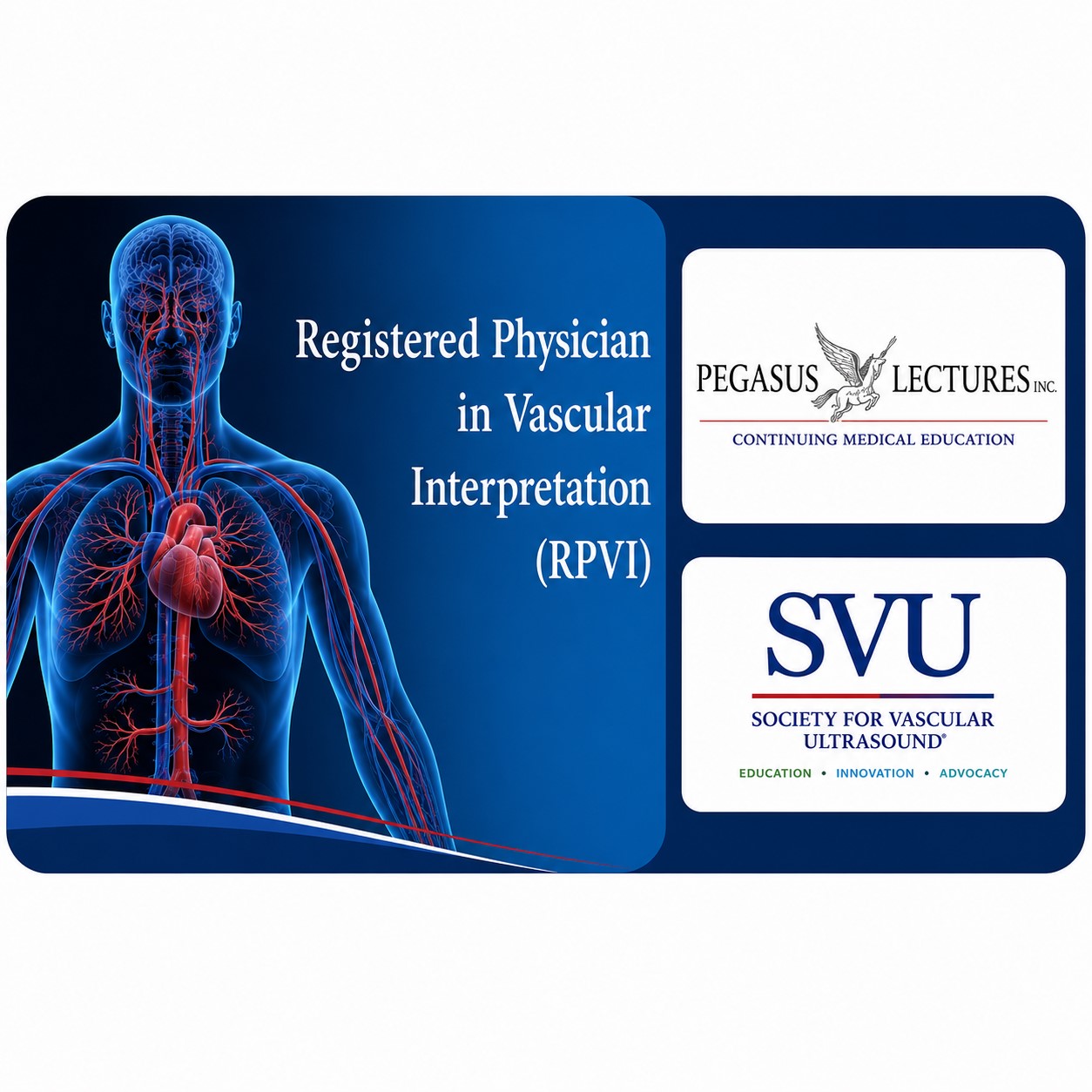
Pegasus Registered Physician in Vascular Interpretation RPVI (RPVI Complete Review) (Videos)
Original price was: $998.00.$30.00Current price is: $30.00.
This Product is shared via google drive download link, So please share your correct Gmail id while placing the order .Please note that there are no CME points or certificate associated with this course Samples for Courses Can be found here : Free Samples Here!
Format: 24 MP4 files
Pegasus Registered Physician in Vascular Interpretation (RPVI) Complete Review (Videos)
Comprehensive RPVI Board Review for Vascular Ultrasound Interpretation & Certification Preparation
The Pegasus Registered Physician in Vascular Interpretation (RPVI) Complete Review eCourse is a comprehensive board preparation program designed to help physicians and vascular specialists prepare for the RPVI (Registered Physician in Vascular Interpretation) certification examination. Developed through a collaboration between the Society for Vascular Surgery (SVS), Society for Vascular Ultrasound (SVU), and Pegasus Lectures, this course provides an in-depth review of vascular ultrasound physics, diagnostic principles, hemodynamics, and interpretation of vascular imaging studies.
The curriculum consists of 24 expert-led modules, including 10 Vascular Physics Review modules and 14 Vascular Specialty Review modules, covering the full spectrum of topics tested on the RPVI examination. Through focused lectures, case-based discussions, image interpretation exercises, and test-taking strategies, participants develop the knowledge and confidence needed to successfully interpret vascular studies and achieve RPVI certification.
This program is valuable for physicians involved in vascular imaging, vascular surgery, cardiology, radiology, vascular medicine, and noninvasive vascular laboratory practice.
Product Details
Course: Pegasus RPVI Complete Review eCourse
Certification Focus: Registered Physician in Vascular Interpretation (RPVI)
Format: Video Lectures
Includes:
- 24 Video Modules
- Vascular Physics Review
- Vascular Specialty Review
- Examination Preparation Content
Delivery: Online / On-Demand
Language: English
Course Overview
The RPVI credential is recognized as a leading certification demonstrating expertise in the interpretation of noninvasive vascular imaging studies. Successful candidates must possess a strong understanding of ultrasound physics, Doppler principles, vascular hemodynamics, diagnostic criteria, and vascular pathology.
The RPVI Complete Review eCourse provides comprehensive preparation in:
- Ultrasound physics
- Doppler technology
- Hemodynamics
- Vascular anatomy
- Cerebrovascular disease
- Peripheral arterial disease
- Venous disease
- Visceral vascular imaging
- Dialysis access evaluation
- Endovascular graft surveillance
- Vascular laboratory interpretation
- Examination strategies
The course emphasizes both theoretical knowledge and practical interpretation skills essential for clinical practice and certification success.
Learning Objectives
Upon completion of this course, participants should be able to:
- Understand the principles of ultrasound physics and instrumentation.
- Apply Doppler and color Doppler technologies in vascular imaging.
- Interpret vascular hemodynamic data accurately.
- Identify common vascular pathologies using duplex ultrasound.
- Evaluate extracranial and intracranial cerebrovascular disease.
- Assess peripheral arterial and venous disorders.
- Interpret visceral vascular and transplant ultrasound examinations.
- Evaluate dialysis access and vascular graft surveillance studies.
- Recognize imaging artifacts and technical limitations.
- Develop effective examination and test-taking strategies for RPVI certification.
Course Curriculum
🔬 RPVI Vascular Physics Review
Module 1 – Exam Overview & Mathematics
- RPVI exam structure
- Basic calculations
- Physics fundamentals
Module 2 – Waves & Attenuation
- Sound wave properties
- Attenuation principles
- Image optimization
Module 3 – Creating Scans & Transducers
- Transducer technology
- Image formation
- Scan acquisition techniques
Module 4 – System Operation
- Ultrasound machine controls
- Instrument optimization
- Quality assurance
Module 5 – Doppler
- Doppler physics
- Spectral Doppler analysis
- Velocity measurements
Module 6 – Color Doppler
- Color flow imaging
- Flow characterization
- Clinical applications
Module 7 – Hemodynamics
- Blood flow physiology
- Pressure-flow relationships
- Vascular resistance
Module 8 – Artifacts
- Recognition of artifacts
- Common imaging pitfalls
- Quality improvement strategies
Module 9 – Q&A, Bioeffects & Test Validation
- Ultrasound safety
- Bioeffects
- Validation principles
Module 10 – Test-Taking Strategies
- Examination preparation
- High-yield review concepts
- Question-solving techniques
❤️ RPVI Vascular Specialty Review
Module 1 – Extracranial Cerebrovascular Disease & Cases
- Carotid artery disease
- Vertebral artery evaluation
- Case interpretation
Module 2 – Intracranial Vascular Imaging
- Transcranial Doppler
- Intracranial circulation
- Clinical applications
Module 3 – Upper Extremity Arterial Disease & Cases
- Upper limb arterial anatomy
- Occlusive disease assessment
- Duplex interpretation
Module 4 – Lower Extremity Arterial Disease & Cases
- Peripheral arterial disease (PAD)
- Arterial duplex studies
- Clinical decision-making
Module 5 – Arterial Duplex & Cases
- Duplex criteria
- Arterial stenosis evaluation
- Case-based interpretation
Module 6 – Venous Ultrasound & Lower Extremity Venous Disease
- Deep vein thrombosis (DVT)
- Chronic venous insufficiency
- Venous duplex interpretation
Module 7 – Visceral Vascular Imaging & Cases
- Mesenteric circulation
- Renal artery disease
- Abdominal vascular evaluation
Module 8 – Hepatoportal Ultrasound
- Portal venous system
- Hepatic vascular imaging
- Doppler assessment
Module 9 – Liver & Kidney Transplant Imaging
- Transplant vascular surveillance
- Post-transplant complications
- Case reviews
Module 10 – Graft Surveillance
- Bypass graft monitoring
- Graft failure detection
- Follow-up protocols
Module 11 – Aorto-Iliac & Endograft Assessment
- Aortic aneurysm surveillance
- EVAR follow-up
- Endoleak detection
Module 12 – Hemodialysis Access
- Arteriovenous fistulas
- Graft evaluation
- Dialysis access complications
Module 13 – Quiz Time Part 1
- Comprehensive case review
- Practice questions
Module 14 – Quiz Time Part 2
- Advanced examination preparation
- High-yield RPVI review
Educational Features
🎥 Comprehensive Video Lectures
Expert-led instruction covering all RPVI examination domains.
🩺 Case-Based Learning
Real-world vascular ultrasound interpretation examples.
📊 Physics & Clinical Integration
Combines ultrasound fundamentals with practical clinical applications.
📚 Examination Preparation
Focused review and test-taking strategies for RPVI success.
Who Should Attend
This course is ideal for:
Physicians
- Vascular Surgeons
- Vascular Medicine Specialists
- Cardiologists
- Interventional Cardiologists
- Radiologists
- Interventional Radiologists
Trainees
- Vascular Surgery Fellows
- Cardiology Fellows
- Radiology Residents
- Vascular Medicine Fellows
Vascular Laboratory Professionals
- Physicians supervising vascular laboratories
- Clinicians pursuing RPVI certification
Why This Course Is Valuable
✔ Complete RPVI Certification Review
✔ Society for Vascular Surgery & SVU Educational Content
✔ Comprehensive Ultrasound Physics Review
✔ Doppler & Hemodynamics Training
✔ Cerebrovascular Imaging Interpretation
✔ Peripheral Arterial & Venous Disease Assessment
✔ Visceral & Transplant Ultrasound Evaluation
✔ Dialysis Access & Graft Surveillance
✔ Case-Based Learning
✔ Examination Preparation & Test-Taking Strategies
✔ Practical Vascular Laboratory Applications
✔ Board-Focused Curriculum
Clinical & Educational Value
The Pegasus RPVI Complete Review eCourse delivers a comprehensive review of vascular ultrasound interpretation and vascular laboratory medicine. Covering both the technical foundations of ultrasound and the clinical interpretation of vascular studies, this program provides an excellent resource for physicians preparing for RPVI certification and clinicians seeking advanced expertise in noninvasive vascular diagnostics.
Related products
Critical Care - Emergency medicine
Gulfcoast Ultrasound-Guided Upper Extremity Nerve Blocks for Emergency Medicine

Anesthesiology & pain medicine
GULFCOAST Introduction to Ultrasound-Guided Regional Anesthesia 2019

Hematology / Oncology
2023 Psychopharmacology in Cancer Care: An Update for Clinicians of All Disciplines
Cardiology