
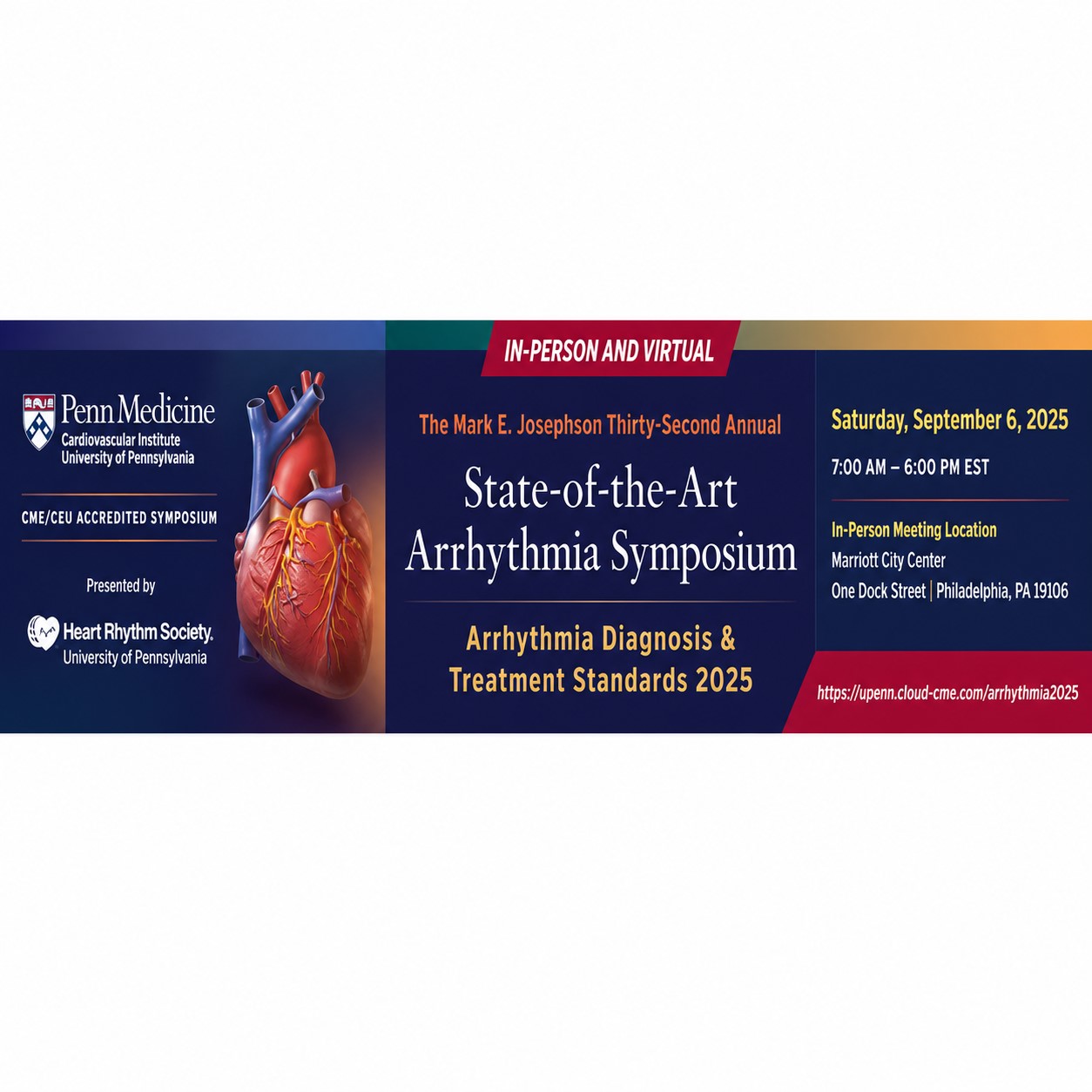
Penn Medicine The Mark E. Josephson Thirty-Second Annual State-of-the -Art Arrhythmia Symposium 2025

Original price was: $90.00.$25.00Current price is: $25.00.
This Product is shared via google drive download link, So please share your correct Gmail id while placing the order .Please note that there are no CME points or certificate associated with this course Samples for Courses Can be found here : Free Samples Here!
Penn Medicine The Mark E. Josephson 32nd Annual State-of-the-Art Arrhythmia Symposium 2025
Advanced Cardiac Electrophysiology, Arrhythmia Management & Contemporary EP Technologies
Penn Medicine The Mark E. Josephson Thirty-Second Annual State-of-the-Art Arrhythmia Symposium 2025 is one of the premier electrophysiology educational conferences dedicated to the diagnosis, evaluation, and treatment of cardiac rhythm disorders. Hosted by the internationally renowned Electrophysiology Program at Penn Medicine, this annual symposium brings together leading experts in cardiac electrophysiology to provide cutting-edge updates on arrhythmia management, catheter ablation, device therapy, ECG interpretation, and emerging EP technologies.
Featuring 30 videos + 32 PDFs (5.98 GB), the symposium combines expert lectures, interactive case presentations, audience participation, panel discussions, debates, and specialized breakout sessions designed for electrophysiologists, cardiologists, fellows, nurses, and allied professionals involved in cardiac rhythm management.
Held on September 6, 2025, at the Philadelphia Marriott Old City, the program includes keynote lectures from internationally recognized electrophysiology leaders, advanced discussions on atrial and ventricular arrhythmias, pulsed field ablation (PFA), leadless devices, genetic arrhythmia syndromes, ambulatory monitoring, and contemporary heart failure device therapies.
Course Overview
Now in its 32nd year, the Mark E. Josephson Arrhythmia Symposium continues its tradition of delivering state-of-the-art education in clinical cardiac electrophysiology. The course focuses on both invasive and non-invasive electrophysiologic tools used in the management of complex rhythm disorders, emphasizing practical clinical applications and evidence-based decision-making.
The symposium is structured with a combined morning session followed by dedicated afternoon breakout tracks for:
- Advanced Electrophysiology
- General Cardiology
- Associated Professionals
This format allows attendees to tailor their educational experience according to their clinical interests and professional roles.
Learning Objectives
After completing this activity, participants will be able to:
- Evaluate patients with frequent PVCs and NSVT.
- Identify indications for antiarrhythmic therapy and catheter ablation.
- Recognize ECG findings associated with sudden cardiac death risk.
- Apply contemporary strategies for atrial fibrillation diagnosis and management.
- Understand indications for leadless pacemakers and defibrillator systems.
- Evaluate candidates for left atrial appendage occlusion and closure.
- Utilize modern catheter ablation technologies and techniques.
- Recognize emerging tools used in complex electrophysiology procedures.
- Diagnose and manage inherited arrhythmia syndromes.
- Incorporate ambulatory monitoring into arrhythmia management.
- Apply advances in cardiac contractility modulation and conduction system pacing.
- Optimize post-procedural pain management while minimizing opioid use.
Major Topics Covered
Premature Ventricular Complexes (PVCs) & Ventricular Arrhythmias
- Evaluation of asymptomatic and symptomatic PVCs
- NSVT management
- PVC-induced cardiomyopathy
- PVC mapping strategies
- Catheter ablation techniques
- Parahisian PVC ablation
- Short-coupled PVCs triggering ventricular fibrillation
Atrial Fibrillation & Atrial Arrhythmias
- Screening and detection strategies
- AF burden assessment
- Ablation indications and endpoints
- Pulsed Field Ablation (PFA)
- Anticoagulation management
- Left atrial appendage closure
- Contemporary AF treatment algorithms
Advanced Catheter Ablation
- VT substrate identification
- Complex ablation techniques
- Epicardial access strategies
- Alcohol venous ablation
- Cardioneural ablation
- Congenital heart disease arrhythmia ablation
- Entrainment and pacing maneuvers
ECG Interpretation & Sudden Death Prevention
- High-risk ECG patterns
- Genetic arrhythmia syndromes
- Sudden cardiac death risk stratification
- Advanced electrocardiographic diagnosis
- Mark E. Josephson ECG methodology
Cardiac Devices & Pacing
- Leadless pacemakers
- Leadless defibrillator systems
- Conduction system pacing
- Cardiac resynchronization therapy (CRT)
- Device troubleshooting
- ICD management
- Cardiac contractility modulation (CCM)
Ambulatory Monitoring
- Long-term rhythm monitoring
- Screening strategies
- Clinical decision making
- Remote monitoring technologies
Heart Failure & Electrophysiology
- Device therapy for systolic dysfunction
- Advanced pacing strategies
- Electrophysiology considerations in heart failure
- Reversibility of LV dysfunction
Emerging Technologies
- Pulsed Field Ablation (PFA)
- Advanced mapping systems
- Novel EP technologies
- Translational electrophysiology research
- Future arrhythmia therapies
Keynote Lectures
Mark E. Josephson Keynote ECG Lecture
How to Identify Critical Substrate and Best Ablate VT
Wendy S. Tzou, MD
Leonard N. Horowitz Memorial Lecture
Understanding Catheter Ablation Energy Delivery to Improve Patient Outcomes
William Sauer, MD
Who Should Attend?
This course is ideal for:
- Electrophysiologists
- Cardiologists
- Interventional Cardiologists
- Internal Medicine Physicians
- Cardiology Fellows
- EP Fellows
- EP Laboratory Staff
- Cardiac Device Specialists
- Nurse Practitioners
- Physician Assistants
- Cardiac Nurses
- Allied Health Professionals involved in arrhythmia care
Why This Course Stands Out
✔ Penn Medicine’s flagship electrophysiology symposium
✔ 32 years of world-renowned arrhythmia education
✔ Advanced electrophysiology and ablation training
✔ Expert-led ECG interpretation sessions
✔ Comprehensive atrial fibrillation updates
✔ Pulsed Field Ablation (PFA) education
✔ Leadless pacing and device therapy updates
✔ Interactive case-based learning
✔ Dedicated EP, Cardiology, and Allied Professional tracks
✔ Internationally recognized keynote speakers
✔ Practical clinical applications and audience participation
Related products
Anesthesiology & pain medicine
Critical Care Symposium: Mastering ED Mechanical Ventilation

Medical Accounts

Internal Medicine

Medical Accounts
Critical Care - Emergency medicine
2022 UPDATES IN THERAPEUTICS: CRITICAL CARE PHARMACY PREPARATORY REVIEW AND RECERTIFICATION COURSE

Critical Care - Emergency medicine

Critical Care - Emergency medicine
ASN Critical Care Nephrology – 2022 Update (On-Demand and Livestream)
Internal Medicine