
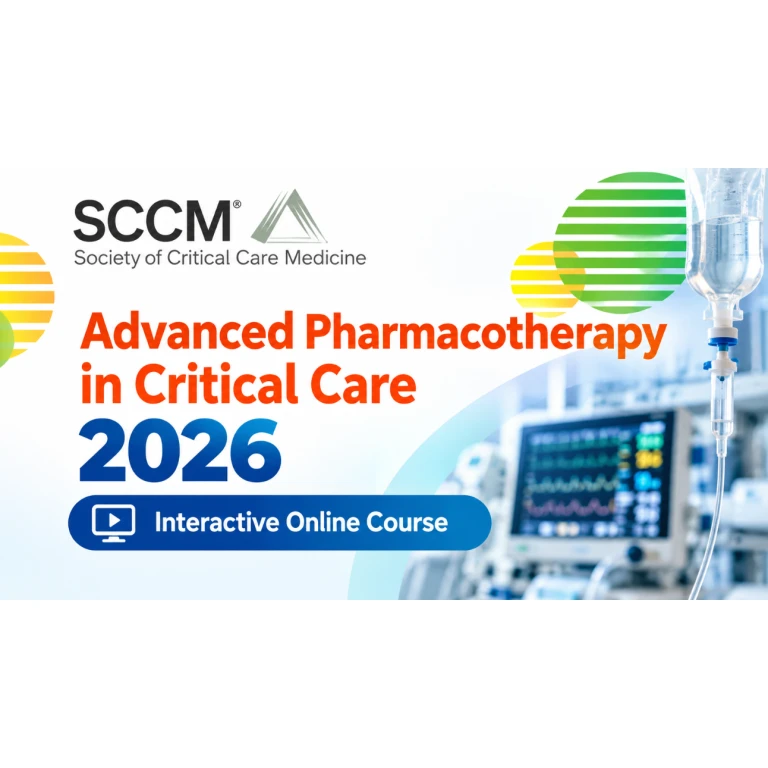
SCCM Advanced Pharmacotherapy in Critical Care 2026 – Interactive Online Course
$70.00
Study ICU medication management through cases, reading, interactive activities and selected audiovisual content. Topics include vasopressors, toxicology, renal dosing, stewardship and medication safety. This independent browser-based course requires internet access and is not a downloadable video or audio package; the delivery notice does not change that online learning format.
Delivery Information: This Product is shared via google drive download link. Please use your correct Gmail address at checkout.
Please note: there are no CME points or certificate associated with this course.
Samples for Courses Can be found here: Free Samples Here!
Advanced Pharmacotherapy in Critical Care examines medication decisions in patients with unstable physiology and complex organ dysfunction. The course addresses vasopressor selection, toxicological emergencies, renal dose adjustment, medication safety and individualized treatment planning. Its case-based approach connects pharmacological principles with evidence assessment, stewardship and practical decisions in the intensive care unit. The material is intended for critical care pharmacists, physicians and other clinicians involved in ICU medication management, and may support review of topics relevant to the BCCCP examination. The subject outline below preserves the listing’s educational topics; these are editorial groupings rather than independently verified official lesson titles.
Format and Access
This listing describes an independent, account-based browser course in English. It combines clinical cases, lecture-based material, structured reading, interactive activities, illustrations and selected short videos and audio. An internet connection and compatible browser are required on desktop, laptop, tablet or smartphone; no separate software installation is needed. Offline access, a complete downloadable MP4 course and a complete audio package are not included. Review the sample and access conditions before purchasing.
The SCCM activity was released August 10, 2026 (ADVPHARM26ON), with an estimated completion time of 14.25 hours. Its accreditation and August 10, 2029 ACE expiration belong to the original provider activity. Independent access is not an official SCCM subscription. BCCCP relevance does not include BPS registration, examination fees or certification.
Official SCCM Learning Objectives
After completing the accredited educational activity, participants should be better able to:
- Apply evidence-based pharmacotherapy principles to optimize medication treatment for critically ill patients with complex hemodynamic, neurological, renal, hepatic, and toxicological conditions.
- Evaluate clinical evidence, guideline recommendations, and emerging treatment approaches to support medication-related decisions in high-risk intensive care scenarios.
- Develop individualized pharmacotherapeutic plans incorporating medication safety, stewardship principles, and appropriate risk-benefit assessment.
- Identify opportunities to use clinical protocols, decision-support tools, and quality improvement strategies to improve medication use in critical care.
Subject Outline
The following groups organize the listed educational topics; they do not establish an official lecture-by-lecture agenda.
Module I – Vasopressors and Hemodynamic Pharmacotherapy
- Vasopressor Pharmacology
- Adrenergic Receptors
- Norepinephrine
- Epinephrine
- Vasopressin
- Phenylephrine
- Dopamine
- Hemodynamic Monitoring
- Medication Selection
- Drug Titration
- Adverse Effects
- Patient-Specific Response
- Medication Safety
Module II – Toxicology and Medication-Related Critical Care Emergencies
- Clinical Toxicology
- Drug Overdose
- Toxic Medication Exposure
- Pharmacokinetics
- Pharmacodynamics
- Antidote Principles
- Toxicity Recognition
- Supportive Management
- Medication Interactions
- Adverse Drug Reactions
- Clinical Monitoring
- Patient Safety
Module III – Renal Dosing and Medication Adjustment
- Acute Kidney Injury
- Chronic Kidney Disease
- Renal Drug Clearance
- Pharmacokinetic Changes
- Renal Dose Adjustment
- Drug Accumulation
- Medication Toxicity
- Therapeutic Monitoring
- Renal Function Assessment
- Individualized Dosing
- Medication Safety
Module IV – Advanced Pharmacotherapy in Critically Ill Patients
- ICU Pharmacotherapy
- Clinical Pharmacology
- Medication Selection
- Drug Interactions
- Pharmacokinetic Changes
- Pharmacodynamic Response
- Medication Monitoring
- Treatment Safety
- Guideline Integration
- Individualized Therapy
- Critical Illness-Related Organ Dysfunction
Module V – Clinical Cases and Pharmacotherapy Decision-Making
- Clinical Case Assessment
- Medication Review
- Pharmacotherapeutic Planning
- Risk-Benefit Analysis
- Critical Care Guidelines
- Treatment Monitoring
- Medication-Related Problems
- Clinical Reasoning
- Patient-Centered Care
- Multidisciplinary Collaboration
Module VI – Medication Safety, Stewardship and Quality Improvement
- Medication Safety
- High-Risk Medications
- Adverse Drug Event Prevention
- Medication Reconciliation
- Stewardship Principles
- Clinical Decision Support
- Standardized Protocols
- Quality Improvement
- Interdisciplinary Communication
- Monitoring Strategies
Module VII – Pharmacotherapy in Hemodynamic, Neurologic, Renal, Hepatic and Toxicologic Conditions
- Hemodynamic Instability
- Neurological Critical Illness
- Kidney Dysfunction
- Hepatic Dysfunction
- Toxicologic Emergencies
- Clinical Pharmacokinetics
- Drug Safety
- Therapeutic Monitoring
- Individualized Treatment Planning
Related products
Critical Care - Emergency medicine
Critical Care - Emergency medicine
Medical Accounts
Critical Care - Emergency medicine
ASN Critical Care Nephrology – 2022 Update (On-Demand and Livestream)

Medical Accounts
Internal Medicine
Cardiology
Critical Care - Emergency medicine