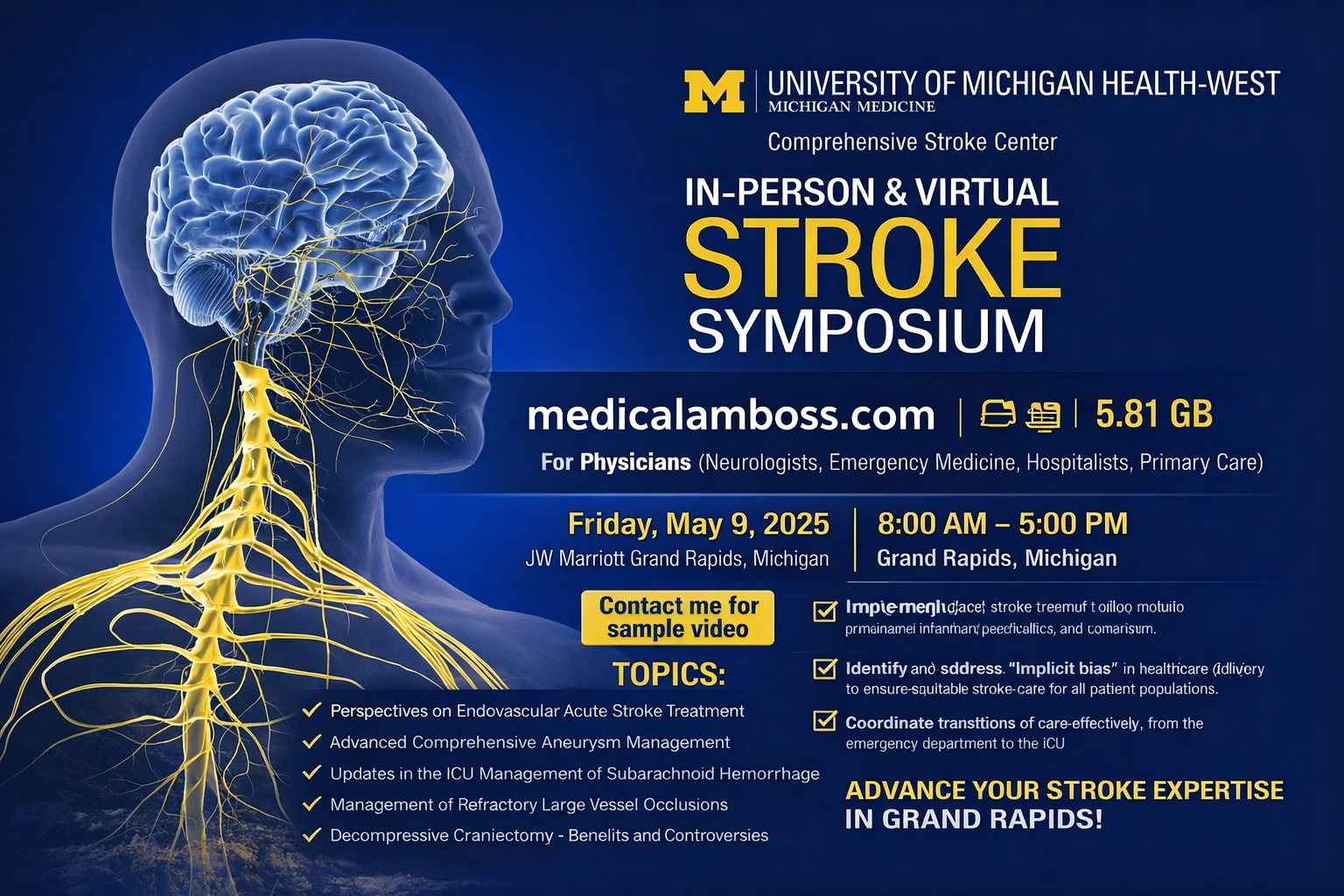
Michigan Medicine UMHW Stroke Symposium 2025
Comprehensive Stroke Care Update: Acute Management, Neurointervention, Rehabilitation & Secondary Prevention
The Michigan Medicine UMHW Stroke Symposium 2025 is a multidisciplinary educational program focused on the complete continuum of stroke care, from pre-hospital assessment and emergency intervention to rehabilitation and long-term prevention. Hosted by the University of Michigan Health-West, this symposium brings together experts from neurology, emergency medicine, neuro-interventional radiology, nursing, rehabilitation, and primary care to deliver practical, evidence-based updates that improve outcomes for patients with cerebrovascular disease.
The program emphasizes a modern systems-of-care approach, demonstrating how coordinated collaboration between EMS personnel, emergency departments, stroke centers, intensive care units, rehabilitation teams, and outpatient providers can optimize stroke treatment and recovery. Participants will review the latest advancements in acute ischemic stroke management, mechanical thrombectomy, neuro-interventional procedures, rehabilitation strategies, health equity initiatives, and secondary prevention.
Through expert-led presentations, multidisciplinary discussions, and case-based learning, attendees gain actionable knowledge that can be immediately implemented in clinical practice.
Product Details
- Format: 10 Videos + 10 Audios + 10 Subtitle Files (.VTT) + 10 PDFs
- Total Size: 5.81 GB
- Course Date: May 9, 2025
- Location: JW Marriott Grand Rapids, Grand Rapids, Michigan
- Organizer: University of Michigan Health-West (UMHW)
- Access: On-Demand
Program Overview
This symposium delivers practical updates covering every phase of stroke care.
Key areas of focus include:
- Acute ischemic stroke
- Mechanical thrombectomy
- Thrombolytic therapy
- Neuro-interventional radiology
- Emergency stroke management
- Critical care neurology
- Stroke rehabilitation
- Health equity in stroke care
- Secondary stroke prevention
- Hypertension management
- Lipid management
- Multidisciplinary stroke systems of care
Participants gain a comprehensive understanding of modern stroke treatment pathways and evidence-based patient management.
Learning Objectives
Upon completion of this activity, participants will be able to:
- Implement updated protocols for acute stroke diagnosis and treatment.
- Evaluate current indications for thrombolytic therapy and mechanical thrombectomy.
- Integrate neuro-interventional advances into clinical stroke management.
- Improve transitions of care across the stroke treatment continuum.
- Recognize and address healthcare disparities affecting stroke outcomes.
- Apply evidence-based rehabilitation principles following stroke.
- Implement effective secondary stroke prevention strategies.
- Strengthen multidisciplinary collaboration within stroke systems of care.
Core Topics Covered
Acute Ischemic Stroke Management
The symposium reviews contemporary approaches to emergency stroke care.
Topics include:
- Stroke recognition
- Rapid triage systems
- Acute neurological assessment
- Thrombolytic therapy
- Treatment timing optimization
- Evidence-based protocols
Participants learn strategies for improving treatment speed and patient outcomes.
Mechanical Thrombectomy
Dedicated sessions focus on:
- Patient selection
- Imaging criteria
- Procedural indications
- Large vessel occlusion management
- Outcomes data
- Expanding thrombectomy eligibility
Experts discuss evolving standards for endovascular stroke intervention.
Neuro-Interventional Radiology
The conference explores advances in:
- Endovascular stroke therapy
- Cerebral angiography
- Neurovascular imaging
- Catheter-based interventions
- Community hospital integration
Participants gain insight into modern neuro-interventional techniques and applications.
Stroke Systems of Care
A major emphasis of the symposium is multidisciplinary coordination.
Topics include:
- EMS activation protocols
- Stroke center networks
- Interfacility transfers
- Hospital workflow optimization
- Team communication
- Quality improvement initiatives
Faculty highlight strategies that improve efficiency across the care continuum.
Critical Care & Inpatient Stroke Management
Sessions address:
- Neurocritical care principles
- ICU management
- Hemodynamic optimization
- Monitoring and complication prevention
- Post-procedure care
Practical recommendations are provided for managing complex stroke patients.
Stroke Rehabilitation
Participants review evidence-based rehabilitation strategies, including:
- Physical therapy
- Occupational therapy
- Speech-language pathology
- Functional recovery optimization
- Multidisciplinary rehabilitation planning
Experts discuss approaches that improve long-term patient outcomes.
Health Equity & Implicit Bias
The symposium highlights the importance of equitable stroke care.
Topics include:
- Healthcare disparities
- Social determinants of health
- Implicit bias recognition
- Access to care
- Community outreach initiatives
Participants learn methods to reduce disparities and improve patient-centered care.
Secondary Stroke Prevention
Comprehensive sessions review:
- Hypertension management
- Lipid optimization
- Antithrombotic therapy
- Diabetes control
- Lifestyle modification
- Smoking cessation strategies
Faculty discuss evidence-based interventions to reduce recurrent stroke risk.
Transitions of Care
The course examines best practices for:
- Emergency department to ICU transitions
- Acute care to rehabilitation transfers
- Outpatient follow-up planning
- Patient education
- Care coordination
Participants gain practical tools for improving continuity of care.
Educational Features
✔ Comprehensive Stroke Care Review
✔ Acute Ischemic Stroke Updates
✔ Mechanical Thrombectomy Education
✔ Neuro-Interventional Radiology Advances
✔ Rehabilitation & Recovery Strategies
✔ Health Equity & Bias Awareness
✔ Secondary Prevention Updates
✔ Multidisciplinary Systems-of-Care Approach
Target Audience
This course is ideal for:
- Neurologists
- Stroke Specialists
- Emergency Medicine Physicians
- Hospitalists
- Primary Care Physicians
- Neurosurgeons
- Neuro-Interventional Specialists
- Nurse Practitioners
- Physician Assistants
- Stroke Coordinators
- Critical Care Nurses
- Rehabilitation Specialists
- EMS Personnel
- Physical Therapists
- Occupational Therapists
- Speech-Language Pathologists
- Social Workers
- Case Managers
Why This Course Stands Out
✔ Covers the full stroke care continuum
✔ Strong emphasis on multidisciplinary collaboration
✔ Reviews the latest thrombectomy and thrombolytic evidence
✔ Includes rehabilitation and long-term recovery strategies
✔ Addresses healthcare disparities and equitable care
✔ Practical guidance for community and academic providers
✔ Focuses on real-world stroke systems implementation
✔ Led by University of Michigan Health-West experts
Clinical & Educational Value
The Michigan Medicine UMHW Stroke Symposium 2025 provides a comprehensive review of modern stroke care, combining advances in acute intervention, neuro-interventional radiology, rehabilitation, prevention, and healthcare systems improvement. Through multidisciplinary education and evidence-based updates, participants gain the skills and knowledge necessary to improve outcomes across the entire stroke care pathway.
+ Topics:
- Perspectives on Endovascular Acute Stroke Treatment – The Past, Present and Future
- Advanced Comprehensive Aneurysm Management
- Updates in the ICU Management of Subarachnoid Hemorrhage
- Updates on the Acute Management of Intracerebral Hemorrhage
- Management of Refractory Large Vessel Occlusions
- Decompressive Craniectomy – Benefits and Controversies
- Management of Acute Carotid and Vertebral Artery Dissection
- Advances in Rehabilitation of Acute Ischemic Stroke
- Management of Symptomatic Intracranial Arterial Stenosis
- Management and Endovascular Treatment of Venous Sinus Stenosis