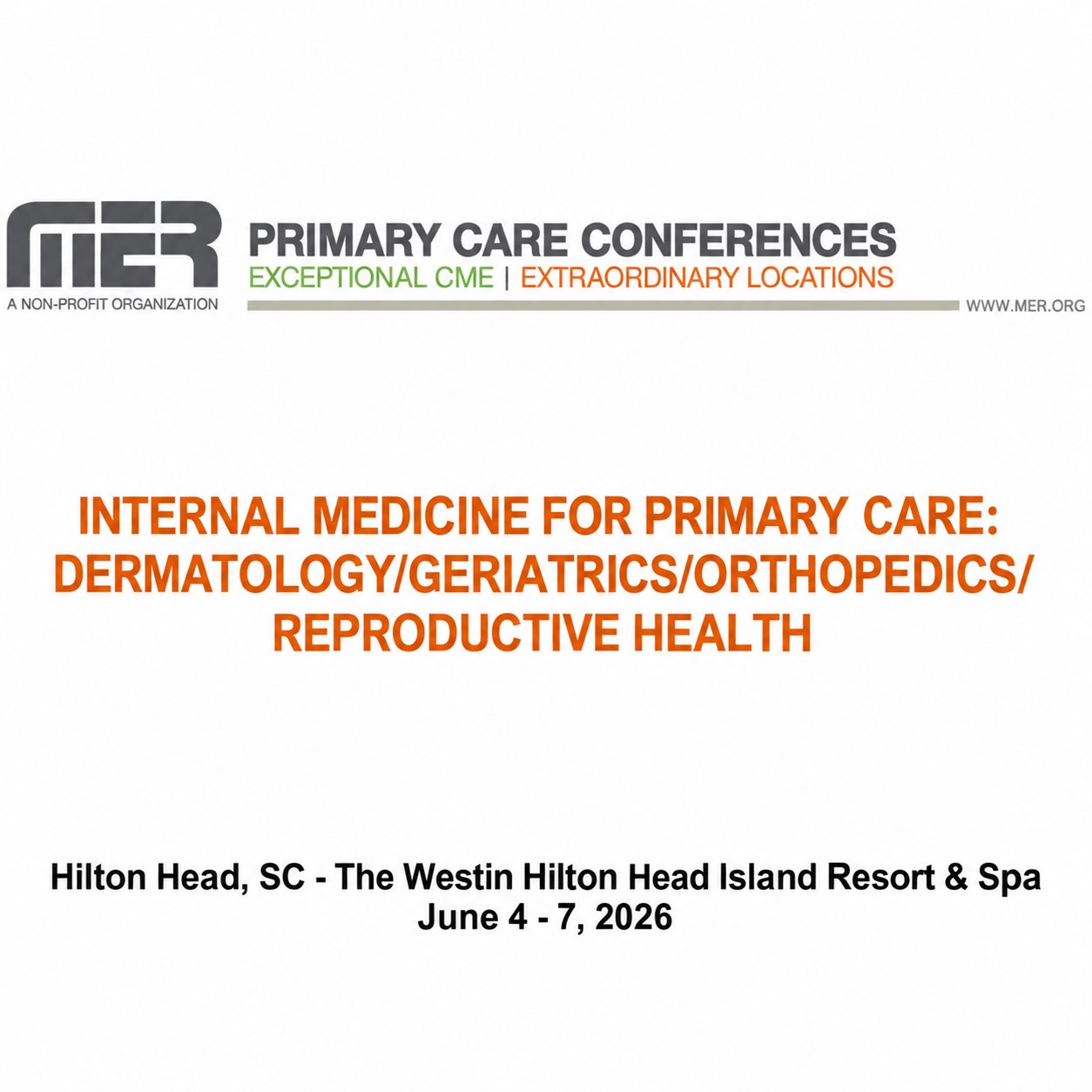
MER Primary Care Conferences Internal Medicine for Primary Care Derm Geri Ortho Reproductive Jun 04-07, 2026

$120.00
This Product is shared via google drive download link, So please share your correct Gmail id while placing the order .Please note that there are no CME points or certificate associated with this course Samples for Courses Can be found here : Free Samples Here!
MER Internal Medicine for Primary Care: Dermatology, Geriatrics, Orthopedics & Reproductive Health 2026 (Videos)
Comprehensive Primary Care CME | Dermatology, Geriatrics, Orthopedics & Reproductive Health
Stay current with practical, evidence-based approaches to common conditions encountered in primary care with MER Internal Medicine for Primary Care: Dermatology/Geriatrics/Orthopedics/Reproductive Health 2026.
Organized by Medical Education Resources (MER), this comprehensive continuing medical education program provides clinically relevant updates across dermatology, geriatrics, orthopedics, reproductive health, urinary symptoms, cognitive disorders, skin cancer, contraception, pregnancy, and lactation.
The conference will take place from June 4–7, 2026, at The Westin Hilton Head Island Resort & Spa in Hilton Head, South Carolina.
Product Details
- Course: Internal Medicine for Primary Care: Dermatology/Geriatrics/Orthopedics/Reproductive Health
- Provider: Medical Education Resources (MER)
- Conference Dates: June 4–7, 2026
- Location: Hilton Head, South Carolina
- Venue: The Westin Hilton Head Island Resort & Spa
- Format: Educational Videos
- Language: English
- Educational Focus: Primary Care & Internal Medicine
- Learning Format: Expert Lectures, Discussion & Case-Based Learning
Course Overview
Primary care clinicians routinely encounter patients with dermatologic conditions, geriatric health concerns, musculoskeletal complaints, urinary symptoms, cognitive disorders, and reproductive health questions.
The MER Internal Medicine for Primary Care 2026 program provides a multidisciplinary review designed to strengthen clinical assessment, diagnosis, treatment planning, and patient counseling across these important areas.
The curriculum combines practical updates in dermatology, geriatrics, orthopedics, and reproductive health, with additional focus on skin cancer, dementia, Alzheimer’s disease, urinary symptoms, contraception, preconception care, pregnancy, lactation, and medication safety.
What You’ll Learn
Participants will strengthen their knowledge of:
- Atopic dermatitis
- Contact dermatitis
- Irritant dermatitis
- Allergic dermatitis
- Nummular dermatitis
- Papulosquamous diseases
- Benign skin tumors
- Malignant skin tumors
- Precancerous skin lesions
- Cancerous skin lesions
- Geriatric assessment
- Cardiovascular disease risk in older adults
- Lower urinary tract symptoms (LUTS)
- Urinary incontinence
- Cognitive impairment
- Dementias
- Alzheimer’s disease
- Knee anatomy and function
- Foot and ankle injuries
- Foot and ankle pain syndromes
- Shoulder injuries
- Wrist injuries
- Hand injuries
- Finger injuries
- Contraceptive counseling
- Complex contraceptive options
- Preconception care
- Pregnancy medication safety
- Lactation medication safety
- Depression during pregnancy
Comprehensive Course Topics
Dermatology
Develop a practical approach to common dermatologic conditions encountered in primary care.
Topics include:
- Atopic dermatitis
- Contact dermatitis
- Irritant dermatitis
- Allergic dermatitis
- Nummular dermatitis
- Papulosquamous diseases
- Benign skin tumors
- Malignant skin tumors
- Precancerous skin lesions
- Cancerous skin lesions
- Appropriate interoffice dermatologic procedures
Dermatitis
Review the clinical presentations and causes of several common forms of dermatitis.
Participants will strengthen their ability to differentiate:
- Atopic dermatitis
- Irritant contact dermatitis
- Allergic contact dermatitis
- Nummular dermatitis
Understanding differences in presentation and etiology can support more appropriate diagnosis and treatment planning in primary care.
Papulosquamous Diseases
Review diagnostic principles and treatment options for papulosquamous diseases presenting with red, raised bumps.
The program focuses on distinguishing these conditions and selecting appropriate treatment approaches.
Skin Tumors & Skin Cancer
Develop a structured approach to evaluating skin tumors.
Topics include:
- Benign skin tumors
- Malignant skin tumors
- Precancerous skin lesions
- Cancerous skin lesions
- Differentiation of benign and malignant lesions
- Appropriate interoffice procedures
- Detection of suspicious skin findings
Geriatrics
The program provides a practical review of important issues encountered in older adults.
Topics include:
- Comprehensive geriatric assessment
- Cardiovascular disease risk
- Lower urinary tract symptoms
- Urinary incontinence
- Cognitive impairment
- Dementias
- Alzheimer’s disease
Comprehensive Geriatric Assessment
Learn how a comprehensive geriatric assessment can help identify potential health issues in elderly patients.
The program emphasizes recognizing problems that may otherwise be overlooked during routine primary care visits.
Cardiovascular Risk in Older Adults
Review approaches to recognizing and screening elderly patients for cardiovascular disease (CVD) risk factors.
Lower Urinary Tract Symptoms & Urinary Incontinence
Review common lower urinary tract symptoms (LUTS) that may progress to urinary incontinence.
Participants will learn to:
- Recognize common LUTS
- Identify symptoms that may progress to urinary incontinence
- Initiate appropriate treatment options
- Incorporate urinary health into comprehensive geriatric care
Cognitive Disorders & Alzheimer’s Disease
The course addresses common cognitive disorders encountered in older adults.
Topics include:
- Cognitive impairment
- Dementias
- Alzheimer’s disease
- Diagnosis
- Treatment approaches
Participants will strengthen their ability to recognize and manage cognitive disorders in the primary care setting.
Orthopedics & Musculoskeletal Medicine
Review common orthopedic conditions and injuries encountered in primary care.
Topics include:
- Knee anatomy and function
- Foot injuries
- Ankle injuries
- Foot and ankle pain syndromes
- Shoulder injuries
- Wrist injuries
- Hand injuries
- Finger injuries
Knee Disorders
Review the anatomy and function of the knee joint as a foundation for evaluating common musculoskeletal complaints.
Foot & Ankle Conditions
Strengthen recognition of:
- Chronic foot injuries
- Chronic ankle injuries
- Foot pain syndromes
- Ankle pain syndromes
Upper Extremity Injuries
Review approaches to common injuries involving:
- Shoulder
- Wrist
- Hand
- Fingers
Reproductive Health
The reproductive health component provides practical education for clinicians managing contraception, preconception care, pregnancy, lactation, and mental health during pregnancy.
Topics include:
- Contraceptive counseling
- Complex contraceptive decisions
- Preconception interventions
- Medication safety during pregnancy
- Medication safety during lactation
- Depression during pregnancy
- Pharmacologic treatment options for major depression during pregnancy
Contraceptive Counseling
Develop strategies for discussing complex contraceptive options with patients.
The program emphasizes patient-centered counseling and consideration of available contraceptive choices.
Preconception Care
Identify interventions that may be implemented before conception to help enhance pregnancy outcomes.
Medication Use During Pregnancy & Lactation
Review commonly used medications that may potentially cause complications during:
- Pregnancy
- Lactation
This content can help clinicians recognize medication-related considerations when caring for women who are pregnant or breastfeeding.
Depression During Pregnancy
Review the advantages and disadvantages of available pharmacologic treatment options for major depression during pregnancy.
The program emphasizes consideration of treatment options within the context of pregnancy.
Learning Objectives
Upon completion of this program, participants should be better able to:
- Differentiate between the presentations and causes of atopic, contact (irritant and allergic), and nummular dermatitis.
- Discriminate the diagnostic principles and treatment options for papulosquamous diseases presenting with red, raised bumps.
- Differentiate benign and malignant skin tumors and employ appropriate interoffice procedures.
- Detect precancerous and cancerous skin lesions.
- Utilize a comprehensive geriatric assessment to identify potential issues in elderly patients.
- Recognize and screen elderly patients for cardiovascular disease risk factors.
- Review common lower urinary tract symptoms (LUTS) that may progress to urinary incontinence and initiate treatment options.
- Diagnose and treat cognitive impairment, dementias, and Alzheimer’s disease.
- Describe the anatomy and function of the knee joint.
- Recognize chronic injuries and pain syndromes affecting the foot and ankle.
- Diagnose and treat shoulder injuries.
- Diagnose and treat wrist, hand, and finger injuries.
- Describe strategies for discussing complex contraceptive options with patients.
- Identify preconception interventions that can enhance pregnancy outcomes.
- List commonly used medications that could potentially cause complications during pregnancy and lactation.
- Describe the advantages and disadvantages of available pharmacologic treatment options for major depression during pregnancy.
Educational Highlights
- Primary Care Medicine
- Internal Medicine
- Dermatology
- Geriatrics
- Orthopedics
- Reproductive Health
- Atopic Dermatitis
- Contact Dermatitis
- Nummular Dermatitis
- Papulosquamous Diseases
- Skin Cancer
- Skin Tumors
- Geriatric Assessment
- Cardiovascular Risk
- Cognitive Impairment
- Dementia
- Alzheimer’s Disease
- Lower Urinary Tract Symptoms
- Urinary Incontinence
- Knee Disorders
- Foot & Ankle Conditions
- Shoulder Injuries
- Wrist & Hand Injuries
- Contraceptive Counseling
- Preconception Care
- Pregnancy
- Lactation
- Depression During Pregnancy
- Continuing Medical Education (CME)
Why Choose This Course?
The MER Internal Medicine for Primary Care: Dermatology/Geriatrics/Orthopedics/Reproductive Health 2026 program provides a multidisciplinary review of several important clinical areas encountered in everyday primary care.
From dermatologic diagnosis and skin cancer recognition to geriatric assessment, orthopedic injuries, cognitive disorders, contraception, pregnancy, and medication safety, the program brings together practical clinical topics in one comprehensive educational activity.
The course is particularly valuable for clinicians seeking to strengthen their ability to recognize common conditions, make appropriate treatment decisions, and provide evidence-based primary care.
Target Audience
This educational activity is designed for office-based primary care providers and other healthcare professionals seeking updates in primary care medicine.
Best For
- Internists
- Primary Care Physicians
- Dermatologists
- Geriatric Physicians
- Orthopaedic Surgeons
- Reproductive Health Physicians
Also Relevant For
- Family Medicine Physicians
- Nurse Practitioners
- Physician Assistants
- Other Healthcare Professionals Providing Primary Care
Who Should Take This Course?
This program is particularly useful for clinicians who:
- Diagnose and manage common dermatologic conditions.
- Evaluate suspicious skin lesions and skin tumors.
- Care for elderly patients in primary care settings.
- Perform comprehensive geriatric assessments.
- Screen older adults for cardiovascular risk factors.
- Evaluate cognitive impairment and dementia.
- Manage Alzheimer’s disease.
- Evaluate lower urinary tract symptoms.
- Manage common orthopedic injuries.
- Evaluate knee, foot, ankle, shoulder, wrist, hand, and finger problems.
- Counsel patients regarding complex contraceptive options.
- Provide preconception care.
- Manage medication-related considerations during pregnancy and lactation.
- Treat major depression during pregnancy.
Course Benefits
By reviewing this program, learners can strengthen their approach to:
- Dermatologic diagnosis
- Skin tumor evaluation
- Skin cancer recognition
- Geriatric assessment
- Cardiovascular risk screening
- Cognitive disorder management
- Alzheimer’s disease
- LUTS and urinary incontinence
- Musculoskeletal assessment
- Orthopedic injury management
- Contraceptive counseling
- Preconception planning
- Pregnancy medication safety
- Lactation medication considerations
- Depression management during pregnancy
- Evidence-based primary care decision-making
4. Topics
Thursday, June 4, 2026
-
Dermatology – Dermatitis: Overview of the causes and forms of skin irritants; Contact, atopic, irritant, nummular, seborrheic and exfoliative; Treatment of blistering, oozing, crusting and flaking; Diagnostic principles and management strategies.
-
Dermatology – Papulosquamous Diseases: Diagnostic principles of skin lesions consisting of red or purple papules; Psoriasis, lichen planus, pityriasis rosea, lupus erythematosus; Discussion of how to tell one scaly rash from another.
-
Dermatology – Benign Skin Tumors: Proper diagnosis and treatment of common benign tumors; Biopsies and histopathologic examination; Nevi, seborrheic keratosis keloids, hemangiomas and miscellaneous tumors; When to refer.
-
Geriatrics – Approach to the Geriatric Patient: The demographics of aging and the physiologic changes in the elderly patient; Medication use in the elderly including changes in age-related pharmacokinetics and pharmacodynamics and medication adherence; Review of risky medications often used in elderly patients.
-
Geriatrics – Vascular Disorders in the Older Adult: Peripheral vascular disease; DVT/thromboembolic disease; abdominal aortic aneurysm and related disorders.
Friday, June 5, 2026
-
Geriatrics – Urological Disorders in the Older Adult: Review of two very common conditions seen in the elderly population: benign prostatic hyperplasia (BPH), and urinary incontinence; Pathogenesis, clinical symptoms, recommended evaluation and management options for BPH; Review of the anatomy and mechanism of normal urinary function, causes of incontinence, the evaluation and management.
-
Geriatrics – Alzheimer’s & Other Dementias: Review of normal age-related changes in cognitive function as well as disorders of memory and cognition as part of dementing illness; Mental status exams, including their limitations in evaluating memory; Various types of dementia and the importance of an accurate diagnosis; Current treatment options for various kinds of dementia; Potentially reversible dementias; The responsibilities of healthcare providers in managing patients with dementia.
-
Dermatology – Premalignant and Malignant Skin Tumors: Recognition of precursors of malignancies; Excisional and punch biopsies; Actinic keratosis, Bowen’s disease, squamous cell carcinoma, basal cell carcinoma, melanoma and other selected tumors; Risk reduction education.
-
Orthopedics – The Knee: Anatomy, Common Injuries, and Exam Techniques: ACL, meniscus, MRI; common sports injuries; osteoarthritis and hyaluronan; bursitis: prepatellar, pesanserine; baker’s cyst; joint injection/X-ray interpretation; pediatrics.
-
Orthopedics – Ankle and Foot: This presentation will address a series of common acute and chronic injuries and pain syndromes to the foot and ankle as they would present in the primary care setting. The focus will be on developing a working differential diagnosis based on the historical mechanism of injury and exam findings.
Saturday, June 6, 2026
-
Orthopedics – The Shoulder: Anatomy, Common Injuries, and Exam Techniques: Rotator cuff syndrome; impingement, frozen shoulder; subacromial bursitis; bicipital tendonitis; A-C joint disease.
-
Orthopedics – Wrist, Hand, and Fingers: Carpal tunnel, CMC arthritis thumb, ganglion cyst, trigger finger, de Quervains disease.
-
Reproductive Health – Contraception: A Primary Care Review of Best Practice: Coverage of the effectiveness, side effects and non-contraceptive benefits of available contraceptive options in the U.S.; Discussion of contraceptive counseling that is patient-centric including communicating without coercion; Management strategies for medically complex contraceptive decisions (patients with a history of VTE, breast cancer, hypertension).
-
Reproductive Health – Preconception Counseling: Screening and evaluation prior to a planned pregnancy; Optimization of medical conditions prior to pregnancy such as hypertension, diabetes, and obesity; When to refer for specialty consultation.
Sunday, June 7, 2026
-
Reproductive Health – Guide to Medication Use During Pregnancy and Lactation: Review of the current classification systems; Discussion of medication classes commonly used during pregnancy and lactation; Discussion of commonly used medications that should be avoided during pregnancy and/or lactation.
-
Reproductive Health – Mental Health in Pregnancy and Postpartum Women: Epidemiology of mood disorders in pregnancy; treatment of major depression during pregnancy; use of psychotropics in pregnancy; treatment of postpartum mood disorders; psychotropics and lactation.
Related products

Internal Medicine
Internal Medicine
Critical Care - Emergency medicine
2022 UPDATES IN THERAPEUTICS: CRITICAL CARE PHARMACY PREPARATORY REVIEW AND RECERTIFICATION COURSE
Medical Accounts
Critical Care - Emergency medicine

Critical Care - Emergency medicine

Medical Accounts