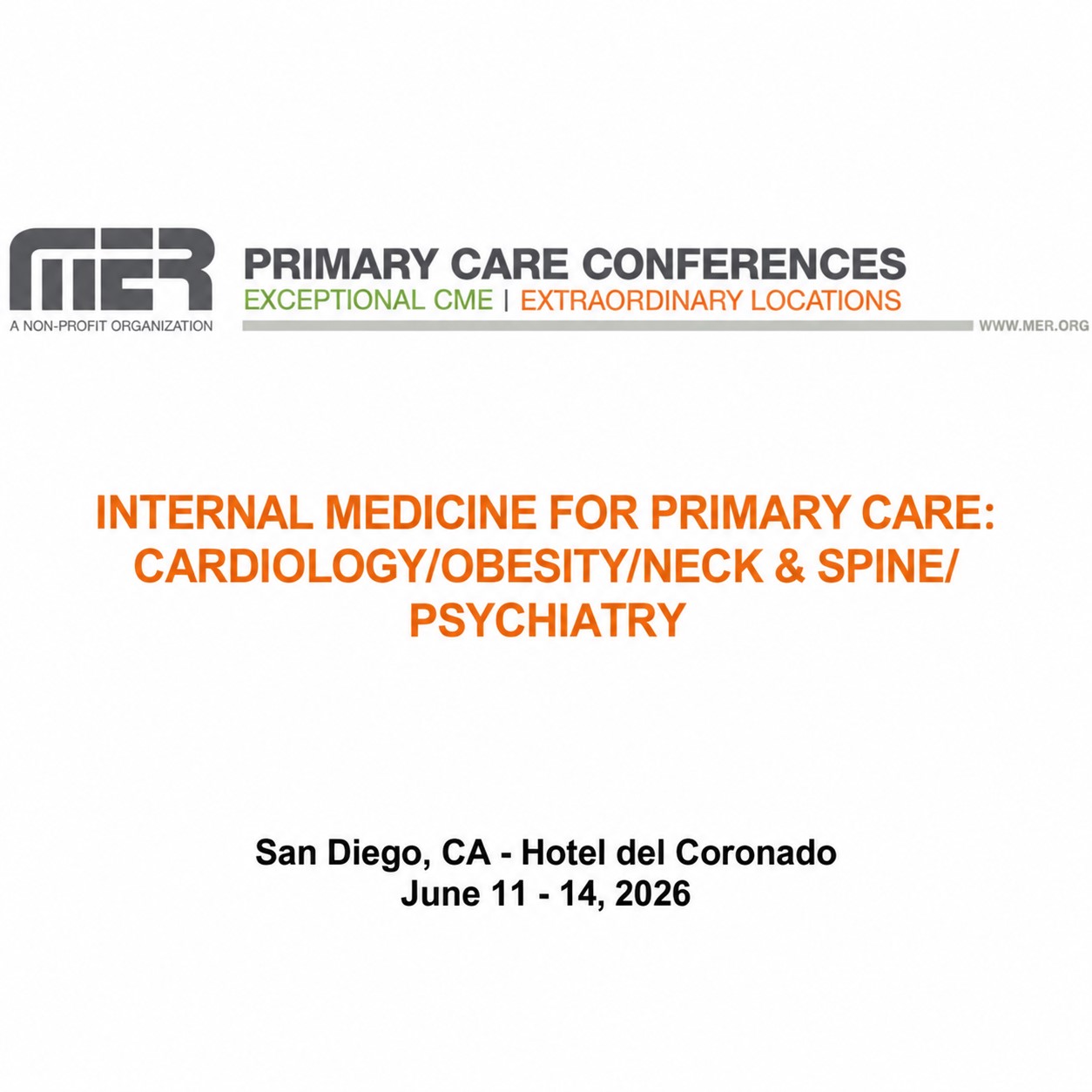
MER Primary Care Conferences Internal Medicine for Primary Care: Cardiology/Obesity/Neck & Spine/Psychiatry 2026
Comprehensive Primary Care Update – Cardiology, Obesity, Neck & Spine & Psychiatry
Stay current with important developments in internal medicine and primary care through the MER Primary Care Conferences – Internal Medicine for Primary Care: Cardiology/Obesity/Neck & Spine/Psychiatry 2026.
This multidisciplinary educational program provides practical updates across four important areas of primary care, emphasizing evidence-based diagnosis, treatment, and clinical decision-making.
Course Details
- Course: Internal Medicine for Primary Care: Cardiology/Obesity/Neck & Spine/Psychiatry
- Year: 2026
- Dates: June 11–14, 2026
- Venue: Hotel del Coronado, San Diego, California
- Provider: Medical Education Resources (MER)
- Specialties: Internal Medicine, Primary Care, Cardiology, Obesity Medicine, Neck & Spine, Psychiatry
Course Overview
The program is designed for office-based primary care providers and healthcare professionals seeking practical updates in commonly encountered medical conditions.
The curriculum integrates updates in:
- Cardiology
- Obesity Medicine
- Neck & Spine
- Psychiatry
Participants will review practical approaches to cardiovascular disease, hypertension, heart failure, obesity, bariatric care, cervical and lumbar spine disorders, gait abnormalities, bipolar disorder, anxiety, depression, and substance use disorders.
Psychiatry
Bipolar Disorder
Review:
- Mood-stabilizing psychosocial treatments
- Pharmacologic treatments
- Frequent psychiatric comorbidities
- Management considerations in primary care
Anxiety Disorders
Review current evidence for the treatment of anxiety disorders and approaches to appropriate clinical management.
Depression
Explore:
- Pharmacologic treatment
- Non-pharmacologic treatment
- Evidence-based approaches to depression management
Substance Use Disorders
Learn strategies for:
- Identifying substance use disorders
- Evaluating affected patients
- Implementing appropriate treatment approaches
Neck & Spine
Lumbar Spine Disorders
Review early treatment options for the management of lumbar spine disorders.
Cervical Spine Disorders
Learn how to utilize:
- Observation
- Palpation
- Range-of-motion assessment
- Neurologic examination
to help diagnose cervical spine disorders.
Cervical Range of Motion
Evaluate cervical spine range of motion as part of the clinical assessment of patients with neck-related conditions.
Abnormal Gait
Develop an approach to evaluating abnormal gait patterns and their potential clinical significance.
Cardiology
Acute Chest Pain
Review:
- Current diagnostic approaches
- Evaluation of acute chest pain
- Role of drug therapy
- Primary care decision-making
Hypertension
Explore current concepts in:
- Diagnosis
- Treatment
- Evidence-based management
- Cardiovascular risk reduction
Coronary Artery Disease Prevention
Learn how to implement:
- Lifestyle modifications
- Lipid management
- Cholesterol guidelines
- CAD prevention strategies
Heart Failure
Review treatment strategies based on recent guidelines and current evidence-based medicine.
Obesity Medicine
Understand the underlying mechanisms and physiological processes contributing to obesity, including:
- Genetics
- Hormones
- Metabolism
- Environmental factors
Non-Surgical Obesity Treatment
Review available non-surgical treatment approaches and their role in comprehensive obesity management.
Bariatric Surgery
Explore:
- Advantages of surgical treatment
- Disadvantages and potential considerations
- Post-surgical care
Post-Bariatric Management
Review approaches to managing patients following bariatric surgery.
Learning Objectives
Upon completion of this program, participants should be better able to:
- Discuss mood-stabilizing psychosocial and pharmacologic treatments for bipolar disorder and associated psychiatric comorbidities.
- Review current evidence for the treatment of anxiety disorders.
- Recommend appropriate pharmacologic and non-pharmacologic treatments for depression.
- Describe strategies for identifying and treating substance use disorders.
- Identify early treatment options for lumbar spine disorders.
- Evaluate abnormal gait patterns.
- Utilize observation, palpation, range of motion, and neurologic examinations to diagnose cervical spine disorders.
- Evaluate cervical spine range of motion.
- Describe current diagnostic approaches and the role of drug therapy for patients with acute chest pain.
- Explain current concepts in the diagnosis and treatment of hypertension.
- Implement lifestyle changes and lipid/cholesterol guidelines for CAD prevention.
- Implement treatment strategies based on recent guidelines and current evidence for heart failure.
- Explain the mechanisms and physiological processes involved in the development and progression of obesity.
- Discuss non-surgical obesity treatment options.
- Describe the advantages and disadvantages of surgical obesity treatment.
- Describe post-surgical care following bariatric surgery.
- Explain approaches to patient management after bariatric surgery.
Who Should Attend?
This program is targeted toward office-based primary care providers and other healthcare professionals seeking updates in primary care medicine.
Best For
- Internists
- Primary Care Physicians
- Cardiologists
- Endocrinologists
- Neck & Spine Surgeons
Major Clinical Areas
- Internal Medicine
- Primary Care
- Cardiology
- Hypertension
- Acute Chest Pain
- Coronary Artery Disease Prevention
- Heart Failure
- Obesity Medicine
- Bariatric Surgery
- Post-Bariatric Care
- Neck & Spine Disorders
- Cervical Spine Disorders
- Lumbar Spine Disorders
- Gait Disorders
- Psychiatry
- Bipolar Disorder
- Anxiety Disorders
- Depression
- Substance Use Disorders
Why This Course Is Valuable
The MER Internal Medicine for Primary Care 2026 program provides a broad, practical review of conditions frequently encountered in primary care.
Its multidisciplinary structure is particularly useful for clinicians who want to strengthen their knowledge across cardiology, obesity medicine, musculoskeletal/neck and spine care, and psychiatry, with an emphasis on practical diagnosis and evidence-based management.
4. Topics
Psychiatry
-
Bipolar Spectrum Disorders: Bipolar spectrum disorders in adults as compared to youth; Comprehensive history-taking; Differential diagnosis; Co-occurring psychiatric and medical conditions; Phase specific treatment considerations and interventions.
-
Anxiety Disorders: The nature of anxiety; Generalized anxiety disorder, panic disorder, social anxiety disorder and post-traumatic stress disorder; etiology and diagnosis; Co-occurring conditions; Treatment options for these disabling conditions.
-
Depressive Disorders: History taking, diagnosis and treatment of depression across the lifespan; pharmacologic and non-pharmacologic treatment options; rational polypharmacy.
-
Substance Use Disorders: Substance abuse history-taking to encourage patient honesty; Accurate diagnosis; Use of screening tools; Brief intervention; Recovery and treatment options; Motivational interviewing; Family symptoms and codependency.
Neck & Spine
-
Diagnosis and Treatment of Lumbar Spine Disorders: A practical approach to the diagnosis and early management of lumbar spine disorders will be presented. Anatomy, differential diagnosis, as well as physical examination concepts will be covered.
-
Physical Examination of the Lumbar Spine, Hip, and Sacroiliac Joint: Exam techniques will be demonstrated and discussed.
-
Diagnosis and Treatment of Cervical Spine and Select Upper Extremity Disorders: A practical approach to the diagnosis and early management of cervical spine and selected upper extremity disorders will be presented. Anatomy, differential diagnosis, as well as physical examination concepts will be covered.
-
Physical Examination of the Cervical Spine and UE Entrapment Neuropathies: Exam techniques will be demonstrated and discussed.
Cardiology
-
Acute Coronary Syndromes: The Patient with Acute Chest Pain: Diagnosis and initial evaluation in the primary care setting, urgent care clinic and emergency department; Initial workup, treatment, and follow-up; Diagnosing and treating ST segment elevation and non-ST segment elevation MIs; The role of drug therapy–primary vs adjunctive to PCI; Follow up after acute coronary syndromome.
-
Hypertension: The 2017 AHA/ACC Hypertension Guidelines; The 2024 ESC Guidelines for hypertension; Approaches to treatment thresholds and goals; Choices for initial and combination therapy; Resistant hypertension; Treating special populations: diabetics, the elderly, patients with renal failure.
-
Primary & Secondary Prevention of CAD: Definitions; AHA/ACC and other lipid guidelines updates; HDL Cholesterol: The good cholesterol?; Metabolic syndrome and/or obesity; Who needs treatment and how much; The role of lifestyle changes, exercise and cardiac rehabilitation; Drug therapy updates; Risk calculation.
-
Heart Failure: Etiologies and stages of heart failure; ACC/AHA Heart Failure Guidelines; Heart failure with reduced EF (HFrEF) and heart failure with preserved EF (HFpEF); Determining patients for referral using biomarkers, eg NT Pro BNP; Treatment options: ACE inhibitors, ARBs, ARNI, beta blockers, mineralocorticoid receptor antagonists, SGLT2i; The role of devices in treatment and antiplatelet drugs; Issues related to the hospitalized patient with acute decompensated heart failure and readmissions.
Obesity
-
Pathophysiology of Obesity: A guide to understanding practice demographics and considerations; The what and why of epigenetics; A practical guide to behavioral and medication management.
-
Medical Management of Obesity: Overview of obesity as a disease state; Costs to the individual of being obese; Use of appetite suppressant medications and lifestyle modifications.
-
Complications and Considerations of Bariatric Surgery: An overview of risks and effectiveness of bariatric surgery; Overview of potential surgical options; Potential complications; The role of support and behavior modification, nutrition, and the stages of patient management post-surgery.
-
Patient Management Post-bariatric Surgery: The role of the clinician for support and behavior modification, nutrition, and the stages of patient management post-surgery.