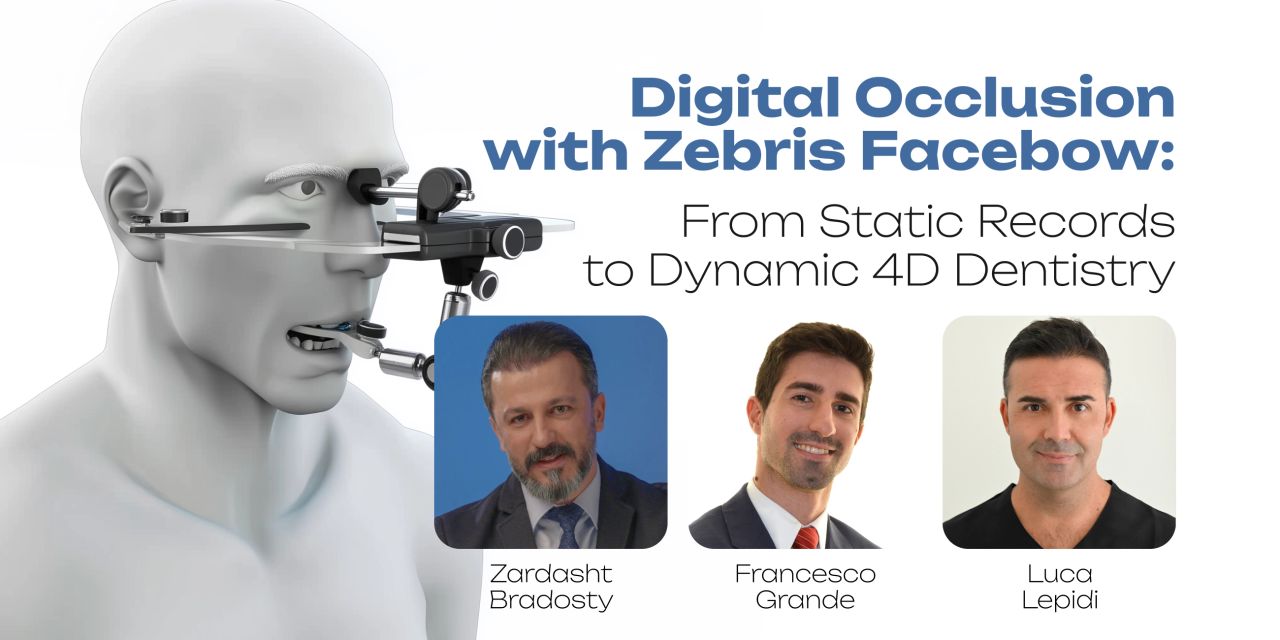
OHI-S Digital Occlusion with Zebris Facebow From Static Records to Dynamic 4D Dentistry 3 lessons 3h 26min
$45.00
This Product is shared via google drive download link, So please share your correct Gmail id while placing the order .Please note that there are no CME points or certificate associated with this course Samples for Courses Can be found here : Free Samples Here!
OHI-S Digital Occlusion with Zebris Facebow
From Static Records to Dynamic 4D Dentistry
3 Lessons | 3 Hours 26 Minutes | 3.25 CE Credits
Move beyond conventional static occlusal records and learn how to integrate real mandibular movement into modern digital prosthodontic workflows with OHI-S Digital Occlusion with Zebris Facebow: From Static Records to Dynamic 4D Dentistry.
This advanced digital dentistry course brings together three complementary technologies and concepts:
- Zebris Jaw Motion Analyzer
- Digital Facebow
- Dynamic 4D Virtual Patient
Presented by:
- Zardasht Najmadine
- Luca Lepidi
- Francesco Grande
the program demonstrates how clinicians can capture patient-specific mandibular dynamics and transfer them into:
- Digital diagnosis
- Prosthodontic treatment planning
- CAD/CAM workflows
- exocad
- Fixed prosthodontic design
- Full-mouth rehabilitation
- Occlusal splint therapy
- Analog articulator workflows
The central clinical progression is:
Record Real Function → Digitize Mandibular Motion → Build a 4D Patient → Transfer Functional Data → Design Restorations Around Patient-Specific Occlusion
Course Details
- Course: Digital Occlusion with Zebris Facebow: From Static Records to Dynamic 4D Dentistry
- Provider: OHI-S
- Faculty: Zardasht Najmadine, Luca Lepidi, Francesco Grande
- Lessons: 3
- Official Duration: 3 Hours 26 Minutes
- Language: English
- Official OHI-S CE: 3.25 CE Credits
- Primary Specialty: Prosthodontics / Digital Dentistry
- Additional Focus: Functional Dentistry
- Technology: Zebris Jaw Motion Analyzer
- Workflow: Digital Facebow + Jaw Tracking + 4D Patient
- Digital Integration: CAD/CAM + exocad
- Clinical Applications: Crowns, Fixed Prosthodontics, Full-Mouth Rehabilitation & Splints
Course Overview
Traditional dentistry often records occlusion as a series of static positions.
These may include:
- Digital impressions
- Intraoral scans
- Bite registrations
- Static models
- Conventional facebow records
However, the mandible functions dynamically.
During real function, the lower jaw performs:
- Opening
- Closing
- Protrusion
- Retrusion
- Lateral excursions
- Functional chewing movements
A static digital model cannot fully reproduce this movement by itself.
This course introduces a workflow designed to add a fourth dimension:
Movement Over Time
creating what the course describes as a:
4D Virtual Patient
From Static Dentistry to Dynamic 4D Dentistry
Conventional digital dentistry may create highly accurate 3-D representations of:
- Teeth
- Gingiva
- Dental arches
- Restorations
but these models remain static unless functional data are incorporated.
Digital jaw tracking adds information about how the patient’s mandible actually moves.
The progression becomes:
3-D Anatomy + Functional Motion = Dynamic 4D Patient
Why Dynamic Occlusion Matters
A restoration should not only fit anatomically.
It must also function within:
- Maximum intercuspation
- Excursive movements
- Functional mandibular trajectories
- Patient-specific occlusion
Failure to account for function may contribute to increased chairside adjustment.
The course therefore focuses on using recorded mandibular data to support more function-oriented restorative design.
Zebris Jaw Motion Analyzer
The Zebris Jaw Motion Analyzer – JMA is the principal functional recording technology featured in the course.
It enables clinicians to record mandibular movement and analyze patient-specific functional information.
The course demonstrates how Zebris data can move from:
Measurement
to:
Clinical Diagnosis
and ultimately to:
Digital Restorative Design
Mandibular Motion Recording
The program explores digital acquisition of mandibular movements.
These recordings may help evaluate:
- Mandibular trajectories
- Functional movement patterns
- Occlusal relationships
- Excursive movement
- Interferences
The objective is to capture information that cannot be represented completely by a static bite record alone.
Digital Facebow
The Zebris Digital Facebow is used within the prosthodontic workflow to transfer patient-specific relationships into a digital environment.
The course addresses:
- Clinical data acquisition
- Maxillomandibular relationships
- Functional orientation
- Digital transfer
- Prosthodontic planning
Digital Facebow vs. Static Records
Traditional records can provide valuable positional information.
Digital functional records add another layer:
Where the Jaw Is + How the Jaw Moves
This additional functional information can then be incorporated into restorative planning.
Creating the 4D Virtual Patient
One of the most important course objectives is creation of a 4D virtual patient.
The concept integrates:
- Digital dental models
- Occlusal relationships
- Jaw position
- Mandibular motion
- Functional data
into a dynamic virtual simulation.
Clinical Value of a 4D Patient
A 4D workflow can help clinicians visualize how proposed restorations interact with patient-specific mandibular movement.
Potential applications within the course include:
- Prosthodontic diagnosis
- Treatment planning
- Full-mouth rehabilitation
- Occlusal splints
- Fixed restorations
LESSON 1
From Diagnosis to Design: Integrating the Jaw Motion Analyzer in Functional Occlusion
Instructor: Zardasht Najmadine
Duration: 1 Hour 10 Minutes
Official CE: 1 Credit
The first lesson establishes the clinical rationale for digital jaw-motion analysis.
Topics include:
- Limitations of traditional occlusal analysis
- Advantages of digital jaw-motion assessment
- Recording mandibular movements
- Occlusal contact analysis
- Mediotrusion interferences
- Mandibular trajectories
- Digital impression validation
- Intraoral scanning validation
- Crown design
- Fixed prosthodontics
- Occlusal splints
- Function-driven prosthetic appliances
Limitations of Traditional Occlusal Analysis
Traditional methods provide useful information but may not reproduce every aspect of dynamic mandibular function.
The course contrasts static assessment with patient-specific motion recording.
The shift is:
Static Relationship → Dynamic Functional Analysis
Occlusal Contact Analysis
The lesson explores how recorded motion can help clinicians better understand the interaction between opposing dental arches during function.
Analysis may include:
- Contact timing
- Excursive contacts
- Functional trajectories
- Interferences
Mediotrusion Interferences
The curriculum specifically includes analysis of mediotrusion interferences.
Identifying potentially problematic functional contacts can be relevant when planning:
- Crowns
- Bridges
- Full-mouth restorations
- Occlusal appliances
Mandibular Trajectories
Rather than estimating movement based only on averages, digital jaw tracking provides patient-specific trajectory information.
This supports the broader concept of:
Individualized Functional Dentistry
Digital Impression Validation
A particularly useful topic in Lesson 1 is using the Jaw Motion Analyzer to help validate digital workflows involving:
- Digital impressions
- Intraoral scanning
- Occlusal relationships
The objective is not simply to produce an accurate scan but to determine whether the resulting digital relationship is compatible with actual function.
From Diagnosis to Restorative Design
The course demonstrates how functional data can progress through:
JMA Recording → Analysis → Digital Planning → Restoration Design
This connects diagnostic information directly with prosthodontic design.
Crowns & Fixed Prosthodontics
Jaw-motion data can be incorporated into planning for:
- Single crowns
- Multiple-unit restorations
- Fixed prostheses
The goal is to create restorations that are designed with patient-specific function in mind.
Occlusal Bite Splints
Lesson 1 also addresses use of JMA data in the fabrication of:
- Occlusal splints
- Function-driven appliances
Rather than designing an appliance based only on static models, functional information can contribute to a more individualized workflow.
LESSON 2
Occlusal Considerations in Prosthodontics: Integrating Zebris Digital Facebow Workflows
Instructor: Luca Lepidi
Duration: 45 Minutes
Official CE: 0.75 Credits
Lesson 2 focuses specifically on incorporating the Zebris Digital Facebow into prosthodontic treatment.
Topics include:
- Digital clinical data collection
- Prosthodontic treatment planning
- Maxillomandibular relationship recording
- Digital facebow transfer
- 4D virtual patient creation
- CAD/CAM integration
- Fixed prosthodontics
- Function-driven workflows
- Digital occlusal analysis
Clinical Data Collection
A function-driven prosthodontic workflow begins with accurate patient data.
Potential records include:
- Intraoral scans
- Occlusal records
- Jaw relation data
- Digital facebow data
- Functional mandibular movement
These datasets can then be integrated for treatment planning.
Maxillomandibular Relationships
The relationship between the maxilla and mandible is central to prosthodontics.
The course explains digital protocols for:
Recording → Transferring → Digitizing
these relationships using Zebris technology.
Prosthodontic Treatment Planning
Functional information can become particularly important when restorative treatment becomes more extensive.
Examples include:
- Multiple restorations
- Altered occlusion
- Full-mouth rehabilitation
- Complex prosthodontics
CAD/CAM Integration
One of the major objectives of the course is incorporating digital facebow and jaw-motion records into CAD/CAM workflows.
The aim is to connect:
Clinical Functional Data → Digital Design Environment
rather than allowing the clinical and laboratory workflows to remain disconnected.
Function-Driven Fixed Prosthodontics
Fixed restorations must satisfy:
- Esthetics
- Fit
- Strength
- Occlusion
- Function
The course emphasizes the functional component through patient-specific digital data.
Reducing Chairside Occlusal Adjustment
One of the proposed practical advantages of function-driven digital planning is reduction of unnecessary adjustment after restoration delivery.
The desired workflow is:
Better Functional Records → Better Digital Design → Fewer Unexpected Occlusal Corrections
This should be understood as a workflow objective rather than a guarantee for every case.
LESSON 3
Jaw Tracking in Digital Prosthodontics: From Static Models to 4D Patients
Instructor: Francesco Grande
Duration: 1 Hour 30 Minutes
Official CE: 1.5 Credits
The third lesson provides the most complete Zebris jaw-tracking workflow.
Topics include:
- Digital jaw-tracking technologies
- Dynamic 4D patient simulation
- Complete Zebris clinical protocol
- Mandibular motion recording
- Functional analysis
- exocad transfer
- Analog articulator transfer
- Full-mouth rehabilitation
- Advanced occlusal treatment planning
- Occlusal splints
- Personalized appliances
- Common Zebris errors
- Workflow troubleshooting
Jaw Tracking
Digital jaw tracking transforms the virtual dental model from a static representation into a functional simulation.
The key addition is:
Patient-Specific Mandibular Movement
Complete Zebris Clinical Protocol
The lesson takes clinicians through a structured workflow for:
- Recording
- Analyzing
- Transferring
- Applying
mandibular motion data.
Transfer to exocad
The course specifically covers transfer of Zebris functional data into exocad.
This is an important SEO and clinical term because it connects jaw tracking directly to one of the most widely used dental CAD environments.
The workflow becomes:
Patient → Zebris → Functional Dataset → exocad → Prosthetic Design
exocad & Dynamic Occlusion
Digital design can incorporate more than dental morphology.
With functional information, clinicians and technicians can evaluate restoration design within a patient-specific motion environment.
Applications may include:
- Crowns
- Bridges
- Full-mouth rehabilitation
- Occlusal appliances
Transfer to Analog Articulators
Despite the digital emphasis of the course, Lesson 3 also discusses transfer to analog articulators.
This creates a hybrid workflow in which digital functional data can support:
- Digital planning
- Conventional laboratory procedures
- Mixed analog-digital workflows
Full-Mouth Rehabilitation
Complex full-mouth cases are one of the strongest applications presented in the course.
These treatments may involve major changes to:
- Occlusion
- Tooth morphology
- Prosthetic relationships
- Functional guidance
Patient-specific functional data can therefore become particularly useful during treatment planning.
Full-Mouth Digital Workflow
A functional digital rehabilitation workflow may follow:
Scan → Record Jaw Motion → Create 4D Patient → Design → Simulate → Manufacture → Verify Clinically
Occlusal Splint Therapy
Lesson 3 addresses Zebris workflows in:
- Occlusal splint therapy
- Personalized occlusal appliance fabrication
Functional data may help customize appliances according to patient-specific mandibular dynamics.
Personalized Occlusal Appliances
A digital appliance can be designed around:
- Patient anatomy
- Occlusal relationship
- Mandibular movement
rather than generic articulator values alone.
Common Zebris Errors
A particularly valuable part of the course is discussion of mistakes in Zebris workflows.
Digital technology does not automatically produce accurate results.
Errors can occur during:
- Recording
- Device positioning
- Data acquisition
- Data transfer
- Interpretation
- Integration
Reliable Digital Functional Records
High-quality output requires:
Correct Clinical Protocol + Accurate Recording + Correct Transfer + Appropriate Interpretation
The technology is only as reliable as the workflow used to generate the data.
STATIC vs. DYNAMIC DIGITAL DENTISTRY
Static Digital Workflow
May include:
- Intraoral scan
- Static bite
- Virtual model
- CAD design
Dynamic 4D Workflow
Adds:
- Jaw tracking
- Functional trajectories
- Patient-specific movement
- Digital facebow information
The major conceptual difference is:
Static Anatomy vs. Anatomy in Motion
Digital Occlusion
Digital occlusion can incorporate information beyond visually examining contacts on static digital casts.
This course connects occlusion with:
- Motion
- Function
- Prosthetic design
- Digital simulation
Functional Dentistry
OHI-S also categorizes this course within Functional Dentistry.
This is appropriate because the primary objective is not simply scanning or CAD design.
It focuses on the functional relationship among:
- Mandible
- Teeth
- Occlusion
- Prosthetic restorations
Digital Prosthodontics
The course is particularly strong for modern prosthodontics because it integrates:
- Digital records
- Jaw relations
- Motion
- CAD/CAM
- exocad
- Restorative design
into one workflow.
Prosthetically Driven Functional Planning
The final restoration should satisfy both:
Morphology
and:
Function
Digital functional data can help clinicians and technicians plan both simultaneously.
Crowns & Fixed Prosthodontics
The course specifically demonstrates applications of JMA information to design:
- Crowns
- Fixed restorations
with patient-specific functional considerations.
Full-Mouth Rehabilitation
For complex rehabilitation, small occlusal inaccuracies across multiple restorations may become clinically significant.
Digital functional planning aims to improve the relationship between:
- Restoration design
- Jaw movement
- Functional contacts
before definitive delivery.
Occlusal Stability
The stated objective of the OHI-S program includes supporting long-term functional stability.
Stable outcomes still depend on multiple factors including:
- Diagnosis
- Tooth condition
- Periodontal health
- Prosthetic design
- Material selection
- Parafunction
- Clinical execution
Dynamic digital records represent one component of this larger process.
Digital Dentistry + Dental Laboratory
One important strength of a Zebris/exocad workflow is the ability to communicate functional information to the laboratory.
Rather than sending only:
- Scans
- Photographs
- Bite records
the clinician can potentially transfer additional patient-specific functional data.
Clinician-Technician Communication
A modern workflow can become:
Patient Data → Functional Records → Laboratory CAD Environment → Prosthetic Design
This is highly relevant to both clinicians and dental technicians.
Key Topics Covered
- Digital Occlusion
- Zebris
- Zebris Jaw Motion Analyzer
- JMA
- Zebris Digital Facebow
- Digital Facebow
- Jaw Tracking
- Mandibular Motion Analysis
- Mandibular Trajectories
- Occlusal Analysis
- Mediotrusion Interferences
- 4D Dentistry
- 4D Virtual Patient
- Digital Prosthodontics
- Functional Dentistry
- CAD/CAM Dentistry
- exocad
- Digital Articulator
- Analog Articulator
- Fixed Prosthodontics
- Crowns
- Full-Mouth Rehabilitation
- Occlusal Splints
- Bite Splints
- Intraoral Scanning
- Digital Impressions
- Maxillomandibular Relationships
- Function-Driven Dentistry
Who Should Take This Course?
This program is particularly relevant for:
- Prosthodontists
- Restorative Dentists
- General Dentists
- Digital Dentistry Clinicians
- Dental Technicians
- Dental CAD/CAM Professionals
- Clinicians performing full-mouth rehabilitation
- Dentists using exocad
- Dentists using Zebris
- Clinicians interested in digital occlusion
- Orthodontists interested in functional jaw records
The strongest primary audience is:
Prosthodontists + Restorative Dentists
because the curriculum is predominantly focused on restorative and prosthodontic application of jaw-motion data.
Is This an Orthodontics Course?
Orthodontists may benefit from digital functional analysis and mandibular tracking.
However, this specific OHI-S course is centered predominantly on:
- Prosthodontic workflows
- Crowns
- Fixed restorations
- Full-mouth rehabilitation
- Splints
- CAD/CAM
- exocad
Therefore, it should not be marketed primarily as an orthodontic course.
Why This Course Is Useful
The strongest feature of Digital Occlusion with Zebris Facebow is that it links technologies that are often taught separately.
Clinical Diagnosis
- Occlusion
- Jaw movement
- Functional relationships
Digital Acquisition
- Intraoral scans
- Zebris JMA
- Digital facebow
Virtual Integration
- 4D patient
- Dynamic simulation
CAD/CAM
- exocad
- Restorative design
Clinical Application
- Crowns
- Fixed prosthodontics
- Full-mouth rehabilitation
- Splints
The overall workflow can be summarized as:
Capture → Analyze → Digitize → Simulate → Design → Restore
Original OHI-S CE Information
The official OHI-S course is listed for:
3.25 CE Credits
with the individual lessons listed as:
- Lesson 1: 1 CE Credit
- Lesson 2: 0.75 CE Credits
- Lesson 3: 1.5 CE Credits
Total:
3.25 CE Credits
These credits relate to participation through the official OHI-S educational activity and fulfillment of its applicable CE requirements.
An independently distributed recording should not automatically be advertised as providing OHI-S CE credit unless official CE eligibility is included.
Product Summary
- Product: Digital Occlusion with Zebris Facebow: From Static Records to Dynamic 4D Dentistry
- Provider: OHI-S
- Faculty: Zardasht Najmadine, Luca Lepidi, Francesco Grande
- Lessons: 3
- Duration: 3 Hours 26 Minutes
- Language: English
- Official OHI-S CE: 3.25 Credits
- Primary Specialty: Prosthodontics / Digital Dentistry
- Technology: Zebris Jaw Motion Analyzer + Digital Facebow
- Software Integration: exocad / CAD-CAM
- Applications: Fixed Prosthodontics, Full-Mouth Rehabilitation & Splints
4. Short Description
OHI-S Digital Occlusion with Zebris Facebow: From Static Records to Dynamic 4D Dentistry is a 3-lesson, 3h 26min course by Zardasht Najmadine, Luca Lepidi, and Francesco Grande.
The program demonstrates how to integrate the Zebris Jaw Motion Analyzer and Digital Facebow into modern prosthodontics, covering mandibular motion recording, occlusal contacts, mediotrusion interferences, maxillomandibular relationships, 4D virtual patient creation, CAD/CAM and exocad transfer, crowns, fixed prosthodontics, full-mouth rehabilitation, analog articulator transfer, occlusal splints, and common Zebris workflow errors.
Topics
Lesson 1. From Diagnosis to Design: Integrating the Jaw Motion Analyzer in Functional Occlusion
-
Limitations of traditional occlusal analysis and the advantages of digital jaw motion assessment
-
Recording mandibular movements and analyzing occlusal contacts, mediotrusion interferences, and mandibular trajectories
-
Using the Jaw Motion Analyzer to validate the accuracy of digital impressions and intraoral scanning workflows
-
Integrating JMA recordings into the design of crowns and fixed prosthodontic restorations
-
Applying JMA data in the fabrication of occlusal bite splints and function-driven prosthetic appliances
-
Bridging digital diagnosis and restorative design to achieve predictable functional and prosthetic outcomes
Lesson 2. Occlusal Considerations in Prosthodontics: Integrating Zebris Digital Facebow Workflows
-
Collecting clinical data using digital protocols for prosthodontic treatment planning
-
Recording and transferring maxillomandibular relationships with the Zebris Digital Facebow
-
Creating a 4D virtual patient through the acquisition and digitalization of functional clinical data
-
Integrating digital facebow records into prosthetic rehabilitation planning and CAD/CAM workflows
-
Managing occlusion in fixed prosthodontics using function-driven digital workflows
-
Improving the accuracy, predictability, and clinical outcomes of prosthetic rehabilitation through digital occlusal analysis
Lesson 3. Jaw Tracking in Digital Prosthodontics: From Static Models to 4D Patients
-
Digital jaw tracking technologies and their role in transforming static virtual models into dynamic 4D patient simulations
-
Complete clinical protocol with Zebris for accurate mandibular motion recording and functional analysis
-
Transfer of Zebris data into exocad and analog articulators for function-oriented prosthetic design
-
Clinical applications of Zebris in full-mouth rehabilitation and advanced occlusal treatment planning
-
Zebris workflows in splint therapy and personalized occlusal appliance fabrication
-
Common errors in Zebris protocols and strategies for achieving reliable clinical results
-
Function-driven digital prosthodontics: improving workflow efficiency, reducing occlusal adjustments, and enhancing restoration accuracy
Related products