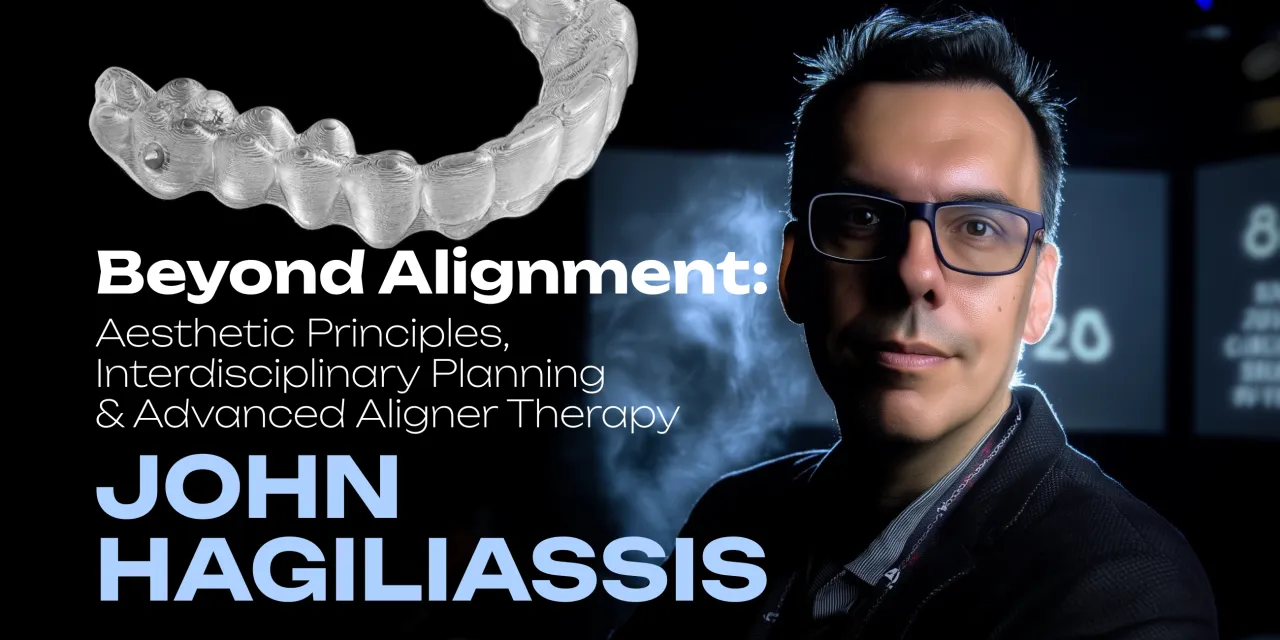
OHI-S Beyond Alignment Aesthetic Principles, Interdisciplinary Planning & Advanced Aligner Therapy 4 lessons 1h 42min
$30.00
This Product is shared via google drive download link, So please share your correct Gmail id while placing the order .Please note that there are no CME points or certificate associated with this course Samples for Courses Can be found here : Free Samples Here!
OHI-S Beyond Alignment
Aesthetic Principles, Interdisciplinary Planning & Advanced Aligner Therapy
4 Lessons | 1 Hour 42 Minutes | John Hagiliassis
Move beyond simple tooth alignment and learn how to incorporate clear aligners into aesthetic, functional, restorative, periodontal, and interdisciplinary treatment planning with OHI-S Beyond Alignment: Aesthetic Principles, Interdisciplinary Planning & Advanced Aligner Therapy.
Presented by John Hagiliassis, this focused orthodontic course provides a structured clinical roadmap for clinicians who want to manage aligner cases according to the patient’s final aesthetic, functional, and restorative objectives, rather than focusing only on straightening individual teeth.
The program combines:
- Aesthetic Orthodontics
- Clear Aligner Therapy
- Smile Analysis
- Facial Aesthetic Evaluation
- Comprehensive Diagnosis
- Interdisciplinary Treatment Planning
- Restorative Considerations
- Periodontal Considerations
- Functional Assessment
- Risk Assessment
- Complex Aligner Case Selection
- SAC Protocols
- Micro and Macro Tooth Movement
- Movement Staging
- Advanced Aligner Therapy
- Restorative Rehabilitation
- Real-World Clinical Cases
The central principle is:
Plan the Final Aesthetic and Functional Result First — Then Design the Orthodontic Movements Required to Reach It
Course Details
- Course: Beyond Alignment: Aesthetic Principles, Interdisciplinary Planning & Advanced Aligner Therapy
- Provider: OHI-S
- Instructor: John Hagiliassis
- Lessons: 4
- Duration: 1 Hour 42 Minutes
- Language: English
- Official OHI-S CE: 1 CE Credit
- Primary Specialty: Orthodontics
- Main Focus: Advanced Clear Aligner Therapy
- Additional Focus: Aesthetic & Interdisciplinary Dentistry
- Format: Online Course
Course Overview
Clear aligner therapy has progressed beyond management of relatively simple alignment cases.
For more complex patients, successful planning requires consideration of:
- Facial aesthetics
- Smile design
- Tooth position
- Periodontal support
- Restorative needs
- Functional requirements
- Patient-specific risk
- Biomechanical limitations
- Final restorative objectives
The course therefore moves from:
“How do I align these teeth?”
toward:
“What is the ideal final aesthetic, restorative, periodontal and functional position—and can aligners predictably achieve it?”
Why “Beyond Alignment”?
A technically straight dental arch does not automatically represent an ideal treatment result.
Orthodontic treatment can influence:
- Smile aesthetics
- Incisal display
- Tooth proportions
- Facial harmony
- Restorative space
- Periodontal architecture
- Occlusion
- Future prosthetic rehabilitation
The course teaches clinicians to view tooth movement as one component of a broader interdisciplinary treatment plan.
Aesthetic-Driven Orthodontic Planning
Aesthetic orthodontic planning begins with defining the desired final result.
Important questions include:
- How should the smile relate to the face?
- Where should the teeth ideally be positioned?
- Will future restorative treatment be needed?
- Does the periodontal condition limit movement?
- Are functional objectives compatible with the aesthetic plan?
- Can the required movement be achieved safely with aligners?
A practical workflow is:
Facial Analysis → Smile Analysis → Dental Diagnosis → Risk Assessment → Final Outcome Design → Movement Planning
LESSON 1
Aesthetic Orthodontic Principles and Aligner Therapy
Duration: 29 Minutes
The first lesson establishes the aesthetic framework for clear aligner treatment.
Topics include:
- Principles of aesthetic orthodontics in aligner therapy
- Smile analysis
- Facial aesthetic evaluation
- Tooth position and facial harmony
- Future restorative considerations
- Defining the ideal orthodontic result
- Patient-specific aesthetic objectives
Principles of Aesthetic Orthodontics
Orthodontic planning should consider more than:
- Crowding
- Spacing
- Overjet
- Overbite
The ideal position of the teeth may also depend on:
- Facial proportions
- Lip position
- Smile architecture
- Existing restorations
- Planned restorative treatment
Smile Analysis
Smile analysis can help evaluate relationships among:
- Teeth
- Gingiva
- Lips
- Smile arc
- Incisal edges
- Facial midline
The goal is to define the final orthodontic outcome before staging aligner movements.
Facial Aesthetic Evaluation
The course emphasizes evaluation of the teeth within the context of the entire face.
This can help prevent a treatment plan that produces technically aligned teeth but fails to support the patient’s broader aesthetic goals.
Tooth Position & Facial Harmony
Tooth position can affect:
- Lip support
- Smile display
- Facial appearance
- Restorative possibilities
Orthodontic planning should therefore consider where teeth need to finish—not simply where they begin.
Future Restorations
One of the most important interdisciplinary concepts is planning orthodontics around future restorative dentistry.
Examples may involve creating appropriate:
- Restorative space
- Tooth position
- Tooth proportions
- Implant spaces
- Preparation conditions
This establishes:
Orthodontics Before Restorative Dentistry
as a planned sequence rather than two independent treatments.
Defining the Ideal Orthodontic Outcome
The first lesson encourages clinicians to define the desired endpoint early.
A useful sequence is:
Patient Goals → Aesthetic Analysis → Functional Requirements → Restorative Requirements → Orthodontic Goal
Only after the endpoint is clear should movement staging begin.
LESSON 2
Diagnosis and Risk Assessment for Complex Aligner Cases
Duration: 24 Minutes
The second lesson focuses on interdisciplinary diagnosis before starting aligner treatment.
Topics include:
- Role of aligners in interdisciplinary dentistry
- Comprehensive patient assessment
- Interdisciplinary diagnosis
- Restorative considerations
- Periodontal considerations
- Functional considerations
- Treatment risk factors
Clear Aligners in Interdisciplinary Dentistry
Aligners can be used as part of larger treatment plans involving:
- Orthodontics
- Periodontics
- Restorative dentistry
- Prosthodontics
- Implant dentistry
The orthodontic objective may therefore be preparation for another phase of treatment.
Comprehensive Patient Assessment
Before planning advanced aligner therapy, clinicians should assess:
- Dental condition
- Periodontal health
- Occlusion
- Restorative needs
- Existing prostheses
- Functional problems
- Patient goals
- Treatment expectations
Interdisciplinary Diagnosis
An interdisciplinary diagnosis considers how one treatment phase affects another.
For example:
Orthodontic Movement → Periodontal Response → Restorative Space → Final Prosthetic Result
The objective is to avoid creating a problem for another specialty while solving an orthodontic issue.
Restorative Considerations
Restorative treatment may influence:
- Space requirements
- Tooth dimensions
- Final incisal position
- Crown proportions
- Implant planning
Aligner therapy can therefore become a preparatory phase for restorative rehabilitation.
Periodontal Considerations
Periodontal health can limit the extent or direction of orthodontic movement.
Evaluation may consider:
- Bone support
- Gingival architecture
- Periodontal stability
- Previous periodontal disease
Appropriate movement planning should respect the available periodontal envelope.
Functional Considerations
Aesthetic alignment should not compromise functional objectives.
The clinician should evaluate:
- Occlusion
- Functional contacts
- Existing bite relationships
- Restorative requirements
before defining the final aligner plan.
Risk Factors
Complex aligner treatment requires recognition of factors that can affect:
- Predictability
- Stability
- Treatment duration
- Biological safety
The objective is to identify risks before treatment rather than after movement has already failed.
LESSON 3
Diagnosis and Risk Assessment for Complex Aligner Cases
Duration: 27 Minutes
The third lesson expands risk assessment into practical complex-case selection.
Topics include:
- Identifying suitable complex aligner cases
- SAC protocols
- Safe case selection
- Treatment-planning protocols
- Micro tooth movements
- Macro tooth movements
- Psychological factors
- Physiological factors
- Medical factors
Complex Aligner Case Selection
Not every orthodontic problem is equally suitable for treatment with clear aligners alone.
The clinician must evaluate:
- Type of movement
- Magnitude of movement
- Biological limitations
- Periodontal condition
- Patient compliance
- Treatment complexity
The key question becomes:
Should This Case Be Treated with Aligners—and Under What Protocol?
SAC Protocol
The official OHI-S curriculum specifically includes SAC protocols for case selection and planning.
A structured complexity classification allows clinicians to organize cases according to:
- Difficulty
- Risk
- Predictability
- Required experience
rather than categorizing every aligner case as equivalent.
Safe Case Selection
Appropriate case selection can reduce:
- Unpredictable movement
- Excessive refinements
- Compromised outcomes
- Biological complications
- Unrealistic treatment expectations
Micro vs. Macro Tooth Movement
The course distinguishes between different scales of orthodontic movement.
Micro Movements
Smaller positional corrections may have different predictability and biomechanical requirements.
Macro Movements
Larger movements can introduce more substantial biomechanical and biological challenges.
Understanding the difference helps guide staging.
Movement Complexity
Different movements do not have identical predictability with aligners.
Treatment planning should account for:
- Direction
- Magnitude
- Anchorage requirements
- Biological response
- Sequence of movements
Psychological Factors
Complex orthodontic treatment also depends on patient-related behavioral factors.
These may affect:
- Compliance
- Expectations
- Treatment adherence
- Acceptance of refinements
- Satisfaction
Physiological Factors
Biological response varies among patients.
Clinical planning should consider factors that may influence:
- Tooth movement
- Tissue response
- Treatment pace
- Stability
Medical Factors
Medical history can influence orthodontic planning and should form part of comprehensive assessment.
The clinician should not view an aligner case as merely a digital tooth-position problem.
LESSON 4
Managing Complex Clinical Cases with Aligners
Duration: 20 Minutes
The final lesson moves from diagnosis into practical advanced treatment strategy.
Topics include:
- Predictable movement staging
- Complex orthodontic tooth movements
- Restorative rehabilitation
- Functional rehabilitation
- Stable aesthetic outcomes
- Stable functional outcomes
- Advanced aligner case studies
- Interdisciplinary treatment planning
Staging Complex Tooth Movements
Complex aligner therapy requires careful sequencing.
The question is not only:
Which teeth need to move?
but also:
In What Order Should They Move?
Proper staging can help manage:
- Anchorage
- Space
- Interactions between movements
- Treatment predictability
Sequential Treatment Planning
A useful concept is:
Create Space → Establish Anchorage → Perform Priority Movements → Refine Position → Finish
The exact sequence depends on individual case requirements.
Interdisciplinary Restorative Rehabilitation
One of the major themes is incorporating aligners into more comprehensive restorative treatment.
This may involve moving teeth to create conditions for:
- Veneers
- Crowns
- Implant restorations
- Other restorative procedures
Orthodontics becomes part of the restorative solution rather than an isolated treatment.
Functional Rehabilitation
Final treatment goals should consider both:
Aesthetic Result
and:
Functional Result
The course emphasizes planning that integrates these objectives rather than optimizing one at the expense of the other.
Stable Outcomes
The objective is not merely achieving the final digital setup.
The clinical goal is a result that is:
- Biologically acceptable
- Aesthetically appropriate
- Functionally appropriate
- Restoratively compatible
The term “predictable” should therefore refer to structured planning rather than guaranteeing an outcome.
Real-World Case Studies
The final lesson uses clinical cases to demonstrate advanced applications of clear aligners.
Case-based education helps illustrate how:
Diagnosis → Risk Assessment → Interdisciplinary Plan → Movement Staging → Final Rehabilitation
works in actual treatment scenarios.
Interdisciplinary Aligner Therapy
The strongest feature of this course is the integration of orthodontics with other areas of dentistry.
Orthodontics + Restorative Dentistry
Aligners can reposition teeth before:
- Veneers
- Crowns
- Direct restorations
- Smile rehabilitation
Orthodontics + Prosthodontics
Tooth movement may help optimize:
- Prosthetic space
- Tooth position
- Occlusal relationships
- Final restorative design
Orthodontics + Periodontics
Periodontal considerations influence:
- Movement limits
- Tooth position
- Biological risk
- Long-term stability
Orthodontics + Implant Dentistry
Aligners may be useful before implant therapy to establish:
- Appropriate space
- Root position
- Restorative relationships
when clinically indicated.
Aesthetic Orthodontics
Aesthetic orthodontics considers the relationship among:
Teeth + Smile + Gingiva + Lips + Face
rather than treating dental alignment as an isolated objective.
Smile-Driven Treatment Planning
A smile-driven plan begins with visualization of the desired final appearance.
The orthodontic plan is then developed to support that endpoint.
This is particularly relevant when orthodontics is followed by restorative treatment.
Clear Aligner Limitations
An advanced aligner course should also emphasize limitations.
Some cases may require:
- Alternative mechanics
- Combination treatment
- More advanced orthodontic strategies
- Referral
- A different appliance system
Good aligner treatment planning involves knowing both:
What Aligners Can Do
and:
When They May Not Be the Best Standalone Tool
Risk-Based Treatment Planning
A useful clinical framework is:
Diagnosis → Complexity → Risk → Treatment Modality → Movement Sequence
This prevents the appliance from driving the diagnosis.
Clinical Decision-Making
One of the official course objectives is expanding the possibilities of aligner therapy through better clinical decision-making.
This does not mean using aligners for every case.
It means understanding:
- Case selection
- Movement limitations
- Risk
- Treatment sequencing
- Interdisciplinary alternatives
well enough to choose an appropriate approach.
Key Topics Covered
- Clear Aligner Therapy
- Advanced Aligner Therapy
- Aesthetic Orthodontics
- Smile Analysis
- Facial Aesthetic Evaluation
- Interdisciplinary Orthodontics
- Complex Aligner Cases
- Aligner Case Selection
- Orthodontic Diagnosis
- Risk Assessment
- SAC Protocol
- Micro Tooth Movement
- Macro Tooth Movement
- Tooth Movement Staging
- Restorative Orthodontics
- Periodontal Orthodontics
- Prosthodontic Planning
- Functional Rehabilitation
- Smile-Driven Orthodontics
- Restorative Rehabilitation
- Adult Orthodontics
- Clear Aligner Treatment Planning
Who Should Take This Course?
This course is particularly relevant for:
- Orthodontists
- Dentists Providing Clear Aligner Therapy
- Restorative Dentists
- Prosthodontists
- Periodontists involved in interdisciplinary cases
- General Dentists with appropriate orthodontic training
- Orthodontic Residents
- Prosthodontic Residents
- Clinicians involved in complex multidisciplinary rehabilitation
The strongest primary audience remains orthodontists and clinicians actively planning clear aligner treatment.
Why This Course Is Useful
Beyond Alignment focuses on the stages of aligner therapy that determine success before an aligner is manufactured:
Aesthetic Analysis
- Smile
- Face
- Tooth position
Diagnosis
- Restorative needs
- Periodontal factors
- Functional considerations
Risk Assessment
- SAC protocols
- Complexity
- Patient factors
Treatment Planning
- Micro and macro movements
- Movement sequence
- Advanced cases
Interdisciplinary Integration
- Restorative dentistry
- Prosthodontics
- Periodontics
- Functional rehabilitation
The overall clinical pathway is:
Analyze the Face & Smile → Diagnose Interdisciplinarily → Assess Risk → Define Final Outcome → Stage Tooth Movement → Integrate Final Rehabilitation
Original OHI-S CE Information
The official OHI-S course is listed for:
1 CE Credit
through the original OHI-S educational platform.
An independently distributed recording should not automatically be advertised as providing official OHI-S CE credit unless the purchaser also receives the necessary official participation and credit-claiming pathway.
Product Summary
- Product: Beyond Alignment: Aesthetic Principles, Interdisciplinary Planning & Advanced Aligner Therapy
- Provider: OHI-S
- Instructor: John Hagiliassis
- Lessons: 4
- Duration: 1 Hour 42 Minutes
- Language: English
- Official OHI-S CE: 1 Credit
- Primary Specialty: Orthodontics
- Main Focus: Advanced Clear Aligner Therapy
- Additional Focus: Interdisciplinary & Aesthetic Dentistry
4. Short Description
OHI-S Beyond Alignment: Aesthetic Principles, Interdisciplinary Planning & Advanced Aligner Therapy is a 4-lesson, 1h 42min online course by John Hagiliassis.
The course moves beyond simple alignment to cover aesthetic orthodontic principles, smile and facial analysis, interdisciplinary diagnosis, restorative and periodontal considerations, complex-case risk assessment, SAC protocols, micro and macro tooth movements, movement staging, and integration of aligners into comprehensive restorative and functional rehabilitation.
Topics
Lesson 1. Aesthetic Orthodontic Principles and Aligner Therapy
-
Principles of aesthetic orthodontics in aligner therapy
-
Smile analysis and facial aesthetic evaluation before treatment
-
Understanding tooth position in relation to facial harmony and future restorations
-
Defining the ideal orthodontic outcome based on the patient’s aesthetic goals
Lesson 2. Diagnosis and Risk Assessment for Complex Aligner Cases
-
The role of clear aligners in interdisciplinary dentistry
-
Comprehensive patient assessment and interdisciplinary diagnosis
-
Identifying restorative, periodontal, and functional considerations before treatment
-
Recognizing risk factors that influence treatment planning and outcomes
Lesson 3. Diagnosis and Risk Assessment for Complex Aligner Cases
-
Identifying suitable complex cases for clear aligner therapy
-
Applying SAC protocols for safe case selection and treatment planning
-
Evaluating micro and macro tooth movement factors
-
Assessing psychological, physiological, and medical factors influencing treatment outcomes
Lesson 4. Managing Complex Clinical Cases with Aligners
-
Predictable staging of complex orthodontic tooth movements
-
Integrating aligners into comprehensive restorative and functional rehabilitation
-
Clinical strategies for achieving stable aesthetic and functional outcomes
-
Real-world case studies demonstrating advanced aligner applications and interdisciplinary treatment planning
Related products
Basic science