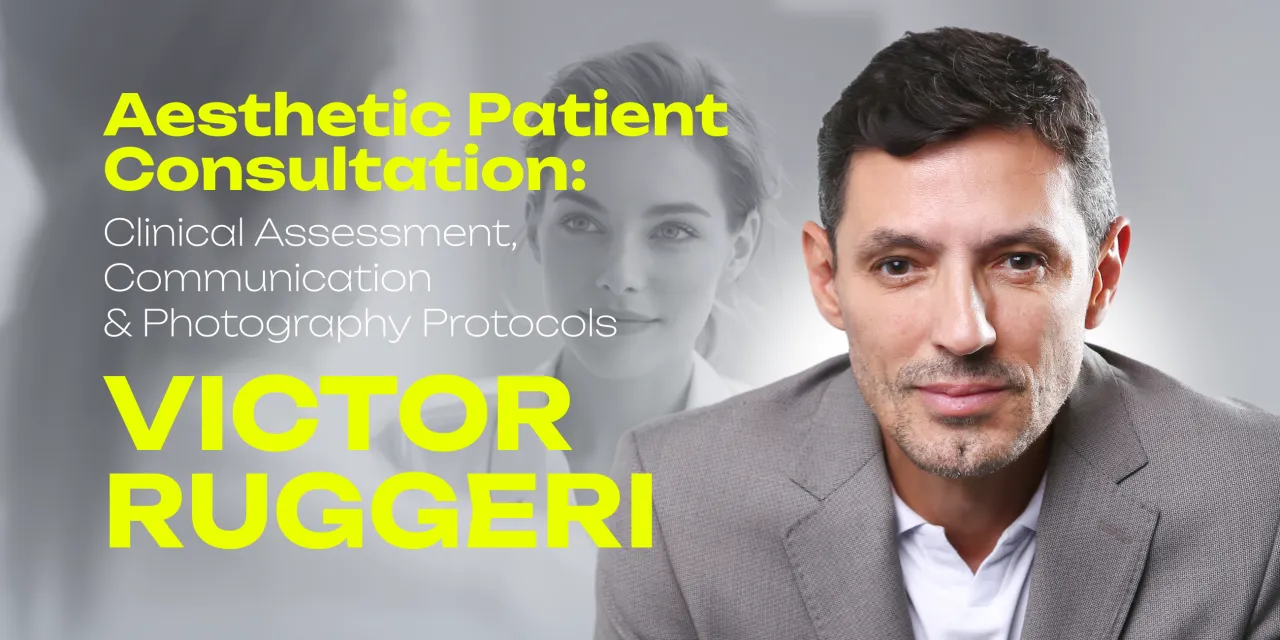
OHI-S Aesthetic Patient Consultation Clinical Assessment, Communication & Photography Protocols 2 lessons 39min

$10.00
This Product is shared via google drive download link, So please share your correct Gmail id while placing the order .Please note that there are no CME points or certificate associated with this course Samples for Courses Can be found here : Free Samples Here!
OHI-S Aesthetic Patient Consultation
Clinical Assessment, Communication & Photography Protocols
2 Lessons | 39 Minutes | Instructor: Victor Ruggeri
Build a systematic approach to aesthetic consultation with OHI-S Aesthetic Patient Consultation: Clinical Assessment, Communication & Photography Protocols.
Presented by Victor Ruggeri, this focused 39-minute course provides a practical framework for managing the aesthetic patient journey from the first consultation through clinical assessment, treatment planning, expectation management, facial analysis, and standardized photographic documentation.
Across two concise lessons, practitioners learn how to combine:
- Clinical assessment
- Clinical reasoning
- Patient communication
- Active listening
- Expectation management
- Facial profiling
- Anthropometric analysis
- Facial proportion assessment
- Clinical photography
- Smartphone photography
- Standardized documentation
The central concept is simple:
Better Aesthetic Outcomes Begin with Better Assessment and Communication
Course Details
- Course: Aesthetic Patient Consultation: Clinical Assessment, Communication & Photography Protocols
- Provider: OHI-S
- Instructor: Victor Ruggeri
- Format: Online Course
- Lessons: 2
- Duration: 39 Minutes
- Language: English
- Official OHI-S Category: Aesthetic Medicine
- Primary Focus: Aesthetic Consultation & Clinical Assessment
- Additional Focus: Facial Profiling, Communication & Clinical Photography
Course Overview
Successful aesthetic treatment begins long before a procedure is performed.
The consultation determines:
- What the patient actually wants
- Whether those expectations are realistic
- What clinical findings are present
- Which features should be prioritized
- Whether treatment is appropriate
- How outcomes will be documented and evaluated
The OHI-S course organizes this process into a structured patient journey:
Assessment → Clinical Reasoning → Treatment Planning → Communication → Documentation → Procedure
The aim is to make aesthetic decision-making more systematic and patient centered.
Why Aesthetic Consultation Matters
Aesthetic patients may arrive with:
- A specific procedure in mind
- A perceived facial imbalance
- Concerns about aging
- Expectations based on social media
- Previous aesthetic treatments
- Unclear treatment goals
The clinician’s role is not simply to perform the procedure requested.
An effective consultation requires:
Listen → Assess → Diagnose → Clarify Expectations → Develop an Appropriate Plan
LESSON 1
The Aesthetic Patient Journey: Assessment, Clinical Reasoning & Communication
Duration: 17 Minutes
The first lesson establishes the core clinical framework for an aesthetic appointment.
It focuses on three structural components:
- Assessment
- Treatment Planning
- Procedural Execution
The session also explores what constitutes clinical success in injectable aesthetics and how communication influences treatment outcomes.
The Aesthetic Patient Journey
A successful aesthetic journey can be viewed as a sequence:
Consultation → Assessment → Diagnosis → Planning → Treatment → Follow-Up
Errors early in this process can influence every stage that follows.
For example:
Poor assessment can lead to poor treatment selection.
Poor communication can lead to unrealistic expectations.
Poor documentation can make objective follow-up difficult.
Clinical Assessment
The initial assessment should establish:
- Patient concerns
- Treatment goals
- Relevant history
- Previous procedures
- Facial characteristics
- Structural patterns
- Areas of concern
- Expectations
The goal is to understand the patient before selecting a procedure.
Clinical Reasoning
Aesthetic medicine requires more than recognizing an isolated feature.
Clinical reasoning involves determining:
- What is actually contributing to the patient’s concern?
- Is the issue primarily structural, proportional, dynamic, or related to aging?
- What should be treated?
- What should not be treated?
- Which areas should be prioritized?
- Is intervention likely to achieve the requested outcome?
A useful model is:
Patient Concern → Clinical Finding → Diagnosis → Treatment Objective
Diagnostic Decision-Making
The course emphasizes moving from a patient request toward an objective clinical assessment.
Instead of starting with:
“Which procedure should I perform?”
begin with:
“What does this patient actually need?”
This helps avoid procedure-driven treatment planning.
Defining Clinical Success
Clinical success in aesthetic medicine is not simply completing a technical procedure.
Success depends on alignment among:
- Clinical indication
- Patient expectations
- Treatment plan
- Technical execution
- Outcome
A technically adequate procedure may still produce dissatisfaction when expectations were never properly defined.
Managing Patient Expectations
Expectation management is one of the most important consultation skills.
The clinician should understand:
- What the patient wants to change
- Why they want to change it
- What result they expect
- Whether that result is achievable
This allows the practitioner to establish realistic treatment objectives before intervention.
Aligning Expectations with Achievable Outcomes
The consultation should create alignment between:
Patient Goal
and:
Clinically Realistic Outcome
This may require explaining:
- Anatomical limitations
- Treatment limitations
- Expected degree of change
- Need for staged treatment
- Alternative approaches
Clear communication reduces misunderstanding.
Communication in Aesthetic Medicine
Technical skill alone is insufficient.
Aesthetic practice requires clinicians to communicate effectively about subjective concerns involving appearance.
Important communication skills include:
- Listening without interruption
- Clarifying concerns
- Asking targeted questions
- Confirming understanding
- Avoiding assumptions
Active Listening
Active listening helps the clinician understand both:
What the patient says
and:
What the patient actually means
Patients may describe aesthetic concerns using nonmedical language.
The practitioner must translate these concerns into clinically meaningful information.
Diagnostic Questions
Targeted questions can clarify:
- Primary concern
- Priority area
- Desired degree of change
- Previous treatment experience
- Satisfaction with prior procedures
- Expectations
The goal is to transform a vague aesthetic request into an actionable clinical assessment.
Patient-Centered Treatment Planning
A patient-centered plan combines:
Clinical Findings + Patient Goals + Realistic Outcomes
rather than applying a standard procedure to every patient.
LESSON 2
Facial Profiling, Anthropometrics & Standardized Photography Protocols
Duration: 21 Minutes
The second lesson moves from communication and reasoning into objective assessment and documentation.
It covers:
- First impressions
- Clinical case assessment
- Standardized photography
- Smartphone photography
- Lighting
- Facial landmarks
- Anthropometric measurements
- Facial proportions
- Lip proportions
- Golden ratios
- Angle analysis
- Facial profile patterns
Building Patient Rapport
The initial encounter influences trust.
A professional consultation begins with:
- Clear communication
- Organized assessment
- Professional presentation
- Respectful interaction
Establishing rapport can improve the quality of information obtained during consultation.
First Impression
The first interaction can affect:
- Patient confidence
- Communication
- Willingness to discuss concerns
- Trust in the treatment plan
The course therefore includes practical attention to how clinicians present themselves during the initial meeting.
Clinical Case Assessment
The course uses a clinical case to demonstrate a step-by-step assessment workflow.
A systematic approach can include:
Patient Concern → Frontal Assessment → Profile Assessment → Proportions → Anthropometrics → Photography → Treatment Planning
FACIAL PROFILING
Facial profiling allows clinicians to evaluate relationships among major facial structures.
Assessment may involve the interaction between:
- Forehead
- Nose
- Lips
- Chin
- Jaw
- Overall facial profile
The objective is not to analyze one structure in isolation.
Facial Balance
Aesthetic perception is influenced by relationships between features.
For example, apparent prominence or deficiency of one structure may be influenced by another.
This is why comprehensive facial assessment is often more informative than isolated feature analysis.
Facial Anthropometrics
Anthropometry involves systematic measurement of facial structures and proportions.
The course introduces important:
- Facial landmarks
- Measurements
- Proportions
- Ratios
- Angles
These tools can make aesthetic assessment more objective.
Anthropometric Landmarks
Recognizing reproducible landmarks can support:
- Baseline evaluation
- Proportion analysis
- Treatment planning
- Follow-up comparison
The goal is to complement visual judgment with objective reference points.
Facial Proportions
Facial proportion analysis examines how different facial regions relate to one another.
The course introduces principles used to assess:
- Overall facial proportions
- Facial thirds
- Lip relationships
- Profile balance
- Structural patterns
Lip Proportions
Lip evaluation should consider relationships rather than volume alone.
Relevant assessment may include:
- Upper-to-lower lip relationship
- Lip projection
- Relationship with the nose
- Relationship with the chin
- Overall facial profile
Golden Ratio Concepts
The course discusses golden ratios as part of facial proportion analysis.
These concepts can provide reference frameworks for aesthetic assessment.
However, facial aesthetics should remain individualized rather than attempting to force every patient into a single mathematical ideal.
Angle Analysis
Facial profile analysis can also incorporate angular relationships.
Angles provide additional objective information when examining:
- Facial convexity
- Lip projection
- Chin position
- Nasal relationships
- Profile structure
Facial Profile Patterns
The course teaches evaluation of different structural profile patterns.
Recognizing a profile pattern can improve understanding of how individual features interact.
This supports broader treatment planning rather than isolated correction.
STANDARDIZED CLINICAL PHOTOGRAPHY
Clinical photography is one of the most practical components of this OHI-S course.
Photography can support:
- Baseline documentation
- Treatment planning
- Follow-up comparison
- Communication
- Clinical records
The key principle is:
Standardization
Why Standardization Matters
Before-and-after photographs are difficult to compare when variables change.
Examples include:
- Different lighting
- Different camera angles
- Different distances
- Different facial expressions
- Different head positions
- Different backgrounds
Standardization reduces these variables.
Smartphone Clinical Photography
The course specifically demonstrates implementation of a standardized photographic protocol using smartphone devices.
This makes the workflow accessible without requiring specialized photographic equipment for every clinical setting.
Smartphone Photography Techniques
Practical considerations include:
- Camera positioning
- Distance
- Framing
- Patient position
- Consistent perspective
- Lighting
The objective is reproducibility.
Lighting for Clinical Photography
Lighting can substantially alter the appearance of:
- Shadows
- Contours
- Skin texture
- Facial volume
Therefore, follow-up photographs should be taken under conditions as similar as possible to the baseline images.
Framing
Consistent framing improves comparison.
Clinical photographs should aim to reproduce:
- Patient position
- Camera position
- Distance
- Image orientation
during future follow-up.
Baseline Photography
Baseline photographs create a visual reference before treatment.
They can support:
- Clinical analysis
- Treatment planning
- Documentation
- Follow-up
Follow-Up Documentation
Standardized photography allows the clinician to compare:
Baseline → Post-Treatment → Later Follow-Up
with greater consistency.
Photography & Patient Communication
Photographs can also support communication during consultation.
They may help patients understand:
- Facial proportions
- Structural relationships
- Areas of concern
- Treatment objectives
However, photographs should be interpreted carefully and should not be used to guarantee a particular outcome.
Consultation + Photography
The strongest value of the course comes from combining the two lessons.
Lesson 1
Focuses on:
Communication + Reasoning + Expectations
Lesson 2
Focuses on:
Measurement + Profiling + Documentation
Together they create:
Listen → Assess → Measure → Photograph → Plan
Key Topics Covered
- Aesthetic Patient Consultation
- Aesthetic Patient Journey
- Clinical Assessment
- Clinical Reasoning
- Diagnostic Decision-Making
- Treatment Planning
- Patient Communication
- Active Listening
- Patient Expectations
- Injectable Aesthetic Consultation
- Facial Profiling
- Facial Analysis
- Facial Anthropometry
- Anthropometric Landmarks
- Facial Proportions
- Lip Proportions
- Golden Ratio
- Facial Angle Analysis
- Profile Analysis
- Clinical Photography
- Aesthetic Photography
- Standardized Photography
- Smartphone Clinical Photography
- Medical Photography
- Baseline Photography
- Treatment Documentation
- Patient-Centered Aesthetic Planning
Who Should Take This Course?
OHI-S officially describes this program for aesthetic practitioners seeking a systematic approach to consultation, diagnosis, and patient-centered treatment planning.
It is particularly relevant for appropriately trained professionals working in:
- Aesthetic Medicine
- Facial Aesthetics
- Cosmetic Medicine
- Dermatology
- Plastic Surgery
- Facial Plastic Surgery
- Maxillofacial / Facial Aesthetic Practice
- Cosmetic Dentistry where facial aesthetic assessment falls within the practitioner’s training and legal scope
This program is especially useful for practitioners who want to improve the consultation and documentation stage of aesthetic care rather than learn a specific injection procedure.
Is This a Cosmetic Dentistry Course?
The content can be highly relevant to cosmetic dentists involved in facial aesthetics, particularly because it covers:
- Facial proportions
- Lip proportions
- Facial profiles
- Patient communication
- Photography
- Treatment planning
However, the official OHI-S classification is:
Aesthetic Medicine
and the official target description is:
Aesthetic Practitioners
Therefore, it should not be marketed as exclusively a cosmetic dentistry course.
Why This Course Is Useful
This course addresses an area that is sometimes underemphasized in procedural aesthetic education:
What Happens Before Treatment
Practitioners learn to improve:
- Consultation structure
- Clinical reasoning
- Patient communication
- Expectation management
- Facial assessment
- Objective documentation
- Photography workflow
The overall framework is:
Patient Goals → Clinical Assessment → Facial Analysis → Communication → Photography → Treatment Planning
Product Information
- Product: OHI-S Aesthetic Patient Consultation: Clinical Assessment, Communication & Photography Protocols
- Provider: OHI-S
- Instructor: Victor Ruggeri
- Lessons: 2
- Duration: 39 Minutes
- Language: English
- Format: Online Educational Course
- Official Category: Aesthetic Medicine
Lesson Durations
- The Aesthetic Patient Journey: Assessment, Clinical Reasoning & Communication – 17 min
- Facial Profiling, Anthropometrics & Standardized Photography Protocols – 21 min
4. Short Description
OHI-S Aesthetic Patient Consultation: Clinical Assessment, Communication & Photography Protocols is a focused 2-lesson, 39-minute course by Victor Ruggeri.
The program provides a systematic framework for the aesthetic consultation, covering clinical assessment, clinical reasoning, patient expectations, active listening, diagnostic questioning, facial profiling, anthropometric landmarks, facial and lip proportions, golden-ratio concepts, profile analysis, and standardized smartphone photography.
Topics
Lesson 1. The Aesthetic Patient Journey: Assessment, Clinical Reasoning & Communication
-
The aesthetic patient journey: assessment, planning, and procedural execution
-
Clinical reasoning and diagnostic decision-making
-
Defining parameters of success in injectable aesthetics
-
Comprehensive assessment: managing and aligning patient expectations
-
Communication skills: mastering active listening in aesthetic consultations
-
Key diagnostic questions for effective active listening
Lesson 2. Facial Profiling, Anthropometrics & Standardized Photography Protocols
-
Mastering initial rapport: how to make a strong first impression
-
Clinical case study: detailed step-by-step patient assessment
-
Implementation of a standardized photographic protocol
-
Smartphone photography techniques and tips
-
Optimal lighting setups for clinical baseline photos
-
Essential anthropometric facial landmarks and measurement
-
Facial and lip proportions, golden ratios, and angle analysis
-
Evaluation of facial profiles and structural patterns
Related products